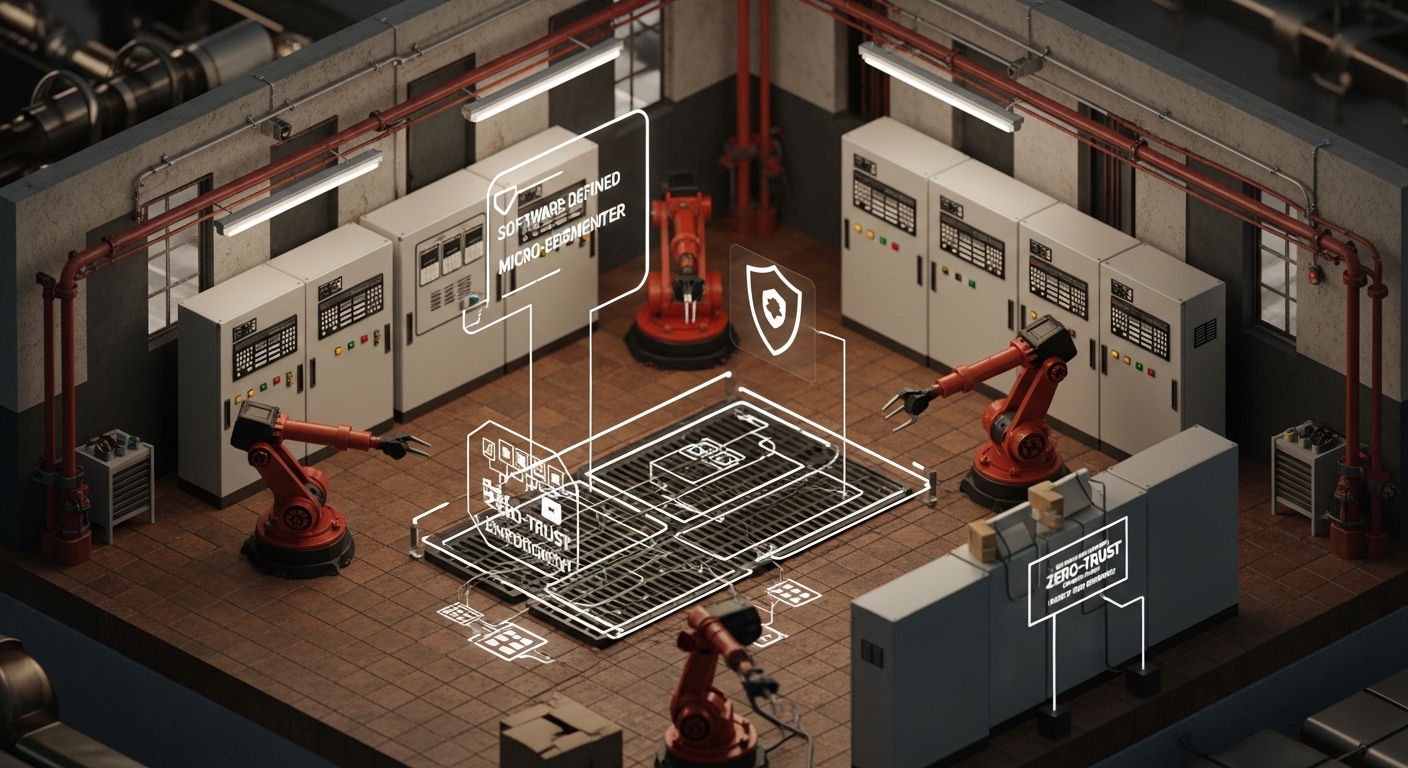
The Brownfield Mandate: Architecting Adaptive Zero-Trust for Legacy SCADA in Converged IT/OT Environments
Apex Insights Research Desk
The Unprotected Core: Confronting the Reality of Brownfield OT Security
The convergence of Information Technology (IT) and Operational Technology (OT) is no longer a forward-looking trend; it is the established reality of modern manufacturing. This integration, while unlocking unprecedented efficiency and data-driven insights, has simultaneously dissolved the decades-old 'air gap' that once served as the de facto security for industrial control systems (ICS). In brownfield environments—facilities operating with a heterogeneous mix of legacy and modern equipment—this reality is particularly acute. At the core of these facilities lie legacy Supervisory Control and Data Acquisition (SCADA) systems, often running on unsupported operating systems and communicating via unencrypted, decades-old protocols. The traditional 'moat and castle' security model, reliant on perimeter firewalls, is fundamentally broken in this context. A single lateral movement from a compromised IT asset can grant an adversary direct access to the deterministic, real-time processes governing physical production.
This architectural vulnerability demands a paradigm shift away from implicit trust based on network location. The only architecturally sound path forward is the adoption of an adaptive Zero-Trust model, meticulously tailored to the unique constraints and deterministic requirements of brownfield OT. This is not about deploying another firewall; it is about re-architecting security from a foundation of "never trust, always verify" for every device, user, and data flow within the converged ecosystem.
Deconstructing the Brownfield SCADA Challenge
Implementing any new security framework in a brownfield manufacturing plant is an exercise in navigating immense technical debt. Legacy SCADA systems and their associated Programmable Logic Controllers (PLCs) and Remote Terminal Units (RTUs) were engineered for reliability and availability, not security. Their inherent design limitations present formidable barriers to traditional IT security controls.
Key challenges include:
- Protocol Fragility: A significant portion of OT traffic relies on protocols like Modbus/TCP, DNP3, or proprietary serial communications (e.g., Modbus RTU over RS-485). These protocols lack authentication, authorization, and encryption. They are 'chatty' and highly sensitive to latency and jitter, meaning that active scanning or inline security inspection can disrupt critical processes.
- Unpatchable Endpoints: Many Human-Machine Interfaces (HMIs) and engineering workstations run on legacy operating systems like Windows XP or Windows 7, for which vendor support has long ceased. The underlying PLC firmware is often immutable without a full production shutdown, which is an economic non-starter. This makes the environment a permanent zero-day landscape, where strategies to halt the pivot in unpatchable OT networks are not just best practice, but a core survival requirement.
- Deterministic Network Requirements: Control networks demand predictable, low-latency communication to ensure physical safety and process integrity. The introduction of security controls cannot compromise these deterministic properties. A delay of even a few milliseconds in a command to a robotic arm or a valve actuator can have catastrophic consequences.
- Lack of Visibility: Most manufacturers lack a complete, dynamic inventory of all connected OT assets. Devices are often added ad-hoc over years, and network diagrams are frequently outdated. Without a definitive asset map, implementing granular security policies is an impossibility.
Core Tenets of an Adaptive Zero-Trust Architecture for IT/OT
A Zero-Trust model, as defined by NIST SP 800-207, is a set of principles, not a specific technology. Applying it to a converged IT/OT environment requires translating these principles into the language of industrial controls.
The central tenet of Zero Trust is to never trust any actor, asset, or data flow implicitly. All access requests must be continuously and explicitly verified based on the principle of least privilege, with the full assumption that the network is already compromised. This shifts the focus from defending a perimeter to protecting individual resources and data.
A successful OT Zero-Trust architecture is built upon these pillars:
- Identity as the New Perimeter: Every entity requires a strong, verifiable identity. This extends beyond human users to include PLCs, sensors, HMIs, actuators, and even specific applications or services. Identity becomes the primary basis for access control decisions.
- Explicit and Continuous Verification: Every request to access an OT resource must be authenticated and authorized. This verification is not a one-time event at login; it is a continuous process that assesses the context of the request—the identity's role, the asset's health, the time of day, the geographic location, and the baseline behavioral patterns.
- Enforced Least-Privilege Access: Access is granted on a per-session, just-in-time basis, providing the absolute minimum permissions required for the entity to perform its designated function. For a SCADA system, this could mean allowing an operator HMI to read temperature data from a PLC but blocking its ability to write new setpoints, while an engineering workstation is granted write access only during a pre-approved maintenance window.
- Assume Breach and Micro-segment: The network is assumed to be hostile. Micro-segmentation is used to create granular, software-defined security zones around critical assets or small groups of assets. If one segment is compromised, the blast radius is contained, preventing an attacker from moving laterally to compromise the entire plant floor.
An Architectural Blueprint for Phased Implementation
Deploying Zero-Trust in a live brownfield environment must be a phased, non-disruptive process. A 'rip and replace' approach is not feasible. The following blueprint outlines a logical, sequential path to maturity.
Phase I: Discovery, Baselining, and Visualization. The foundational step is to achieve 100% visibility. Deploy passive network sensors (e.g., via SPAN/TAP ports on network switches) that use Deep Packet Inspection (DPI) for OT protocols. The goal is to build a dynamic asset inventory, map all communication pathways, and establish a behavioral baseline of normal operations. This phase is purely for listening and learning; no policies are enforced, ensuring zero operational impact.
Phase II: Architecting the Policy Engine and Enforcement Points. With a clear map, you can design the Zero-Trust control plane. This involves a central Policy Decision Point (PDP), which ingests data and makes access decisions, and distributed Policy Enforcement Points (PEPs), which enforce those decisions. In a brownfield environment, PEPs can be next-generation firewalls at IT/OT boundaries, specialized OT security appliances placed in front of critical cells, or modern switches with L2/L3 access control capabilities.
Phase III: Macro- and Micro-Segmentation. Begin with broad policies that enforce the Purdue Model, creating a strong segmentation boundary between the IT enterprise network (Level 4/5) and the OT control network (Level 0-3). Once stable, proceed to micro-segmentation. Create a protected enclave around a single, critical production line. Define explicit rules for every data flow entering or leaving that segment. For instance, only the historian server is allowed to query PLCs on port 502, and only from a specific IP address. This incremental approach allows the team to build confidence and troubleshoot issues in a controlled manner.
Phase IV: Implementing Adaptive, Identity-Based Policies. This is the transition from static rules to a truly adaptive model. Integrate the PDP with an OT-aware Identity and Access Management (IAM) system. Policies are no longer based on IP addresses but on the identity of the user or device. A maintenance engineer's access to a PLC's logic is granted only after multi-factor authentication and is tied to a valid work order in the maintenance system. The policy is automatically revoked when the work order is closed. This is where the true power of the architecture is realized.
Phase V: Continuous Monitoring and Response. The system must constantly monitor for policy violations and anomalous behavior. When a deviation from the established baseline is detected, the PDP can automatically trigger a response, such as quarantining a suspect device, blocking a specific data flow, or alerting the security operations center (SOC). This creates a self-healing, resilient architecture.
Practical Implementation Challenges
Architecting this model is not without significant engineering hurdles that require specialized expertise to overcome.
The Determinism Mandate
Perhaps the most significant challenge is the potential for security controls to introduce latency and jitter into real-time control communications. Inline PEPs performing DPI can add microseconds or even milliseconds of delay. While insignificant in IT, this can violate the cycle time of a high-speed packaging line or a coordinated robotic system. Addressing this requires careful placement of out-of-band sensors for detection and using enforcement mechanisms that do not sit directly in the time-critical data path, or leveraging next-generation OT security platforms designed for sub-millisecond inspection. The core issue revolves around preserving real-time integrity in micro-segmented ICS networks, a non-negotiable requirement for operational stability.
Protocol and Firmware Agnosticism
Legacy SCADA environments are a chaotic mix of vendor protocols and firmware versions. A viable Zero-Trust solution must be protocol-agnostic, capable of parsing Modbus, DNP3, S7comm, CIP, and others, and firmware-agnostic, providing protection without requiring any agent or software change on the endpoint PLC or RTU. This is a complex undertaking, as proprietary protocol extensions and vendor-specific implementations are common. This technical hurdle is at the heart of unpacking the architectural challenges of Zero-Trust on legacy PLCs, as a vendor-locked solution will fail in 90% of real-world deployments.
Non-IP and Serial Layer Security
Standard Zero-Trust frameworks are inherently IP-based. However, critical process controls often exist at Level 0/1 on serial buses like Modbus RTU (over RS-485) or Profibus. These networks are invisible to conventional network security tools. Securing these layers requires specialized gateways that can act as PEPs, translating serial communication, inspecting it against policy, and then forwarding it. Alternatively, it requires deploying network-level security that can create micro-segments that isolate these serial islands from the rest of the IP-based network.
Cultural and Skillset Dissonance
The most resilient architecture will fail if the people managing it are not aligned. OT engineers prioritize availability and safety, often viewing security changes with suspicion as a threat to operational stability. IT security teams often lack a deep understanding of control processes and the consequences of their actions on the physical world. A successful Zero-Trust program requires the creation of a cross-functional team with a shared governance model, joint training, and a unified mission to ensure both security and operational resilience.
Conclusion: The Resilient Future of Manufacturing
Implementing an adaptive Zero-Trust security model in a brownfield manufacturing environment is a complex, multi-year journey, not a singular project. It is an architectural and cultural transformation that moves security from a peripheral function to a core enabler of the business. By systematically dismantling implicit trust and building a new foundation on explicit verification, least-privilege access, and micro-segmentation, organizations can build resilient operations that are secure by design. This approach not only defends against today's cyber threats but also provides a scalable framework to securely integrate the next generation of IIoT and smart factory technologies, ensuring that the future of manufacturing is both efficient and safe.
Sources / References
- NIST Special Publication 800-207, Zero Trust Architecture: https://csrc.nist.gov/publications/detail/sp/800-207/final
- ISA/IEC 62443 Series of Standards on Industrial Automation and Control Systems Security: https://www.isa.org/standards-and-publications/isa-standards/isa-iec-62443-series-of-standards
- Cybersecurity and Infrastructure Security Agency (CISA), Zero Trust Maturity Model: https://www.cisa.gov/resources-tools/resources/zero-trust-maturity-model