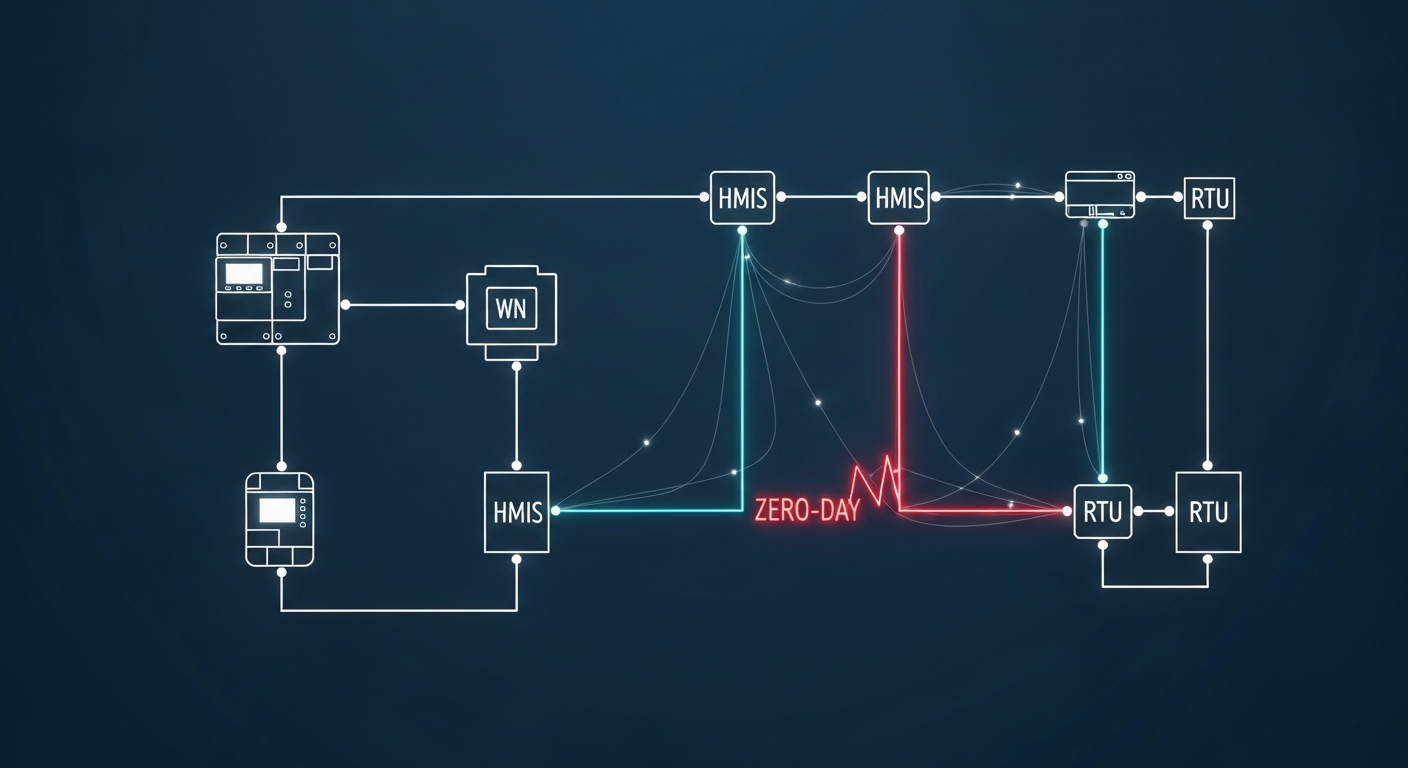
The Invisible Sentinel: A Blueprint for Agentless Behavioral Analytics in Legacy ICS
Apex Insights Research Desk
The Unpatchable Dilemma: Securing Legacy ICS from Zero-Day Threats
Industrial Control Systems (ICS) and Operational Technology (OT) environments are the bedrock of modern civilization, orchestrating everything from power grids and water treatment facilities to advanced manufacturing. Yet, a significant portion of this critical infrastructure runs on legacy systems—hardware and software designed decades ago, long before the emergence of the modern cyber threat landscape. These systems are often unpatchable, fragile, and operate under the stringent mandate of near-100% uptime. This creates a perilous security gap: how do you defend against novel, unknown zero-day attacks when traditional, signature-based security tools are both incompatible and ineffective?
The answer lies in shifting the security paradigm from reactive signature matching to proactive behavioral analysis. Specifically, agentless behavioral analytics offers a potent solution, providing deep visibility and threat detection capabilities without installing any software on the sensitive endpoints themselves. This approach is not merely an alternative; it is an architectural necessity for brownfield OT environments. This research desk provides a technical blueprint for implementing such a system, focusing on the dual, non-negotiable objectives of detecting sophisticated zero-day threats while guaranteeing the integrity and availability of critical physical processes.
Core Tenet: Why 'Agentless' is Non-Negotiable in OT
In the IT world, endpoint agents are a cornerstone of security. In OT, they are an operational impossibility. Attempting to deploy agent-based solutions on legacy PLCs, RTUs, or HMIs introduces unacceptable risks:
- Resource Contention: Legacy controllers have minimal excess CPU and memory resources. An additional software agent, however lightweight, can introduce latency and jitter, potentially disrupting time-sensitive processes and triggering safety interlocks.
- System Stability and Warranty Invalidation: These are brittle, purpose-built systems. Any unauthorized software installation risks system instability, crashes, or unpredictable behavior. Furthermore, it almost universally voids vendor warranties and support agreements, placing the asset owner in an untenable position.
- Patching and Lifecycle Mismatch: The lifecycle of an OT asset is measured in decades, while software agents require frequent updates. This mismatch creates a constant, high-risk maintenance burden on systems that are designed for minimal change.
Agentless monitoring circumvents these issues entirely by operating out-of-band. It treats the network as the source of truth, passively observing communications to understand and model the physical process itself. This approach forms the foundation of a resilient security posture that respects the operational realities of the industrial world.
Architectural Blueprint for Non-Intrusive Behavioral Monitoring
Implementing an effective agentless analytics platform requires a deliberate, multi-stage architectural approach. The primary design principle is zero-impact data acquisition, followed by multi-layered analysis to build a high-fidelity model of normal operations.
Passive Data Acquisition Fabric: The foundational layer is the collection of network traffic without altering the flow of production data. This is achieved exclusively through the use of network Test Access Points (TAPs) or, as a secondary option, Switched Port Analyzer (SPAN) ports on managed switches. TAPs are strongly preferred as they are fail-safe devices; in the event of a power failure, they maintain the physical link, ensuring the production network is never interrupted. This data stream, a perfect mirror of the OT network traffic, is forwarded to the analytics engine, ensuring zero latency is introduced into the control network.
Deep Packet Inspection (DPI) and Asset Baselining: Raw packet data is ingested by the analytics platform's DPI engine. This is not a superficial Layer 3/4 analysis. The engine must possess native fluency in a wide array of OT protocols (e.g., Modbus/TCP, DNP3, CIP, S7, PROFINET, IEC 104). It decodes the application layer (Layer 7) to extract critical context: Which PLC is communicating with which HMI? What specific function codes are being used (e.g.,
Read Coil Statusvs.Force Single Coil)? What data registers are being accessed? This process builds a comprehensive asset inventory and a communication map, forming the initial skeleton of the operational baseline.High-Fidelity Machine Learning (ML) Modeling: This is the core of the analytics engine. Using the contextualized data from the DPI engine, unsupervised machine learning models are trained to build a deeply nuanced, multi-dimensional profile of the industrial process. This goes far beyond simple allow-lists. The model learns the grammar of the operation, including:
- Stateful Communication Sequences: The model learns that a specific valve is always opened (
Write Coil) before a specific pump is activated (Write Coil), and never the other way around. - Value-Range Parameters: It learns that a pressure sensor reading from a specific register should always fall between 45-55 PSI during normal operation.
- Deterministic Timing: It profiles the precise polling intervals between a SCADA master and its RTUs. Deviations in this timing can be an early indicator of network manipulation or device degradation.
- User-Device Interaction: The model learns which engineering workstation is permitted to upload new ladder logic to a specific set of controllers, and during which maintenance windows.
- Stateful Communication Sequences: The model learns that a specific valve is always opened (
Real-Time Anomaly Detection and Correlation: Once the baseline is established, the engine operates in real-time, comparing every live packet and communication sequence against the learned model. When a deviation occurs, an anomaly is flagged. These are not generic alerts; they are context-rich events. For example, instead of "Anomalous Modbus Packet," the system should generate an alert like: "Zero-Day Alert: Unauthorized 'Write Single Register' command (Function Code 6) sent from HMI-3 to PLC-7 targeting a critical temperature setpoint register, a sequence never before observed during production."
This level of detail is critical. It allows OT engineers to immediately understand the potential physical impact of a cyber event, dramatically reducing the mean time to response (MTTR). This passive monitoring approach aligns perfectly with a defense-in-depth strategy, often working in concert with network segmentation. Truly effective security is achieved when this type of behavioral detection is layered on top of a robust policy enforcement framework, as detailed in our research on Synergistic Defense: An Architectural Blueprint for Integrating Zero-Trust Segmentation and Anomaly Detection for Modbus/TCP.
Practical Implementation Challenges
The transition from theory to a deployed, functional system in a brownfield environment is fraught with engineering challenges that demand specialized solutions.
Protocol Obscurity and Encryption
While standard protocols are common, many environments contain a mix of proprietary vendor protocols that are not publicly documented. A DPI engine cannot parse what it doesn't understand. In these cases, analysis must shift from deep payload inspection to metadata and behavioral modeling. The system can still baseline communication patterns—source, destination, frequency, payload size, timing—to detect anomalous behavior even without understanding the specific commands. Addressing these blind spots is a critical hurdle, as we've explored in our analysis of Non-Disruptive Anomaly Detection for Proprietary OT Protocols.
Baseline Pollution in Chaotic Environments
No legacy network is pristine. They often contain intermittent device failures, misconfigured assets, and forgotten test equipment that generate erratic traffic. During the initial learning phase, this 'operational noise' can be inadvertently incorporated into the baseline of normal behavior, a phenomenon known as baseline pollution. This can desensitize the system to real threats. Mitigating this requires a combination of longer learning periods, statistical filtering to exclude outliers, and a human-in-the-loop 'review and accept' process where an OT engineer can validate or reject components of the learned baseline.
Managing Process Evolution and Baseline Drift
Industrial processes are not static. Production lines are re-tooled, setpoints are adjusted, and new equipment is added. A rigid baseline will quickly become outdated, leading to a flood of false positives. The analytics system must support dynamic baseline management. This involves techniques for incremental learning, where the model can be updated without a complete retraining cycle. More advanced platforms provide 'supervised learning' modes where an operator can place the system into a maintenance or re-tooling mode, allowing it to learn new, authorized behaviors and seamlessly integrate them into the existing model upon approval.
The ISA/IEC 62443 standards emphasize the concept of zones and conduits, logically segmenting the ICS to manage risk. Agentless behavioral analytics provides the essential verification layer for this architecture, continuously monitoring the traffic flowing through these conduits to ensure that communication conforms not only to the security policy but also to the expected operational behavior.
Uptime as the Uncompromising Objective
Ultimately, the success of any OT security solution is measured by its ability to enhance security without compromising availability. Agentless behavioral analytics is architected from the ground up to meet this mandate.
- Purely Passive Operation: The system is fundamentally read-only from the network's perspective. It cannot transmit packets, inject latency, or otherwise interfere with control communications.
- Focus on Detection, Not Prevention: The primary output is high-fidelity, context-aware alerting, not automated blocking. In a high-stakes OT environment, the decision to shut down a process must remain with the human operator. The analytics platform's role is to provide that operator with the most accurate and timely data possible to make an informed decision.
- Resilient Sensor Infrastructure: The use of hardware TAPs with fail-open capabilities ensures that the monitoring infrastructure itself does not become a single point of failure for the production network.
By embracing this philosophy, asset owners can deploy a powerful defense against zero-day exploits, insider threats, and operational misconfigurations, transforming their legacy networks from opaque liabilities into monitored, understood, and defensible assets. This approach is foundational for achieving a mature security posture, a journey that often culminates in architecting a truly resilient, verifiable micro-segmentation in legacy OT without operational disruption, where detection and enforcement work in concert.
Conclusion: The Shift to Proactive, Process-Aware Defense
Securing legacy ICS against the next generation of threats requires moving beyond the limitations of traditional IT security tools. Agentless behavioral analytics provides a robust, non-intrusive, and operationally safe methodology for uncovering zero-day attacks that bypass signature-based defenses. By building a deep, learned understanding of the physical process as reflected on the network, this approach enables security teams to detect the subtle deviations that are often the only precursor to a significant cyber-physical event. While the implementation path has its challenges, the architectural principles of passive acquisition and machine-learning-driven analysis provide a viable and essential blueprint for protecting the world's most critical infrastructure without ever putting uptime at risk.
Sources / References
- NIST Special Publication 800-82 Rev. 2: Guide to Industrial Control Systems (ICS) Security. https://csrc.nist.gov/publications/detail/sp/800-82/rev-2/final
- ISA/IEC 62443 Standards Series: Security for industrial automation and control systems. https://www.isa.org/standards-and-publications/isa-standards/isa-iec-62443-series-of-standards
- CISA - Securing Industrial Control Systems: A collection of recommended practices and resources. https://www.cisa.gov/uscert/ics/Recommended-Practices