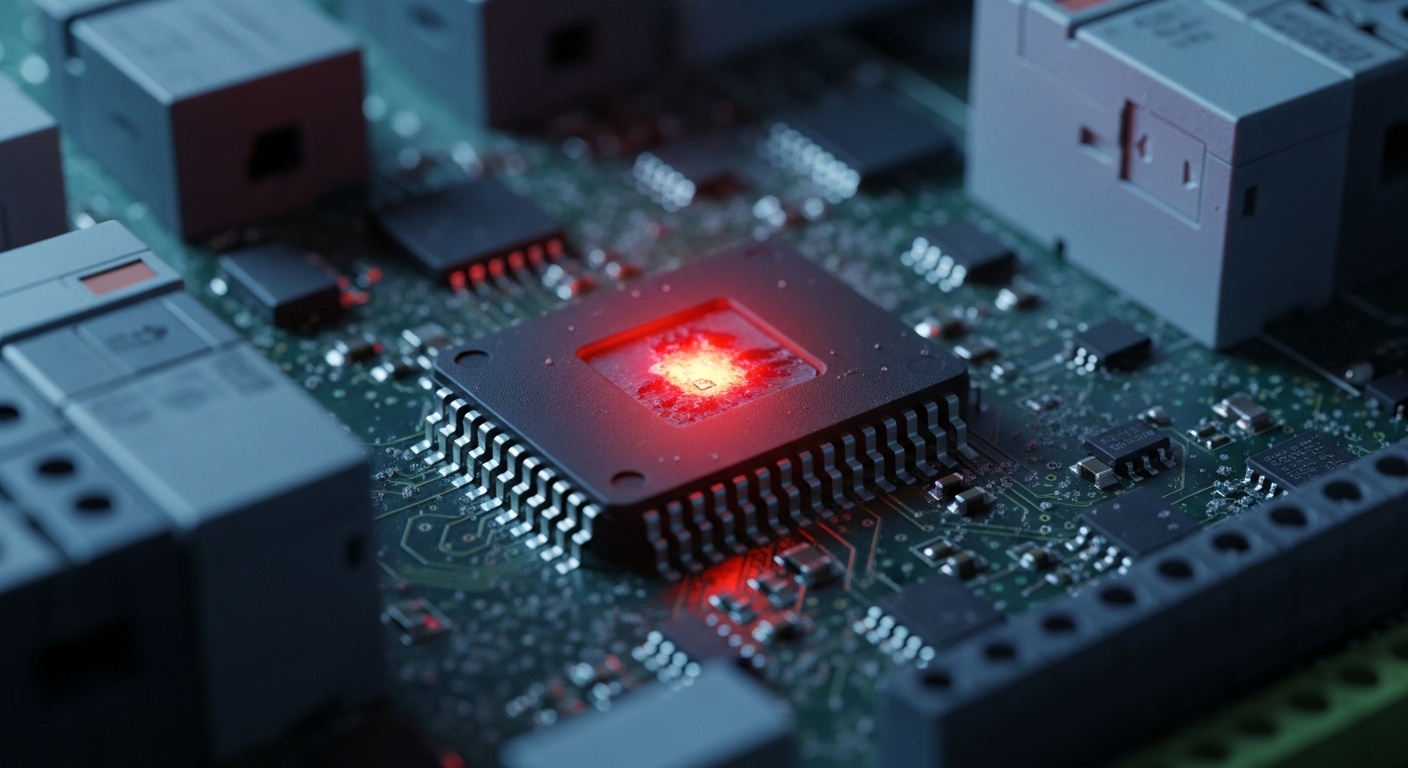
The Firmware Ghost: Unmasking Polymorphic Malware in Air-Gapped ICS with AI Behavioral Analytics
Apex Insights Research Desk
Introduction: The Air-Gap Fallacy in the Age of Firmware Threats
For decades, the air gap has been the foundational security principle for Industrial Control Systems (ICS) and Operational Technology (OT). The logical and physical isolation from external networks was considered a sufficient bulwark against cyber threats. However, sophisticated state-sponsored attacks, exemplified by Stuxnet, shattered this illusion by demonstrating that the most critical assets—the embedded firmware on Programmable Logic Controllers (PLCs), Remote Terminal Units (RTUs), and other field devices—are vulnerable. Today, the threat has evolved from targeted worms to polymorphic malware: malicious code that dynamically alters its signature to evade static detection, rendering traditional antivirus and signature-based Intrusion Detection Systems (IDS) entirely obsolete.
This presents a formidable challenge. How can security architects defend against a threat that constantly changes its form, targeting legacy hardware with minimal computational resources, operating within a supposedly impenetrable network? The answer lies not in examining what the code is, but in understanding what it does. This is the domain of AI-driven behavioral analytics, a paradigm shift that moves from static signatures to dynamic, high-fidelity baselining of firmware execution. By modeling the deterministic, cyclical behavior of industrial controllers, we can identify the subtle deviations—the digital fingerprints—that betray the presence of even the most advanced polymorphic malware.
This research brief from the Apex Insights desk provides an architectural blueprint for leveraging AI-driven behavioral analytics to identify and neutralize polymorphic threats at the firmware level in legacy, air-gapped ICS environments.
The Architectural Imperative: Why Static Defenses Fail
The core limitation of conventional security tools within an OT context is their reliance on known threat intelligence. A signature-based approach requires prior knowledge of a malware's hash or its indicators of compromise (IOCs). Polymorphic malware is engineered specifically to defeat this model by encrypting its payload or using metamorphic engines to rewrite its code with every new infection, ensuring no two samples look alike.
In the context of embedded firmware, this problem is magnified:
- Resource Constraints: Legacy PLCs and RTUs lack the CPU and memory to run host-based security agents or sandboxing environments.
- Opaque Systems: Firmware is often a proprietary black box, making direct code analysis or instrumentation impossible without vendor cooperation, which is rarely forthcoming for legacy systems.
- Deterministic Operations: ICS processes are highly repetitive and time-sensitive. Any security solution that introduces latency or jitter can disrupt physical processes, leading to downtime or unsafe conditions.
The only viable surface for analysis is the observable behavior of the device itself. Every CPU cycle, memory read/write operation, I/O call, and network packet timing is a potential data point. For a stable industrial process, these behaviors form a predictable, high-dimensional pattern. It is the un-modeled deviation from this pattern that signals a compromise.
A Blueprint for an AI-Driven Behavioral Sentinel
Detecting polymorphic malware in firmware requires an external, non-intrusive monitoring architecture that builds a sophisticated behavioral model of the target device. This is not a single tool, but a multi-stage data processing pipeline.
Stage 1: Non-Intrusive Telemetry Acquisition
The first challenge is to gather high-resolution data without loading the target device. Direct agent installation is not an option. Instead, a combination of passive and side-channel techniques is required.
- Network Traffic Analysis: A network tap or SPAN port provides passive access to all control-plane and data-plane traffic. For ICS, this is a treasure trove of behavioral data. Packet timing, sequence of operations (e.g., Modbus function codes), and payload sizes are highly consistent. Advanced systems can tackle AI anomaly detection for obscure protocols in air-gapped ICS, creating models even for proprietary vendor communication.
- Electrical Side-Channel Analysis: By monitoring the power consumption of the device, it's possible to infer computational activity. A malicious instruction loop or cryptographic function introduced by malware will create a distinct power usage signature compared to the normal operating baseline. This is computationally expensive but offers a view directly into CPU activity without touching the device.
- Diagnostic Port Interrogation: Many PLCs and embedded controllers have physical diagnostic ports (e.g., serial, JTAG) that output low-level system state information. When accessible, these can provide ground-truth data on CPU states, memory registers, and system calls.
Stage 2: Feature Engineering and High-Dimensional Baselining
Raw telemetry is just noise. The next stage is to extract meaningful features that represent the device's operational state. This is where domain expertise is critical. Features for a PLC might include:
- Execution Cycle Time: The precise time taken to complete one scan cycle.
- Memory Access Frequency: The rate of read/write operations to specific memory blocks.
- Instruction Mix: A statistical distribution of different types of CPU instructions being executed (inferred from side-channels).
- I/O State Transition Matrix: The probability of one I/O state changing to another.
- Protocol Command Cadence: The timing and sequence of commands like Modbus
Read CoilsorWrite Register.
These features are then fed into an unsupervised machine learning model over a 'peacetime' learning period. The model, typically a variational autoencoder (VAE) or a Long Short-Term Memory (LSTM) network, learns the complex, non-linear relationships between these features. The output is not a set of rules, but a compressed, mathematical representation of 'normal'—the baseline operational envelope.
Stage 3: Real-Time Anomaly Detection and Scoring
Once the baseline is established, the system shifts to real-time monitoring. Live telemetry is processed through the same feature engineering pipeline and fed into the trained AI model. The model attempts to reconstruct the input based on its learned understanding of 'normal'.
The core principle is reconstruction error. When the live behavior perfectly matches the learned baseline, the model can reconstruct the input with very low error. However, when polymorphic malware executes—introducing novel instruction paths, accessing forbidden memory, or altering process timing—the live feature set deviates from the baseline. The model struggles to reconstruct this alien input, resulting in a high reconstruction error. This error becomes the Anomaly Score.
This is the essence of a deterministic sentinel for real-time AI detection of polymorphic threats on embedded RTOS, where the AI acts as a vigilant observer that understands the expected physics and logic of the system it protects.
Practical Implementation Challenges
Architecting such a system is fraught with engineering complexity, moving far beyond theoretical data science into the unforgiving realities of brownfield OT environments.
Model Training in an Air-Gapped Environment: How do you deploy and update sophisticated AI models without an internet connection? This requires a robust MLOps framework designed for offline environments. Models must be trained on a separate, high-performance computing system, validated, and then transferred via secure, whitelisted removable media or a dedicated data diode to the monitoring appliance within the air-gapped network.
Handling Controlled Process Changes: An industrial process is not static. A change in a chemical recipe, a retooling of a robotic arm, or a seasonal adjustment to HVAC parameters will alter the behavioral baseline. The system must be able to distinguish a sanctioned operational change from a malicious one. This often requires a 'human-in-the-loop' mechanism where an operator can approve a baseline drift, triggering a controlled retraining period for the AI model.
The Deterministic Noise Floor: Real-world systems exhibit jitter. Network latency, sensor fluctuations, and minor variations in PLC scan times create a 'noise floor' in the telemetry. The AI model's sensitivity must be calibrated with extreme care. If it's too sensitive, it will generate a flood of false positives, leading to alert fatigue. If it's not sensitive enough, it will miss the subtle footprints of a sophisticated adversary. This tuning process is non-trivial and specific to each deployment.
Data Fidelity from Legacy Devices: Extracting high-quality telemetry from a 30-year-old PLC with only a serial Modbus RTU interface is an immense challenge. The data rate may be too low for fine-grained analysis, forcing architects to rely more heavily on network-level features rather than device-level ones. This underscores the need for a layered defense, as discussed in our research on how to implement a non-disruptive zero-trust microsegmentation in brownfield ICS, where network controls compensate for endpoint visibility gaps.
Conclusion: Shifting to a Behavioral Paradigm
The threat of polymorphic malware targeting the firmware of critical infrastructure is a clear and present danger that renders traditional security architectures inadequate. The physical isolation of an air gap provides a false sense of security against threats that can bridge it via removable media, insider threat, or supply chain compromise.
Defending these legacy systems requires a fundamental shift away from signature-matching and towards a deep, mathematical understanding of expected behavior. AI-driven behavioral analytics, while complex to implement, provides the only technologically viable path forward. By creating high-fidelity models of normal firmware execution through non-intrusive means, security architects can build a deterministic sentinel capable of detecting the subtle tremors of a compromise long before a catastrophic failure occurs. This is not just an incremental improvement; it is the next generation of defense for the industrial systems that underpin modern civilization.
Sources / References
- NIST Special Publication 800-82 Rev. 2: Guide to Industrial Control Systems (ICS) Security -
https://csrc.nist.gov/publications/detail/sp/800-82/rev-2/final - SANS Institute Whitepaper: Out-of-Band Management of Air Gapped Networks -
https://www.sans.org/white-papers/36932/ - IEEE Xplore Digital Library: Search for academic papers on "firmware anomaly detection" or "side-channel analysis for malware detection in embedded systems." -
https://ieeexplore.ieee.org/