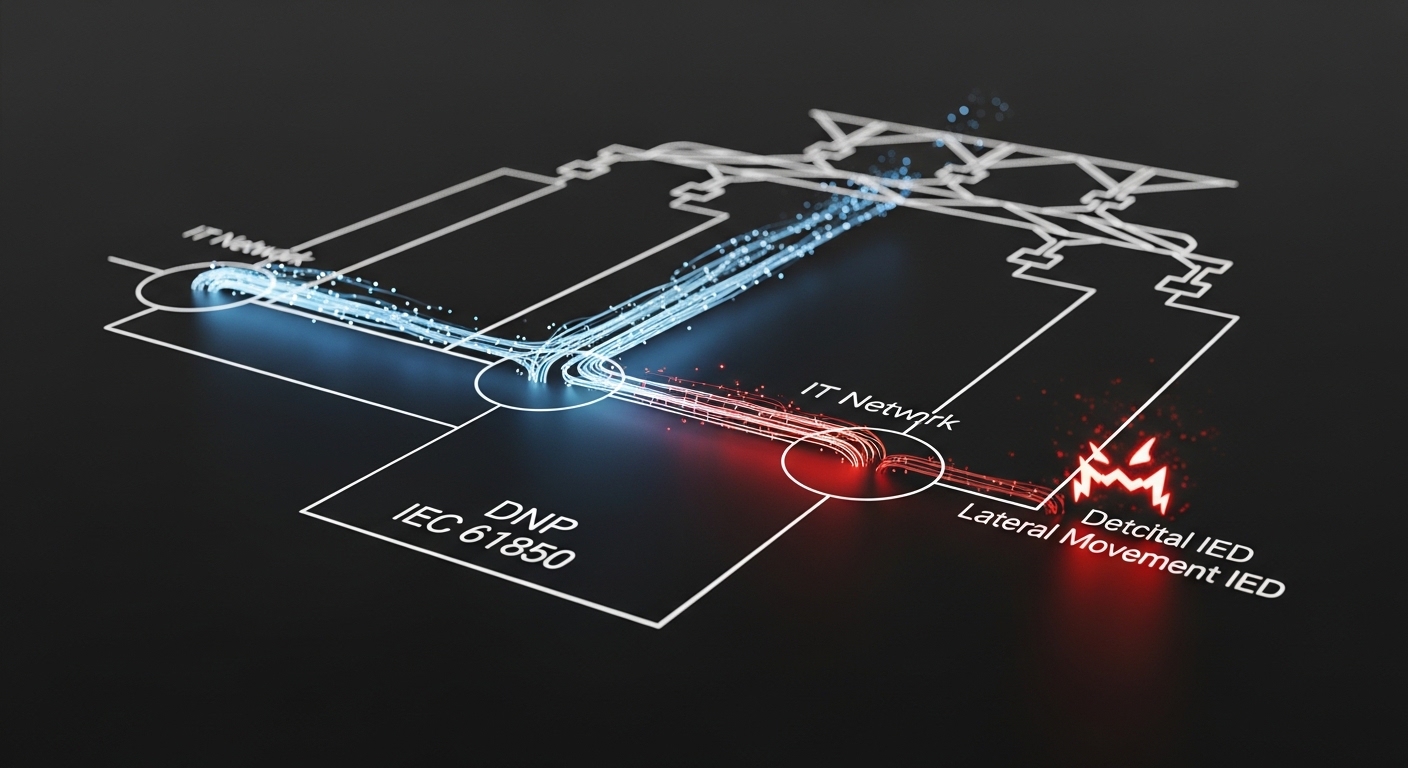
Unmasking the Ghost: AI-Powered Lateral Movement Detection in Agentless Smart Grid OT/IT Networks
Apex Insights Research Desk
The Visibility Gap in Converged Grid Architectures
The convergence of Information Technology (IT) and Operational Technology (OT) within smart grid substations represents a paradigm shift in utility management, enabling unprecedented efficiency and remote control. However, this integration creates a highly permeable attack surface. Threat actors who gain an initial foothold in the corporate IT network can pivot into the OT domain, targeting critical infrastructure with devastating potential. The primary challenge is that the foundational assets of the grid—Intelligent Electronic Devices (IEDs), Remote Terminal Units (RTUs), and Programmable Logic Controllers (PLCs)—are often legacy systems or specialized embedded devices incapable of supporting modern endpoint security agents like EDR or XDR. This agentless reality creates a critical visibility gap, rendering traditional endpoint-centric security models obsolete and ineffective.
Sophisticated adversaries exploit this gap by employing lateral movement techniques that are subtle and often masquerade as legitimate operational traffic. They leverage trusted IT-to-OT conduits, abuse native OT protocols, and use authorized engineering software for malicious purposes. In this environment, the network itself becomes the last line of defense. The only viable strategy for identifying these stealthy intrusions is through advanced, AI-driven anomaly detection systems that operate at the network level, building high-fidelity behavioral baselines of the entire converged ecosystem without requiring any software installation on the endpoints themselves.
The Anatomy of Lateral Movement in Substation Networks
To architect an effective detection strategy, it is imperative to understand the specific attack vectors within a typical substation network. These environments are a complex amalgamation of IT systems (domain controllers, patch servers, historian databases) and OT assets communicating over specialized protocols. A threat actor's objective is to traverse from a compromised IT node, such as an engineer's workstation, to a high-value OT target, like a protective relay or breaker controller.
Common Pivot Points and Pathways
- Dual-Homed Engineering Workstations (EWS): These machines are often the primary bridge between IT and OT. Compromising an EWS provides a direct, authenticated pathway into the process control network.
- Historian and SCADA Servers: Systems that aggregate OT data for IT-level analysis serve as high-value targets. A compromised historian can be used to issue spoofed commands or to pivot deeper into the OT segment.
- Remote Access Gateways: VPNs and other remote access solutions, if not properly segmented and monitored, offer a direct line for an external attacker to land within a trusted network zone.
Sophisticated Evasion Techniques
Adversaries no longer rely solely on noisy network scans. Modern TTPs (Tactics, Techniques, and Procedures) in the OT space focus on stealth:
- Living-off-the-Land (LotL): Using legitimate, pre-installed software and protocols to execute actions. An attacker might use the actual relay configuration software, launched from a compromised EWS, to push a malicious logic file. To a traditional firewall, this traffic appears entirely legitimate.
- Protocol-Specific Abuse: Manipulating the state machines and function codes of protocols like DNP3 or IEC 61850. For example, an attacker might issue a series of seemingly benign DNP3
READcommands for reconnaissance before issuing a single, criticalDIRECT_OPERATE_NO_ACKcommand to trip a breaker without waiting for a confirmation, an action that deviates from normal operational sequences. - Time-Delayed Execution: Spreading malicious activities over extended periods—hours or even days—to blend in with the normal operational noise of the network and evade detection systems that focus only on high-velocity attacks.
An Architectural Blueprint for Network-Centric AI Detection
An effective AI detection system for agentless environments must be architected around passive, non-intrusive data ingestion and multi-dimensional behavioral analysis. The system does not interact with OT devices; it only listens.
Data Ingestion Layer: The foundation is a comprehensive data acquisition strategy. This involves placing network TAPs (Test Access Points) or configuring SPAN/mirror ports on key network switches at the boundaries between IT and OT (the DMZ), within the OT network itself, and at aggregation points leading to remote substations. The goal is to capture a complete, bit-for-bit copy of every packet traversing these critical segments without introducing latency or a point of failure.
Deep Packet Inspection (DPI) and Feature Extraction: Raw packet captures are fed into a DPI engine that possesses native fluency in OT protocols (DNP3, Modbus/TCP, IEC 61850, GOOSE, etc.). This engine doesn't just parse packet headers; it decodes the application-layer payload. Key features are extracted, including:
- Protocol-Specific Fields: DNP3 function codes, object variations, and flags; IEC 61850 MMS commands; Modbus function codes and register addresses.
- Session-Level Metadata: Source/destination IPs and ports, packet timing, session duration, and data volume.
- Asset-Level Context: The system must be able to map a MAC/IP address to a specific device type, vendor, and physical location (e.g., 'Breaker B12 Relay' in 'Substation Alpha').
Multi-Model AI/ML Core: A single algorithm is insufficient. A robust system employs an ensemble of machine learning models, each specializing in detecting a different facet of an attack.
- Unsupervised Baseline Modeling: At the heart of the system are unsupervised models, such as variational autoencoders or Long Short-Term Memory (LSTM) networks. These models are trained over weeks on the captured network data to learn the intricate, high-dimensional