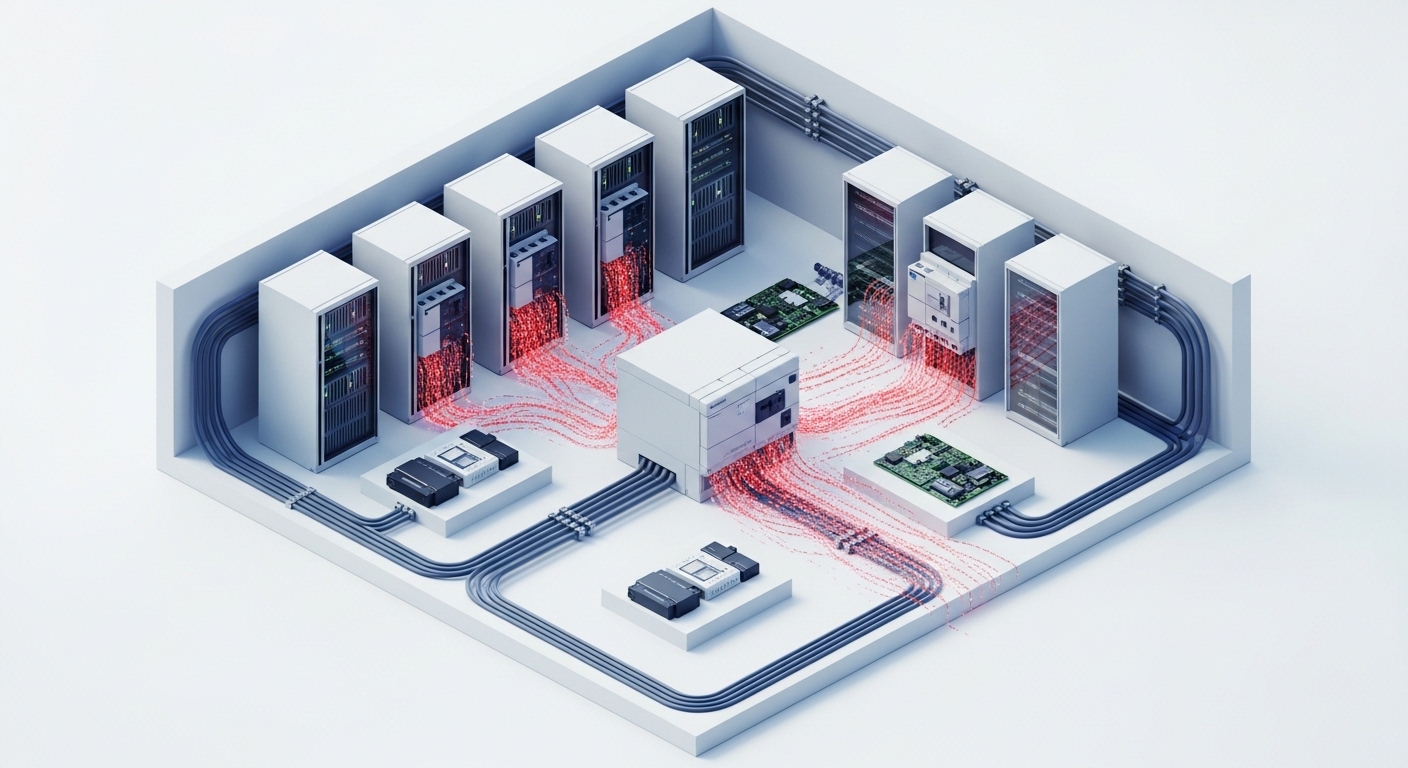
The Runtime Conundrum: Deploying AI Zero-Trust Against Polymorphic Malware in Water Treatment PLCs
Apex Insights Research Desk
Introduction: The New Frontline in Critical Infrastructure Defense
The security of national critical infrastructure, particularly water treatment and distribution systems, represents a non-negotiable imperative. These facilities are no longer isolated mechanical constructs; they are sprawling cyber-physical systems (CPS) where digital control dictates physical outcomes. At the heart of this control fabric lies the Programmable Logic Controller (PLC)—the deterministic workhorse executing the precise, repetitive logic that governs everything from chemical dosing to pressure regulation. Historically, the perceived security of these PLCs relied on network segmentation and the obscurity of their proprietary protocols. This air-gap philosophy is now demonstrably obsolete.
Advanced Persistent Threats (APTs) have shifted their focus from the enterprise IT network to the Operational Technology (OT) domain, targeting the Level 1 and Level 0 devices of the Purdue Model. The weapon of choice is increasingly sophisticated, polymorphic malware. Unlike its static predecessors, polymorphic code actively mutates its identifiable features—such as file names, encryption keys, and string literals—to evade signature-based detection engines. For a PLC, whose operation is measured in microseconds and whose failure can have catastrophic kinetic consequences, the infiltration of such a threat at the runtime level constitutes a worst-case scenario. In response, the cybersecurity paradigm is shifting toward a Zero-Trust architecture, augmented by Artificial Intelligence (AI), to provide a more dynamic and resilient defense. However, deploying this advanced paradigm at the PLC runtime level in a water treatment plant is not a straightforward integration; it is an engineering challenge of immense complexity, fraught with architectural, computational, and safety-critical constraints.
The Unseen Battlefield: PLC Runtime Environments
To grasp the magnitude of the challenge, one must first understand the alien landscape of a PLC's internal execution environment. Unlike general-purpose computing systems, PLCs are governed by a Real-Time Operating System (RTOS) or, in many cases, a simple firmware executive loop. Their primary mandate is not flexibility but deterministic, uninterrupted execution.
The core principle of a real-time system is predictability. The system must not only produce the correct result but must produce it within a guaranteed time-bound, known as the deadline. Any security mechanism that introduces jitter or non-deterministic latency fundamentally compromises the integrity of the control process.
This deterministic mandate means the PLC scan cycle—the sequence of reading inputs, executing logic, and writing outputs—is a sacred contract. For critical processes like valve actuation or pump speed control in a water system, this cycle time is often in the low millisecond range. Introducing an AI inference engine, even a highly optimized one, into this tight loop risks violating these real-time guarantees. A missed deadline is not a performance degradation; it is a system failure that could lead to pressure imbalances, incorrect chemical mixtures, or equipment damage. Furthermore, the hardware itself is severely resource-constrained, featuring minimal RAM and specialized processors not designed for the matrix multiplication and floating-point arithmetic that power modern machine learning models.
Polymorphic Malware: The Shape-Shifting Adversary in OT
Traditional antivirus and intrusion detection systems are fundamentally reliant on matching observed data against a known library of malicious signatures. This model collapses in the face of polymorphic malware. By using techniques like register renaming, instruction substitution, and metamorphic code generation, the malware can create a virtually infinite number of unique variants from a single codebase. In the context of PLCs, this could manifest as a payload that alters ladder logic in subtle ways, changing setpoints or disabling alarms, while constantly modifying its own binary representation within the PLC's memory to avoid detection by periodic integrity checks.
The only viable detection vector against such a threat is behavioral analysis. The malware's signature may change, but its intent—its ultimate effect on the control process—must eventually manifest as anomalous behavior. This could be an unexpected change in the scan cycle time, the modification of a protected memory register, an unusual sequence of control logic execution, or an attempt to communicate over a non-standard protocol. It is this behavioral deviation that AI-driven security models aim to identify, shifting the defensive posture from