The Sentient Factory Floor: Architecting Context-Aware Identity for Zero-Trust OT/IT Security
Apex Insights Research Desk
Introduction: The Imperative for Context in the Converged Industrial Landscape
The traditional air-gapped security model for Operational Technology (OT) is a relic of a bygone era. The relentless push towards Industry 4.0, driven by the need for data-driven optimization and predictive maintenance, has irrevocably shattered the perimeter between enterprise Information Technology (IT) and the factory floor. This IT/OT convergence, while unlocking unprecedented efficiency, has concurrently created a vast and complex attack surface. Adversaries no longer need to physically breach a facility; they can pivot from a compromised corporate network directly into the industrial control systems (ICS) that govern physical processes, with potentially catastrophic consequences.
In this new paradigm, the foundational security assumption must be flipped. The Zero-Trust model, encapsulated by the principle of "never trust, always verify," is no longer an IT-centric luxury but a manufacturing-critical necessity. However, a naive application of Zero-Trust principles is insufficient for the deterministic, low-latency, and legacy-heavy reality of OT. The critical missing element is context. Effective identity verification in a hybrid OT/IT environment cannot rely solely on a static credential. It must be a dynamic, continuous evaluation based on a rich stream of contextual signals from both domains. This research desk will delineate the best practices for architecting such a context-aware identity and access management (IAM) framework within a Zero-Trust architecture, tailored for the unique physics of manufacturing.
Deconstructing Context-Aware Identity: Beyond Static Credentials
At its core, a context-aware approach extends the concept of identity beyond a simple binary state of authenticated or not. It assesses the legitimacy of an access request by scrutinizing the holistic circumstances surrounding it. In a converged OT/IT environment, this means building a multi-dimensional trust model derived from a federated set of signals.
The Spectrum of Identities
First, we must expand our definition of "identity." In manufacturing, we contend with a heterogeneous ecosystem:
- User Identities: Engineers, operators, maintenance staff, and remote vendors. These are typically managed in IT systems like Active Directory.
- Device Identities: This is far more complex than in IT. It includes everything from Windows-based HMIs and engineering workstations to real-time operating system (RTOS) based PLCs, RTUs, and a myriad of IIoT sensors. Many of these devices lack the capability to participate in standard authentication protocols.
- Service/Application Identities: These are non-person entities (NPEs), such as the MES communicating with a SCADA historian, or an ERP system pulling production data. Their access patterns are often programmatic and highly predictable.
- Process Identities: A more abstract but critical concept. This represents the identity of a specific manufacturing process or state, such as 'Batch A Production' or 'System Maintenance Mode.' Access rights should change dynamically based on the active process.
Contextual Signals: The Data Layer for Dynamic Trust
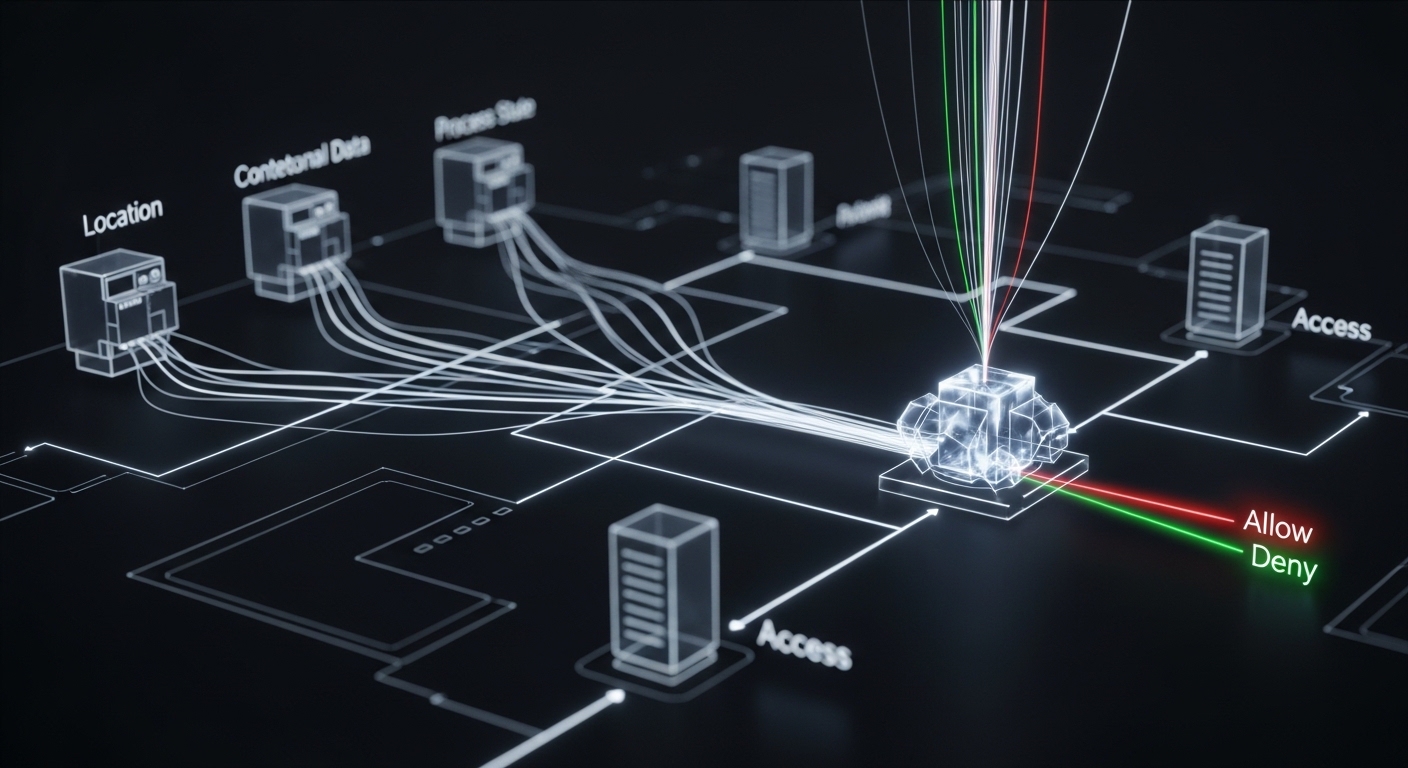
The Policy Decision Point (PDP) in a Zero-Trust architecture requires rich data to make intelligent decisions. A robust system will continuously ingest and analyze signals from across the converged environment:
IT-Derived Signals:
- User Role & Attributes: Group membership, security clearance, and role from an IAM platform (e.g., Active Directory, Okta).
- Device Posture: Patch level, endpoint detection and response (EDR) agent health, running processes, and known vulnerabilities on the source device (e.g., an engineer's laptop).
- Network Location: Source IP address, subnet, and whether the connection originates from a trusted corporate LAN, a remote VPN, or an untrusted network.
- Temporal Context: Time of day and day of the week, aligning access with scheduled work shifts or maintenance windows.
OT-Derived Signals:
- Asset Profile: The intrinsic identity of the OT device—vendor, model, firmware version, and its designated role in the process (e.g., 'Siemens S7-1500 PLC for Conveyor Belt 3').
- Protocol & Function Code: Deep packet inspection (DPI) to verify not just the protocol being used (e.g., Modbus/TCP, S7comm, EtherNet/IP) but the specific function being requested (e.g., 'Read Coil' vs. 'Write Program').
- Operational State: Data from the control system itself indicating its current mode. A request to upload a new PLC program should be permissible during a 'maintenance' state but strictly denied during a 'live production' state.
- Behavioral Baseline: Anomalous communication patterns, such as a sensor attempting to communicate with an external IP address or a PLC communicating with another PLC for the first time.
The fundamental engineering principle is this: Trust is not a one-time event granted at login. It is a continuously calculated score based on the aggregate legitimacy of every contextual signal associated with an access request. A deviation in any single vector—an engineer logging in at 3 AM from an unrecognized IP, using a non-compliant device to send a dangerous function code to a PLC running a critical batch—must trigger an immediate policy re-evaluation and potential denial.
Architectural Blueprint for Contextual Identity Verification
Implementing this strategy requires a methodical, architecturally sound approach. The following steps provide a high-level blueprint for deployment in a hybrid manufacturing environment.
Phase 1: Asset Discovery and Identity Baselining You cannot protect what you cannot see. The initial phase involves deploying passive network monitoring tools capable of deep packet inspection for OT protocols. The goal is to build an exhaustive, real-time inventory of every device, its communication patterns, and its role within the industrial process. This establishes the foundational identity and behavioral baseline for every asset, which is a prerequisite for a universal identity fabric for vendor-agnostic M2M IAM.
Phase 2: Context Aggregation and Federation Establish a central repository or data lake to act as the Context Aggregation Engine. This system must have API connectors to pull data from disparate sources: the IT IAM platform, the EDR/XDR solution, network infrastructure, the asset inventory system, and the process historian. The primary function is to normalize this data into a unified format that the policy engine can consume.
Phase 3: Dynamic Policy Engine Configuration Replace static ACLs and firewall rules with a dynamic policy engine. Policies should be written in a human-readable format that explicitly links identity to context. For example:
ALLOW: group:OT_Engineers -> resource:PLC_Line5 | IF: source_device:compliant AND time:maintenance_window AND protocol:S7comm/Write.Phase 4: Phased Enforcement via Micro-segmentation The Policy Enforcement Points (PEPs) are the control gates. In a brownfield OT environment, these are typically not agents on the endpoints but rather network-based enforcement points like next-generation firewalls or specialized OT security appliances placed at key network chokepoints (e.g., between Level 2 and Level 3 of the Purdue model). Begin in a monitor-only mode to validate policies against real-world traffic without disruption. Once confidence is high, switch to active enforcement, creating micro-segments around critical assets. This form of Zero-Trust policy enforcement in legacy industrial networks via software-defined micro-segmentation is paramount for protecting unpatchable systems.
Practical Implementation Challenges
Transitioning to a context-aware Zero-Trust model in manufacturing is a complex engineering endeavor fraught with specific, non-trivial hurdles.
Deterministic Network Constraints: Perhaps the most significant challenge. Industrial control networks often rely on deterministic, low-latency communication for safe and correct operation. Any security solution that introduces latency or jitter, such as a cloud-based policy engine or a slow inline appliance, is a non-starter. This necessitates enforcement points and policy decisions that operate at line rate, a core challenge addressed by architects focusing on designing sub-10ms Zero Trust for brownfield ICS.
Protocol Opacity and Encryption: While standard IT protocols are well-understood, many OT protocols are proprietary, undocumented, or being wrapped in encryption (e.g., OPC UA). This can blind network-based sensors, requiring advanced DPI capabilities or alternative methods of gaining visibility.
The Agentless Imperative: The vast majority of OT endpoints—PLCs, VFDs, RTUs—are embedded systems that cannot host a security agent. This fundamentally limits endpoint-based posture checking and forces a reliance on network-based identity inference and behavioral analysis.
Cultural and Skillset Gap: The teams managing OT and IT often have different priorities, vocabularies, and risk tolerances. OT engineers prioritize availability and safety above all, while IT prioritizes confidentiality and integrity. A successful implementation requires a unified security team with cross-domain expertise to translate policies and manage the converged architecture.
Scalability of Policy Management: Defining and maintaining granular, context-aware policies for tens of thousands of devices and users is not feasible manually. This necessitates a robust policy orchestration platform that leverages automation, templating, and increasingly, AI/ML to suggest and refine policies based on observed behavior.
Conclusion: Towards an Adaptive, Self-Defending Factory
Adopting a Zero-Trust architecture in a hybrid OT/IT manufacturing environment is not about deploying a single product. It is a strategic shift towards a more resilient and defensible security posture. The lynchpin of this strategy is context-aware identity verification. By moving beyond static authentication and embracing a continuous, data-rich evaluation of every access request, organizations can build a security framework that is both powerful and sensitive to the unique operational demands of the factory floor.
This approach allows for the enforcement of true least-privilege access, drastically reducing the lateral movement capabilities of an attacker who has breached the initial perimeter. It enables the secure integration of modern IT capabilities with legacy OT systems, protecting unpatchable devices and ensuring the safety, reliability, and availability of critical industrial processes. The result is not just a more secure factory, but a sentient one—an environment that understands the context of its own operations and can dynamically adapt its defenses to the evolving threat landscape.
Sources / References
- NIST Special Publication 800-207: Zero Trust Architecture - https://csrc.nist.gov/publications/detail/sp/800-207/final
- ISA/IEC 62443 Series of Standards on Industrial Automation and Control Systems Security - https://www.isa.org/standards-and-publications/isa-standards/isa-iec-62443-series-of-standards
- CISA: Securing Industrial Control Systems - https://www.cisa.gov/topics/industrial-control-systems/securing-industrial-control-systems
- SANS Institute - Securing Industrial Control Systems (ICS) - https://www.sans.org/ics-security/