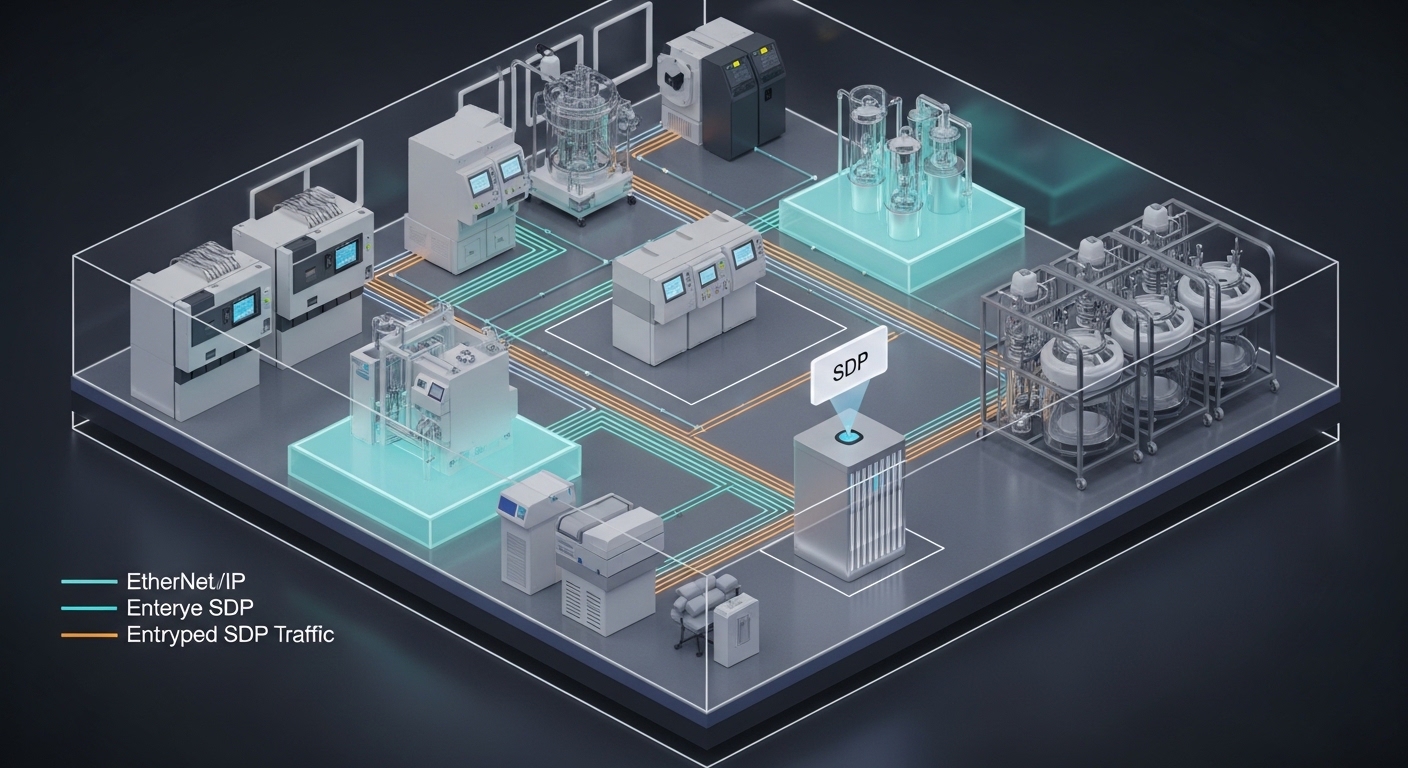
The Determinism Mandate: Guaranteeing Real-Time PLC/HMI Latency in SDP-Secured Pharmaceutical OT
Apex Insights Research Desk
Introduction: The Unyielding Demands of Pharmaceutical Manufacturing
In the highly regulated world of pharmaceutical manufacturing, operational integrity is not a target; it is an absolute mandate. The precision of a bioreactor's control loop, the timing of a filling line's actuation, and the data integrity of a batch record are directly tied to product efficacy and patient safety. These critical control systems, often managed by legacy Programmable Logic Controllers (PLCs) and Human-Machine Interfaces (HMIs), operate on the principle of deterministic latency. This is not merely a need for speed, but a requirement for predictable, repeatable message delivery within stringent, often sub-millisecond time windows. Any significant deviation, or jitter, can lead to batch deviation, regulatory non-compliance, or catastrophic process failure.
Simultaneously, the convergence of IT and OT networks has exposed these historically isolated systems to a sophisticated threat landscape. The imperative to adopt modern cybersecurity paradigms, such as Zero Trust, is undeniable. Software-Defined Perimeters (SDPs) have emerged as a powerful implementation of Zero Trust, promising to render critical assets 'dark' to unauthorized users and dynamically provision access based on verified identity and context. However, this raises a critical engineering question: How can the security overhead inherent in an SDP—authentication, encryption, and policy enforcement—be reconciled with the non-negotiable deterministic latency requirements of legacy PLCs and HMIs? This article from the Apex Insights Research Desk provides an architectural blueprint for achieving this synthesis, ensuring that security enhancement does not come at the cost of process integrity.
Deconstructing the Latency Challenge in SDP-Protected OT
To engineer a solution, we must first dissect the problem. Deterministic latency in an Industrial Control System (ICS) environment means that the time delay between a cause (e.g., a sensor reading crossing a threshold) and an effect (e.g., a valve actuation command from a PLC) is constant and predictable. Jitter, the variation in this latency, is the primary adversary of real-time control loops.
A typical SDP architecture introduces several potential points of latency and jitter that are foreign to traditional, flat OT networks:
- Authentication & Authorization Overhead: The initial access request in an SDP model often involves Single Packet Authorization (SPA), where a client sends a cryptographically signed packet to a controller. The controller verifies the request, checks policies, and instructs a gateway to accept a connection. This multi-step handshake, while secure, adds initial connection latency.
- Per-Packet Policy Enforcement: Once a connection is established, the SDP gateway acts as a Policy Enforcement Point (PEP). Every packet transiting the gateway must be inspected against a policy ruleset. The complexity of these rules can directly impact forwarding delay.
- Cryptographic Processing: The establishment of secure, encrypted tunnels (typically using TLS or DTLS) between the client (e.g., an HMI) and the gateway protecting the resource (the PLC) imposes a computational load for encryption and decryption on every packet. This can be a significant source of latency if not handled by dedicated hardware.
- Network Path Elongation: If SDP gateways are not placed strategically, traffic between an HMI and a PLC that was once a direct Layer 2 hop could be forced through a centralized gateway, a phenomenon known as network 'tromboning.' This physically longer path directly increases latency.
Addressing these challenges requires moving beyond generic IT-centric SDP deployments and adopting an OT-aware architectural approach.
Architectural Blueprint for Deterministic SDP Deployment
Guaranteeing determinism is an exercise in meticulous system design. The following architectural principles are essential for successfully deploying an SDP in a latency-sensitive pharmaceutical manufacturing environment.
Edge-Native Policy Enforcement: The core principle is to move the Policy Enforcement Point (PEP) as close to the operational assets as possible. Instead of backhauling traffic to a centralized data center gateway, SDP gateways must be deployed at the Purdue Model's Level 2 or Level 1, directly at the access layer switch connecting a cell or area's PLCs and HMIs. This co-locates the enforcement function with the control loop, eliminating path elongation and ensuring that policy decisions are made at wire speed within the local segment.
Protocol-Aware, Stateful Session Establishment: Generic IP/port-based filtering is grossly inadequate for OT. The SDP gateway must possess a protocol-aware engine capable of Deep Packet Inspection (DPI) for industrial protocols like EtherNet/IP (with CIP), Modbus/TCP, and OPC-UA. This allows for the creation of stateful, pre-authorized sessions. After an initial, rigorous identity-based authentication (e.g., device certificate validation), the gateway establishes a long-lived, cryptographically-bound session for a specific PLC-to-HMI data flow (e.g., permit read access to specific Modbus registers). Subsequent packets belonging to this flow are forwarded via a hardware-accelerated 'fast path,' bypassing the more computationally expensive policy engine. This approach is a cornerstone of effective Zero Trust micro-segmentation for PLC-to-HMI communications, as it minimizes the per-packet overhead that introduces jitter.
Hardware-Accelerated Cryptography and Forwarding: Relying on general-purpose CPUs for line-rate encryption and packet forwarding in a high-throughput manufacturing environment is a recipe for non-determinism. The selected SDP gateway hardware must feature specialized ASICs or FPGAs dedicated to cryptographic functions (e.g., AES-GCM) and packet forwarding. This hardware offloading ensures that the security functions operate with predictable, low-nanosecond latency, independent of the main CPU's load, which might be handling control plane tasks or logging.
QoS Passthrough and Prioritization: Critical OT networks heavily rely on Quality of Service (QoS) mechanisms, such as Differentiated Services Code Point (DSCP) markings, to prioritize time-critical traffic. For instance, EtherNet/IP uses specific DSCP values to prioritize CIP Sync (PTP) and I/O traffic over diagnostics. A viable SDP solution must not strip or ignore these markings. It must be architected to inspect, honor, and even enforce these QoS policies, ensuring that time-sensitive control packets are always processed ahead of less critical traffic within its own queues.
The fundamental engineering principle for secure OT is that the security overlay must conform to the operational requirements of the underlying physical process, not the other way around. Determinism is a physical requirement, and the cybersecurity architecture must be subservient to it.
Practical Implementation Challenges
Deploying such an architecture is not without significant engineering hurdles that must be systematically addressed.
Sub-Millisecond Jitter Baselining: Before implementation, a high-fidelity baseline of the existing network's latency and jitter characteristics is required. This cannot be accomplished with simple ICMP pings. It requires deploying network TAPs (Test Access Points) and using specialized protocol analyzers (e.g., Wireshark with expert dissectors) to measure the precise time delta between command and response packets for critical I/O messages. This baseline is the ultimate metric against which the post-SDP implementation will be judged.
Handling Non-Routable and Multicast Protocols: Many legacy OT protocols were not designed for routed, security-segmented networks. EtherNet/IP, for example, uses multicast for implicit messaging and device discovery. A standard unicast-based SDP tunnel can break this functionality. The SDP gateway must incorporate features like multicast proxying or IGMP snooping to intelligently manage this traffic, ensuring that essential discovery and I/O messages are not dropped while still preventing multicast storms.
Controller and Gateway High Availability: In a system where downtime can cost millions per hour, single points of failure are unacceptable. A robust design requires a high-availability cluster for the SDP controllers. More critically, the edge gateways must be deployed in redundant pairs using a protocol like the Virtual Router Redundancy Protocol (VRRP) or a proprietary failover mechanism. The failover time of these gateways must be measured and guaranteed to be less than the maximum tolerable process disruption time.
Agent vs. Agentless Trade-offs on HMIs: While PLCs will be protected by a network gateway (agentless), the initiating device (HMI, engineering workstation) may require an SDP client (agent). The CPU and memory footprint of this agent must be carefully evaluated. An inefficient agent could starve the HMI application (e.g., SCADA software) of resources, introducing application-level latency even if network latency is low. This analysis is central to the ongoing debate over agent-based versus agentless security models in brownfield environments, which is deeply explored in our analysis of continuous verification in Zero-Trust for hybrid ICS environments.
Conclusion: Synthesizing Security and Determinism
Integrating Software-Defined Perimeters into pharmaceutical manufacturing environments is not an impossible task, but it is one that demands a departure from conventional IT security thinking. The illusion that a single, centralized security solution can be overlaid onto a real-time control system without consequence is dangerous.
By embracing an architecturally distributed model with edge-native, hardware-accelerated, and protocol-aware policy enforcement, it is possible to achieve the powerful security guarantees of Zero Trust without sacrificing the deterministic performance that underpins process safety and product quality. The key is to design the security system around the operational realities of the control loop. This involves pre-authorizing static communication paths to minimize per-packet overhead and leveraging advanced, granular policy models. The future of this field likely involves enriching these SDP policies with real-time context, moving towards low-latency ABAC for Modbus & EtherNet/IP to make authorization decisions that are not only based on identity but also on the current operational state of the plant.
Ultimately, for critical infrastructure, the successful SDP deployment is not the one with the most complex rule set, but the one whose presence is functionally invisible to the PLC, ensuring every command is delivered securely, authenticated, and, most importantly, on time.
Sources / References
- NIST Special Publication 800-207, Zero Trust Architecture: https://csrc.nist.gov/publications/detail/sp/800-207/final
- IEC 62443 Series of Standards for Industrial Automation and Control Systems (IACS) Security: https://www.isa.org/standards-and-publications/isa-standards/isa-iec-62443-series-of-standards
- ODVA, Inc., The CIP Networks Library, Volume 1: Common Industrial Protocol (CIP): https://www.odva.org/library-and-technical-resources/
- RFC 8446 - The Transport Layer Security (TLS) Protocol Version 1.3: https://datatracker.ietf.org/doc/html/rfc8446