The 50ms Mandate: Architecting Deterministic Zero-Trust for Legacy Modbus SCADA
Apex Insights Research Desk
The Apex Insights Research Desk Analysis
Introduction: The Determinism-Security Paradox in Brownfield OT
In the realm of Operational Technology (OT), particularly within legacy SCADA networks leveraging the Modbus protocol, the concept of determinism is sacrosanct. The predictable, timely delivery of control signals is not merely a performance metric; it is the fundamental requirement for safe and stable physical processes. Introducing modern cybersecurity paradigms, such as Zero Trust, into these environments presents a formidable engineering paradox: how does one enforce granular, identity-based security policies without violating the stringent, often sub-100ms latency mandates of critical control loops? The conventional wisdom, shaped by the performance overhead of enterprise IT security solutions, suggests this is an intractable problem.
This research desk posits that this view is outdated. It is not only possible to implement Zero-Trust micro-segmentation in a legacy Modbus SCADA network without exceeding a 50ms latency budget for critical signals, but it is an architectural necessity for resilient industrial operations. The solution, however, does not lie in repurposed IT firewalls or software agents. It requires a purpose-built, hardware-accelerated architecture that treats latency not as a consequence, but as a primary design constraint. Addressing this challenge head-on is crucial, as outlined in our foundational analysis of [The Brownfield Conundrum: Architecting Zero-Trust for Legacy Modbus and DNP3 Systems](https://apex-insight.pl/zero-trust-challenges-modbus-dnp3-ics), which details the inherent vulnerabilities of these flat, trust-by-default networks.
Deconstructing the Latency Budget
To engineer a solution, we must first meticulously dissect the latency budget of a Modbus transaction. Total round-trip time (RTT) for a request-response cycle is a sum of multiple components:
- Propagation Delay: The time for the signal to travel across the physical media. In a typical plant floor network, this is often negligible (nanoseconds per meter).
- Serialization Delay: The time required to place the bits of the packet onto the wire, dependent on packet size and baud rate (for serial Modbus RTU) or link speed (for Modbus TCP). For a small Modbus packet, this is typically in the low milliseconds.
- Processing Delay (End Devices): The time a PLC or RTU takes to parse a request, execute the logic, and formulate a response. This varies significantly but is a known baseline for a given control system.
- Security Overhead Delay (The Variable): This is the additional latency introduced by any security enforcement mechanism. It is the critical variable that must be ruthlessly minimized.
Traditional, CPU-based firewalls introduce significant and, more importantly, non-deterministic latency. Their processing time fluctuates with CPU load, policy complexity, and traffic volume. A security policy lookup on a general-purpose processor, context switching between kernel and user space, can easily consume tens of milliseconds, shattering the 50ms budget before the control signal has even been processed by the PLC. Therefore, the architectural approach must be fundamentally different, prioritizing deterministic, low-latency packet handling above all else.
Architectural Blueprint: Bump-in-the-Wire Hardware Enforcement
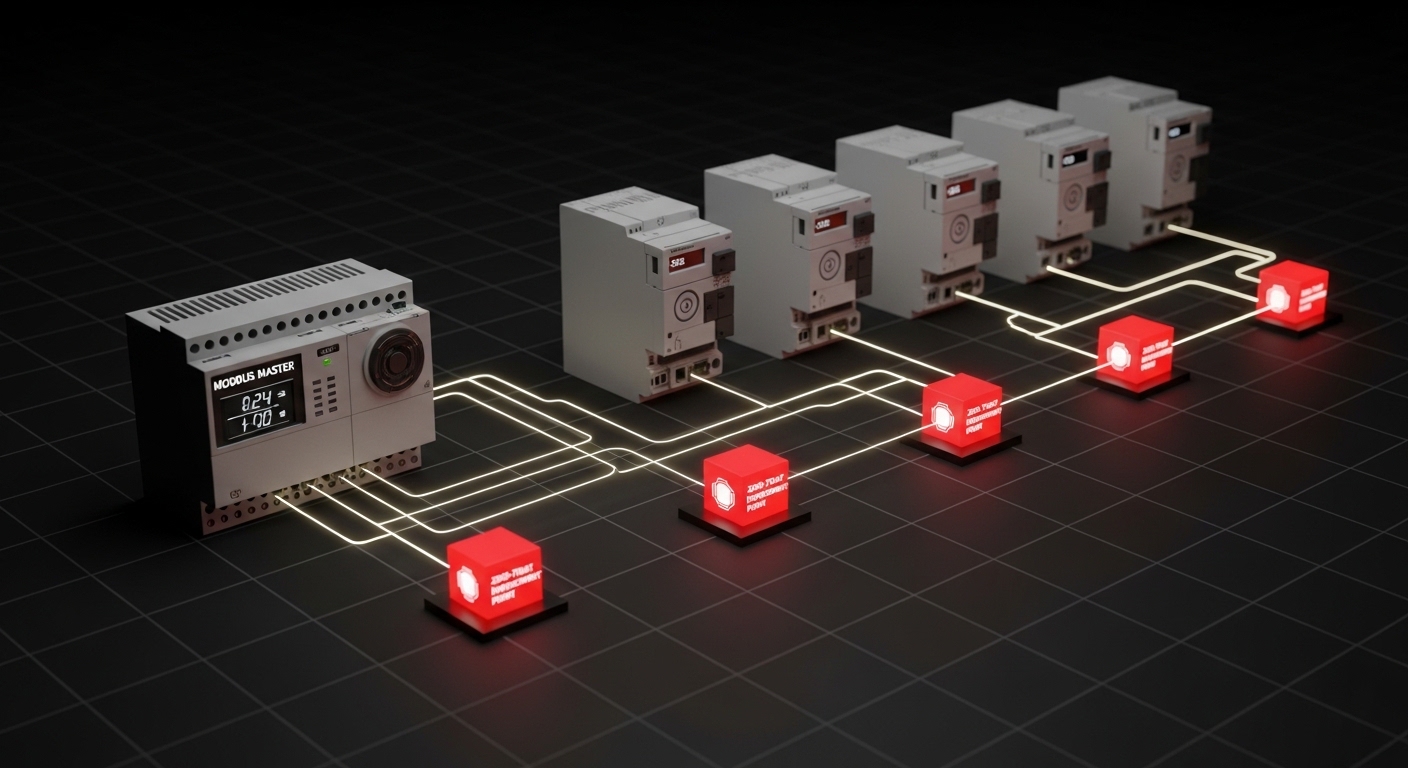
A viable architecture hinges on distributing policy enforcement to the edge, as close to the protected asset as possible, using specialized hardware. This is achieved through a 'bump-in-the-wire' (BITW) or 'transparent bridge' model.
The Enforcement Point (PEP): A compact, hardened hardware appliance is placed in-line on the network link immediately preceding a PLC, RTU, or other critical endpoint. This device operates at Layer 2, making it transparent to the existing IP/serial configuration. It requires no changes to endpoint addressing or SCADA host software, a critical requirement for legacy systems.
FPGA/ASIC-Based Packet Processing: The core of the PEP is not a general-purpose CPU, but a Field-Programmable Gate Array (FPGA) or an Application-Specific Integrated Circuit (ASIC). These silicon-level solutions process network packets in parallel, executing policy lookups in hardware logic gates. This approach eliminates OS overhead and context switching, reducing packet inspection and forwarding latency to microseconds, not milliseconds. The determinism of hardware logic ensures that latency is constant and predictable, regardless of traffic load.
Protocol-Aware State Machine: The FPGA is loaded with a hardware-based state machine that performs deep packet inspection (DPI) specifically for Modbus. It decodes the entire Modbus frame in real-time, parsing the Unit ID, Function Code, Register Addresses, and Data Values. This granular understanding is essential for effective policy enforcement and is a core component of
[Protocol-Aware DPI: Architecting Resilient SCADA Security at the IT/OT Edge](https://apex-insight.pl/protocol-aware-dpi-scada-security-it-ot-edge). The PEP can distinguish between a benign 'Read Holding Registers' request from an HMI and an anomalous 'Write Multiple Coils' command from an unauthorized source targeting a critical motor controller.Decoupled & Cached Policy Decision: The PEP does not make policy decisions; it enforces them. A central Policy Decision Point (PDP) or controller compiles high-level security policies (e.g., "HMI-1 can only read registers 40001-40050 from PLC-A") into a highly efficient, low-footprint ruleset. This ruleset is pushed to and cached in the local memory of the PEP. The enforcement action becomes a simple, high-speed lookup in this local cache, a process that can be completed within a few clock cycles on an FPGA.
Centralized Orchestration: A Policy Administration Point (PAP) provides a single interface for security operators to define, manage, and monitor policies across hundreds or thousands of distributed PEPs. This allows for scalable management without touching the endpoints themselves.
Practical Implementation Challenges
Deploying this architecture requires surmounting significant engineering hurdles that are unique to the OT environment.
Jitter and Determinism in Serial-to-Ethernet Conversion
For legacy Modbus RTU (serial) segments, the PEP must act as a transparent serial bridge. This involves more than just passing bits. The device must precisely manage RS-485 signaling, maintain strict timing, and avoid introducing jitter that could cause framing errors on sensitive end devices. The hardware must have high-precision clocks and buffer management designed specifically for industrial serial protocols, not generic terminal server applications.
Policy Granularity vs. Hardware Complexity
There is a direct trade-off between the complexity of the security policy and the resources required on the FPGA. A simple rule based on function codes is trivial. A stateful policy that tracks transaction sequences (e.g., "allow a write only if preceded by a specific read from an authorized user") requires more logic gates and memory, potentially increasing the chip's cost and power consumption. The architecture must strike a balance that provides meaningful security without becoming prohibitively expensive or complex.
Environmental Hardening and Physical Tampering
PEPs are deployed in harsh industrial environments. They must be rated for extreme temperatures (e.g., -40°C to +85°C), high humidity, vibration, and significant electromagnetic interference (EMI). Furthermore, the physical security of the PEP itself must be considered. Tamper-evident casings and features that zeroize configuration if the device is opened are critical to prevent physical bypass.
Fail-State Engineering: Availability vs. Security
The behavior of the PEP during a power failure or internal fault is a critical design decision. A 'fail-open' configuration, where an internal relay bypasses the electronics, prioritizes availability but creates a window of security risk. A 'fail-closed' configuration blocks all traffic, prioritizing security but guaranteeing a process shutdown. The optimal design incorporates high-availability pairs (redundant PEPs) and configurable, risk-based fail-states with hardware-level bypass relays that can be controlled deterministically.
Defining the Micro-Perimeter: Policy as Code
With the architecture in place, the Zero-Trust principle of 'never trust, always verify' can be translated into concrete, enforceable policies. Each PEP creates a micro-perimeter around a single industrial asset or a small group of functionally related assets. The identity of a communicating entity is established not by a certificate (which legacy devices lack), but by verifiable network attributes like its source IP/MAC address and the physical switch port it is connected to. This contextual identity is a cornerstone of [Securing the Sentinel: A Zero-Trust Blueprint for Identity Verification on Legacy RTUs](https://apex-insight.pl/zero-trust-identity-verification-legacy-rtu), which adapts identity concepts for devices incapable of participating in modern authentication schemes.
Key policy enforcement takeaways include:
- Command Whitelisting: Only explicitly permitted Modbus function codes from authorized sources to specific destinations are allowed. All other function codes (e.g., Stop PLC, Write Firmware) are dropped by default.
- Register-Level Access Control: Policies can be defined to restrict access to specific memory ranges. An HMI may be granted read-only access to status registers, while an engineering workstation is granted temporary write access to configuration setpoint registers.
- East-West Traffic Lockdown: Direct communication between PLCs, which is often unnecessary and a common vector for malware propagation, can be explicitly blocked. All communication must be arbitrated through the SCADA host.
- Read-Only Zones: For connections to business networks for analytics, the PEP can enforce a strict hardware-based read-only policy, ensuring that no commands can flow from the IT network back into the OT environment.
The principle of "Do No Harm" is paramount in OT. Security controls must be provably non-disruptive to the underlying physical process before full deployment. Verification is not optional; it is a core project requirement.
Validation must be rigorous. It involves lab-based network emulation to stress-test the PEPs under worst-case load conditions, using high-precision network analyzers to measure per-packet latency down to the microsecond. This is followed by a passive, monitoring-only deployment in the live environment to validate policy logic against real traffic before moving to active enforcement on non-critical, and finally, critical systems.
Conclusion: Engineering Resilience into Legacy Systems
The challenge of securing legacy Modbus SCADA systems within a 50ms latency window is not a security problem; it is a systems engineering problem. By shifting the enforcement paradigm from software-based, centralized chokepoints to hardware-accelerated, distributed enforcement points, we can achieve the granular control mandated by Zero Trust without compromising the deterministic performance required for physical process safety and stability. This approach transforms security from a source of operational risk into a foundational component of industrial resilience, proving that even the oldest, most critical infrastructure can be secured for the modern threat landscape.
Sources / References
- NIST Special Publication 800-82 Rev. 2, Guide to Industrial Control Systems (ICS) Security. URL: https://csrc.nist.gov/publications/detail/sp/800-82/rev-2/final
- Modbus Application Protocol Specification V1.1b3. URL: https://modbus.org/docs/Modbus_Application_Protocol_V1_1b3.pdf
- SANS Institute, "Securing Industrial Control Systems," (Various Whitepapers and Webcasts). URL: https://www.sans.org/ics-security/