Architecting Resilience: A Blueprint for Dynamic, Identity-Based Micro-segmentation of Multi-Vendor Robotic Fleets
Apex Insights Research Desk
The Imperative for Granularity in Robotic Operations
The modern manufacturing floor is a complex, heterogeneous ecosystem of cyber-physical systems. The era of air-gapped, single-vendor robotic cells is definitively over. Today, fleets of industrial robots from manufacturers like KUKA, FANUC, ABB, and Yaskawa operate in converged IT/OT networks, communicating with Manufacturing Execution Systems (MES), SCADA platforms, and cloud-based analytics engines. This hyper-connectivity, while unlocking unprecedented efficiency, exposes these high-value assets to a sophisticated threat landscape. Traditional network security paradigms, predicated on static VLANs and perimeter firewalls, are fundamentally incapable of providing the granular, real-time control required. They establish coarse-grained perimeters that, once breached, offer attackers extensive lateral movement pathways.
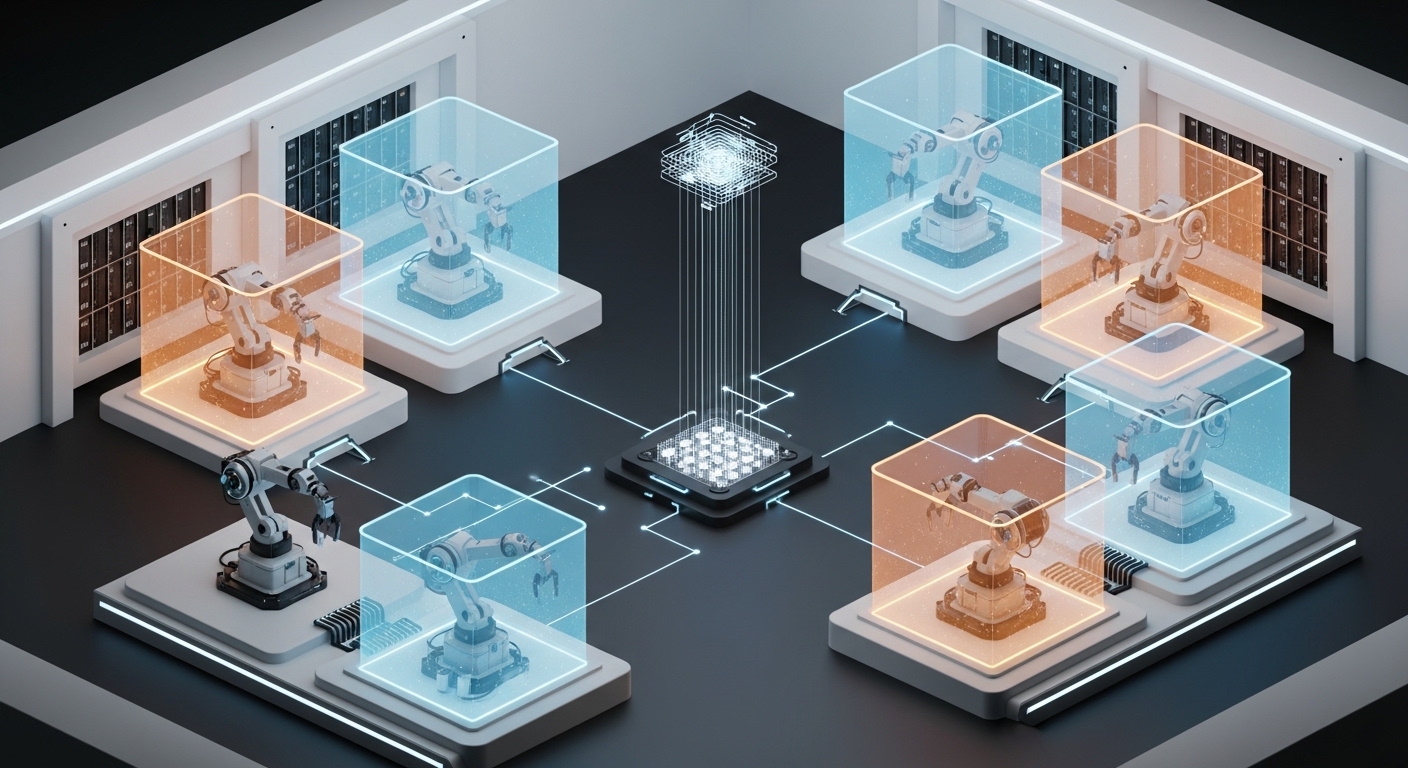
The architectural mandate is a shift from network-centric to identity-centric security. We must treat each robotic arm, controller, and even software process as its own defensible micro-perimeter. This is the core tenet of dynamic micro-segmentation: enforcing least-privilege access based on a verifiable, context-aware identity, in real-time. It's about ensuring a FANUC robot in a welding cell can only communicate with its designated PLC and the MES for its specific work order, and nothing else—and that this permission is ephemeral, existing only for the duration of that task.
Foundational Principles: Identity as the New Perimeter
At its core, identity-based micro-segmentation decouples security policy from network topology. Instead of creating rules based on IP addresses or subnets—which are brittle and easily spoofed—policy is tied to the intrinsic properties of the workload itself. The efficacy of this model hinges on a robust and multi-faceted definition of 'identity' for an industrial asset.
In the context of Zero Trust, identity is not limited to a user account. It extends to devices, applications, and services. An asset's identity is an aggregation of attributes that can be used for authentication, authorization, and policy enforcement. This includes hardware identifiers, software manifests, cryptographic certificates, and behavioral characteristics.
For a multi-vendor robotic fleet, a strong identity is a composite of multiple attributes, creating a high-fidelity digital fingerprint:
- Hardware-Rooted Identity: Utilizing a Trusted Platform Module (TPM) or Physical Unclonable Function (PUF) within the robot controller to provide a cryptographically secure, unforgeable root of trust. This forms the bedrock of the identity claim, as detailed in our analysis on Hardware-Rooted Attestation: The Bedrock of Zero-Trust in Brownfield ICS Environments.
- Software Attestation: A cryptographic manifest of the running firmware, operating system, and key application binaries. This ensures the robot is running approved, untampered software.
- Operational Context: Attributes derived from external systems. This is the 'dynamic' component. This includes the current work order ID from the MES, the maintenance status from the CMMS, or the identity of the engineer logged into the teach pendant.
- Network and Behavioral Metadata: Baseline network traffic patterns, protocol usage (e.g., EtherNet/IP, PROFINET), and expected physical state (e.g., joint positions, tool status).
By building policies using these attributes (an Attribute-Based Access Control or ABAC model), we create a system that is both highly secure and operationally resilient. A policy can state: "Allow robot_model=ABB_IRB_6700 with firmware_attestation=SHA256_HASH executing task_id=WELD_ASSEMBLY_XYZ to communicate with plc_model=Siemens_S7-1500 over PROFINET on port 102, but only for profinet_function=IO_DATA_EXCHANGE. Deny all other communication."
Architectural Blueprint for Real-Time Enforcement
Deploying this model requires a carefully orchestrated architecture comprising a central policy brain and distributed enforcement points. The goal is to ensure policy decisions are intelligent and centralized, while enforcement is fast, distributed, and as close to the asset as possible to minimize latency.
Identity Provider (IdP) & Asset Inventory Integration: The process begins with establishing a canonical source of truth for all robotic assets. This system integrates with the CMDB/asset inventory and is responsible for provisioning and managing the lifecycle of cryptographic identities for each robot controller.
Centralized Policy Decision Point (PDP): This is the control plane. The PDP is where administrators define access policies using the rich, attribute-based language described above. It continuously ingests contextual data from MES, SCADA, and security information and event management (SIEM) systems to enrich its policy decisions. For example, a vulnerability scan result indicating a critical flaw on a specific robot model could trigger the PDP to automatically generate a quarantine policy.
Distributed Policy Enforcement Points (PEPs): This is the data plane, where the policies are actually enforced. The placement of PEPs is a critical design decision in OT environments. Options include:
- Host-based agents: A lightweight agent on the robot controller itself. Often infeasible in legacy or proprietary systems.
- Network fabric enforcement: Utilizing next-generation switches or gateways that act as PEPs.
- Hypervisor-based enforcement: For virtualized robot controllers or offline programming environments.
- Transparent Gateway/Bump-in-the-wire: A dedicated appliance that sits inline between the robot and the network switch, intercepting all traffic.
Policy Distribution & Synchronization: The PDP securely distributes compiled, optimized policies to the relevant PEPs. This communication must be resilient and low-latency. When a robot's context changes (e.g., a new work order is assigned), the PDP computes the new policy and pushes it to the PEPs responsible for that robot's traffic, ideally within milliseconds.
Continuous Monitoring & Logging: All traffic flows, allowed and denied, must be logged by the PEPs and streamed back to a central analytics platform. This provides complete visibility for auditing, compliance, and threat hunting, and is a cornerstone of any effective Zero Trust implementation. Establishing this visibility is often the first step in tackling the security of proprietary industrial networks, a challenge we've outlined in our blueprint, Zero-Trust in Brownfield OT: A Non-Disruptive Blueprint for Segmenting Proprietary Industrial Networks.
Practical Implementation Challenges
Architecting such a system in a real-world manufacturing plant presents significant engineering hurdles that move beyond theoretical models.
Determinism and Latency Injection
Industrial robotics relies on deterministic, low-latency communication for safe and precise operation. A PEP, particularly an inline appliance performing deep packet inspection (DPI) and cryptographic validation, inevitably introduces latency and jitter. Even a few milliseconds of delay in a high-speed coordinated motion control loop can lead to product defects or hazardous conditions. The engineering challenge is to design or select PEPs that can perform complex policy evaluation and enforcement with sub-millisecond overhead. This requires hardware acceleration, optimized software data planes (e.g., DPDK), and rigorous testing to validate that the security overlay does not violate the operational constraints of the control system. The details of this challenge are immense, touching upon what we call The Sub-Millisecond Mandate: Best Practices for Ultra-Low Latency Micro-Segmentation in Multi-Site ICS.
Heterogeneity and Brownfield Constraints
Few manufacturing environments are greenfield. Most are a patchwork of equipment spanning decades, vendors, and protocol versions. A 20-year-old FANUC controller running a proprietary OS on a 10BASE-T connection has no concept of a TPM or the ability to run a security agent. The challenge here is to devise agentless enforcement strategies. This often involves placing a transparent PEP gateway directly in front of the legacy asset, acting as a security proxy. This PEP spoofs the identity of the legacy device to the network, handling authentication and authorization on its behalf. This requires sophisticated protocol parsing and a deep understanding of the legacy system's behavior to avoid disruption.
Policy Scalability and Management Overhead
In a plant with thousands of robots and tens of thousands of potential communication paths, defining and managing policies manually is an impossible task. The system can suffer from 'policy explosion,' becoming a brittle and unmanageable web of rules. The solution lies in abstraction and automation. Policies should be defined based on roles and templates (e.g., a 'Welding Robot' role template) and then applied to assets programmatically based on their tags and attributes from the asset inventory. The entire policy lifecycle—creation, update, decommissioning—must be automated via APIs and integrated into existing CI/CD and infrastructure-as-code (IaC) pipelines.
Failsafe Design and Safety Interlocks
In OT, safety trumps security. A security control cannot create an unsafe condition. What happens if the PDP becomes unreachable? The PEPs must have a pre-configured, deterministic failsafe state. This could be 'fail-open' (allow all traffic) for a non-critical process or 'fail-secure/fail-closed' (block all traffic) for a sensitive one. More sophisticated designs might involve the PEP falling back to a cached, more permissive 'emergency operations' policy. These mechanisms must be carefully designed in collaboration with process control engineers and integrated with the plant's functional safety systems (e.g., safety PLCs).
Conclusion: Towards the Autonomous, Resilient Factory
Dynamic, identity-based micro-segmentation represents a paradigm shift in securing industrial robotics. It moves beyond brittle, network-based perimeters to a flexible, resilient model where security is an intrinsic property of the operational workload. By building a robust identity framework, deploying a distributed enforcement architecture, and tackling the challenges of latency, legacy integration, and scalability head-on, manufacturers can build a security foundation that not only defends against current threats but also enables the next generation of smart, autonomous manufacturing. This is not merely a defensive measure; it is a strategic enabler for building the secure, agile, and resilient factories of the future.
Sources / References
- NIST Special Publication 800-207, Zero Trust Architecture. Available: https://csrc.nist.gov/publications/detail/sp/800-207/final
- ISA/IEC 62443 Series of Standards on Industrial Automation and Control Systems Security. Available: https://www.isa.org/standards-and-publications/isa-standards/isa-iec-62443-series-of-standards
- EtherNet/IP Secure Transport (CIP Security™). ODVA, Inc. Available: https://www.odva.org/technology-standards/key-technologies/cip-security/