The Sterile Enclave: A Blueprint for Hardware-Enforced Zero-Trust in Brownfield Pharmaceutical OT
Apex Insights Research Desk
The Imperative for Deterministic Security in Pharmaceutical OT
In the highly regulated domain of pharmaceutical manufacturing, Operational Technology (OT) networks are the central nervous system of production. These environments, governed by stringent GxP (Good x Practice) guidelines and FDA 21 CFR Part 11, demand absolute process integrity and data reliability. A continuous batch process for a high-value biologic cannot be paused; a deviation in a bioreactor's control loop can invalidate a multi-million dollar batch. This operational reality makes traditional IT security paradigms, which often accept minor latency or brief outages for patching and scanning, not just impractical but catastrophically risky.
Brownfield pharmaceutical facilities present an even more acute challenge. They are typically a heterogeneous mix of legacy PLCs, modern Distributed Control Systems (DCS), and proprietary skid-based equipment, often communicating over a flat, unsegmented network. The introduction of any security control must adhere to a primary directive: primum non nocere—first, do no harm. It cannot introduce latency, jitter, or any variable that could disrupt the deterministic, real-time communication essential for process control and product quality.
Software-defined segmentation, while powerful in IT, often falls short here. It relies on agents that cannot be installed on legacy controllers or introduces processing overhead on network switches that can interfere with time-sensitive protocols like PROFINET IRT or CIP Sync. This is where hardware-enforced zero-trust micro-segmentation emerges not as an option, but as an architectural necessity. By deploying dedicated security gateways that operate at line speed, it becomes possible to enforce granular, least-privilege access control without altering the underlying control system's behavior or performance.
Shifting the Paradigm: From Perimeter Defense to Intrinsic Trust Zones
The foundational principle of zero-trust is to 'never trust, always verify'. In a pharmaceutical OT context, this translates to enforcing that a specific PLC controlling a mixing tank only communicates with its designated HMI and the Batch Historian, and only using specific Modbus function codes or OPC UA tags. Any other communication attempt—be it from a compromised engineering workstation or a laterally moving threat actor—is blocked by default.
Hardware enforcement provides the physical and logical chokepoints to make this verification possible without impacting the control network's deterministic nature.
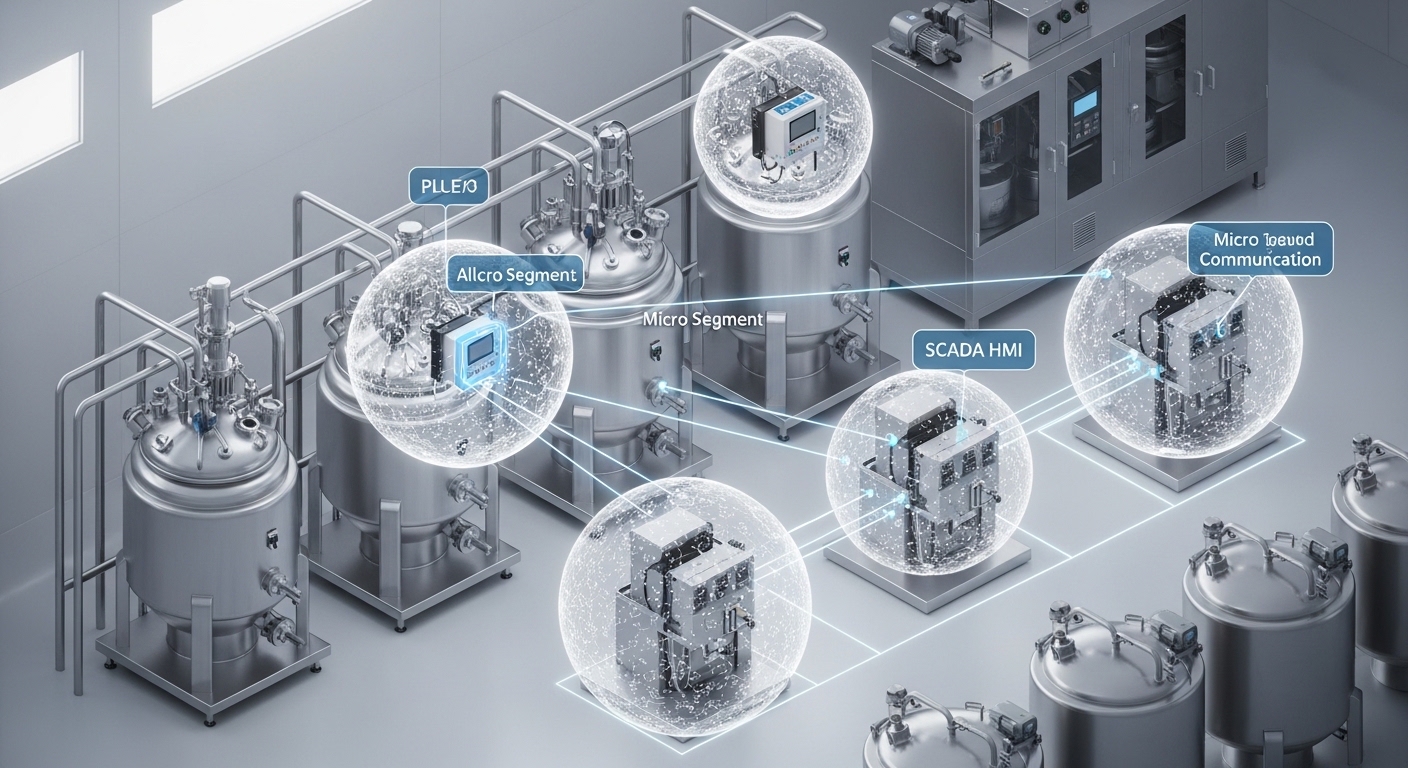
The core engineering principle is to move the policy enforcement point as close to the protected asset as possible, executing policy decisions in dedicated hardware to eliminate any performance impact on the control logic itself. This creates what can be termed a 'sterile enclave' around each critical process unit or cell.
Unlike traditional firewalls that segment large network zones (e.g., Level 1 from Level 2 in the Purdue Model), hardware-enforced micro-segmentation creates tiny, purpose-built perimeters around individual controllers or small functional groups of assets. This granularity is critical for halting lateral movement, as a compromise of one system cannot propagate across the plant floor.
The Architectural Blueprint for Zero-Downtime Implementation
Deploying such a robust architecture in a live, 24/7 manufacturing environment requires a meticulous, phased approach that prioritizes operational continuity above all else. A 'rip and replace' strategy is untenable. The following blueprint outlines a non-disruptive pathway.
Phase 1: Deep Passive Discovery and Communication Baselining The initial phase is entirely non-intrusive. By placing network TAPs or utilizing SPAN ports, all network traffic is mirrored to a dedicated OT security platform. The objective is to build a high-fidelity map of the entire environment without sending a single active packet. This involves:
- Asset Inventory: Identifying every PLC, HMI, VFD, sensor, and server, including firmware versions and hardware details.
- Communication Flow Mapping: Diagramming every connection, detailing source, destination, protocol (e.g., S7COMM, Modbus/TCP, EtherNet/IP), and specific function codes or commands used.
- Dependency Analysis: Understanding the critical communication paths required for continuous batch operations versus those used for periodic maintenance or data collection. This deep discovery phase is fundamental. An incomplete or inaccurate baseline is the primary cause of failed segmentation projects, as it leads to policies that inadvertently block critical process traffic. This is the stage where techniques for architecting OT resilience through non-intrusive DPI are paramount to building an accurate operational model.
Phase 2: Policy Modeling and Virtual Segmentation With a validated asset and flow map, the next step is to design the zero-trust policies in a virtual environment. This 'monitor-only' stage allows for the creation and testing of micro-segmentation rules without any real-world enforcement. The system simulates the effect of the proposed policies against live traffic, flagging any communication that would have been blocked. This allows engineers to refine rules, correct exceptions (e.g., an undocumented vendor maintenance connection), and demonstrate policy efficacy to stakeholders and validation teams before making any physical network changes.
Phase 3: Phased 'Bump-in-the-Wire' Hardware Deployment Hardware security gateways are now physically installed at strategic points, typically between the Level 1 control network and the Level 2 supervisory network, or directly in front of a critical production line's controllers. Critically, these devices are deployed in a fail-open, passive-monitoring mode. They are physically in-line but are configured to pass all traffic without inspection or blocking. This step serves to burn-in the hardware and confirm that its physical presence introduces no unacceptable latency or packet drop, de-risking the physical implementation entirely.
Phase 4: Granular, Risk-Based Policy Enforcement This is the most critical phase. Instead of activating all policies at once, enforcement is rolled out incrementally. A sound strategy involves:
- Start with Low-Impact Policies: Begin by blocking universally disallowed protocols like SMBv1 or FTP from the control network.
- Segment by Process Criticality: Enforce policies around less critical systems, like a packaging line, before moving to the primary bioreactor controls.
- Enforce During Scheduled Downtime: Whenever possible, activate new rule sets during planned maintenance windows or between batches to allow for immediate observation and rollback if needed.
- Whitelisting, Not Blacklisting: The policies should be based on a default-deny posture, explicitly allowing only the validated communication flows identified in Phase 1.
Phase 5: Continuous Verification and Auditability A zero-trust architecture is not a 'set and forget' solution. As processes are optimized or equipment is updated, communication patterns change. The system must continuously monitor traffic against the enforced policies, logging all allowed and blocked connections. This provides an invaluable audit trail for GxP compliance and regulatory bodies. The goal is to achieve a state of verifiable micro-segmentation in legacy OT, where the security posture is not just assumed but is continuously proven and documented.
Practical Implementation Challenges
Executing this blueprint requires overcoming significant engineering hurdles specific to brownfield OT.
Deterministic Network Performance: Real-time control protocols have strict timing requirements. A hardware gateway must process and forward packets with deterministic, microsecond-level latency and near-zero jitter. Any device that introduces variability can desynchronize controllers and trigger a process fault. This necessitates hardware with dedicated ASICs for traffic processing, bypassing general-purpose CPUs for the data plane.
Proprietary and Non-IP Protocol Handling: Many pharmaceutical environments utilize a mix of Ethernet-based and serial, non-IP protocols (e.g., PROFIBUS, DeviceNet). Hardware gateways must be able to either proxy these connections intelligently or be deployed in conjunction with secure gateways that can translate serial traffic to IP for policy inspection without altering the protocol's timing characteristics. Deep packet inspection (DPI) engines must also be capable of handling the unique challenges of non-disruptive anomaly detection for proprietary OT protocols that don't conform to well-known standards.
Physical and Environmental Constraints: Control cabinets on the plant floor are often space-constrained, subject to vibration, and lack the cooling of a traditional data center. Enforcement hardware must be industrially hardened, with a small form factor, DIN rail mounting, and passive cooling to operate reliably in these conditions.
GxP Validation and Change Control: This is perhaps the most significant non-technical challenge. Any modification to the production network must undergo a rigorous change control and validation process to prove it does not impact product quality, safety, or data integrity. The phased, monitor-first approach is essential for gathering the data needed to satisfy these validation requirements, proving that the security controls have no adverse effect on the validated state of the system.
Conclusion: From Liability to Asset
Implementing hardware-enforced zero-trust micro-segmentation in a brownfield pharmaceutical OT network is a complex but achievable endeavor. By abandoning disruptive, IT-centric deployment models in favor of a cautious, operations-aware, and phased approach rooted in passive discovery, an organization can fundamentally transform its security posture. This methodology respects the sanctity of the continuous batch process, ensuring that the pursuit of security does not compromise the core mission of safely and reliably producing life-saving medicines. The result is a resilient, auditable, and defensible architecture that turns a fragile, legacy network from a critical liability into a secure, well-understood operational asset.
Sources / References
- ISA/IEC 62443 Series of Standards on Industrial Automation and Control Systems Security. International Society of Automation. (https://www.isa.org/standards-and-publications/isa-standards/isa-iec-62443-series-of-standards)
- NIST Special Publication 800-207: Zero Trust Architecture. National Institute of Standards and Technology. (https://csrc.nist.gov/publications/detail/sp/800-207/final)
- FDA 21 CFR Part 11: Electronic Records; Electronic Signatures. U.S. Food & Drug Administration. (https://www.fda.gov/regulatory-information/search-fda-guidance-documents/part-11-electronic-records-electronic-signatures-scope-and-application)