The Deterministic Mandate: Latency-Aware Zero-Trust Micro-segmentation in Multi-Vendor OT
Apex Insights Research Desk
The Deterministic Mandate: Latency-Aware Zero-Trust Micro-segmentation in Multi-Vendor OT
From the Apex Insights Research Desk
Introduction: The Collision of Security and Physics
In the realm of Information Technology (IT), the adoption of Zero-Trust Architecture (ZTA) is a logical evolution, replacing outdated perimeter-based security models with a granular, identity-centric paradigm. However, transposing this paradigm directly into the world of Operational Technology (OT) and multi-vendor manufacturing environments is an engineering exercise fraught with peril. The core conflict is not one of philosophy, but of physics. While an IT network can tolerate milliseconds of variable latency introduced by security inspection, a manufacturing control loop cannot. For a Programmable Logic Controller (PLC) managing a high-speed robotic arm or a precision chemical mixing process, deterministic, sub-millisecond communication is not a feature—it is the fundamental requirement for safety, quality, and operational viability.
This paper dissects the best practices for architecting and implementing Zero-Trust micro-segmentation in complex, heterogeneous OT environments without violating the sacrosanct principle of control loop determinism. We move beyond theoretical frameworks to address the specific architectural decisions and engineering trade-offs required to secure the factory floor without disrupting the physical processes it governs.
The Deterministic Imperative: Why Latency is Non-Negotiable
Before designing a security architecture, one must first deeply understand the constraints of the system being protected. In OT, the primary constraint is the temporal integrity of process control communications. This is not simply about bandwidth, but about predictability—the guarantee that a packet will travel from a sensor to a controller, and from the controller to an actuator, within a rigid, non-negotiable time window. Any significant deviation, or 'jitter,' introduced by a security appliance can have catastrophic consequences:
- Robotics and Motion Control: A delay of even a few milliseconds in a command to a multi-axis robot can result in imprecise welds, incorrect assembly, or physical collisions, causing equipment damage and production halts.
- Process Safety Systems: In a chemical or energy facility, a Safety Instrumented System (SIS) relies on instantaneous communication to shut down a process before it reaches a dangerous state. Latency here is a direct threat to human life and environmental safety.
- High-Speed Manufacturing: In industries like bottling or packaging, PLCs are synchronized to the microsecond. Security-induced jitter can disrupt this synchronization, leading to massive product waste and mechanical failure.
The challenge, therefore, is not to apply Zero Trust to OT, but to re-architect Zero Trust for OT, with latency as the primary design constraint.
Foundational Principles for OT-Centric Zero-Trust
A successful implementation hinges on adapting the core tenets of ZTA to the physical realities of the plant floor. The abstract principles remain, but their practical application is radically different. This requires a shift in thinking from purely logical security to a cyber-physical security posture.
The foundational tenet of Zero Trust is to never trust and always verify. In an OT context, this must be amended to: "Verify every connection, but do so in a manner that is deterministic, protocol-aware, and does not add disruptive latency or jitter to time-sensitive control communications."
This amended principle leads to a specific set of architectural goals:
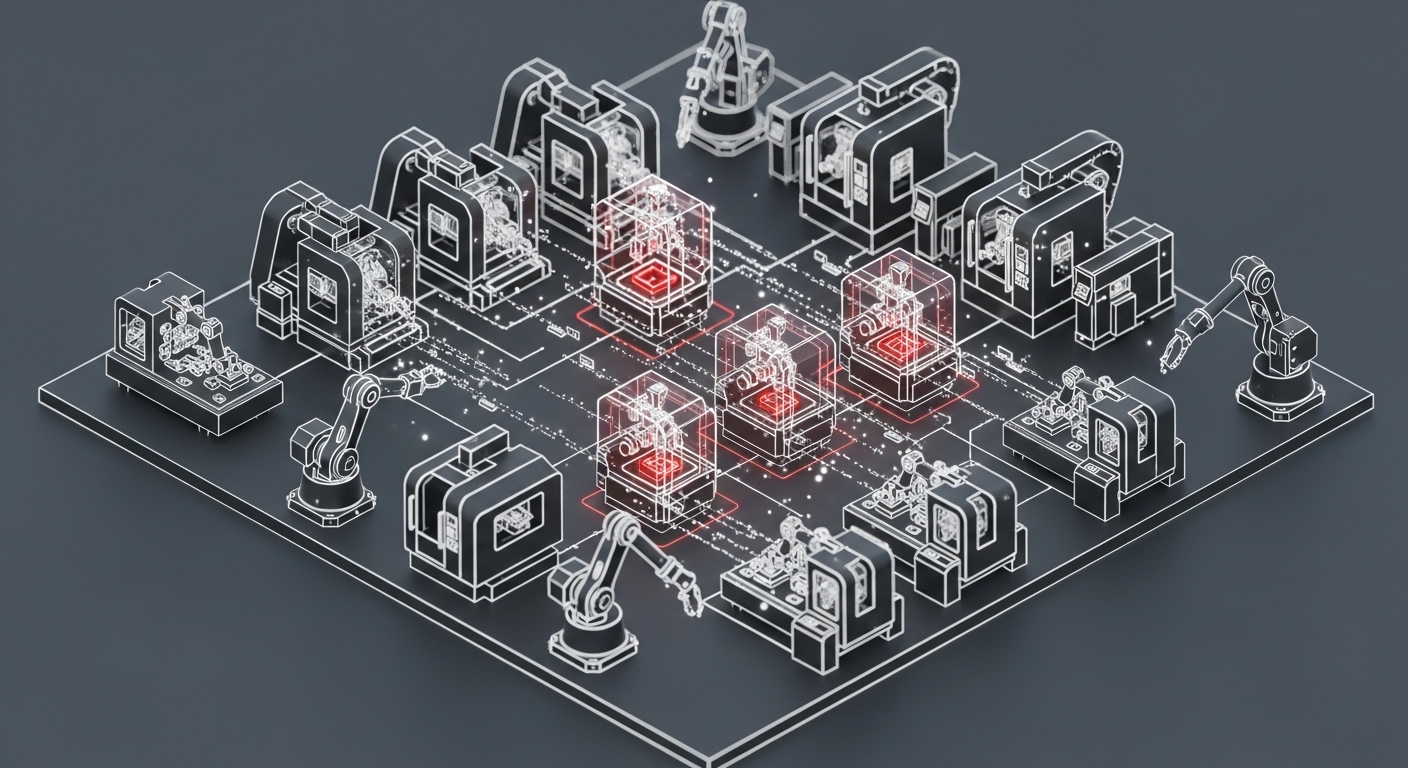
- Granularity: The objective is to create micro-segments, or 'enclaves,' around the smallest possible functional units—a single PLC, a robotic cell, or a specific production line. This drastically limits the 'blast radius' of a potential compromise.
- Least Privilege: Communications should be explicitly allowed based on a 'known good' baseline. A Rockwell PLC controlling a conveyor should only be able to communicate with its designated HMI and I/O blocks using specific EtherNet/IP commands, and nothing else. All other traffic is implicitly denied.
- Continuous Verification: The system must continuously monitor traffic against established policies, not just at the initial connection. However, this verification must be performed by enforcement points engineered for OT environments.
An Architectural Blueprint for Deterministic Implementation
Implementing a latency-aware micro-segmentation strategy is a methodical engineering project, not a simple product deployment. It requires a multi-phased approach that prioritizes operational stability.
Phase 1: Passive Discovery and Communication Baselining: You cannot segment what you cannot see. The initial phase must be entirely passive, using network taps or SPAN ports to capture traffic without being in-line. The goal is to build a comprehensive asset inventory and a high-fidelity map of all communication flows. This involves identifying device types (PLCs, HMIs, VFDs), vendors (Siemens, Rockwell, Schneider), protocols (PROFINET, Modbus/TCP, S7Comm), and, most critically, the timing profiles of these conversations. This baseline is the source of truth for all future policy creation.
Phase 2: Defining Micro-Perimeters and Policy Scaffolding: Using the baseline data, assets are grouped into logical micro-segments based on the physical process they control. For example, all devices on 'Assembly Line 5' form one segment. Policies are then drafted in a human-readable format before being translated into firewall rules. A policy might state:
Allow HMI-05 to read register 40001 from PLC-A5 using Modbus Function Code 03, once per second. Deny all else.This level of granularity is key.Phase 3: Deploying OT-Aware Policy Enforcement Points (PEPs): This is the most critical phase for latency management. Standard IT firewalls are unsuitable. The choice of PEP must be deliberate, focusing on solutions purpose-built for OT environments. These typically use hardware acceleration (FPGAs/ASICs) to perform deep packet inspection and policy enforcement with deterministic, microsecond-level latency. They are designed to understand the nuances of OT protocols and do not introduce the jitter associated with general-purpose CPUs and stateful inspection engines. The goal must align with a zero-downtime mandate for manufacturing OT, often requiring careful planning for insertion during scheduled maintenance windows.
Phase 4: Monitor, Validate, and Incrementally Enforce: Policies should never be deployed in 'blocking' mode on day one. The initial deployment should be in a 'monitor-only' or 'permissive' mode. The PEP logs all traffic that would have been blocked by the defined policy. These logs are reviewed by control engineers and security teams to validate that the policies accurately reflect required operational flows and are not blocking legitimate traffic. Only after a period of validation and refinement are the policies incrementally moved into active enforcement, segment by segment. This iterative process minimizes the risk of production impact.
Practical Implementation Challenges
Deploying this architecture in a brownfield, multi-vendor environment presents significant engineering hurdles that must be proactively addressed.
- Proprietary Protocol Variants: Many OT protocols, while based on standards, have vendor-specific extensions. A generic DPI engine may fail to parse these correctly, leading to either false positives that block legitimate commands or false negatives that allow malicious traffic. The PEP must have a robust and frequently updated protocol decoding library.
- Jitter Injection from Stateful Inspection: Traditional firewalls maintain state tables for TCP sessions. While efficient in IT, the processing overhead for managing these tables can introduce non-deterministic delays. For time-sensitive UDP-based protocols like PROFINET IRT, this jitter is fatal. The solution is to use OT-native gateways that can perform stateless, line-rate inspection for critical control traffic while applying stateful rules to less sensitive management traffic (e.g., programming updates).
- The Brownfield Identity Crisis: Zero Trust is predicated on strong identity. However, a 15-year-old PLC has no concept of a TPM, X.509 certificates, or 802.1X. For these legacy devices, identity must be forged through other means. This often starts with basic MAC address whitelisting but should evolve to more sophisticated passive device fingerprinting, which analyzes unique protocol behaviors and timing characteristics to create a high-fidelity identity. Successfully securing Brownfield PLC networks without sacrificing latency depends heavily on solving this identity problem without intrusive agents.
- East-West Traffic Obscurity: In many flat OT networks, there is a massive amount of unmonitored 'east-west' traffic between controllers. This is often the primary path for lateral movement during an attack. Micro-segmentation is specifically designed to control these flows, but gaining the initial visibility to build the policies can be challenging and politically sensitive within an organization. It is essential for effectively halting lateral movement in multi-vendor ICS environments.
Conclusion: The Cyber-Physical Synthesis
Implementing Zero-Trust micro-segmentation in multi-vendor manufacturing OT is not an IT security project; it is a multi-disciplinary engineering initiative. It demands a deep synthesis of network security principles, control systems engineering, and an intimate understanding of the physical processes being automated. The path to success is not through deploying a single technology, but through a methodical, risk-managed process of discovery, baselining, and incremental enforcement using purpose-built, latency-aware tools. By treating deterministic performance as an inviolable constraint, organizations can build a defensible, resilient, and segmented architecture that enhances security posture without compromising the core mission of safe and efficient production.
Sources / References
- NIST Special Publication 800-207, Zero Trust Architecture. Available at: https://csrc.nist.gov/publications/detail/sp/800-207/final
- NIST Special Publication 800-82 Rev. 3 (Draft), Guide to Operational Technology (OT) Security. Available at: https://csrc.nist.gov/publications/detail/sp/800-82/rev-3/draft
- ISA/IEC 62443 Series of Standards, Security for industrial automation and control systems. Overview available at: https://www.isa.org/standards-and-publications/isa-standards/isa-iec-62443-series-of-standards