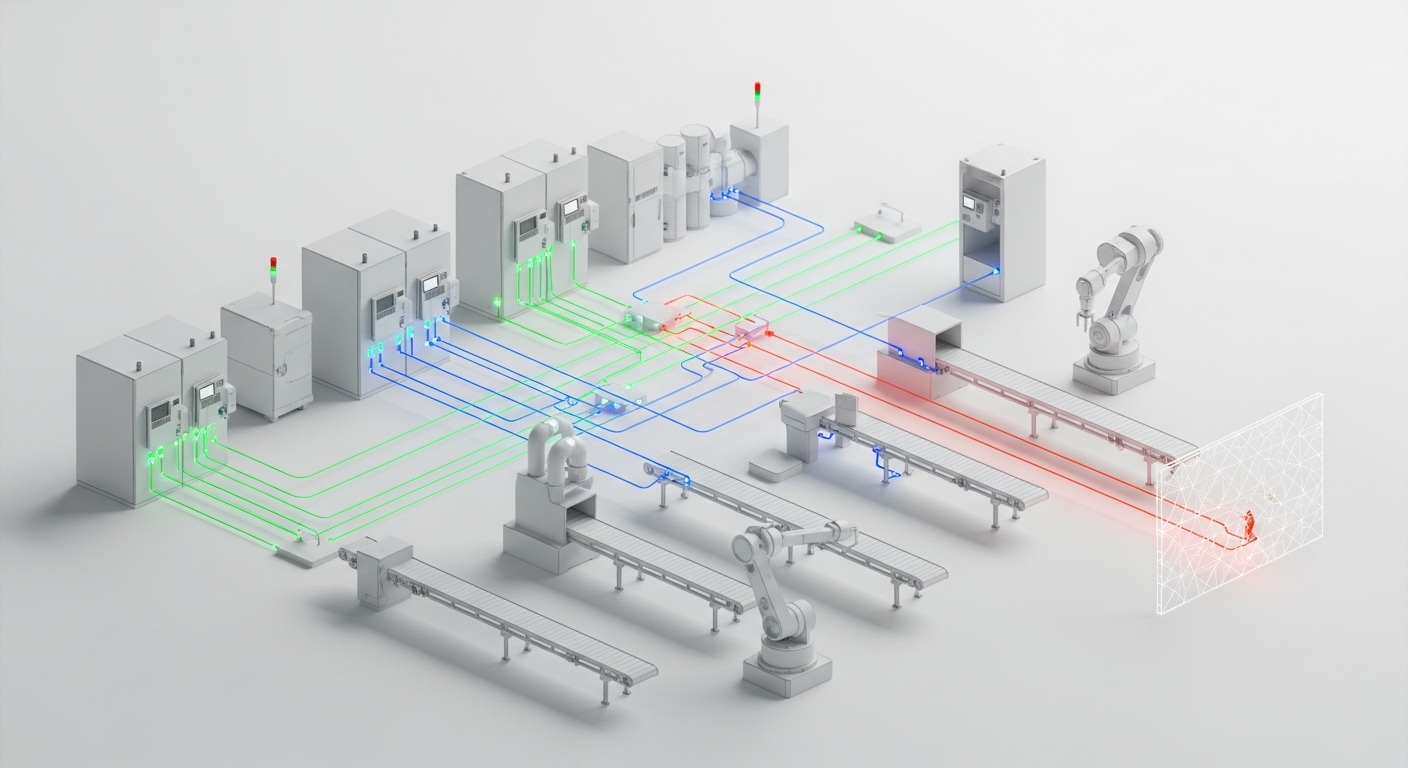
The Deterministic Mandate: Policy-Enforced Micro-segmentation in Real-Time ICS
Apex Insights Research Desk
The Apex Insights Research Desk Analysis
The convergence of Information Technology (IT) and Operational Technology (OT) has irrevocably altered the security landscape for Industrial Control Systems (ICS). While this integration unlocks unprecedented efficiency, it also exposes safety-critical processes to a threat surface that was previously inconceivable. The traditional security paradigm of a hardened perimeter with an assumed-trust interior—the so-called "moat and castle" approach—is demonstrably inadequate. The engineering imperative has thus shifted towards a Zero Trust architecture, with micro-segmentation as its foundational enforcement mechanism. However, for OT environments, this presents a formidable challenge: how to implement granular, policy-enforced security without violating the sacrosanct principle of real-time operational determinism.
This analysis from the Apex Insights Research Desk presents an architectural blueprint for achieving robust micro-segmentation in ICS networks while preserving the low-latency, low-jitter performance characteristics essential for safe and reliable operations.
The Bedrock of OT: Deconstructing Determinism
In enterprise IT networks, performance is often measured by bandwidth and throughput, operating on a "best-effort" delivery model. In OT, the critical metrics are latency and jitter, which together define determinism. Determinism is the guarantee that a specific action or data transmission will occur within a precise, bounded time window, every single time. A deviation of even a few milliseconds can have catastrophic consequences in high-speed applications such as motion control in a robotics cell, pressure regulation in a chemical reactor, or synchronization in a power grid.
Any security control introduced into the data path of a real-time control loop must be engineered with this constraint as a primary design specification. The insertion of a security appliance that adds unpredictable latency (jitter) can destabilize a finely tuned PID (Proportional-Integral-Derivative) loop, leading to process failure, equipment damage, or, in the worst case, a safety incident. Therefore, the central engineering problem is not if we should segment, but how we can segment without compromising this deterministic mandate.
Re-Architecting Segmentation for Industrial Control
Micro-segmentation is the practice of dividing a network into small, isolated segments—ideally down to the individual workload or device level—and enforcing security policies that govern the traffic between them. This strategy is a cornerstone of Zero Trust, as it drastically limits an adversary's ability to move laterally across a network after an initial breach. It effectively contains the "blast radius" of an attack.
However, the implementation differs significantly from a standard data center environment.
Moving Beyond Coarse-Grained Zones
The Purdue Model and the ISA/IEC 62443 standard provide a foundational framework for segmenting OT networks into logical zones and conduits. While essential, this is a form of macro-segmentation. Micro-segmentation takes this concept to its logical extreme, creating security perimeters around a PLC, a specific HMI, or a small functional group of sensors and actuators. This requires policy enforcement points (PEPs) that are far more distributed and intelligent than a single firewall at the IT/OT boundary (Level 3.5).
The Enforcement Blueprint: Key Engineering Principles
Achieving this level of granular control without impacting determinism requires adherence to a specific set of architectural principles.
Decouple Policy Orchestration from Real-Time Enforcement: The Policy Decision Point (PDP)—the brain that creates, manages, and distributes the security policies—should operate out-of-band. The Policy Enforcement Point (PEP)—the muscle that applies these policies to live traffic—must be located in-band, as close to the protected asset as possible. The PEP must be a lightweight, high-performance component designed specifically for low-latency OT environments.
Mandate Protocol-Aware, Deep Packet Inspection (DPI): Standard Layer 3/4 firewalls that filter based on IP address and port number are dangerously insufficient for OT. Industrial protocols like Modbus/TCP, EtherNet/IP, S7, or DNP3 often use a single port (e.g., TCP/502 for Modbus) for a wide variety of commands. An effective PEP must operate at Layer 7, understanding the protocol syntax to distinguish between a benign
Read Coil Statuscommand from an HMI and an unauthorizedWrite Single Registercommand from a compromised engineering workstation aimed at a PLC's setpoints.
In the context of industrial control, a security policy is not merely a rule; it is a digital codification of the intended physical process. Enforcement must therefore be process-aware, validating not just the 'who' and 'where' of a communication, but also the 'what' and 'why' within the specific operational context.
Deploy a Phased, Verifiable Rollout: A "rip and replace" or "flag day" cutover is untenable in a live production environment. The implementation must follow a meticulous, multi-stage process that prioritizes operational continuity.
- Phase I: Passive Discovery and Performance Baselining. Deploy network sensors in a passive, listen-only mode (e.g., via SPAN/TAP ports). The primary objective is to build a complete, high-fidelity map of all assets, communication patterns, protocol usage, and, critically, a statistical baseline of network performance, including minimum, maximum, and average latency and jitter for all critical control flows.
- Phase II: Policy Modeling and Simulation. Using the baseline data, model the proposed micro-segmentation policies. This "digital twin" of the policy framework allows engineers to simulate the impact of the rules, identify legitimate traffic that would be inadvertently blocked, and predict any potential performance degradation before a single packet is ever dropped.
- Phase III: Monitor-First Enforcement. Switch the PEPs from a passive state to an active, in-line state but configured in a "monitor and alert" mode. All policy violations are logged, but no traffic is blocked. This phase serves to validate the accuracy of the modeled policies against live traffic, allowing for fine-tuning with zero production risk.
- Phase IV: Graduated Enforcement. Begin active blocking, starting with the least critical network segments. This methodical approach ensures that any unforeseen issues are contained and can be resolved without impacting core processes. This strategy is central to any project involving the verifiable Zero-Trust micro-segmentation for Modbus/TCP without halting production.
Practical Implementation Challenges
Deploying such a system in a brownfield environment presents numerous technical hurdles that demand specialized engineering solutions.
The Latency Budget Constraint
Every device added in-line to a data path—be it a switch, router, or security appliance—contributes to the total latency. In high-speed control applications, the total latency budget for a round-trip communication can be in the low single-digit milliseconds. A security appliance based on a general-purpose CPU architecture may introduce latency that is not only too high but, more dangerously, too variable (jitter). The solution lies in utilizing PEPs built on hardware acceleration platforms like FPGAs (Field-Programmable Gate Arrays) or specialized network processors, which can perform DPI and policy enforcement at line-rate with deterministic, sub-millisecond latency. Navigating these constraints is a core tenet of our research into the sub-10ms mandate for ultra-low-latency Zero Trust.
Brownfield Heterogeneity and Legacy Systems
No two industrial networks are alike. A typical plant floor is a heterogeneous mix of devices from multiple vendors, spanning decades of technological evolution. This includes modern EtherNet/IP devices, legacy Modbus/TCP controllers, and even non-IP serial devices connected via terminal servers. A successful micro-segmentation strategy cannot rely on a single enforcement technology. It requires a flexible architecture that can accommodate different types of PEPs—from inline transparent bridges for Ethernet segments to policy enforcement at the gateway for serial networks. The challenge becomes creating a unified policy orchestration layer that can abstract this complexity and apply a consistent security intent across a disparate array of enforcement technologies. This is especially complex when dealing with devices that cannot host security agents, requiring a deep understanding of architecting granular, identity-based Zero Trust for agentless legacy ICS.
The Fail-State Conundrum
In IT security, the default failure state for a security control is "fail-closed"—if the firewall fails, it blocks all traffic. In OT, this is often the most dangerous possible outcome, as it can sever the connection between an operator and a critical process, effectively blinding them. An OT-centric PEP must be designed with a predictable and safe failure mode, such as "fail-open" (becoming a pass-through wire) or, more preferably, "fail-to-last-known-good-state," where it continues to enforce the last valid policy it received before its management connection was lost. This requires redundant hardware components and a robust architectural design that prioritizes operational continuity over security purity in a failure scenario.
Conclusion: Weaving Security into the Deterministic Fabric
Achieving policy-enforced micro-segmentation in real-time ICS is not an IT security project; it is a multi-disciplinary systems engineering endeavor. It requires a fundamental shift away from simply porting IT security tools into the OT space and toward developing purpose-built solutions that treat determinism as a non-negotiable design constraint. By decoupling policy management from enforcement, mandating protocol-aware DPI, and adopting a phased, verifiable implementation methodology, organizations can build a security architecture that is both robust and respectful of the operational realities of the plant floor. The ultimate goal is to create an environment where granular security controls are not a fragile layer added on top of the process, but an intrinsic, resilient, and deterministic part of the control system itself.
Sources / References
- ISA/IEC 62443 Series of Standards on Industrial Automation and Control Systems Security. Available from: https://www.isa.org/standards-and-publications/isa-standards/isa-iec-62443-series-of-standards
- NIST Special Publication 800-82 Rev. 2, Guide to Industrial Control Systems (ICS) Security. Available from: https://csrc.nist.gov/publications/detail/sp/800-82/rev-2/final
- SANS Institute, "Defending Industrial Control Systems". Available from: https://www.sans.org/industrial-control-systems-security/