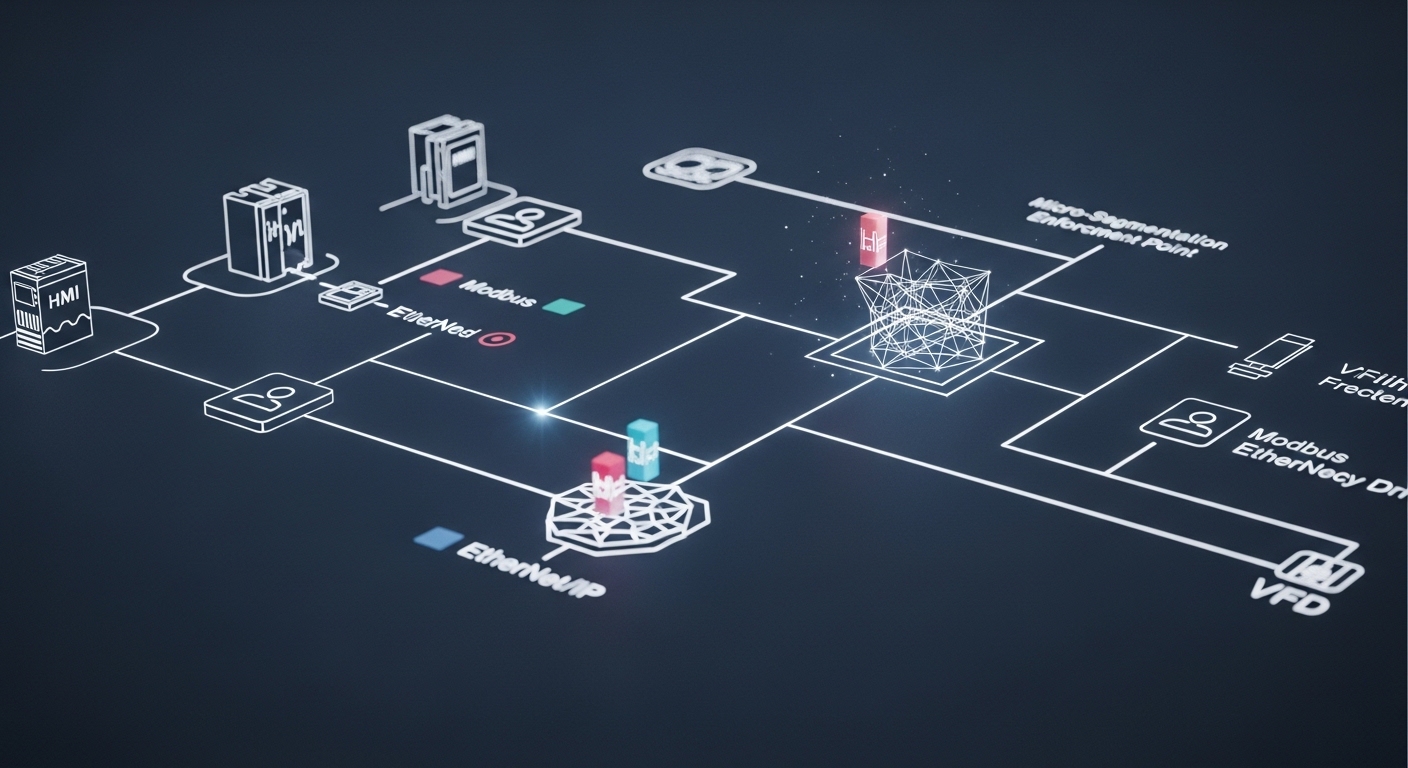
Protocol-Aware Micro-segmentation: An Engineering Blueprint for Securing Modbus/TCP and EtherNet/IP
Apex Insights Research Desk
The Inadequacy of the Perimeter in Modern OT
For decades, the prevailing security model for Operational Technology (OT) networks has been a variation of the 'castle-and-moat' approach: a hardened perimeter with a largely flat, trusted network inside. This architectural paradigm, inherited from enterprise IT, is fundamentally broken when applied to industrial control systems (ICS). The convergence of IT and OT, coupled with the proliferation of connected devices, has rendered the perimeter porous. Once an adversary gains a foothold—whether through a compromised engineering workstation, a misconfigured remote access point, or a supply chain attack—a flat network offers an unrestricted attack surface for lateral movement, process disruption, and catastrophic failure.
Traditional network segmentation using VLANs and firewall access control lists (ACLs) provides only a marginal improvement. While these Layer 2/3 controls can segregate production lines or functional areas, they are protocol-agnostic. They can block an IP address, but they cannot comprehend the language of the control system itself. They cannot differentiate between a legitimate 'Read Holding Registers' query from a Human-Machine Interface (HMI) and a malicious 'Write Multiple Coils' command from a compromised asset intended to trip a safety interlock. This is the critical gap that protocol-aware micro-segmentation is architected to fill. It is a security strategy predicated on the Zero Trust principle of 'never trust, always verify,' applied not just to network connections, but to the very commands that govern physical processes.
Foundational Principles: Beyond L2/L3 Policy
The core limitation of VLANs and standard firewalls is their inability to perform deep packet inspection (DPI) on industrial protocols. They operate at the network and transport layers (Layers 3 and 4 of the OSI model), making decisions based on IP addresses and TCP/UDP ports. Modbus/TCP, for example, universally uses TCP port 502. An ACL can either allow or deny all traffic on this port between two endpoints, offering no granularity into the specific operations being performed. This is an all-or-nothing proposition that is untenable in a production environment.
Protocol-aware micro-segmentation elevates policy enforcement to the application layer (Layer 7). By parsing the payload of each packet, an enforcement engine can understand the specific Modbus function codes or EtherNet/IP Common Industrial Protocol (CIP) services being invoked. This enables the creation of highly granular, least-privilege policies that reflect the precise operational requirements of the industrial process. The guiding philosophy is no longer about which devices can talk, but what they are allowed to say. This approach forms the technical bedrock required to implement a true Zero-Trust micro-segmentation blueprint for legacy Modbus/TCP networks, effectively creating a digital shield around unpatchable and inherently insecure endpoints.
Architectural Blueprint for Protocol-Aware Implementation
Deploying protocol-aware micro-segmentation in a brownfield OT environment requires a meticulous, phased approach to avoid operational disruption. The objective is to transition from a permissive to a deny-by-default security posture without impacting production uptime or control system determinism.
Phase 1: Passive Discovery and Communication Baselining The foundational phase involves creating a high-fidelity map of the existing OT environment. This is achieved non-intrusively using network TAPs or switch SPAN/mirror ports to duplicate live traffic to a monitoring platform. The goal is to automatically identify every asset (PLCs, RTUs, HMIs, VFDs, etc.), map every communication flow, and, most importantly, baseline the specific industrial protocol commands used in normal operations. This goes beyond IP-to-IP flows; it involves cataloging which HMI uses Modbus Function Code 3 to read data from a specific PLC's Unit ID, or which engineering workstation uses CIP services to program a robot controller.
Phase 2: Granular Policy Definition Using the baseline data, security and control engineering teams collaborate to define a least-privilege policy set. This policy is not human-readable in the traditional sense of firewall rules. It's an operational logic translation. For example:
ALLOW: HMI-01 (10.10.1.50) -> PLC-05 (10.10.1.22) | Protocol: Modbus/TCP | Function Codes: 01, 02, 03, 04DENY: HMI-01 (10.10.1.50) -> PLC-05 (10.10.1.22) | Protocol: Modbus/TCP | Function Codes: 05, 06, 15, 16ALLOW: Engineering-WS (10.20.5.10) -> VFD-12 (10.10.2.100) | Protocol: EtherNet/IP | CIP Class: Parameter (0x0F) | CIP Service: Set_Attribute_Single (0x10)DENY: Any -> VFD-12 (10.10.2.100) | Protocol: EtherNet/IP | CIP Class: Parameter (0x0F) | CIP Service: Set_Attribute_Single (0x10)
Phase 3: Monitor-Only Enforcement and Validation Before blocking any traffic, the defined policy is deployed in a non-blocking, 'monitor' mode. The enforcement points (e.g., OT-aware firewalls or dedicated security appliances) inspect traffic and generate alerts for any communication that would have violated the policy. This critical phase allows engineers to validate that the policy baseline is accurate and refine any rules that would inadvertently block legitimate process communication, thus de-risking the transition to active enforcement.
Phase 4: Phased Active Enforcement Once confidence in the policy is high, active enforcement is rolled out in a controlled manner. This could be done by segmenting less critical systems first or by initially enforcing policies only for specific, high-risk protocols or assets. Each segment, sometimes as small as a single PLC, becomes a 'micro-enclave' protected by its own granular policy, drastically limiting the potential for lateral movement.
Modbus/TCP Specific Considerations
Modbus is the de facto lingua franca of industrial automation, but its 1979 design predates modern security concerns. It lacks authentication, authorization, and encryption. Protocol-aware segmentation provides compensating controls where native security is absent. The key is to enforce policy based on the two primary elements of a Modbus/TCP transaction: the Unit ID (or Slave Address) and the Function Code. A single physical device with one IP address might host multiple logical Modbus slave units. Segmentation policies must be able to restrict access not just to the IP, but to a specific Unit ID, and further restrict which function codes can be sent to that unit. Blocking write functions (05, 06, 15, 16) from unauthorized sources is one of the most effective and immediate security improvements possible in a Modbus network.
EtherNet/IP Specific Considerations
EtherNet/IP, based on the Common Industrial Protocol (CIP), offers a much richer but more complex attack surface. It utilizes a sophisticated object-oriented model. Protocol-aware segmentation solutions must have a deep understanding of CIP to be effective.
The principle of least privilege in a CIP environment dictates that access control should be applied not only at the service level (e.g., Get/Set Attribute) but also at the object level (Class/Instance/Attribute). An HMI may require read-only access (
Get_Attribute_Single) to a variable-frequency drive's 'Output Frequency' attribute but should be explicitly denied write access (Set_Attribute_Single) to the 'Commanded Speed' attribute.
This level of specificity is essential for architecting least-privilege control for EtherNet/IP in real-time OT, where deterministic performance is non-negotiable. The policy must also differentiate between the time-critical implicit messaging used for I/O data and the less time-sensitive explicit messaging used for diagnostics and programming, ensuring security controls do not introduce jitter into control loops.
Practical Implementation Challenges
While powerful, the deployment of protocol-aware micro-segmentation is not without significant engineering hurdles.
- Latency and Determinism: Inline DPI engines inherently add latency. While often negligible for monitoring applications, this latency can be catastrophic for high-speed, deterministic control loops like motion control or synchronized drive systems. Selection of enforcement technology with hardware-accelerated processing and appropriate architectural placement (e.g., not in the middle of a real-time I/O ring) is critical.
- Proprietary Protocol Extensions: While Modbus/TCP and EtherNet/IP are standards, many vendors add proprietary extensions or encapsulate data in unique ways. A DPI engine must be able to correctly parse these variations or risk misinterpreting traffic, leading to false positives or negatives.
- Policy Orchestration at Scale: Manually defining and managing granular policies for thousands of assets in a large facility is unsustainable. A successful implementation relies on a centralized management platform that can ingest baseline data, suggest policies using machine learning, and deploy rulesets to distributed enforcement points programmatically.
- Handling Encrypted Traffic: The adoption of protocols like CIP Security introduces TLS encryption, which blinds passive DPI tools. This requires an architecture that can either act as a proxy to terminate and inspect the traffic (a Man-in-the-Middle approach) or fall back to metadata and behavioral analysis when the payload is opaque. This represents a significant architectural decision with performance and security trade-offs.
Alignment with ISA/IEC 62443
This entire architectural approach directly implements the foundational concepts of the ISA/IEC 62443 series of standards. The process of discovery and segmentation maps directly to the creation of security 'zones' (groups of assets with common security requirements) and 'conduits' (the communication pathways between zones). Protocol-aware micro-segmentation is the enforcement mechanism that allows an organization to define and apply Security Levels (SLs) to these conduits, ensuring that communication between zones adheres to a verified, risk-based policy. This alignment provides a concrete technical control for operators seeking to implement a defense-in-depth strategy that meets the stringent requirements of both frameworks, a core theme in our research on converging ISA/IEC 62443 and Zero Trust mandates.
In conclusion, moving beyond perimeter security to a protocol-aware, Zero Trust micro-segmentation model is an imperative for securing modern OT networks. It transforms the network from a passive data transport fabric into an active, intelligent enforcement layer capable of understanding and policing the language of industrial control. For legacy protocols like Modbus/TCP and complex ecosystems like EtherNet/IP, it is the most effective architecture for preventing unauthorized commands and containing threats without halting critical physical processes.
Sources / References
- Modbus Organization, "Modbus Application Protocol Specification V1.1b3", URL:
https://modbus.org/docs/Modbus_Application_Protocol_V1_1b3.pdf - ODVA, Inc., "The CIP Networks Library, Volume 1: CIP Common", URL:
https://www.odva.org/library-page/(Access to specific documents may require registration) - International Society of Automation (ISA), "ISA/IEC 62443 Series of Standards", URL:
https://www.isa.org/standards-and-publications/isa-standards/isa-iec-62443-series-of-standards