The Deterministic Sentinel: Architecting Real-Time Behavioral Anomaly Detection for PLC Firmware Zero-Days
Apex Insights Research Desk
The Apex of Vulnerability: PLC Firmware and the Deterministic Mandate
In the realm of Operational Technology (OT), Programmable Logic Controllers (PLCs) represent the bedrock of industrial automation. They are the nerve centers executing time-critical logic that governs physical processes. However, this foundational role also makes them a high-value target for sophisticated threat actors. Attacks targeting PLC firmware, such as Stuxnet or the more recent TRITON/TRISIS malware, bypass conventional network security by manipulating the controller's core execution logic. These zero-day exploits can lead to catastrophic physical consequences, from equipment destruction to loss of life.
The principal challenge in defending against such threats is the deterministic nature of industrial control systems (ICS). The PLC's scan cycle—the sequence of reading inputs, executing logic, and writing outputs—is a sacred, time-sensitive contract. Any security solution that introduces latency or jitter into this cycle is operationally untenable. This raises a critical engineering question: How can we implement real-time, behavior-based anomaly detection capable of unmasking firmware zero-day exploits without violating the deterministic timing constraints of the control process?
Conventional security postures are fundamentally inadequate for this task. Signature-based antivirus is irrelevant against unknown exploits. Network Intrusion Detection Systems (NIDS) may flag anomalous network commands but are blind to manipulations occurring directly within the PLC's memory and execution flow. Periodic firmware integrity checks are too infrequent to catch a transient attack and can be subverted by a sufficiently advanced rootkit. A new architectural paradigm is required—one that provides deep introspection without being intrusive.
An Architectural Blueprint: The Out-of-Band Co-Processing Sentinel
The solution lies in physically and logically decoupling the security monitoring process from the PLC's real-time execution path. This is achieved through an out-of-band co-processing architecture, which we term the Deterministic Sentinel. This model ensures zero performance impact on the target PLC while providing continuous, high-fidelity behavioral analysis.
Non-Invasive Data Acquisition Telemetry: The foundational layer is the ability to tap into the PLC's internal operations without altering its software or hardware configuration. This is accomplished not by an agent, but through a hardware-based mirroring technique. A passive TAP is placed on the PLC's backplane bus or a dedicated probe is engineered to monitor memory bus activity. This provides a raw, real-time feed of instruction execution, memory reads/writes, and I/O state changes, forming a high-resolution stream of operational telemetry.
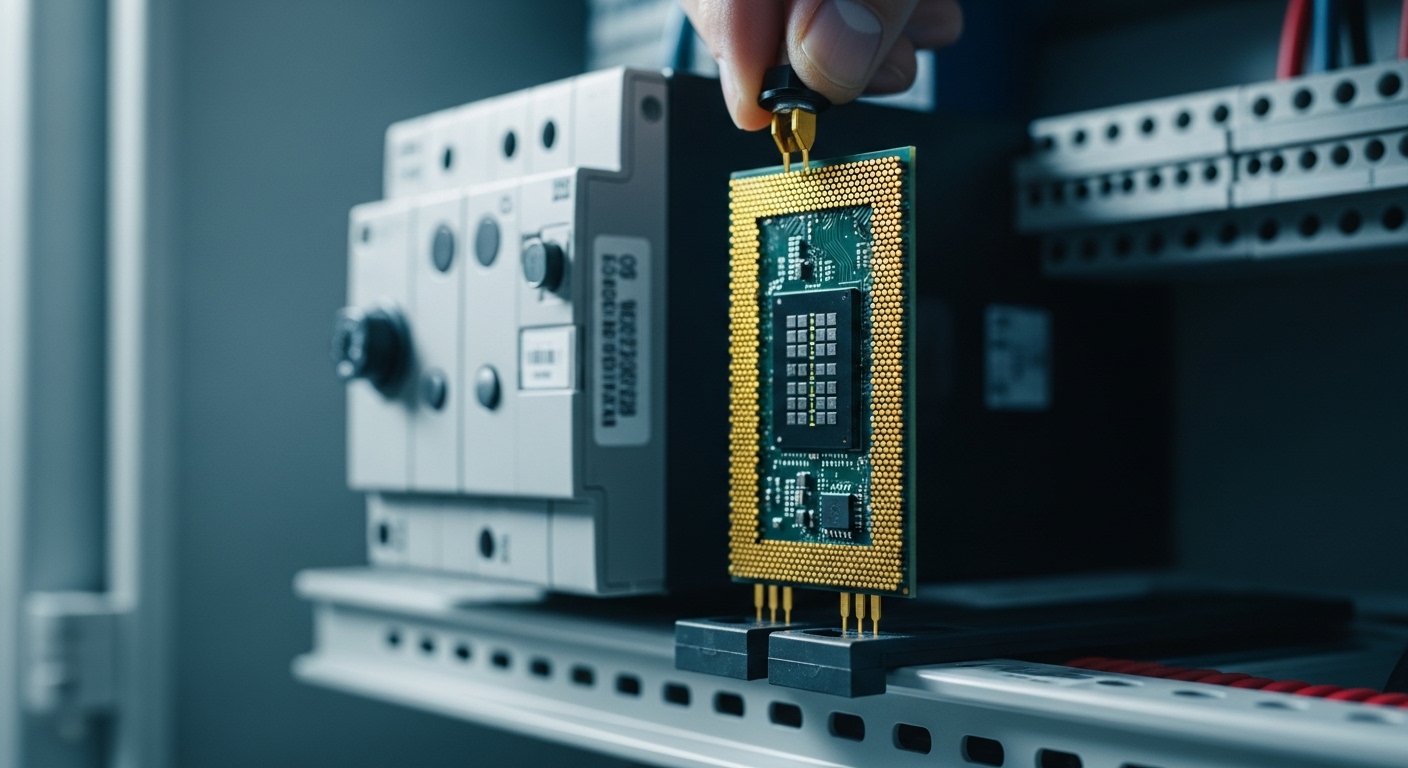
The Sentinel Co-Processor: This telemetry stream is fed directly to a dedicated, external hardware device—the sentinel. This could be a powerful System-on-a-Chip (SoC) or, for maximum parallelism and low-latency processing, a Field-Programmable Gate Array (FPGA). This device is the analytical brain of the operation, existing entirely outside the PLC's control loop and resource pool.
High-Fidelity State Modeling: Within the sentinel, the raw telemetry is used to reconstruct a precise digital twin of the PLC's execution state. This model tracks the program counter, register values, memory access patterns, and the exact sequence of ladder logic (or other IEC 61131-3 language) execution. It is a live, behavioral replica of the controller's core logic.
Unsupervised Behavioral Baselining: During a controlled 'learning phase' on a known-good, air-gapped system, the sentinel employs unsupervised machine learning algorithms (e.g., autoencoders, isolation forests, or clustering algorithms like DBSCAN) to build a multi-dimensional baseline of normal operation. This is not a simple whitelist. It is a complex statistical model representing the normative manifold of the PLC's behavior, encompassing parameters such as:
- Scan cycle time distribution and statistical variance.
- Instruction execution frequency and sequence probabilities (n-grams).
- Memory address access patterns and legitimate data ranges.
- I/O state transition timing and correlation.
Real-Time Anomaly Detection Engine: Once deployed, the sentinel continuously compares the live, reconstructed state against the learned baseline. Deviations, or anomalies, are flagged in real-time. A firmware-level exploit, by its very nature, will manifest as a behavioral anomaly. Examples include:
- Execution Flow Hijacking: An unexpected jump instruction to a non-standard memory location, indicating a code injection or return-oriented programming (ROP) attack.
- Data Manipulation: Writing values to memory addresses outside of the learned normative ranges, potentially altering critical setpoints or safety thresholds.
- Timing Perturbations: Subtle, malicious modifications to the logic can introduce minute jitter into the scan cycle, which a statistical model can detect even if the deviation is within the manufacturer's tolerance.
- Cryptographic Deviations: If firmware signing is used, the sentinel can perform continuous, hardware-accelerated signature verification on memory segments, offloading this task from the PLC.
This architecture is inherently respectful of the deterministic mandate. The PLC's CPU and RTOS are completely untouched, experiencing zero additional load, zero added code paths, and zero risk of interference from the security solution.
The fundamental principle is that any modification to the PLC's firmware or execution logic, however subtle, will inevitably create a detectable perturbation in the high-frequency telemetry stream when compared against a sufficiently granular behavioral baseline.
Practical Implementation Challenges
Deploying a Deterministic Sentinel architecture is not without significant engineering hurdles that require specialized expertise:
- Proprietary Backplane Interfacing: PLC backplanes are not standardized. Developing a passive hardware TAP requires deep reverse engineering of proprietary, high-speed bus protocols for each PLC family (e.g., Siemens Profibus/Profinet backplane, Rockwell ControlLogix ControlBus). This is a non-trivial hardware engineering effort.
- Signal Integrity and EMI: Industrial environments are electromagnetically noisy. The hardware probes must be meticulously designed with advanced shielding and signal conditioning to prevent data corruption from electromagnetic interference (EMI), which could otherwise trigger a flood of false positive alerts.
- Semantic Gap and Instruction Sets: Raw instruction traces are meaningless without context. The sentinel must possess a disassembler or interpreter for the specific CPU architecture and instruction set of the PLC (e.g., PowerPC, ARM, custom ASICs). This is necessary to translate raw opcodes into meaningful actions for the behavioral model.
- Model Drift and MLOps: The physical process a PLC controls can change over time due to recalibration, retooling, or normal wear and tear. This causes 'model drift,' where the established baseline no longer represents normal behavior. A robust MLOps (Machine Learning Operations) pipeline is essential for monitoring model accuracy, triggering automated retraining on validated new data, and deploying updated models without compromising security or operational continuity.
- Scalability and Data Volume: A single PLC can generate terabytes of telemetry data. The sentinel hardware and the supporting data infrastructure must be capable of processing this firehose of information in real-time, requiring optimized algorithms and high-throughput data pipelines.
Contextualizing Detection within a Zero-Trust Fabric
A detection capability, no matter how advanced, is only one component of a resilient security architecture. The alerts generated by the Deterministic Sentinel become potent triggers within a broader Zero-Trust framework. A high-confidence alert indicating firmware manipulation is not just an entry in a log file; it is actionable intelligence.
This intelligence can drive dynamic policy enforcement at the network layer. For instance, upon detecting a firmware anomaly, the sentinel can signal a micro-segmentation platform to immediately quarantine the compromised PLC, severing its network connections to all other assets except for a forensic analysis terminal. This real-time response halts lateral movement before it can begin. While our focus here is on the deepest layer of the device, this principle aligns with creating a synergistic defense model for integrating zero-trust and anomaly detection for Modbus/TCP at the network protocol level. The two approaches are complementary, providing defense-in-depth from the wire to the silicon.
Furthermore, this method of direct behavioral observation of the control process itself provides a powerful defense against attacks that aim to subvert safety logic. Even if an attacker manages to compromise a device, their attempts to manipulate physical outputs will deviate from the established baseline. This approach is a direct evolution of the concepts discussed in our research on securing PLC ladder logic modifications in Zero-Trust OT, extending the verification from just the static logic to its dynamic, real-time execution.
Ultimately, the core challenge of any security implementation in OT is managing the trade-off between security and operational availability. The out-of-band sentinel architecture directly addresses the determinism dilemma in preserving real-time integrity by creating a parallel, non-interfering security plane.
Conclusion: The Path to Verifiable Integrity
Protecting critical infrastructure from advanced firmware-level zero-day exploits requires moving beyond perimeter defenses and network-centric monitoring. The Deterministic Sentinel architecture offers a viable, non-disruptive blueprint for achieving deep, real-time behavioral introspection. By leveraging out-of-band hardware and unsupervised machine learning, it is possible to unmask the most subtle signs of compromise without introducing a single microsecond of jitter to the critical control loop.
This approach transforms PLC security from a probabilistic exercise in vulnerability scanning and patching into a deterministic process of continuous, verifiable integrity monitoring. For industries where operational uptime and physical safety are paramount, such an architectural evolution is not just an option, but an imperative.
Sources / References
- National Institute of Standards and Technology (NIST). (2015). Guide to Industrial Control Systems (ICS) Security (Special Publication 800-82 Rev. 2). https://csrc.nist.gov/publications/detail/sp/800-82/rev-2/final
- García, L., Brasser, F., Cintuglu, M. H., Sadeghi, A. R., Mohammed, O. A., & Man-Ki, Y. (2017). Hey, My Malware Knows Physics! A New Generation of Stealthy Attacks on Industrial Control Systems. In Proceedings of the 2017 ACM SIGSAC Conference on Computer and Communications Security (CCS '17). https://doi.org/10.1145/3133956.3134018
- The SANS Institute. (2021). ICS/OT Cybersecurity Year in Review. https://www.sans.org/white-papers/39900/
- International Electrotechnical Commission. (2013). IEC 62443-3-3: Security for industrial automation and control systems - Part 3-3: System security requirements and security levels. https://webstore.iec.ch/publication/7086