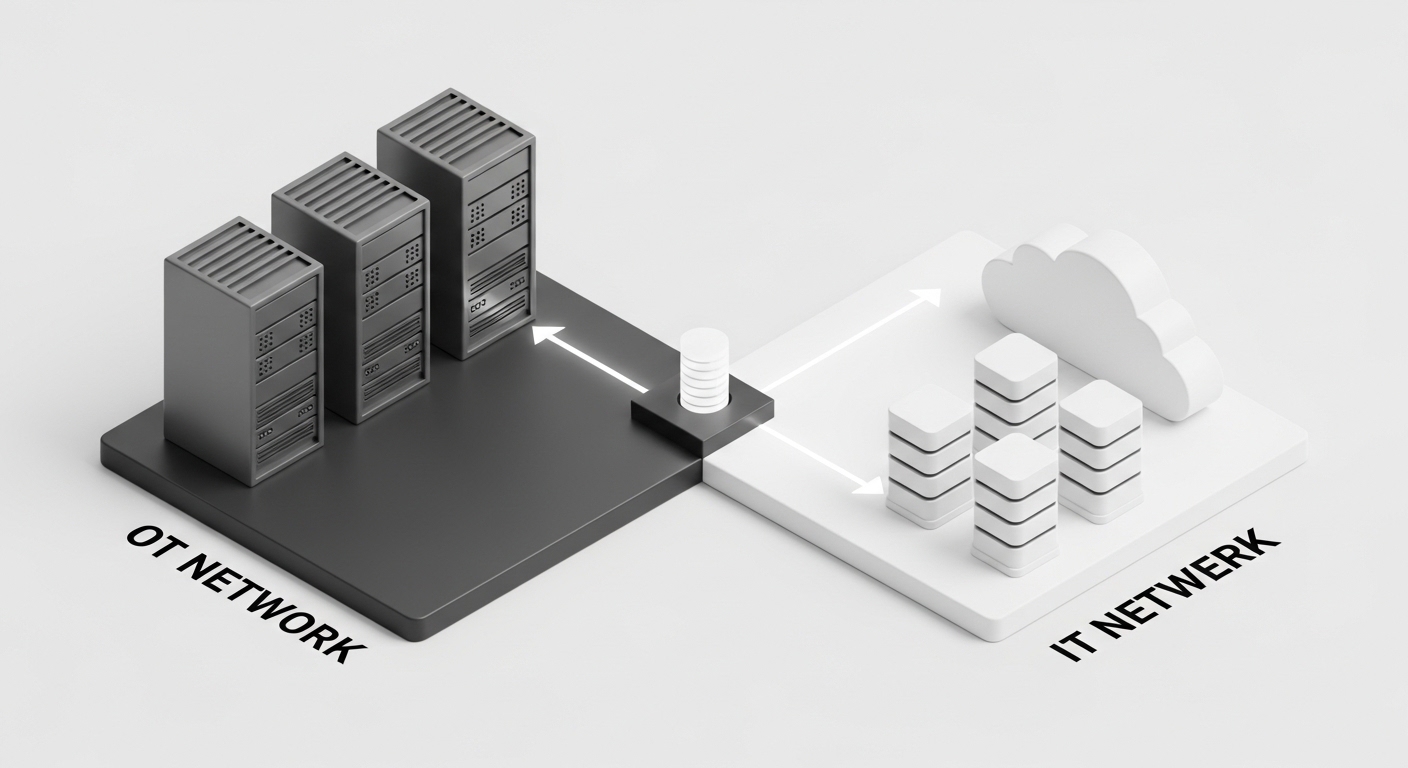
The Digital Sluice Gate: A Blueprint for Secure, Unidirectional Data Flow from Air-Gapped OT to Enterprise IT
Apex Insights Research Desk
The Convergence Paradox: Bridging the Air-Gap Without Compromising Control
For decades, the physical air gap was the gold standard for securing Supervisory Control and Data Acquisition (SCADA) systems. This deliberate physical isolation of Operational Technology (OT) from Information Technology (IT) networks was an effective, if blunt, instrument for protecting critical infrastructure. However, the modern enterprise's insatiable demand for real-time operational data—for predictive maintenance, efficiency optimization, enterprise resource planning (ERP) integration, and business intelligence—has rendered the absolute air gap an operational relic. The challenge now facing asset owners is not if they should bridge this gap, but how to do so without exposing legacy, often unpatchable, systems to the myriad threats resident on enterprise networks.
The core of the problem lies in the fundamentally different design principles of OT and IT. OT systems prioritize availability and deterministic, real-time performance. IT systems prioritize confidentiality and integrity. Attempting to connect these disparate domains with conventional, bidirectional firewalls creates a permeable membrane ripe for exploitation. A single compromised workstation in the enterprise space could become a pivot point into the control network, with potentially catastrophic physical consequences. Therefore, the engineering mandate is clear: establish a secure, real-time, and strictly unidirectional data flow from the OT domain to the IT domain, ensuring that no data, and more importantly, no malicious command, can ever flow back into the control system.
This research brief provides an architectural blueprint for achieving this unidirectional data transfer, focusing on hardware-enforced and software-defined methodologies that can be implemented without disrupting ongoing production—a non-negotiable requirement in any brownfield critical infrastructure environment.
Architectural Tenets of Unidirectional Data Transfer
A true unidirectional data flow is not simply a firewall rule; it is an architectural state enforced by physics or deterministic software logic. The primary objective is to break the protocol stack at the network layer, preventing TCP handshakes and other bidirectional session establishment mechanisms that are the bedrock of modern networking but also the primary vectors for lateral movement.
The principle of inherent security dictates that a connection which is physically or logically incapable of returning data cannot be used as a covert channel or command-and-control vector. This is the foundational concept behind high-assurance cross-domain solutions.
Two primary architectural patterns have emerged to meet this requirement: Hardware-enforced data diodes and software-defined unidirectional gateways.
The Hardware-Enforced Data Diode
A data diode is an opto-isolator-based hardware appliance that enforces one-way data flow at the physical layer (Layer 1). Its fundamental design consists of a transmitter on one side and a receiver on the other, linked by a fiber optic connection. Light can only travel from the transmitter's LED to the receiver's photodiode, making any return signal physically impossible. This is not a policy; it is physics.
Architectural Breakdown:
- OT-Side Proxy: A server or appliance sits on the OT network. It polls or receives data from source systems (e.g., PLCs, RTUs, historians) using their native protocols (Modbus, DNP3, S7comm, etc.).
- Data Transmission: The OT proxy serializes this data and sends it through the transmit-only side of the data diode.
- Physical Isolation: The fiber optic link ensures data can only flow in one direction.
- IT-Side Proxy: A corresponding server on the IT network receives the raw data stream from the receive-only side of the diode.
- Protocol Reconstruction: The IT proxy reassembles the data and typically translates it into a modern, IT-friendly protocol like OPC-UA, MQTT, or formats it for ingestion into a database or cloud platform.
This architecture provides the highest level of assurance against network-based attacks from the IT domain. However, it requires careful engineering to manage connectionless protocols. Since TCP's three-way handshake is impossible, data is typically sent over UDP, requiring the proxy servers to handle packet loss, ordering, and data integrity checks without a return channel.
The Software-Defined Unidirectional Gateway
For environments where the cost or complexity of a hardware diode is prohibitive, a software-defined approach can provide a robust, albeit not physically enforced, alternative. This architecture typically uses a single, highly-secured server with two independent network interfaces, one connected to the OT network and one to the IT network. Crucially, IP forwarding between these interfaces is disabled at the kernel level.
Core Logic Flow:
- OT Ingress: A process bound exclusively to the OT network interface listens for and collects data from the SCADA systems.
- Data Replication: This process writes the collected data to a memory-based, one-way message queue or intermediary storage location within the hardened server.
- IT Egress: A completely separate, unprivileged process, bound exclusively to the IT network interface, reads the data from the message queue and transmits it to the destination enterprise systems.
This creates a