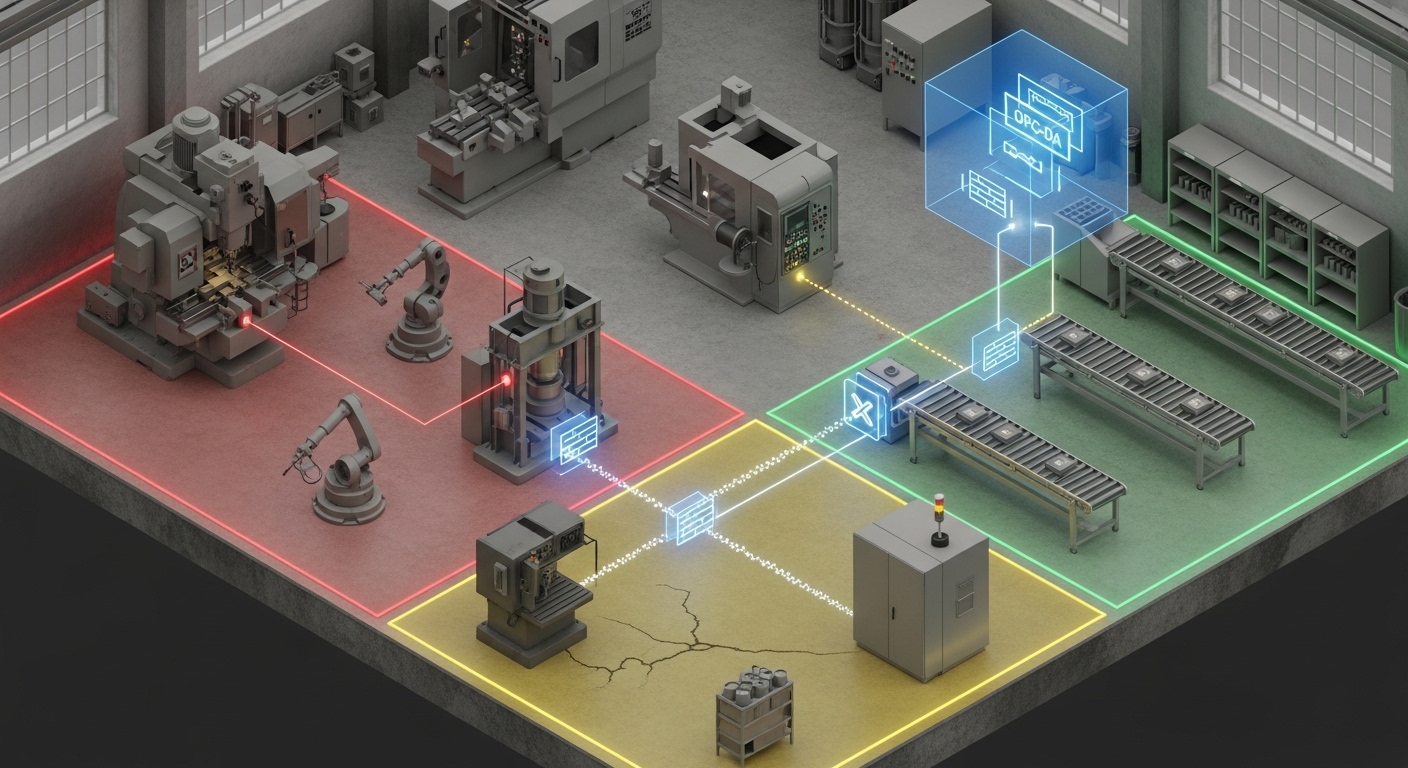
Zero Downtime Validation: A Framework for Deploying Micro-Segmentation in Brownfield OT Environments with OPC-DA
Apex Insights Research Desk
Introduction: The Imperative for Granular Control in Legacy OT
Operational Technology (OT) environments, particularly brownfield sites laden with legacy equipment and established processes, represent a unique and formidable cybersecurity challenge. These systems, designed for reliability and uptime, were often architected long before the advent of pervasive network-based threats. Consequently, they frequently exhibit flat network architectures where a single breach can facilitate unrestricted lateral movement, placing entire production lines at risk. Micro-segmentation—the practice of dividing a network into small, granular security zones—has emerged as a foundational strategy for implementing a Zero Trust security model in these environments. However, the critical question for any plant operator or control systems engineer is not why to implement micro-segmentation, but how to validate and deploy it without inducing catastrophic downtime.
This challenge is acutely magnified when dealing with legacy communication protocols, chief among them being OPC Data Access (OPC-DA). Built upon Microsoft's complex Distributed Component Object Model (DCOM), OPC-DA's dynamic port allocation model is notoriously difficult to secure with traditional firewalls. Any attempt to enforce a security policy that is not perfectly architected to accommodate these protocol-specific behaviors risks severing critical data links between HMIs, historians, and PLCs.
This article from the Apex Insights Research Desk presents a comprehensive, phased framework for validating a new micro-segmentation strategy in brownfield OT environments that rely on OPC-DA. We will detail a methodology designed to move from passive discovery to full enforcement with near-zero operational risk, ensuring that security enhancements do not compromise the fundamental availability of the industrial control system (ICS).
The Unique Challenge of OPC-DA in Brownfield OT Security
Before architecting a validation strategy, it is essential to understand the specific technical constraints imposed by both the environment and the protocol. The combination of brownfield characteristics and OPC-DA's communication patterns creates a perfect storm of security and operational risk.
Understanding the OPC-DA Communication Model
OPC-DA is not a simple, single-port protocol. Its reliance on DCOM for inter-process communication is the primary source of complexity for network segmentation. The process works as follows:
- Initial Connection: An OPC client initiates a connection to an OPC server using the RPC Endpoint Mapper on TCP port 135.
- Dynamic Port Negotiation: The client requests a connection to the OPC-DA service. The server's DCOM process then instructs the client to reconnect on a dynamically allocated port from the high-range RPC port block (typically above 1024, and often above 49152 in modern Windows versions).
- Data Exchange: All subsequent communication for that session occurs over this high-range port.
This dynamic negotiation means that simply opening port 135 is insufficient. A firewall must be able to intelligently inspect the initial RPC conversation to predict and permit the subsequent high-port connection. Any segmentation solution that lacks this application-layer awareness will inevitably block legitimate OPC-DA traffic.
The Fragility of Brownfield Systems
Brownfield environments are characterized by their heterogeneity and age. They often contain:
- Legacy Operating Systems: Windows NT, Windows XP, and Server 2003 are still prevalent and lack modern security features.
- Sensitive Hardware: Programmable Logic Controllers (PLCs) and Distributed Control Systems (DCS) have deterministic processing loops that are highly sensitive to network latency and jitter.
- Uncertain Dependencies: Decades of organic growth can lead to undocumented communication paths that are critical for specific operational functions.
Introducing any new network component, such as a segmentation firewall, carries an inherent risk of disrupting these finely-tuned, yet fragile, systems. A single dropped packet or a few milliseconds of added latency can cause process timeouts, leading to equipment shutdown or production loss.
A Phased Validation Framework for Minimizing Downtime
To navigate these challenges, a methodical, four-phase approach is required. This framework prioritizes operational continuity by ensuring that no policy is enforced until its impact is fully understood and validated against live, real-world traffic patterns.
Phase 1: Passive Discovery and Baselining
The foundation of any successful micro-segmentation project is a perfect understanding of existing communication flows. You cannot protect what you cannot see. This phase is strictly non-intrusive.
- Implementation: Deploy network TAPs (Test Access Points) or configure SPAN (Switched Port Analyzer) ports on core network switches to mirror all OT traffic to a dedicated monitoring platform.
- Technology: Utilize an OT-aware network security monitoring (NSM) solution with Deep Packet Inspection (DPI) capabilities. This tool must be able to parse OPC-DA and other relevant ICS protocols (e.g., Modbus, S7, EtherNet/IP).
- Objective: The goal is to build a comprehensive, high-fidelity map of all network conversations. This map should detail every OPC-DA client-server relationship, the specific tags being accessed, the frequency of communication, and the protocols used. This granular baseline is not only for segmentation but is also the first step in architecting real-time behavioral anomaly detection for Siemens S7 SCADA protocols and other industrial systems, as it defines what constitutes 'normal' behavior.
This discovery phase should run for a sufficient period—typically several weeks—to capture all operational cycles, including month-end reporting, infrequent maintenance tasks, and batch processing startups.
Phase 2: Policy Simulation and Virtual Enforcement
With a robust baseline established, the next step is to design the micro-segmentation policies. However, instead of deploying them directly, they are first run in a simulation mode.
- Implementation: Using the discovery data, engineers define granular segmentation policies. For example, a policy might state: "HMI-01 is only permitted to communicate with PLC-07 via OPC-DA for reading tags X, Y, and Z. All other communication is denied."
- Technology: The chosen security platform must have a