Architecting Verifiable Zero-Trust for Brownfield DCS: A Blueprint for Dynamic Micro-Segmentation in Critical Manufacturing
Apex Insights Research Desk
The Brownfield DCS Paradox: Securing the Unsecurable
In the realm of critical manufacturing, Distributed Control Systems (DCS) represent a fundamental paradox. They are the bedrock of industrial automation, orchestrating complex physical processes with high reliability, yet they are often architectural relics from an era when cybersecurity was an afterthought. These brownfield environments, characterized by legacy hardware, unpatchable firmware, and proprietary protocols, operate under an implicit-trust model that is fundamentally incompatible with modern threat landscapes. The traditional 'castle-and-moat' security paradigm, reliant on perimeter firewalls, has proven catastrophically insufficient against adversaries adept at lateral movement.
The core challenge is therefore not merely to secure these systems, but to do so without disrupting sensitive, deterministic processes or embarking on a cost-prohibitive 'rip-and-replace' strategy. The architectural imperative is clear: we must superimpose a new security model onto the existing infrastructure. This research desk posits that a verifiable, dynamically adaptive Zero-Trust micro-segmentation framework is the only technically and operationally viable path forward. This is not about building higher walls; it is about eliminating the concept of a trusted internal network altogether and enforcing granular, verifiable control over every interaction within the Industrial Control System (ICS) environment.
Foundational Principles: Deconstructing the Zero-Trust Mandate for DCS
Transitioning a legacy DCS to a Zero-Trust architecture requires a radical departure from conventional OT security thinking. The foundational principles, as defined by frameworks like NIST SP 800-207, must be meticulously translated to the unique constraints of the industrial world.
- Never Trust, Always Verify: Every access request, regardless of its origin within the network, must be treated as hostile until proven otherwise. A request from an engineering workstation (EWS) to a controller must be authenticated and authorized with the same rigor as a request originating from the IT network.
- Enforce Least Privilege: Access must be granted on a need-to-know, function-by-function basis. This means moving beyond simple network-level access control (IP A can talk to IP B) to application-level granularity. For example, a specific HMI should only be authorized to read a specific set of registers from a PLC, while a maintenance terminal is granted temporary, time-bound write access to a different set of parameters.
- Assume Breach: The architecture must be designed with the assumption that an adversary is already inside the network. Security controls must be focused on preventing lateral movement, limiting the blast radius of an incident, and enabling rapid detection and response.
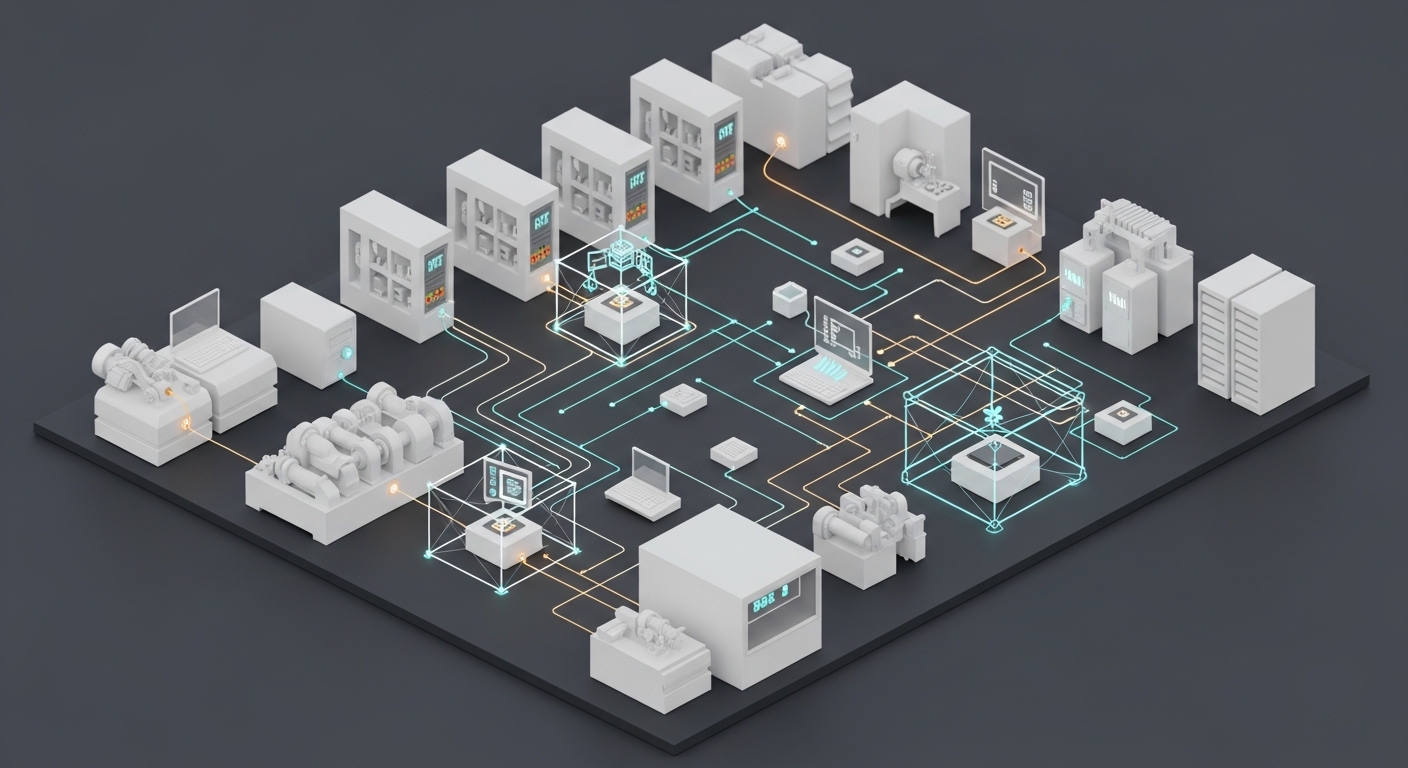
Micro-segmentation is the primary enforcement mechanism for these principles. It involves creating minute, software-defined security perimeters around individual assets or small, logical groups of assets (e.g., a single control loop, a specific production cell). Each micro-segment becomes its own 'protect surface,' with all traffic entering or leaving the segment subject to rigorous policy enforcement. This effectively neuters an attacker's ability to move laterally from a compromised, non-critical asset (like an IP camera) to a Level 1 controller.
The Architectural Blueprint: A Phased Overlay Approach
Deploying this framework in a live brownfield environment demands a phased, non-disruptive overlay approach that respects the sanctity of the underlying control process. The core components of the legacy DCS remain untouched; the security fabric is built around them.
Deep Visibility and Asset Baselining: The foundational phase is achieving 100% visibility into the OT environment. This cannot be accomplished with active scanning, which can crash fragile legacy devices. The methodology must be passive, leveraging network taps or SPAN ports to ingest a copy of all network traffic. Deep Packet Inspection (DPI) engines, capable of decoding not just standard protocols like Modbus/TCP and DNP3 but also proprietary vendor-specific protocols, are essential. This process builds a high-fidelity asset inventory and, more importantly, a detailed communication baseline. It maps every legitimate data flow, function code, and register access, establishing a definitive 'known good' operational profile. This requires a network-centric approach. As we have detailed in The Brownfield Imperative: A Network-Centric Blueprint for Zero-Trust on Legacy PLCs & HMIs, the focus shifts from attempting to modify brittle endpoints to understanding and controlling the conversations between them.
Policy Definition and Simulation: With a complete operational baseline, the next step is to translate functional requirements into granular Zero-Trust policies. This is a collaborative effort between OT engineers and security architects. A policy might state:
ALLOW SRC:HMI-01 DST:PLC-04 PROTO:Modbus/TCP FUNC_CODE:03 (Read Holding Registers) REGISTERS:40001-40010. Crucially, these policies are first deployed in a monitor-only or simulation mode. The Policy Enforcement Points (PEPs) analyze traffic against the proposed policies and log any violations without actually blocking the traffic. This allows for iterative policy refinement and validation, guaranteeing that the security rules will not inadvertently disrupt legitimate control processes once enforced.Compensating Controls and Policy Enforcement: Since installing agents on legacy controllers is often impossible, enforcement relies on external compensating controls. These PEPs are typically industrial-grade firewalls or dedicated OT security appliances strategically placed at key network chokepoints—often at the aggregation layer switch connecting a group of controllers. By steering traffic through these PEPs, the centrally defined micro-segmentation policies can be enforced without any modification to the target endpoints. For distributed assets, this can involve deploying smaller-form-factor enforcement points closer to the edge.
Achieving Dynamic Adaptation through Contextual Intelligence
A static ruleset is insufficient for a dynamic manufacturing environment. The framework's intelligence comes from its ability to adapt policies based on real-time context. A central Policy Decision Point (PDP), or policy engine, must continuously ingest multiple streams of data to make informed authorization decisions.
The principle of dynamic control dictates that a security policy must be as fluid as the operational environment it protects. A policy that is valid during normal production may be dangerously restrictive during a plant shutdown or an emergency response. Context is the key to resolving this conflict.
Key contextual inputs include:
- Operational State: Data feeds from the DCS or Manufacturing Execution System (MES) can inform the policy engine about the current plant state (e.g., 'Normal Production', 'Scheduled Maintenance', 'Emergency Stop'). During a 'Scheduled Maintenance' window, policies can be dynamically altered to permit authenticated remote access from a vendor's EWS to specific controllers.
- Identity and Role: Moving beyond IP addresses, the system should integrate with identity providers to base decisions on user roles. An operator's access rights differ significantly from a control engineer's, and policies must reflect this.
- Behavioral Analytics: This is where behavioral analytics, often powered by machine learning, become critical. By continuously comparing real-time traffic against the established baseline, the system can detect subtle anomalies indicative of a developing attack. The policy engine must be capable of AI-driven dynamic micro-segmentation, adjusting security postures in real-time to isolate a suspicious device or quarantine anomalous traffic patterns without manual intervention.
The Verifiability Component: Closing the Trust Loop
For critical infrastructure, it's not enough to simply enforce a policy; the enforcement must be continuously verifiable and auditable. The framework must provide cryptographic proof that the network is in its intended secure state.
- Policy as Code (PaC): Security policies should be defined in a structured, machine-readable format (like YAML or JSON). This allows for version control, automated review, and programmatic deployment, drastically reducing the risk of human error and creating a clear audit trail.
- Continuous Attestation: The system must constantly audit its own enforcement. This involves polling the PEPs to confirm the active ruleset matches the intended policy defined in the PDP. This creates a closed-loop system where policy drift is impossible. While network-level verification is crucial, the gold standard for endpoint integrity is Hardware-Rooted Attestation: The Bedrock of Zero-Trust in Brownfield ICS Environments, which provides a cryptographic proof of an endpoint's state, though its application in legacy DCS is a forward-looking goal.
- Immutable Logging: Every access request and policy decision—both allowed and denied—must be logged to a centralized, tamper-evident logging platform. This provides the forensic data necessary for incident response and the compliance evidence required by regulators.
Practical Implementation Challenges
Architecting such a framework is not without significant engineering hurdles:
- Latency and Jitter: Introducing any device into the data path of a real-time control loop risks adding latency and jitter. The chosen PEPs must be capable of line-rate processing with deterministic, microsecond-level latency to avoid impacting time-sensitive operations.
- East-West Traffic Blindness: In a legacy flat network architecture, traffic between two PLCs connected to the same physical switch will never traverse a central PEP. Addressing this requires either network re-architecture to create logical chokepoints or the use of technologies that can enforce policy at the switch level, which can be complex to implement in brownfield settings.
- Encrypted and Proprietary Protocols: While DPI is effective for many protocols, some vendors use encrypted or completely undocumented protocols. In these cases, segmentation may have to be based on coarser metadata (like IP/port) unless protocol-specific proxies or gateways can be introduced.
- Policy Scalability: A large DCS can have tens of thousands of assets, leading to millions of potential communication paths. Managing the corresponding micro-segmentation policies manually is impossible. The solution hinges on a powerful policy engine that can use asset metadata and high-level logical rules to auto-generate the necessary granular policies.
- Physical Layer Tampering: A sophisticated adversary with physical access could bypass network-level controls by directly connecting to a device or switch port. This highlights the continued importance of physical security as a foundational layer, even within a Zero-Trust model.
Conclusion: From Theoretical Ideal to Operational Reality
The security of legacy Distributed Control Systems in critical manufacturing is a non-negotiable imperative. The architecture outlined here—a verifiable, dynamically adaptive Zero-Trust micro-segmentation framework—moves beyond theoretical concepts to provide a pragmatic, operationally-aware blueprint. By leveraging a non-disruptive overlay of passive visibility, intelligent policy automation, and context-aware enforcement, it is possible to impose a modern, resilient security posture on decades-old infrastructure. This is not a one-time project but a fundamental shift in security philosophy: a continuous process of verification, adaptation, and vigilance that finally brings the principles of Zero-Trust to the heart of our most critical industrial environments.
Sources / References
- NIST Special Publication 800-207, Zero Trust Architecture. Available at: https://csrc.nist.gov/publications/detail/sp/800-207/final
- ISA/IEC 62443 Series of Standards, Security for industrial automation and control systems. Available at: https://www.isa.org/standards-and-publications/isa-standards/isa-iec-62443-series-of-standards
- CISA, Cybersecurity Best Practices for Industrial Control Systems. Available at: https://www.cisa.gov/sites/default/files/publications/Cybersecurity_Best_Practices_for_Industrial_Control_Systems_DHS_122018_508.pdf