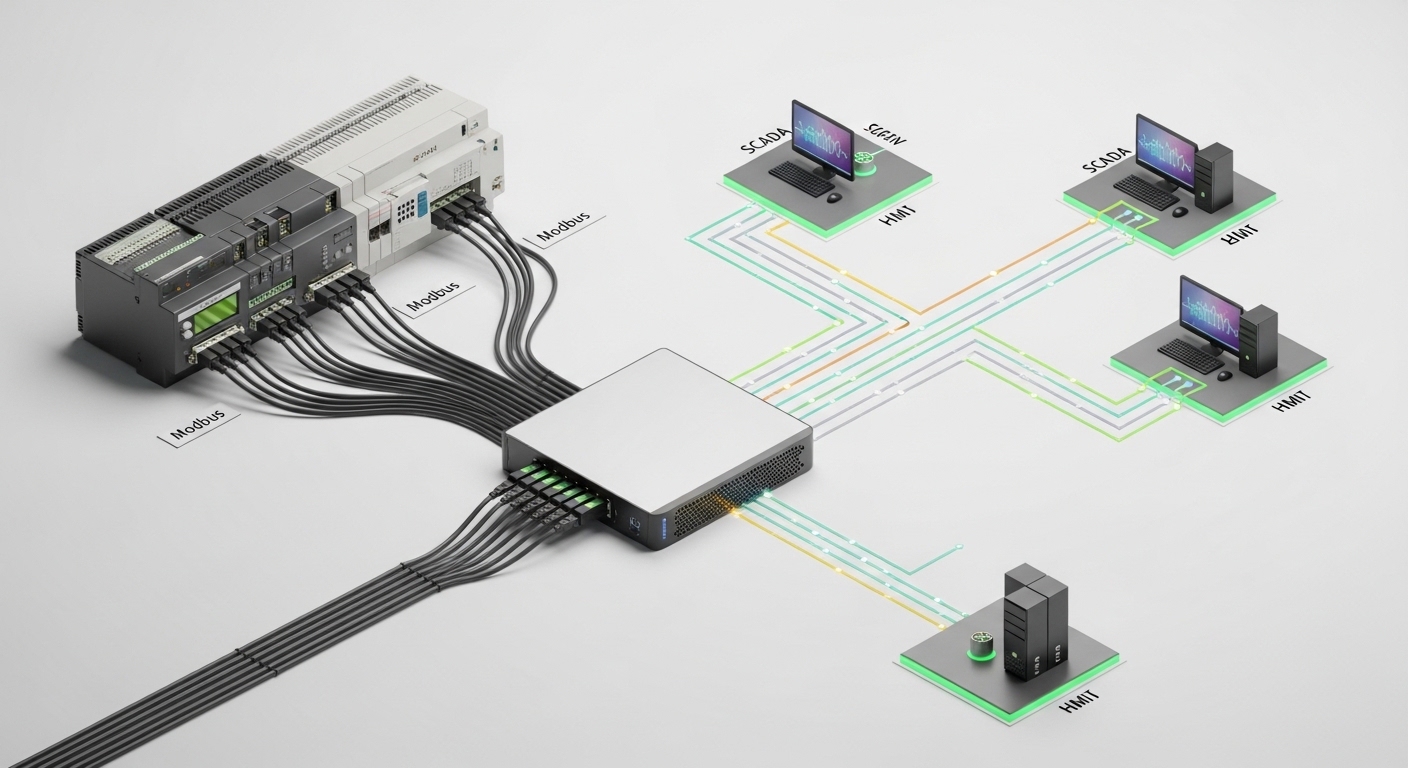
The Verifiable Mandate: A Zero-Trust Micro-segmentation Blueprint for Legacy Modbus & OPC-DA
Apex Insights Research Desk
The Unseen Threat in Plain Sight: Securing Brownfield ICS
Industrial Control Systems (ICS) in brownfield environments represent a paradox of modern engineering: they are the bedrock of critical infrastructure, yet often operate on networking protocols conceived decades before the advent of the modern cyber threat landscape. Legacy protocols such as Modbus and the DCOM-based OPC Classic (DA) are pillars of industrial automation due to their simplicity and reliability. However, they are inherently insecure, lacking authentication, encryption, and authorization mechanisms. This creates a vast, flat, and dangerously permissive attack surface within the operational technology (OT) domain. The traditional approach of perimeter-based security—the so-called "castle-and-moat" architecture—is demonstrably insufficient against threats that bypass the perimeter, such as insider threats, compromised supply chains, or lateral movement from a breached IT network.
This paper presents an engineering blueprint for implementing a verifiable Zero-Trust micro-segmentation framework specifically tailored for these challenging brownfield environments. The objective is not merely to create policies but to architect a system where security controls are granular, enforcement is deterministic, and the entire security posture is continuously attested against a known-good operational baseline, all without incurring prohibitive downtime or requiring a wholesale replacement of functional legacy assets.
Deconstructing the Legacy Protocol Challenge
To architect a robust solution, we must first dissect the fundamental vulnerabilities of the target protocols. Modbus, whether serial (RTU) or TCP, operates on a master-slave model with no concept of identity. Any device on the network can, in theory, send a validly formatted Modbus command (e.g., Function Code 16 - Write Multiple Registers) to a Programmable Logic Controller (PLC), potentially causing a catastrophic physical process upset.
OPC Data Access (DA) presents a more complex, but equally severe, challenge. Its reliance on Microsoft's Distributed Component Object Model (DCOM) introduces two primary issues:
- Authentication Ambiguity: While DCOM has authentication features, they are often misconfigured or disabled in OT environments for operational simplicity, effectively reverting to a null-trust model.
- Network Porosity: DCOM uses RPC (Remote Procedure Call), which initiates communication over a well-known port (TCP 135) but then negotiates a dynamic, high-range port for subsequent data exchange. This behavior makes static firewall rulesets brittle and ineffective, often forcing network administrators to open vast port ranges, defeating the purpose of segmentation.
The core principle of Zero Trust dictates: "Never trust, always verify." In an OT context, this translates to assuming that any network communication is hostile until proven otherwise. This verification must happen for every single transaction, regardless of its point of origin, and must be based on a granular, context-aware policy.
The Architectural Blueprint: A Phased Implementation for Verifiable Security
Implementing Zero-Trust micro-segmentation in a live production environment must be a methodical, phased process to mitigate operational risk. The following blueprint outlines a deterministic path from initial discovery to continuous verification.
Phase 1: High-Fidelity Network Discovery and Flow Mapping The foundational step is to achieve complete, passive visibility. You cannot secure what you cannot see. This requires deploying network TAPs or configuring SPAN/mirror ports on key network switches to capture all east-west and north-south traffic. The captured data must be fed into an OT-aware analysis platform capable of Deep Packet Inspection (DPI) for Modbus and OPC-DA. The goal is to produce an exhaustive inventory of all assets (PLCs, HMIs, Engineering Workstations, Historians) and a high-fidelity map of all communication flows, including specific Modbus function codes, register maps, and OPC DA tag reads/writes between specific endpoints.
Phase 2: Baselining and Granular Policy Definition Using the mapped flows, the next step is to establish a "golden baseline" of legitimate operational communication. This is the most critical intellectual exercise in the process. A policy should be far more granular than
allow IP_A to talk to IP_B. A robust, Zero-Trust policy for OT looks like this:- "The HMI at 192.168.1.10 is authorized to communicate with the PLC at 192.168.1.50 using Modbus/TCP on port 502, but is restricted to only using Function Codes 3 (Read Holding Registers) and 4 (Read Input Registers) for addresses 40001-40100."
- "The Historian server is authorized to establish an OPC-DA connection with the OPC Server, but only for reading specific tag groups related to temperature and pressure." This process of defining least-privilege access is fundamental. It transforms the network from a permissive free-for-all into a collection of deterministic micro-perimeters. For a deeper dive into this initial stage, our desk has previously detailed a strategy for Non-Invasive Zero-Trust Micro-segmentation for Legacy Modbus OT.
Phase 3: Network-Centric Policy Enforcement Legacy endpoints cannot host security agents. Therefore, enforcement must be external, implemented via compensating controls. These are typically industrial firewalls or dedicated OT security appliances deployed as transparent "bumps-in-the-wire" or as gateways for specific network segments. These Policy Enforcement Points (PEPs) inspect every packet and enforce the granular policies defined in Phase 2. If a packet from the HMI attempts to use Modbus Function Code 16 (Write Multiple Registers), the PEP will drop it and log the violation, preventing the unauthorized command from ever reaching the PLC.
Phase 4: Continuous Verification and Attestation This is what elevates the framework to being "verifiable." It's not enough to set and forget policies. A continuous feedback loop is required. All traffic—both allowed and, critically, denied—must be logged by the PEPs and streamed to a central Policy Decision Point (PDP) or management console. This console provides a real-time, continuously updated view of the network's security posture. Automated alerts should be configured for any policy violation, indicating either a potential attack or an unauthorized operational change. This continuous monitoring is crucial for building a truly resilient architecture, particularly when dealing with the kind of dispersed assets common in OT, a concept explored in our blueprint for verifiable Zero-Trust microsegmentation in critical OT with legacy RTUs.
Practical Implementation Challenges
While the blueprint is sound, field implementation presents significant engineering hurdles that require specialized solutions.
Taming OPC-DA's DCOM: Standard firewalls cannot effectively segment DCOM traffic due to the use of dynamic RPC ports. The PEP must possess an application-layer understanding of DCOM. It must inspect the initial RPC negotiation on TCP port 135 to identify the UUID of the requested service and the dynamically assigned port. The PEP then creates a temporary, stateful pinhole in its ruleset to allow that specific conversation, which is torn down upon session termination. This requires significant processing power and a sophisticated DPI engine.
Latency and Determinism: Placing an enforcement appliance inline introduces latency and jitter. While negligible in IT, an additional 5-10ms of inconsistent delay can disrupt sensitive control loops, leading to process instability or safety shutdowns. It is imperative to use hardware-accelerated PEPs designed for OT environments. Pre-deployment testing in a high-fidelity lab that mirrors the production environment is non-negotiable. Achieving security without compromising operational timing is paramount, a subject we've analyzed in detail in our research on the Sub-10ms Mandate for brownfield ICS.
Managing Policy at Scale: In a large plant, there can be tens of thousands of individual communication flows. Manually creating and managing these granular policies is untenable and error-prone. A successful deployment relies on a robust policy orchestration engine that supports policy-as-code principles. Engineers should be able to define policies in a structured, human-readable format (like YAML) and use automation tools to push them to the PDP, which then distributes them to the relevant PEPs across the network.
The Serial Gateway Aggregation Risk: Modbus RTU (serial) devices connected via serial-to-Ethernet gateways present a unique challenge. From the network's perspective, all communication appears to originate from the gateway's IP address. A sophisticated PEP must be able to look deeper into the Modbus PDU to enforce policies based on the serial Slave ID, effectively creating micro-segments for devices that don't even have an IP address.
Conclusion: From Assumed Trust to Verifiable Integrity
Implementing a verifiable Zero-Trust micro-segmentation framework in brownfield ICS environments is a complex but achievable imperative. By moving away from the brittle, perimeter-based security models of the past, organizations can build resilient, defensible control systems that are hardened against modern cyber threats. The methodology—discover, baseline, enforce, and continuously verify—provides a structured path to transforming legacy networks from environments of assumed trust into zones of explicit, verifiable integrity. This proactive stance is no longer a recommendation; it is a fundamental requirement for ensuring the safety, reliability, and availability of critical industrial processes in an increasingly connected world.
Sources / References
- NIST Special Publication 800-82 Rev. 3 (Draft), "Guide to Operational Technology (OT) Security": https://csrc.nist.gov/publications/detail/sp/800-82/rev-3/draft
- ISA/IEC 62443 Standards for IACS Security: https://www.isa.org/standards-and-publications/isa-standards/isa-iec-62443-series-of-standards
- Modbus Protocol Specifications: http://www.modbus.org/specs.php
- OPC Foundation, "What is OPC Classic?": https://opcfoundation.org/about/what-is-opc/opc-classic/