The Brownfield Imperative: Architecting Zero-Trust for Legacy Modbus SCADA Without Operational Disruption
Apex Insights Research Desk
Introduction: The Unsecurable Plant Floor
In the domain of critical manufacturing, brownfield SCADA (Supervisory Control and Data Acquisition) environments represent a formidable engineering challenge. These networks are the central nervous system of modern production, yet they are often built upon decades-old infrastructure and communication protocols that predate contemporary cybersecurity paradigms. At the heart of this challenge lies Modbus TCP/IP, a ubiquitous but inherently insecure protocol that operates on a principle of implicit trust. It lacks native authentication, authorization, and encryption, making any network segment where it operates a fertile ground for lateral movement by threat actors. The core dilemma for asset owners and system integrators is stark: how do you superimpose a modern, robust security framework like Zero-Trust onto a fragile, legacy operational technology (OT) environment without triggering catastrophic downtime?
Traditional perimeter-based security, reliant on a hardened exterior and a soft, trusted interior, has been proven catastrophically insufficient for OT. A single breach, whether from a compromised HMI or an infected engineering workstation, grants an adversary near-unfettered access to critical control systems. The Zero-Trust model, which mandates that no user or device is trusted by default, offers the only logical path forward. However, its application in brownfield environments is not a simple lift-and-shift of IT security solutions. It requires a nuanced, surgically precise approach that respects the deterministic, low-latency, and often brittle nature of industrial control systems (ICS). This article presents an architectural blueprint for implementing a Zero-Trust framework for Modbus TCP/IP-based SCADA systems, focusing on non-disruptive techniques that preserve operational continuity.
Deconstructing Zero-Trust for the OT Domain
The foundational principles of Zero-Trust, as articulated in frameworks like NIST SP 800-207, must be re-contextualized for the physical realities of the plant floor. While the core tenets remain, their implementation and priorities shift dramatically.
In an operational technology context, the principle of "never trust, always verify" transcends user identity and extends to the machine-to-machine communication layer. Every Modbus read/write request, every command from an HMI to a PLC, must be treated as a potentially unauthorized access attempt that requires explicit, policy-based permission before it can be executed on the control network.
This shift means moving beyond IP addresses and port numbers, which are easily spoofed, to a deeper understanding of the communication's context. Who (or what) is communicating? What specific action are they attempting (e.g., reading a coil, writing to a holding register)? Is this action consistent with the established operational baseline for that device and process? The traditional IT focus on data confidentiality is often secondary to the OT imperatives of integrity and availability. A denied command that halts a production line is as damaging as a malicious one that causes a safety incident. Therefore, the architecture must be fundamentally resilient and operationally transparent.
A Phased Blueprint for Non-Disruptive Implementation
A "big bang" deployment of Zero-Trust in a running manufacturing facility is a non-starter. The risk of interrupting production is too high. A phased, network-centric overlay approach is the only viable strategy. This involves inserting intelligent enforcement points into the network that can first learn and then control traffic without requiring any changes to the legacy endpoints themselves.
Phase 1: Deep Discovery and Passive Baselining The foundational phase is about achieving total visibility. You cannot protect what you cannot see. This requires deploying network TAPs or utilizing SPAN ports to passively mirror all SCADA traffic to a monitoring platform capable of Deep Packet Inspection (DPI) for industrial protocols. The objective is to build a high-fidelity map of the OT environment, identifying every asset (PLCs, HMIs, RTUs, engineering workstations), their communication patterns, and the specific Modbus commands they use. This process establishes an operational "ground truth"—a detailed baseline of normal behavior. This is the essence of building a context-aware micro-segmentation strategy, where security policies are derived from a deep understanding of the industrial process itself.
Phase 2: Network Overlay and Policy Simulation ('Listen Mode') Once a stable baseline is established, the next step is to deploy segmentation enforcement points (such as industrial firewalls or dedicated segmentation gateways) in-line, but in a non-enforcing "listen mode." In this configuration, traffic flows through the hardware, allowing the system to test potential Zero-Trust policies against live traffic without blocking anything. The system can generate alerts for any communication that would have been blocked by a proposed policy. For example, a policy might state, "The HMI at 10.10.1.5 is only allowed to read registers 40001-40050 from the PLC at 10.10.1.10 using Modbus Function Code 03." In listen mode, if that HMI attempts to write to a register, an alert is generated, allowing engineers to validate if this is an undocumented but legitimate operational behavior or a true policy violation, all without risking downtime.
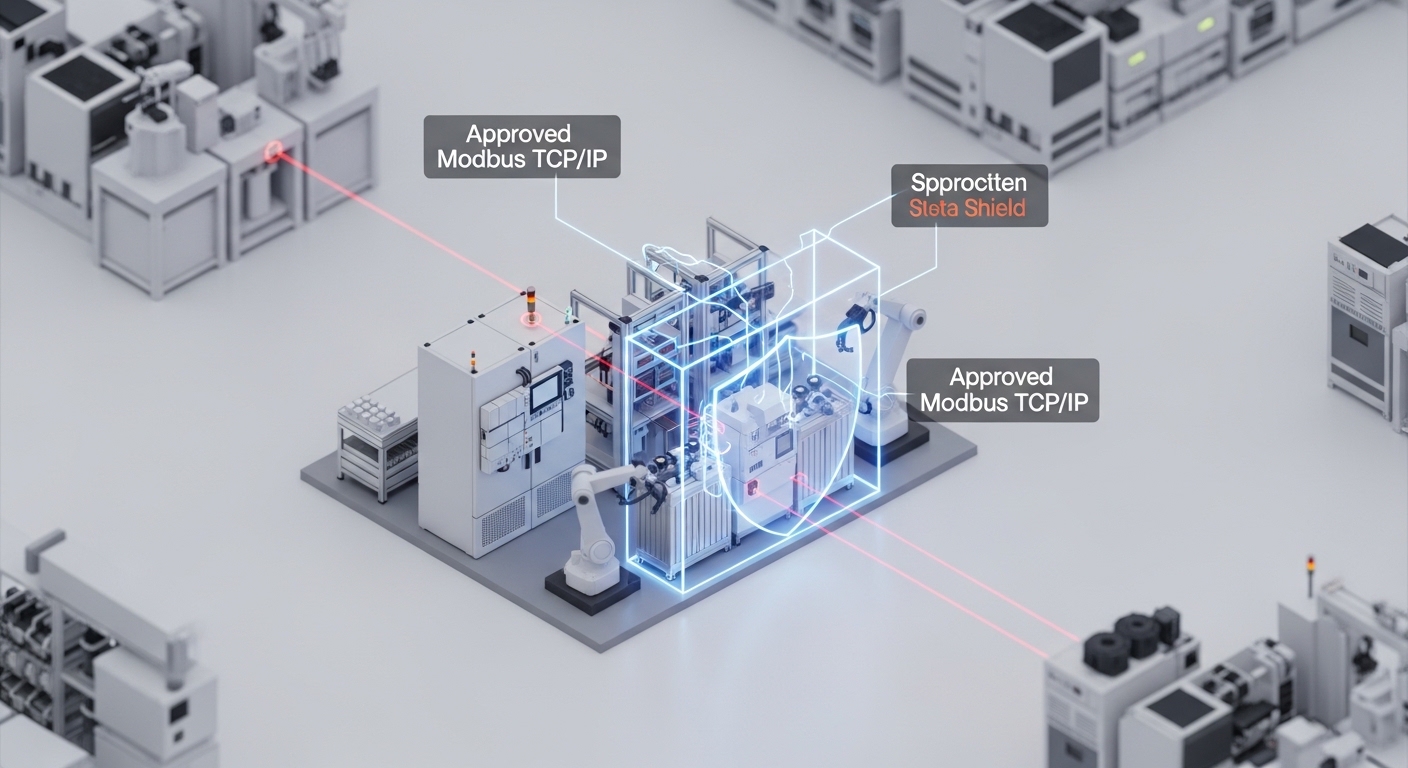
Phase 3: Granular Policy Enforcement ('Enforce Mode') After a period of simulation and policy refinement, the enforcement points can be switched to "enforce mode." This is the activation of the Zero-Trust micro-perimeter. Now, the segmentation gateway actively inspects every Modbus TCP packet and enforces the validated policies. Any traffic that does not conform to an explicit "allow" rule is dropped. This enforcement must be highly granular. A properly architected system will not just allow or deny a connection between two IPs; it will enforce policy at the protocol command level. This approach enables true least-privilege access, ensuring a device can only perform the exact functions required for its role. The ability to create rules based on specific registers and function codes is paramount, a concept further detailed in our analysis on Zero-Trust policy at the PLC register level.
Phase 4: Dynamic Identity and Continuous Verification Static, IP-based rules are a strong starting point, but mature Zero-Trust architectures evolve toward identity-based access control. In the OT context, "identity" can be a composite of factors: the device's MAC address, its hardware fingerprint, its software/firmware version, and its network location. When an engineer needs remote access, their identity (authenticated via an IAM platform) is temporarily mapped to a policy that grants them specific, time-bound access to a particular PLC. This dynamic model drastically reduces the attack surface compared to static firewall rules. This becomes even more critical when securing mixed environments, as the principles for establishing trust must often bridge modern IP networks with legacy serial connections, a challenge explored in our guide on Zero-Trust for legacy serial devices.
Practical Implementation Challenges
Deploying this architecture is not without significant engineering hurdles that require careful planning and specialized solutions.
Latency and Jitter Injection
Any in-line device that performs DPI and policy enforcement will introduce latency. In IT networks, a few extra milliseconds is irrelevant. In a high-speed packaging line or a motion control application, it can cause process failure or physical damage. The chosen segmentation solution must demonstrate deterministic, ultra-low latency performance (often sub-millisecond) and minimal jitter, typically achieved through hardware-based acceleration (FPGA/ASIC) rather than software-based processing.
Proprietary Protocol Deviations
While Modbus TCP/IP is a standard, many vendors have implemented proprietary extensions or function codes. A generic Modbus DPI engine may misinterpret or block this legitimate traffic, causing an outage. The security platform must either have a comprehensive library of these vendor-specific variants or possess the capability to learn and create custom parsers for unknown protocol flavors.
The Fragility of Legacy Endpoints
Many legacy PLCs and embedded devices have extremely fragile TCP/IP stacks. They were never designed to handle modern network traffic and can crash when subjected to something as simple as a port scan. This vulnerability makes agent-based security solutions impossible and underscores the necessity of a network-based overlay approach. The enforcement points must also be able to "sanitize" traffic, ensuring that only perfectly formed, expected Modbus packets reach the sensitive endpoint.
Change Management and the IT/OT Divide
Perhaps the most significant challenge is cultural. The OT engineering team's primary directive is maintaining availability and safety, often leading to a risk-averse posture toward network changes. The IT security team is driven by risk reduction and compliance. A successful Zero-Trust project requires a unified effort, where OT engineers use their process knowledge to define the communication baseline and security policies, and IT provides the cybersecurity expertise and tools. The project must be framed as an initiative to enhance operational resilience, not merely to impose security controls.
Engineering Takeaways for a Resilient Architecture
Achieving a non-disruptive rollout hinges on specific architectural choices and deployment methodologies.
- Prioritize Transparent Insertion: Utilize solutions that can be deployed as a "bump-in-the-wire" or transparent Layer 2 bridge. This minimizes the need for re-addressing IP schemes or making complex routing changes in a legacy network.
- Design for High Availability: Any in-line security control becomes a potential single point of failure. Enforcement points must be deployed in high-availability (HA) pairs with sub-second failover to ensure a hardware failure does not bring down the entire control process.
- Define Fail-Safe States: Determine the appropriate fail state for each enforcement point. Should it "fail open" (allowing all traffic to pass) to prioritize availability, or "fail closed" (blocking all traffic) to prioritize security? This decision must be made on a per-segment basis through a rigorous risk assessment of the specific industrial process being protected.
- Embrace Centralized Management: While enforcement should be distributed as close to the protected asset as possible, policy creation, management, and monitoring must be centralized. This provides a single pane of glass for visibility and ensures consistent policy application across the entire facility or enterprise.
Conclusion: From Implicit Trust to Explicit Verification
Implementing Zero-Trust in brownfield SCADA environments is not an esoteric cybersecurity exercise; it is a fundamental step toward building resilient manufacturing operations for the next decade. By abandoning the flawed paradigm of implicit trust and adopting a network-centric overlay strategy, organizations can surgically impose granular security controls on their most critical systems without disrupting the delicate processes they manage. The journey from a flat, trusted network to a fully micro-segmented, continuously verified architecture is a marathon, not a sprint. However, by following a phased, operationally-aware blueprint, manufacturers can systematically reduce their attack surface and fortify their legacy infrastructure against the evolving threat landscape, ensuring both safety and productivity.
Sources / References
- NIST Special Publication 800-207, Zero Trust Architecture: https://csrc.nist.gov/publications/detail/sp/800-207/final
- NIST Special Publication 800-82 Rev. 3 (Draft), Guide to Operational Technology (OT) Security: https://csrc.nist.gov/publications/detail/sp/800-82/rev-3/draft
- The Modbus Organization, Modbus TCP/IP Messaging Implementation Guide V1.0b: https://modbus.org/docs/Modbus_Messaging_Implementation_Guide_V1_0b.pdf
- ISA/IEC 62443 Series of Standards on Industrial Automation and Control Systems Security: https://www.isa.org/standards-and-publications/isa-standards/isa-iec-62443-series-of-standards