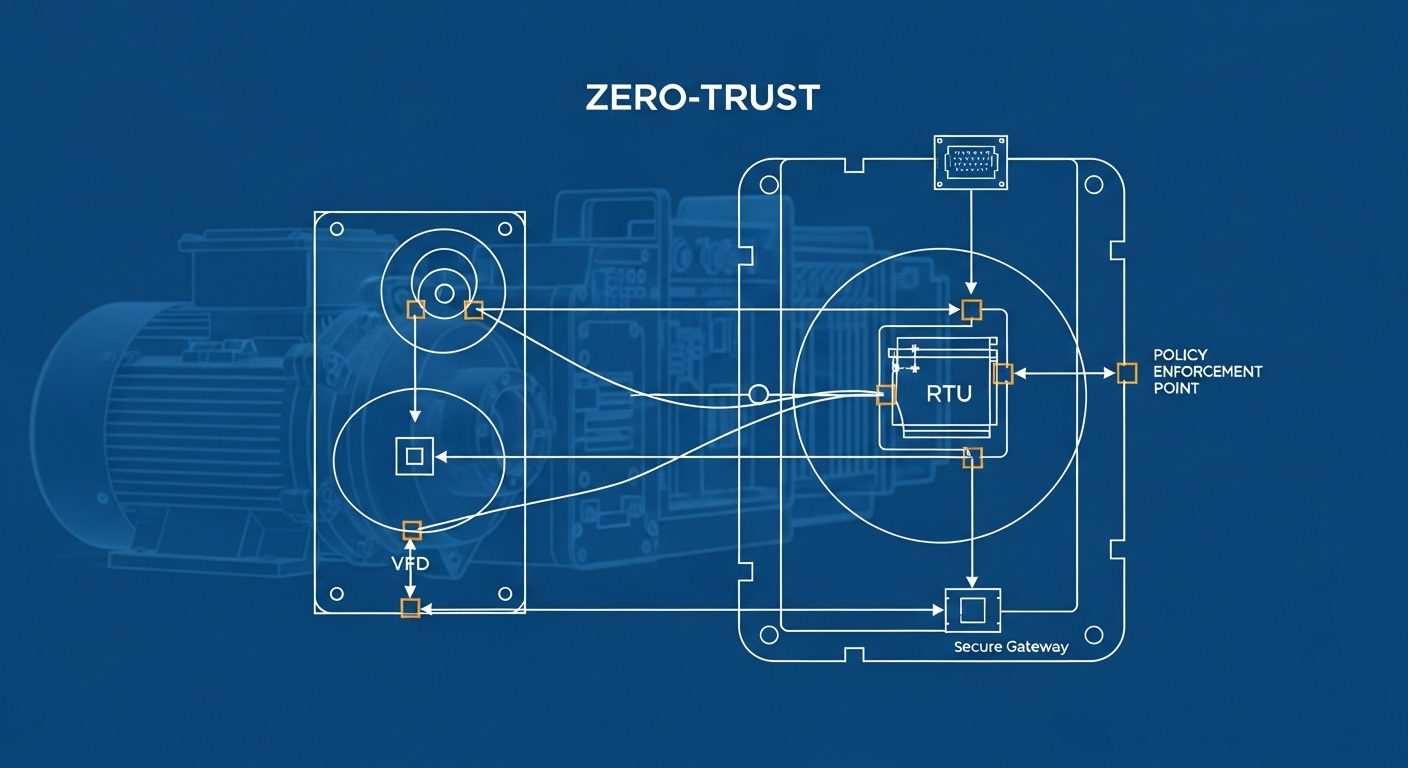
Architecting Zero-Trust for Legacy OT: A Pragmatic Guide to Securing VFDs and RTUs
Apex Insights Research Desk
The Imperative for a New Defense Paradigm in Operational Technology
In the realm of Operational Technology (OT), the bedrock of modern industry is often composed of equipment engineered decades ago. Variable Frequency Drives (VFDs) and Remote Terminal Units (RTUs) are the workhorses of industrial control systems (ICS), yet they represent a significant cybersecurity paradox. These devices, designed for reliability and longevity in physically isolated environments, are now increasingly interconnected, exposing their inherently insecure-by-design nature to a sophisticated threat landscape. The traditional "castle-and-moat" approach of perimeter security is fundamentally broken in the face of converged IT/OT networks and the persistent threat of lateral movement within the OT zone.
This article from the Apex Insights Research Desk provides a detailed architectural blueprint for applying Zero-Trust principles—specifically the principle of least-privilege access—to these legacy OT assets. We will move beyond theoretical frameworks to provide a pragmatic, engineering-focused guide for creating a resilient and defensible control environment, even when the endpoints themselves cannot be hardened.
The Fundamental Disconnect: Legacy Protocols vs. Modern Security
To architect a solution, we must first define the problem's core parameters. Legacy OT devices present a unique and formidable set of challenges that preclude the direct application of modern IT security controls.
Inherent Vulnerabilities of Legacy Hardware
- Unauthenticated Protocols: Many VFDs and RTUs communicate using protocols like Modbus TCP, DNP3, or proprietary serial-to-ethernet adaptations that lack any form of authentication or encryption. Any device on the network can, in principle, send a valid command.
- Fragile TCP/IP Stacks: The network stacks on these embedded systems are often brittle and can fail or crash when subjected to unexpected traffic, such as a standard network vulnerability scan.
- Limited Computational Resources: The processors and memory on these devices are sized exclusively for their control loop tasks, leaving no capacity for modern security agents, encryption overhead, or robust logging.
- Opaque and Inflexible Firmware: Firmware is rarely updated due to fears of operational disruption, and source code is almost never available, making vulnerability assessment and patching a high-risk, low-frequency event.
These characteristics render endpoint-based security unfeasible. Therefore, the security controls must be externalized into the network fabric itself, which is the foundational concept of applying Zero-Trust in a brownfield OT environment.
A Zero-Trust Architectural Blueprint for Legacy OT
Zero-Trust dictates a simple but powerful principle: never trust, always verify. In an OT context, this means that every single communication request to a VFD or RTU must be authenticated, authorized, and inspected, regardless of its point of origin within the network. Since the device itself cannot perform this verification, we must architect a system of network-based compensating controls that act on its behalf.
This architecture is built on three core pillars: micro-segmentation, centralized policy enforcement, and continuous monitoring.
Pillar 1: Identity-Based Micro-segmentation
The first step is to dismantle the flat, trusted OT network. Micro-segmentation involves creating extremely granular network zones, ideally around a single device or a small, functionally related group of devices. A VFD controlling a critical pump and the HMI that manages it would exist in separate micro-segments.
This segmentation is enforced by a Policy Enforcement Point (PEP), typically a next-generation firewall (NGFW) or a dedicated OT security appliance positioned logically in front of the legacy asset. This PEP acts as a proxy or gateway, intercepting all traffic destined for the protected device. The device's IP address is no longer directly reachable from the wider network; all communication must terminate at the PEP for inspection.
Pillar 2: The Centralized Policy Engine
The PEP makes its decisions based on policies received from a centralized Policy Decision Point (PDP) or policy engine. This is where the principle of least-privilege is codified into explicit rules. Instead of broad 'allow' rules based on IP addresses, Zero-Trust policies are granular and context-aware, defining the 'who, what, where, when, and how' of access.
An example policy for a VFD might be:
ALLOW connection from 'HMI-ProcessLine-A' to 'VFD-Pump-07' on TCP/502 IF AND ONLY IF:
Protocol is Modbus TCPModbus Function Code is '0x06' (Write Single Register) or '0x03' (Read Holding Registers)The target register address is within the range 40001-40010 (e.g., speed setpoint, status)The time is during normal operational hours (07:00-19:00)
Any attempt to use a different function code (like 0x10, Write Multiple Registers) or target a safety-critical configuration register would be blocked and logged by the PEP, even if it originates from a seemingly trusted HMI.
Pillar 3: Continuous Monitoring and Deep Packet Inspection (DPI)
Zero-Trust is not a 'set and forget' architecture. It demands continuous monitoring and verification of all network flows. The PEP must perform Deep Packet Inspection (DPI) tailored to industrial protocols.
This goes beyond simply checking port numbers. The PEP's DPI engine understands the structure of Modbus or DNP3 and can validate the contents of the packets themselves. This granular inspection is the key to identifying malicious or anomalous commands masquerading as legitimate traffic. Effective DPI is a critical tool for differentiating stealth cyber-physical attacks from operational noise in SCADA systems, as it provides the context needed to discern intent from raw data flow.
This continuous stream of telemetry—logs of all allowed and denied connections, protocol-level command details—is fed into a central analytics platform or SIEM for threat hunting and incident response.
Architectural Comparison Table
| Feature | Traditional Perimeter Approach | Zero-Trust Micro-segmentation Approach |
|---|---|---|
| Trust Assumption | Implicit trust for all assets inside the OT perimeter. | No implicit trust. Every connection is treated as hostile until verified. |
| Access Control | Based on broad IP address ranges and network zones (e.g., Purdue Model Level 2 vs. Level 1). | Based on specific machine/service identity, protocol commands, and operational context. |
| Attack Surface | Entire internal network is exposed once the perimeter is breached. | Reduced to individual PEP gateways. A compromised HMI cannot directly access other segments. |
| Lateral Movement | Unchecked and difficult to detect. | Severely restricted or completely blocked by default-deny policies at each micro-segment boundary. |
| Visibility | Limited to traffic crossing the IT/OT boundary. | Deep visibility into all east-west traffic, including command-level details within industrial protocols. |
| Resilience | A single breach can lead to widespread system compromise. | A breach is contained within a single micro-segment, preventing catastrophic failure. |
Practical Implementation Challenges: The Engineering Hurdles
Deploying a Zero-Trust architecture in a brownfield OT environment is a complex engineering task fraught with specific, technical challenges that must be proactively addressed.
Protocol Brittleness and Latency: The introduction of a PEP, effectively a transparent man-in-the-middle, adds processing latency. While modern NGFWs measure this in microseconds, sensitive, high-speed control loops are extremely intolerant to both latency and jitter. An improperly configured DPI engine can delay a critical packet just long enough to cause a process trip. Extensive testing in a lab environment that mirrors the production network is non-negotiable. This mirrors the complex timing constraints encountered when architecting real-time behavioral anomaly detection for Siemens S7 SCADA protocols, where security processing must not interfere with deterministic control operations.
Operational Drift and Policy Debt: An industrial process is not static. Control parameters are tuned, components are replaced, and logic is updated. Each change can alter communication pathways. A Management of Change (MOC) process that is not tightly integrated with the security policy management workflow will inevitably lead to policy debt. Outdated rules will either block legitimate operational traffic (causing downtime) or leave security gaps that defeat the purpose of the architecture.
Passive Discovery Limitations: Identifying all assets and their communication patterns is the first step. While passive network monitoring is the safest method, it may not uncover connections used only during specific failure modes, maintenance cycles, or infrequent diagnostic procedures. This can lead to a baseline policy that is incomplete, resulting in service disruption when those rare conditions occur after enforcement is activated.
Physical Network Constraints: The theoretical model of placing a PEP in front of every asset often clashes with the reality of aging physical infrastructure. The presence of unmanaged network switches, cascaded hubs, or convoluted cabling can make it physically impossible to isolate an asset and route its traffic through a single enforcement point without significant and costly network re-architecture.
Proprietary Protocol Obfuscation: While DPI for common protocols like Modbus TCP is mature, many vendors use proprietary extensions or entirely custom protocols. If the PEP cannot parse these protocols, it can only enforce Layer 3/4 policies (IP and port), which significantly diminishes the security value. Gaining the necessary visibility may require close vendor collaboration or specialized protocol analysis tools.
Conclusion: Architecting Resilience from the Network Up
Securing legacy VFDs and RTUs with a Zero-Trust mindset is not about installing a new product; it is a strategic shift in security architecture. It acknowledges the immutable insecurity of the endpoint and builds a resilient, defensible ecosystem around it using the network as the primary control plane. By externalizing authentication, authorization, and inspection to intelligent Policy Enforcement Points, we can apply modern security principles to decades-old equipment.
The path to implementation is one of incremental progress: discover, segment, monitor, and then enforce. It requires a deep understanding of both network security and industrial control processes. While the engineering challenges are significant, the alternative—leaving critical infrastructure exposed with only a brittle perimeter for protection—is no longer a viable option in the modern industrial landscape.
Sources / References
- NIST Special Publication 800-207, Zero Trust Architecture:
https://csrc.nist.gov/publications/detail/sp/800-207/final - ISA/IEC 62443 Series of Standards for Industrial Automation and Control Systems Security:
https://www.isa.org/standards-and-publications/isa-standards/isa-iec-62443-series-of-standards - CISA Zero Trust Maturity Model:
https://www.cisa.gov/resources-tools/resources/zero-trust-maturity-model