The Converged Enclave: A Zero-Trust Blueprint for Securing Legacy PLCs and 5G IoT in Manufacturing
Apex Insights Research Desk
The Architectural Imperative for Zero-Trust in Converged IT/OT
The modern discrete manufacturing floor presents a profound architectural paradox. On one hand, the drive for Industry 4.0 has supercharged operations with high-speed, low-latency 5G IoT sensors, streaming terabytes of predictive maintenance and quality control data to cloud analytics platforms. On the other hand, the deterministic, real-time control of physical processes remains the domain of legacy Programmable Logic Controllers (PLCs). Many of these workhorses still communicate using insecure-by-design serial protocols like Modbus RTU or DF1, representing a decades-old technological stratum with no native concept of authentication or encryption.
This convergence of bleeding-edge wireless technology with brownfield operational technology creates a massively expanded and heterogeneous attack surface. Traditional perimeter-based security models, predicated on a 'trusted' internal network, are fundamentally obsolete in this multi-site, interconnected environment. A single compromised IoT sensor or a lateral intrusion from the corporate IT network can provide a direct path to the most critical control systems, risking production downtime, intellectual property theft, or even physical safety events. The architectural mandate is clear: a granular, identity-centric security model is required. This is the domain of Zero-Trust Micro-segmentation.
Deconstructing the Core Challenge: Serial Protocols and 5G Ingress
To engineer a robust solution, we must first dissect the two primary vectors of complexity. Legacy serial-protocol PLCs represent the 'soft underbelly' of the OT environment. Deployed on flat, unsegmented networks, they operate on implicit trust, executing any well-formed command they receive. There is no cryptographic identity, no session verification, and no access control beyond physical access to the serial port. Any endpoint on the same network segment can potentially halt a process, manipulate a recipe, or disable safety interlocks.
Conversely, 5G IoT sensors introduce a new, high-velocity data plane and countless new network ingress points. While offering unprecedented operational intelligence, each sensor is a potential beachhead for an attacker. The integration of 5G, whether through a private deployment or network slicing on a public carrier, requires a rigorous security posture that isolates this new radio access network (RAN) from the sensitive OT control plane. Allowing direct, unfettered communication between a 5G-connected device and a legacy PLC is an unacceptable risk.
The challenge is therefore to create a security architecture that can impose modern, identity-based access control on devices that were never designed for it, while safely harnessing the data streams from new, IP-native technologies across a distributed, multi-site enterprise.
The Zero-Trust Micro-segmentation Blueprint for Converged Manufacturing
A successful implementation is not a single product purchase but a systematic architectural evolution. The following steps provide a strategic blueprint for layering zero-trust principles onto a complex IT/OT environment without disrupting critical operations.
Phase 1: Deep Asset Discovery and Communication Flow Baselining The foundational principle of zero-trust is 'never trust, always verify,' which is impossible without a comprehensive understanding of every asset and its legitimate communication patterns. This requires deploying passive network monitoring tools capable of Deep Packet Inspection (DPI) for both standard IP protocols (TCP/IP, UDP) and specialized OT protocols (Modbus/TCP, S7, EtherNet/IP) and, crucially, serial communications encapsulated over Ethernet. The objective is to build a definitive 'map' that answers: What devices are on the network? What protocols are they using? Who are they talking to? What is the function of that communication (e.g., read-only monitoring vs. control command)? This baseline is the source of truth for all subsequent policy creation.
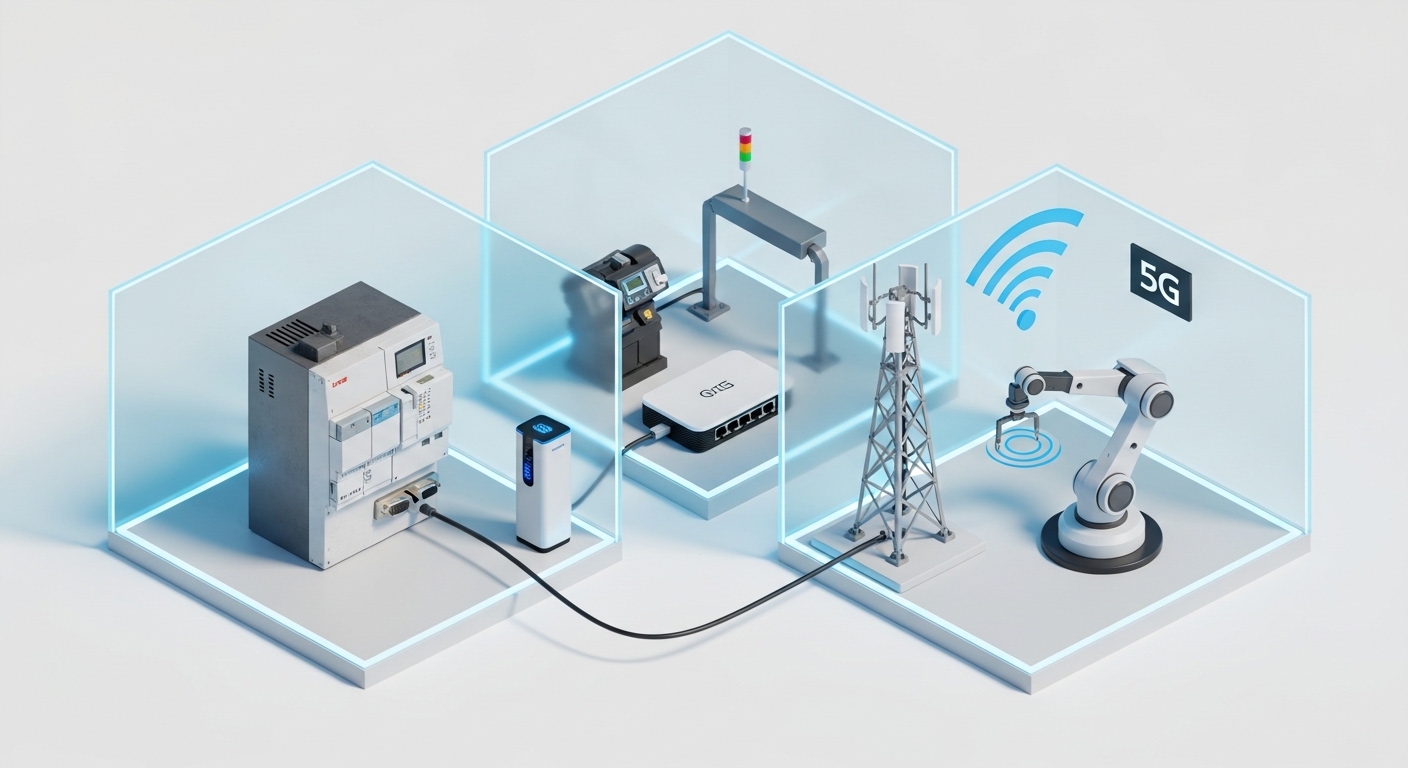
Phase 2: Defining the Micro-Perimeter via 'Deterministic Enclaves' With a complete map, the next step is to logically group assets into the smallest possible security zones, or micro-segments. For the most critical assets, this could be a segment of one—a single PLC. This concept, which we term a 'Deterministic Enclave,' isolates a control function from the rest of the network, ensuring that only explicitly authorized traffic can enter or leave. This is the most effective strategy for preventing lateral movement by an attacker. Crafting these isolated zones without disrupting time-sensitive operations is a significant engineering challenge, which we detail further in our research on creating a Deterministic Enclave for legacy PLCs.
Phase 3: Deploying Protocol-Aware Policy Enforcement Points (PEPs) Legacy PLCs lack the onboard processing power to enforce security policies. Therefore, enforcement must be externalized to a dedicated device that acts as a gatekeeper for the micro-segment. For serial PLCs, this is typically a secure industrial gateway or a micro-firewall that sits in-line between the PLC and the network. This PEP must be more than a simple firewall; it must be protocol-aware. It must be able to inspect the payload of Modbus traffic, for example, and enforce rules like, "Allow HMI-1 to read holding registers 40001-40010, but block any write attempts." For IP-based OT protocols, modern industrial firewalls can serve as PEPs, enforcing similar Layer 7 policies.
Phase 4: Architecting Secure Ingress for 5G IoT Data Traffic from 5G IoT sensors should never terminate directly within the OT control network. A robust architecture dictates that all 5G traffic lands in a dedicated OT DMZ or 'sensor landing zone.' Here, traffic is inspected, authenticated, and brokered. A common pattern is for sensors to publish data via MQTT to a broker in this DMZ. IT systems and cloud platforms can then subscribe to the broker to receive this data, completely decoupling the information flow from the control flow. Any data destined for OT systems (e.g., a historian) must pass through a PEP with strict policies governing its access.
Phase 5: Implementing Dynamic, Identity-Based Policy Orchestration Static, IP-based firewall rules are brittle and insufficient. A mature zero-trust architecture bases access decisions on identity and context. For legacy devices, identity is conferred by the PEP that guards it. For modern devices and users, identity can be established via certificates (802.1X) or other authentication mechanisms. The central policy orchestrator—the brain of the zero-trust system—should be able to grant temporary, just-in-time access based on a maintenance ticket, for example. Every policy decision and access request must be logged to create a verifiable chain of custody, a critical component for both security forensics and regulatory compliance, forming what is known as the immutable record for verifiable audit trails.
Practical Implementation Challenges
Deploying this architecture in a live, multi-site manufacturing environment is fraught with engineering hurdles that require careful planning and specialized expertise.
- Deterministic Latency Constraints: Any in-line security device (PEP) must perform its inspection and enforcement functions without adding latency or jitter that could disrupt real-time control loops. This often requires specialized hardware and highly optimized software, as standard IT firewalls are typically unsuitable for high-speed, deterministic OT networks.
- Serial Protocol Translation and Inspection: Many legacy PLCs are connected to the network via serial-to-Ethernet converters that simply encapsulate serial data in TCP or UDP packets. A PEP must be able to de-encapsulate this traffic on the fly to inspect the underlying serial commands, adding significant complexity.
- Scalability of Policy Management: In a large enterprise with thousands of PLCs and sensors across dozens of sites, managing millions of granular micro-segmentation policies is impossible without a centralized orchestration platform that supports policy-as-code, templating, and automated rule generation based on the discovered asset baseline.
- Environmental Hardening and Physical Placement: PEPs must often be deployed in harsh plant floor environments subject to extreme temperatures, vibration, and electromagnetic interference. This necessitates the use of ruggedized, industrial-grade hardware with passive cooling and appropriate certifications (e.g., Class I, Div 2).
- Addressing Brownfield Interoperability: The act of inserting a security gateway can sometimes break communications with older, non-compliant or 'buggy' protocol implementations on legacy devices. A phased rollout with extensive testing in a lab environment that mirrors production is absolutely critical to avoid causing unplanned downtime. These represent some of the core micro-segmentation hurdles in live brownfield PLC environments that must be overcome.
Governing Principle: Alignment with IEC 62443 This architectural blueprint directly aligns with the foundational concepts of the ISA/IEC 62443 series of standards for Industrial Automation and Control Systems (IACS) security. The creation of 'Deterministic Enclaves' and the deployment of PEPs are a direct implementation of the standard's 'zones and conduits' model, which mandates segmenting a system into logical groups of assets (zones) and controlling all data flow between them through defined pathways (conduits).
Conclusion: Engineering the Future of Secure Manufacturing
The convergence of 5G IoT and legacy OT is inevitable and offers immense value. However, it mandates a fundamental departure from outdated, perimeter-based security thinking. A zero-trust micro-segmentation strategy provides the architectural framework necessary to manage this complexity securely. By treating every device and data flow as untrusted, verifying every request against granular policy, and isolating critical control systems within protected enclaves, manufacturers can build a resilient, adaptable, and defensible production environment. This is not merely a security upgrade; it is a foundational pillar for building the smart, autonomous, and secure manufacturing enterprises of the future.
Sources / References
- NIST Special Publication 800-207: Zero Trust Architecture - https://csrc.nist.gov/publications/detail/sp/800-207/final
- ISA/IEC 62443 Standards for IACS Security - https://www.isa.org/standards-and-publications/isa-standards/isa-iec-62443-series-of-standards
- CISA: Securing Industrial Control Systems - A Recommended Practice - https://www.cisa.gov/sites/default/files/publications/Recommended_Practice_Securing_ICS_A_Brief_for_All.pdf