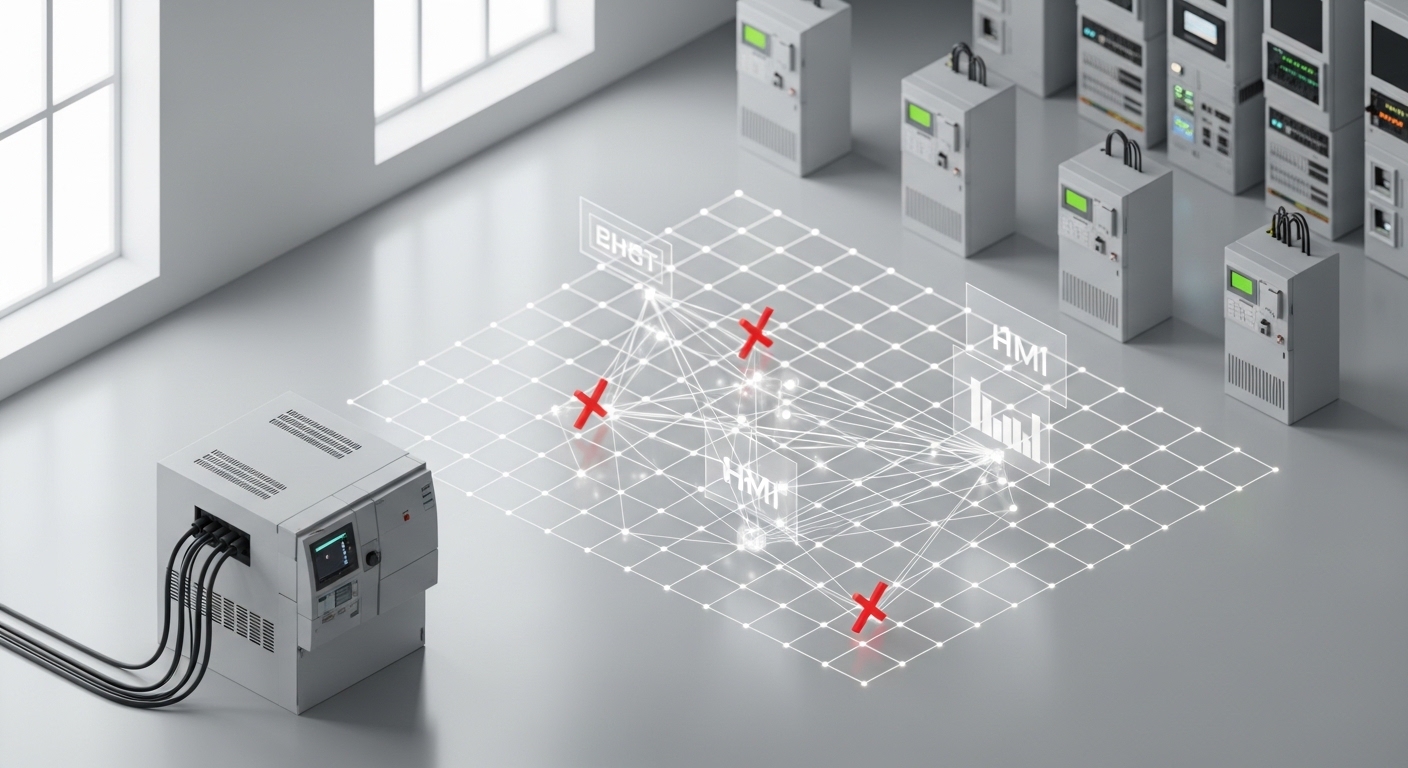
Securing the Unsecurable: A Blueprint for Zero-Trust Micro-segmentation in Brownfield OT Networks
Apex Insights Research Desk
The Unsecurable Asset: Embracing Zero Trust in Legacy OT Environments
The convergence of Information Technology (IT) and Operational Technology (OT) has unlocked unprecedented efficiency but has simultaneously dismantled the air-gapped security model that once protected industrial control systems (ICS). For brownfield environments, characterized by a heterogeneous mix of legacy and modern equipment, this presents a formidable challenge. The prospect of securing decades-old Programmable Logic Controllers (PLCs)—many of which were designed before the internet became ubiquitous—without a cost-prohibitive 'rip and replace' strategy seems insurmountable. Yet, the principles of a Zero-Trust Architecture (ZTA) offer a pragmatic and powerful path forward.
This research desk analysis provides an architectural blueprint for implementing real-time, policy-enforced micro-segmentation in existing brownfield OT networks. We will demonstrate how to create granular security zones around critical assets, including legacy PLCs, by decoupling security enforcement from the underlying physical network. This overlay approach allows organizations to achieve a robust Zero Trust posture, drastically reduce their attack surface, and prevent the lateral movement of threats without modifying or replacing core operational hardware.
The Imperative for Zero Trust in Brownfield OT
Traditional OT security relied on a 'castle-and-moat' perimeter defense. Once inside this trusted network, traffic was largely uninspected, allowing threats to move laterally with ease. The core tenet of Zero Trust—'never trust, always verify'—shatters this paradigm. It assumes that threats exist both outside and inside the network and that no user or device should be trusted by default.
This is critically important in OT for several reasons:
- Insecure-by-Design Protocols: Legacy OT protocols like Modbus, DNP3, and S7comm often lack basic security features such as authentication, encryption, or integrity checks. An attacker with network access can often read process values or issue control commands with impunity.
- Vulnerable Endpoints: Legacy PLCs and Human-Machine Interfaces (HMIs) may run on unpatched, unsupported operating systems, making them highly susceptible to known exploits.
- Converged Attack Paths: IT-based attacks, such as ransomware, can now traverse the network and impact OT systems, causing physical disruption and safety risks.
Micro-segmentation is the cornerstone of implementing Zero Trust in this context. It involves dividing the network into small, isolated segments—ideally down to the individual asset level—and enforcing strict communication policies for traffic moving between them. For a PLC, this means it is only allowed to communicate with its designated HMI and engineering workstation, using specific protocols and commands, and nothing else.
Foundational Architecture: The Overlay Model for Micro-segmentation
To apply micro-segmentation without altering the physical network or replacing legacy devices, we must employ an overlay model. This architecture introduces a layer of intelligent security enforcement on top of the existing infrastructure.
Gaining Visibility with Network TAPs and SPAN
The first principle of control is visibility. It's impossible to segment what you cannot see. The initial step is to passively acquire network traffic without introducing any latency or potential point of failure. This is achieved using:
- Network TAPs (Test Access Points): These are hardware devices that create an exact copy of the bi-directional traffic flow, sending one copy to the production network and the other to a monitoring/security platform. They are fail-safe and do not impact network performance.
- SPAN (Switched Port Analyzer) Ports: On managed switches, a SPAN port can be configured to mirror traffic from one or more source ports to a destination port connected to the security platform.
This passive data collection is the foundation for asset discovery and communication mapping.
The Central Policy Enforcement Engine
This is the brain of the Zero Trust architecture. It is a centralized platform where security and operations teams:
- Ingest and analyze the passively collected traffic data.
- Automatically discover and classify all assets (PLCs, RTUs, HMIs, Historians, etc.).
- Visualize all communication flows, protocols, and dependencies.
- Define granular micro-segmentation policies based on the principle of least privilege.
- Simulate and model the impact of policies before enforcement.
- Distribute the finalized policies to distributed enforcement points.
Distributed Policy Enforcement Points (PEPs)
PEPs are the 'muscle' of the architecture, responsible for enforcing the policies defined by the central engine. These can be physical appliances or virtualized gateways strategically placed within the network. To avoid disrupting legacy systems, they are typically deployed as transparent Layer 2 bridges. This means they can be inserted into a network segment without requiring any IP address changes on the existing PLCs or endpoints, making them invisible to the operational assets they are protecting.
A Phased Implementation Methodology
A successful deployment is incremental and non-disruptive. A phased approach mitigates operational risk and builds confidence in the solution.
Phase 1: Passive Discovery and Asset Baselining
Before any policy is enforced, the system must operate in a 'monitor-only' mode. For weeks or even months, the platform passively ingests traffic to build a comprehensive baseline of normal operations. This involves using Deep Packet Inspection (DPI) to:
- Identify every asset: Catalog its IP/MAC address, vendor, model, and role.
- Map all communication flows: Determine which assets talk to each other, over which ports, and using which specific OT protocols and function codes.
- Establish a behavioral baseline: This detailed map of 'normal' is the ground truth. This process is fundamental to later security stages; a robust baseline is the only way to begin differentiating stealth cyber-physical attacks from operational noise in SCADA systems. Any deviation from this established pattern can then be flagged as a potential anomaly or policy violation.
Phase 2: Policy Modeling and Simulation
With a high-fidelity baseline, administrators can begin building micro-segmentation policies. For example:
Allow: [PLC-Boiler-A (10.10.20.5)] -> [HMI-Boiler-A (10.10.20.10)] | Protocol: Modbus/TCP (Port 502) | Function Codes: Read Holding Registers, Write Single CoilDeny: Any -> [PLC-Boiler-A (10.10.20.5)](Implicit Deny)
Crucially, these policies are first run in a simulation mode. The system will generate alerts for any traffic that would have been blocked, allowing teams to identify legitimate but previously unknown communication paths. This prevents accidental disruption of critical processes when enforcement is activated.
Phase 3: Gradual Enforcement and Tuning
Enforcement begins with the least critical network segments. The PEPs are switched from 'monitor-only' to 'enforcement' mode for a small group of assets. The system is closely monitored for any unexpected operational impact. As confidence grows, enforcement is rolled out across the entire facility, zone by zone. This iterative process of enforcement, monitoring, and tuning is key to a successful brownfield deployment.
Policy Enforcement Mechanisms for Legacy Protocols
Simple IP and port-based filtering is insufficient for OT. True micro-segmentation requires protocol-aware enforcement.
Protocol-Aware Stateful Inspection
The PEPs must have deep knowledge of industrial protocols. This allows for Layer 7 inspection, enabling policies that control not just who can talk, but what they can say. A policy can allow an engineering workstation to read variables from a PLC but block it from writing new setpoints or updating firmware. This stateful inspection can differentiate between a benign status query and a malicious 'STOP CPU' command within the same protocol, sent from the same IP address.
Identity-Based Segmentation via Network Context
Since a legacy PLC has no inherent identity like a username or certificate, the system must create a logical identity based on network context. This 'identity' is a composite of factors like its static IP address, MAC address, physical switch port location, and VLAN tag. Policies are then applied to this logical identity, ensuring that even if an attacker spoofs an IP address, they cannot communicate with the target PLC unless they are also physically connected to the same network port.
Practical Implementation Challenges
Deploying this architecture requires surmounting specific engineering hurdles:
- Network Latency and Jitter: Inserting any inline device, even a transparent bridge, introduces a small amount of latency. For control loops with tight timing requirements (e.g., high-speed motion control), even a few milliseconds of delay can be critical. PEPs must be based on high-performance hardware or optimized virtual appliances with kernel-bypass technologies to ensure latency remains in the microsecond range.
- SCADA Protocol Nuances: Many OT vendors have proprietary extensions or non-standard implementations of common protocols. A DPI engine must be robust enough to handle these variations without misinterpreting or blocking legitimate traffic. This level of granular protocol analysis is essential, as detailed in our research on architecting real-time behavioral anomaly detection for Siemens S7 SCADA protocols, where understanding specific commands is paramount.
- Physical Topology Constraints: In older facilities, the network may be comprised of unmanaged switches with no SPAN port capability. This necessitates the physical installation of network TAPs, which requires a brief, scheduled outage for each network link being monitored.
- Asymmetric Routing: Networks with complex or redundant routing paths can cause traffic to flow through different paths in each direction. This can complicate the placement of PEPs, requiring careful network architecture analysis to ensure all relevant traffic passes through an enforcement point.
- Change Management and Operational Buy-in: The most significant hurdle is often cultural. The OT engineering team prioritizes availability and safety above all else. A new security control that could potentially trip a plant must be introduced with extreme care, extensive testing, and a clear demonstration of its 'monitor-only' and fail-safe capabilities to gain their trust.
Analytical Framework: Evaluating Micro-segmentation Efficacy
To measure the success of a micro-segmentation project, organizations should track key performance indicators against a baseline.
| Metric | Description | Measurement Method | Target State (Zero Trust) |
|---|---|---|---|
| Blast Radius Index | The number of assets a compromised host can communicate with before and after segmentation. | Network path analysis from simulated compromised hosts. | Reduction of >95% from the initial flat network state. |
| Unauthorized Flow Attempts | The number of connection attempts blocked by PEPs per day that violate established policies. | Aggregated logs from all Policy Enforcement Points. | High initial count, trending down as policies stabilize. |
| Policy Exception Rate | The percentage of legitimate traffic that requires a policy exception or modification after initial deployment. | Analysis of help desk tickets and policy change requests. | <1% after the initial tuning phase is complete. |
| Asset Discovery Coverage | The percentage of physical assets in the plant that have been identified and classified by the system. | Comparison of system inventory against physical audits. | >99% coverage. |
Conclusion: A Pragmatic Path to Zero Trust
Implementing a Zero Trust architecture in a brownfield OT environment does not require the replacement of functional, albeit legacy, PLCs and control systems. By adopting an overlay model that leverages passive visibility and distributed, protocol-aware enforcement, organizations can surgically impose the principles of least privilege deep within the industrial network.
This approach of discovery, modeling, and gradual enforcement allows for the implementation of robust micro-segmentation that dramatically reduces the attack surface and contains threats without disrupting critical operations. It is a pragmatic, achievable, and architecturally sound method for bringing decades-old infrastructure into a modern, defensible security posture, proving that even the most challenging environments can be secured.
Sources / References
- NIST Special Publication 800-82 Rev. 2: Guide to Industrial Control Systems (ICS) Security - https://csrc.nist.gov/publications/detail/sp/800-82/rev-2/final
- NIST Special Publication 800-207: Zero Trust Architecture - https://csrc.nist.gov/publications/detail/sp/800-207/final
- ISA/IEC 62443 Series of Standards on Industrial Automation and Control Systems Security - https://www.isa.org/standards-and-publications/isa-standards/isa-iec-62443-series-of-standards