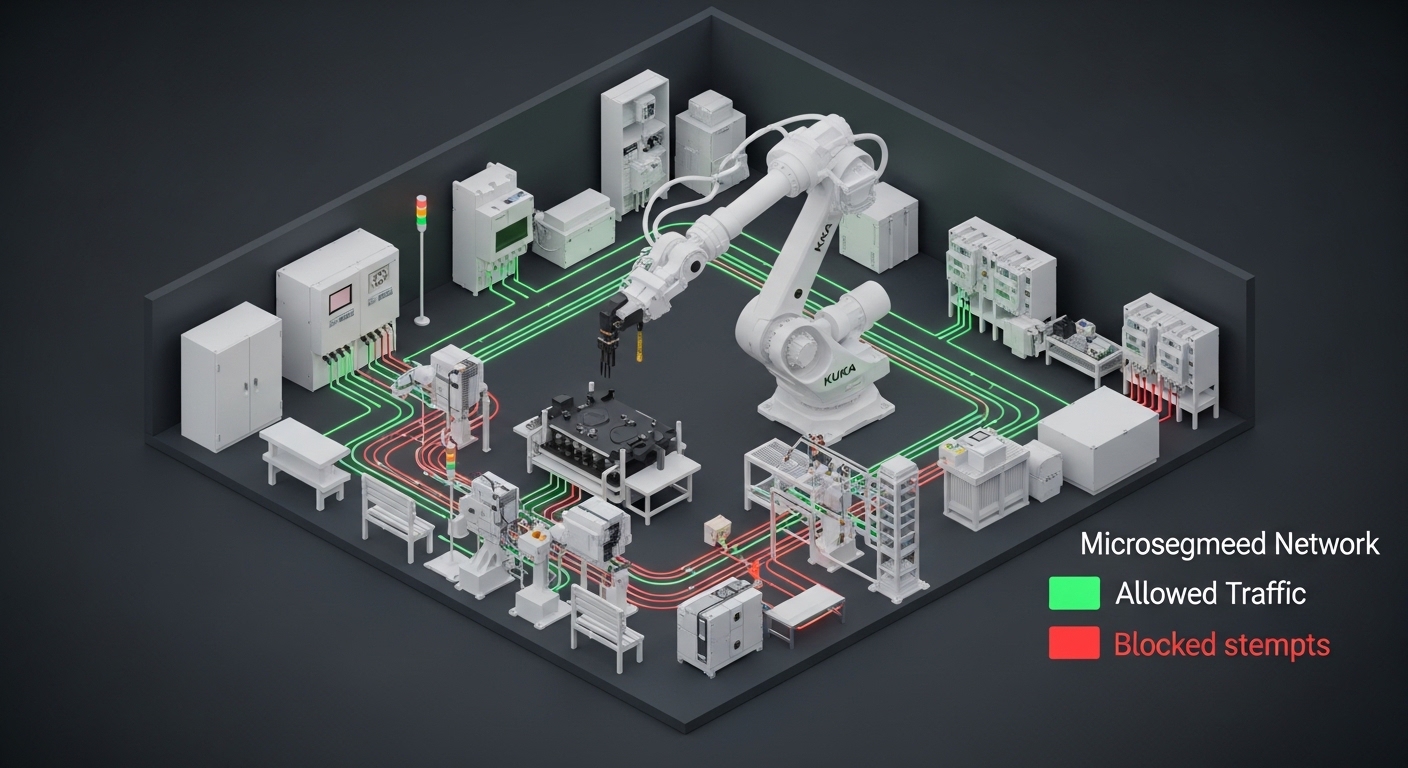
The Brownfield Bind: Implementing Zero-Trust Micro-segmentation in KUKA Robot Work Cells
Apex Insights Research Desk
The Convergence of Steel and Silicon: A New Attack Surface
The modern automotive manufacturing floor is a marvel of high-speed, synchronized automation. At its heart lies the robotic work cell, a deterministic ecosystem where controllers, robots, sensors, and actuators execute complex sequences with sub-millisecond precision. KUKA robotic arms, ubiquitous in this domain, are not just mechanical appendages; they are sophisticated cyber-physical systems operating within a complex Operational Technology (OT) network. However, the very connectivity that enables Industry 4.0's efficiency also exposes these critical assets to significant cyber threats.
Traditionally, OT security relied on a perimeter-based or "air-gap" model. This approach is no longer tenable. The convergence of IT and OT, driven by demands for predictive maintenance, real-time production analytics, and remote diagnostics, has rendered the perimeter porous. Once an adversary gains a foothold inside this historically "trusted" network—perhaps via a compromised engineering workstation or HMI—they often enjoy unrestricted lateral movement. For a KUKA work cell, this could translate into production sabotage, intellectual property theft of robotic programs, or catastrophic safety failures.
Zero-Trust Architecture (ZTA) offers a fundamentally different security paradigm, operating on the principle of "never trust, always verify." Its most potent implementation in an OT context is micro-segmentation: the practice of dividing the network into small, granular security zones—ideally down to the individual workload or device level—and enforcing strict access control policies for all traffic between them. Yet, applying this IT-native concept to a brownfield automotive OT environment, particularly one filled with legacy, latency-sensitive KUKA systems, is an engineering challenge of the highest order.
The Anatomy of a KUKA Work Cell Threat Surface
To grasp the implementation hurdles, one must first understand the architectural complexity of a typical KUKA robot cell. It is not a single entity but a system of systems, each with its own communication requirements:
- KUKA Robot Controller (KRC): The brain of the operation, often a KRC4 or the newer KRC5. It runs a proprietary real-time operating system (like VxWorks) and handles motion planning, I/O logic, and program execution. It communicates over industrial Ethernet protocols for deterministic control.
- Industrial Protocols: The lifeblood of the cell is real-time communication. This is dominated by protocols like PROFINET, EtherNet/IP, and EtherCAT, which have stringent timing requirements (jitter and latency) that cannot be compromised.
- Safety PLC: A dedicated controller (e.g., Siemens SIMATIC F-CPU) that manages the cell's safety functions (light curtains, E-stops, door interlocks) and communicates with the KRC over a safety-rated protocol like PROFIsafe.
- Ancillary Systems: This includes machine vision systems, weld timers, end-of-arm tooling (EOAT), and HMIs (like the KUKA smartPAD), all communicating with the KRC and each other.
- Upstream Connectivity: The work cell connects to Level 3 systems like Manufacturing Execution Systems (MES) for production orders and SCADA servers for plant-wide monitoring. This connection is a primary vector for IT-to-OT threat propagation.
The inherent network architecture is often flat at the cell level (Purdue Model Level 1/2), designed for performance and simplicity, not security. A threat actor compromising a vision system could potentially pivot to the KRC and issue unauthorized commands, a risk that traditional perimeter firewalls are powerless to prevent.
Practical Implementation Challenges: An Engineering Deep Dive
Transitioning a live, high-throughput automotive production line to a zero-trust model is not a simple task of deploying firewalls. It requires navigating a minefield of technical, operational, and architectural constraints. The core challenge is achieving granular security enforcement without disrupting the deterministic nature of the control processes.
The Deterministic Mandate and Latency Intolerance
Robotic control is a real-time application. The communication between the KRC, drives, and I/O modules is cyclic and must occur within a predefined, often sub-millisecond, time window. Traditional security appliances, designed for enterprise IT, introduce unacceptable levels of latency and jitter when performing deep packet inspection, which can disrupt the control loop and trigger a fault state in the robot controller. This reality underscores the need for security architectures that are purpose-built for OT environments. The primary engineering goal must be to secure brownfield PLC and robot networks with zero-trust without sacrificing real-time latency, a principle that must guide every architectural decision.
In accordance with ISA/IEC 62443, the implementation of security countermeasures must not compromise the essential functions of the Industrial Automation and Control System (IACS), specifically those related to safety, reliability, and availability. Any micro-segmentation solution must be verifiable against these operational requirements before full enforcement.
Asset Discovery in a 'Fog of OT'
You cannot protect what you cannot see. Brownfield networks are notorious for their lack of accurate documentation and asset inventories. The first step—creating a high-fidelity map of every device, its role, and its communication patterns—is a monumental task. Passive scanning is essential, as active probing can crash brittle legacy devices. This process involves capturing and analyzing network traffic to baseline what is 'normal,' a moving target in a dynamic production environment.
The Identity Conundrum for Headless Devices
Zero-trust is predicated on strong identity verification. But how do you assign and manage a verifiable identity for a 15-year-old conveyor belt controller or an IP-enabled sensor that lacks a TPM (Trusted Platform Module) and supports no modern authentication protocols like 802.1X? Forging a trustworthy identity for these headless, legacy devices often requires a proxy-based approach, where a network enforcement point imputes identity based on a combination of factors like MAC address, network location, and protocol-specific identifiers (e.g., a PROFINET device name). This is a foundational challenge in applying ZTA to legacy OT.
Protocol-Level Policy Enforcement
Effective OT micro-segmentation cannot rely on simple IP address and port rules (L3/L4). True security requires context-aware policies at the application layer (L7). The enforcement engine must deeply understand industrial protocols to create granular rules such as:
- ALLOW Engineering Workstation A to send a
Project_Uploadcommand to KRC-01. - DENY Engineering Workstation A from sending a
Stop_Programcommand during active production hours. - ALLOW Vision System B to send
Part_Present_OKcoordinates to KRC-01. - BLOCK all other traffic from Vision System B to the KRC.
Crafting such policies requires specialized deep packet inspection (DPI) engines that can parse the command and data structures within protocols like PROFINET, KUKA's own RSI (Robot Sensor Interface), and others. This necessitates sophisticated architectural blueprints for dynamic policy enforcement on proprietary OT protocols that can adapt to the unique traffic flows of a robotic cell.
The Zero-Downtime Imperative
Downtime in an automotive plant is measured in tens of thousands of dollars per minute. The concept of a 'maintenance window' to re-architect the network is often a non-starter. Any implementation must be non-disruptive and phased. This is perhaps the most significant operational barrier. A successful strategy must start in a passive, monitor-only mode to build confidence in the discovered assets and simulated policies. This is why a proven, field-tested methodology like a zero-downtime blueprint for micro-segmentation in live manufacturing OT is not just a recommendation but a critical requirement for project success.
An Architectural Blueprint for Phased Implementation
A viable strategy for deploying zero-trust micro-segmentation within a KUKA work cell must be methodical and risk-averse. The following steps provide a high-level architectural roadmap:
Passive Discovery and Flow Mapping: Deploy non-intrusive network sensors (using SPAN/TAP ports) to collect traffic from the work cell switch. Utilize an OT-aware visibility platform to automatically identify devices, classify protocols, and map all communication flows. This phase builds the foundational ground truth without any production risk.
Policy Simulation and Virtualization: Using the mapped flows, the platform should allow security architects to create and simulate micro-segmentation policies. For example, create a virtual segment around the KRC and its dedicated safety PLC. The system can then analyze live or recorded traffic to report which flows would be blocked by this policy, allowing for refinement before any enforcement is active.
Staged Enforcement with Inline Gateways: Deploy purpose-built OT security gateways or transparent firewalls at strategic choke points. A logical starting point is between the work cell switch and the wider plant network, effectively creating the first macro-segment around the entire cell. This immediately contains any potential east-west threat propagation from adjacent cells or the IT network.
Granular Intra-Cell Segmentation: Once the outer boundary is secure, deploy additional enforcement points within the cell. For instance, place a gateway directly in front of the KUKA Robot Controller. This allows for the creation of micro-segments that isolate the robot controller from the vision system, HMIs, and other peripherals.
Iterative Policy Refinement: Begin with the enforcement points in a permissive, logging-only mode. Once confidence in the baseline is high, slowly tighten the ruleset. Start by blocking unauthorized protocols entirely (e.g., no SMB or RDP traffic allowed to the KRC). Gradually progress to enforcing the granular, command-level policies derived from the discovery phase. This iterative process minimizes the risk of operational disruption.
Conclusion: Forging Deterministic, Resilient Enclaves
Implementing a zero-trust micro-segmentation strategy in a brownfield automotive OT network is not a product deployment; it is a fundamental shift in security architecture and operational philosophy. The challenges—preserving real-time determinism, navigating proprietary ecosystems, establishing identity for legacy assets, and adhering to the zero-downtime mandate—are substantial. However, the risk of inaction is far greater.
By adopting a phased, protocol-aware, and non-disruptive approach, manufacturing organizations can transform their vulnerable, flat networks into resilient enclaves of deterministic operation. This process moves security from a brittle perimeter to an intrinsic attribute of the system itself, creating a production environment that is not only efficient and connected but also fundamentally secure by design.
Sources / References
- NIST Special Publication 800-207: Zero Trust Architecture. Available at: https://csrc.nist.gov/publications/detail/sp/800-207/final
- ISA/IEC 62443 Series of Standards on Industrial Automation and Control Systems Security. Available at: https://www.isa.org/standards-and-publications/isa-standards/isa-iec-62443-series-of-standards
- KUKA AG, "Planning the power supply and network infrastructure for KUKA robot controllers (KRC4, KRC5)". Official documentation typically available via the KUKA Xpert portal.
- SANS Institute, "Effective Industrial Control System (ICS) Cybersecurity: The Top 20 Controls". Available at: https://www.sans.org/white-papers/34270/