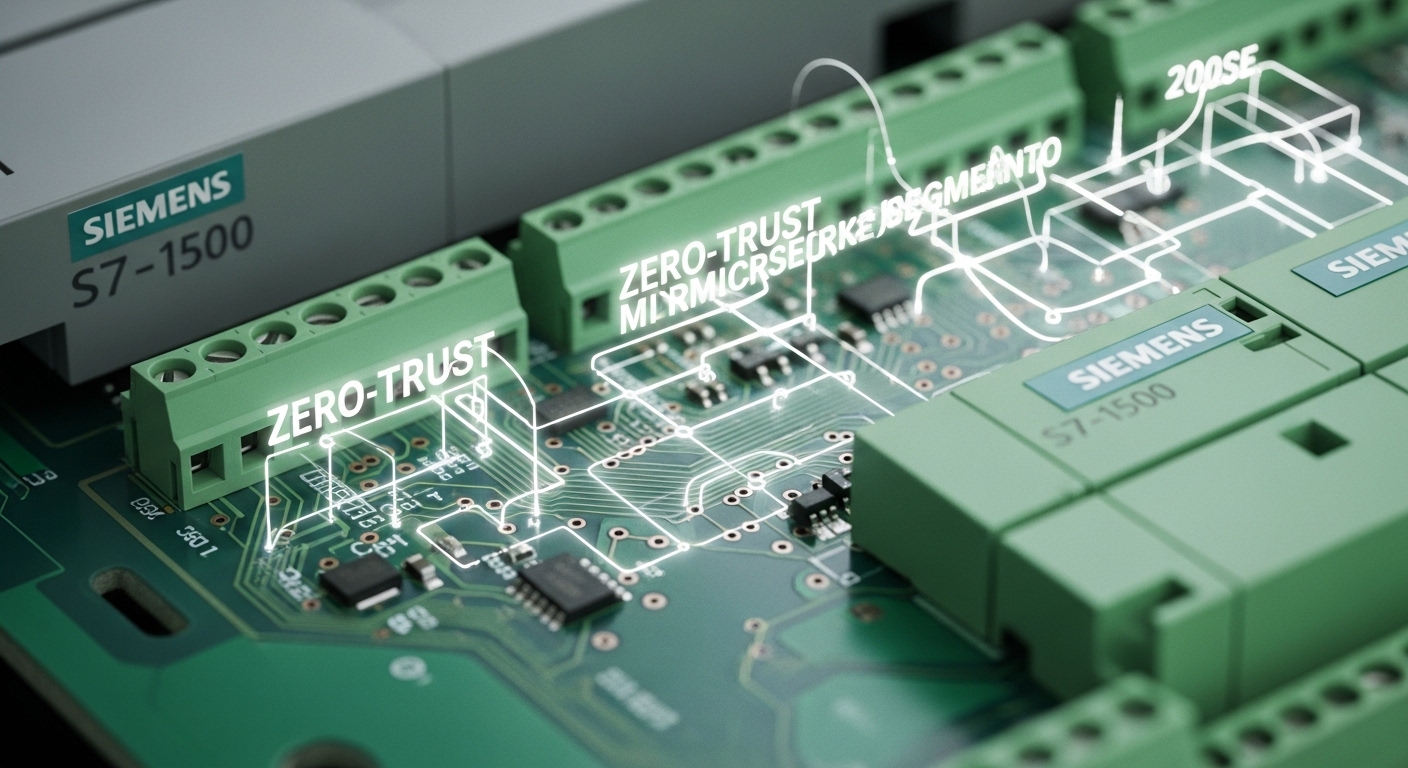
The Deterministic Dilemma: Integrating Zero-Trust Micro-segmentation in OT with Proprietary Protocols like S7Comm+
Apex Insights Research Desk
The Shift from Perimeter Defense to Granular Control in Operational Technology
The long-standing security paradigm for Operational Technology (OT) and Industrial Control Systems (ICS) has been one of physical isolation. The Purdue Model, with its hierarchical levels and the conceptual "air gap" separating enterprise networks (IT) from process control networks (OT), reinforced a perimeter-centric security posture. However, the relentless drive for operational efficiency, predictive maintenance, and data-driven manufacturing through IT/OT convergence has systematically dismantled these air gaps, exposing mission-critical, and often fragile, control systems to new threat vectors. In this converged landscape, the implicit trust model of the flat, internal OT network is no longer defensible.
Enter Zero-Trust Architecture (ZTA), a security model predicated on the principle of "never trust, always verify." Rather than trusting anything inside the network perimeter, ZTA enforces strict identity verification and authorization for every device and user before granting access to resources. Micro-segmentation is a core enabling technology for ZTA, breaking large network perimeters into small, granular zones—sometimes down to the individual workload or device—to contain lateral movement and limit the blast radius of a potential breach. While this is a mature concept in IT, its application in OT environments, particularly those reliant on proprietary industrial protocols, presents a unique and formidable set of engineering challenges. This is especially true when dealing with protocols like Siemens S7 Communication Plus (S7Comm+), the foundational language of the TIA Portal ecosystem.
The Protocol-Level Barrier: Why S7Comm+ Defies Conventional Segmentation
At a surface level, S7Comm+ is an application-layer protocol that typically runs over TCP on port 102. An IT-centric firewall can easily write a rule to allow or deny traffic on this port between an HMI and a PLC. This, however, is a fundamentally inadequate security control that fails to grasp the nature of industrial communication. The critical challenge lies in the protocol's proprietary and opaque structure.
Unlike open standards such as Modbus/TCP, where function codes (e.g., 0x01 Read Coils, 0x05 Write Single Coil) are publicly documented, the internal commands, data structures, and function parameters of S7Comm+ are not. A standard Next-Generation Firewall (NGFW) performing Deep Packet Inspection (DPI) sees a stream of bytes within a TCP session. It can verify that the session is legitimate at Layer 4, but it has no semantic understanding of the Layer 7 payload. It cannot differentiate between:
- A benign read request for a production counter from a SCADA server.
- A malicious 'Stop CPU' command from a compromised engineering workstation.
- An unauthorized modification of safety logic or alarm thresholds.
- An attempt to exfiltrate proprietary process logic by repeatedly reading program blocks.
To the IT firewall, these are all valid TCP packets destined for port 102. This opacity renders conventional segmentation tools blind, forcing them to operate on coarse-grained allow/deny lists based on IP addresses alone. This falls drastically short of the Zero-Trust principle of least-privilege access, which demands policy based on the specific intent of the communication.
Practical Implementation Challenges
Translating the Zero-Trust philosophy into a brownfield OT environment running Siemens PLCs requires overcoming specific, deeply technical hurdles that have no direct parallel in the IT world. These challenges extend beyond the protocol itself into the very physics and operational mandates of the industrial process.
- The Deterministic Mandate and Latency Injection: Industrial control networks are not built for best-effort delivery; they are built for deterministic, real-time communication. PLC scan cycles, which can be as low as a few milliseconds, are the heartbeat of the manufacturing process. A security control that introduces even a minor, variable amount of latency (jitter) can disrupt this timing, causing missed I/O updates, process instability, or even triggering a safety interlock that halts production. A core engineering principle for any OT security architecture is therefore non-interference.
The introduction of any inline security component must be provably non-disruptive to the deterministic communication paths upon which the control and safety systems depend. Any latency injected by packet inspection or policy enforcement must be negligible and, critically, consistent.
The Identity and Authentication Void: Zero-Trust is fundamentally rooted in strong, verifiable identity. Yet, the vast majority of deployed PLCs, including many S7-300, S7-400, and even early S7-1200/1500 models, lack robust identity mechanisms. Communication is often based on pre-shared keys or no authentication at all. How does a segmentation gateway differentiate between a legitimate HMI and an attacker's laptop spoofing its IP address? This identity gap is a primary obstacle. Forging a trusted identity for devices that were never designed to have one is a central challenge in securing these networks. This requires an architectural approach that moves beyond simple IP addresses, as detailed in the blueprint for an identity-based Zero-Trust micro-segmentation in brownfield Siemens OT.
Granularity of Policy Enforcement: Effective Zero-Trust in an S7 environment requires policies of surgical precision. For example: "Allow the
HMI_Boiler_Controlat192.168.1.10to READ variables within Data BlockDB10of thePLC_Boiler_S7-1500at192.168.1.5, but DENY all WRITE operations. DENY all 'Program Upload/Download' functions from any source outside of the designatedEngineering_VLAN." Enforcing such a rule necessitates a security device that can fully parse the S7Comm+ protocol, identify the function codes for reading vs. writing, recognize block numbers, and understand system-level commands like 'Stop CPU'. This level of protocol-specific intelligence is absent in generic security platforms.Asset Discovery and Policy Baselining: You cannot secure what you cannot see. The first step in any micro-segmentation project is to build a comprehensive inventory of all assets and map their communication patterns. In sprawling, decades-old brownfield sites, this is a monumental task. Asset lists are often outdated, and the full extent of device-to-device communication is unknown. Deploying a solution in active enforcement mode without a high-fidelity baseline of legitimate traffic flows is a recipe for disaster, as it will inevitably block critical process communication. Successfully navigating these Zero-Trust micro-segmentation hurdles in live brownfield PLC environments depends entirely on achieving this visibility without disrupting operations.
Architectural Blueprints for S7Comm+ Segmentation
Overcoming these challenges is not impossible but requires moving away from IT-centric tools and adopting an OT-native approach. The goal is to build a resilient architecture that contains threats without compromising process integrity.
Phase 1: Passive Discovery and Baselining. The initial deployment should always be non-intrusive. By connecting to the network via a Test Access Point (TAP) or a switch's SPAN port, a protocol-aware security platform can begin to learn. It passively listens to all S7Comm+ traffic, identifying PLCs, HMIs, and engineering stations. It then builds a high-fidelity communication map, automatically baselining every legitimate connection: which HMI reads which data block, which PLC communicates with which drive, and during what time windows. This phase builds the foundation of the Zero-Trust policy without risking any operational impact.
Phase 2: Policy Simulation and Refinement. Once a stable baseline is established, the system can move into a simulation mode. The proposed micro-segmentation rules are loaded, and the platform analyzes live traffic against this policy. It flags any traffic that would have been blocked without actually dropping the packets. This allows engineers to identify and whitelist legitimate but infrequent communications (e.g., quarterly maintenance activities) and refine the policy until false positives are eliminated.
Phase 3: Phased Enforcement with Compensating Controls. Active enforcement should be rolled out in a phased, controlled manner, starting with the least critical segments of the plant. Inline segmentation gateways, specifically designed for OT with low-latency hardware and S7Comm+ protocol dissectors, are placed at key network chokepoints (e.g., between Level 1 and Level 2 of the Purdue model). These gateways enforce the refined policy, effectively creating micro-enclaves around critical assets or process cells. The ultimate goal is to evolve towards a system of dynamic policy enforcement on proprietary OT protocols, where rules can be adapted based on real-time operational context.
Phase 4: Continuous Monitoring and Threat Response. Micro-segmentation is not a one-time setup. The security platform must continuously monitor traffic within the newly created segments for any anomalous behavior that could indicate a compromised device. This includes monitoring for unauthorized commands, unusual data payloads, or changes in communication timing, providing a final layer of defense inside the perimeter.
Conclusion: The Path to a Deterministic and Secure OT Environment
Integrating Zero-Trust micro-segmentation into OT environments dominated by proprietary protocols like S7Comm+ is a complex engineering endeavor. It represents a significant departure from the plug-and-play simplicity often found in IT security. The core challenges—protocol opacity, the absolute requirement for deterministic performance, the inherent lack of device identity, and the difficulty of baselining in brownfield settings—demand specialized, OT-aware solutions and a methodical, phased implementation strategy. Simply porting IT firewalls to the factory floor is a proven path to failure. The future of resilient industrial operations hinges on our ability to build security architectures that respect the unique physics of process control while applying the rigorous, explicit trust model of Zero-Trust. It is a deterministic dilemma that can only be solved with protocol-fluent, identity-driven, and operationally-aware security controls.
Sources / References
- NIST Special Publication 800-82 Revision 3 (Draft), "Guide to Operational Technology (OT) Security":
https://csrc.nist.gov/publications/detail/sp/800-82/rev-3/draft - Siemens ProductCERT Security Advisory on S7 Communication (Example):
https://cert-portal.siemens.com/productcert/pdf/ssa-568427.pdf - SANS Institute Whitepaper, "A Practical Application of the Top 20 CSCs in an ICS Environment":
https://www.sans.org/white-papers/34290/ - Wireshark Wiki for S7 Communication Protocol Dissection:
https://wiki.wireshark.org/S7comm.html