Architecting Deterministic Zero-Trust for Legacy Rockwell ControlLogix Across Multi-Site WANs
Apex Insights Research Desk
Introduction: The Brownfield CIP Conundrum
In modern, distributed manufacturing, the Rockwell ControlLogix platform remains a bedrock of industrial automation. These powerful Programmable Logic Controllers (PLCs) form the cognitive core of processes where downtime is measured in millions of dollars per hour. Historically, the networks connecting these PLCs—primarily running the Common Industrial Protocol (CIP) over EtherNet/IP—were isolated, air-gapped, and implicitly trusted. This paradigm is obsolete. The convergence of IT and OT, driven by demands for remote monitoring, cloud analytics, and multi-site production orchestration, has exposed these critical systems to unprecedented risk by stretching them across Wide Area Networks (WANs).
The core challenge is architectural: How does an organization implement a modern, dynamic Zero-Trust security posture on legacy, brownfield ControlLogix systems without violating the cardinal rule of OT—the preservation of real-time, deterministic operations? Traditional IT security tools, ignorant of the CIP protocol's nuances and intolerant of latency, are not merely ineffective; they are actively dangerous to production integrity. This analysis from the Apex Insights Research Desk presents a network-centric architectural blueprint for enforcing dynamic, CIP-aware Zero-Trust policies across a multi-site WAN without compromising the deterministic guarantees required by high-speed control loops.
Deconstructing the Architectural Challenge
The difficulty of this task lies at the intersection of three complex domains: the ControlLogix platform, the CIP protocol, and the physics of wide-area networking.
Rockwell ControlLogix & EtherNet/IP: The ControlLogix architecture relies heavily on EtherNet/IP, an application-layer protocol that encapsulates CIP. CIP traffic is not monolithic. It includes:
- Implicit Messaging (Class 1): High-speed, cyclic I/O data, often using UDP multicast. This is the heartbeat of the control system, where jitter and latency are measured in microseconds and can directly impact physical processes. It operates on a producer/consumer model.
- Explicit Messaging (Class 3): Acyclic, connection-oriented client/server communication used for diagnostics, programming, and HMI data transfers. While less time-sensitive than Class 1, it is a primary vector for unauthorized access and malicious commands.
The implicit trust model of EtherNet/IP assumes that any device on the network is legitimate. This is fundamentally incompatible with Zero-Trust principles.
The Determinism Mandate: The primary function of a PLC is to execute control logic in a predictable, repeatable, and timely manner. Any security solution that introduces significant latency or, more critically, unpredictable jitter, threatens to break this deterministic contract. This is the central engineering problem. As detailed in our prior research on The Determinism Dilemma: Preserving Real-Time Integrity in Micro-Segmented ICS Networks, security cannot come at the cost of operational stability.
In Operational Technology, the principles of the CIA triad (Confidentiality, Integrity, Availability) are re-prioritized to AIC. Availability and Integrity are paramount. A security control that causes a process to halt or behave erratically has failed in its primary objective, regardless of how many threats it blocks.
Multi-Site WAN Complexity: Stretching a control network across a WAN introduces variable latency, packet loss, and reduced bandwidth. Enforcing a consistent, synchronized security policy across multiple sites while managing these network inconsistencies requires a sophisticated architectural approach that goes far beyond simple firewalling at the plant edge.
An Architectural Blueprint for Dynamic CIP Policy Enforcement
A viable solution must be network-centric, protocol-aware, and centrally orchestrated. Modifying the firmware or ladder logic of thousands of deployed ControlLogix PLCs is a non-starter due to validation, certification, and operational risk. The following step-by-step blueprint outlines a non-disruptive, overlay-based approach.
Establish a Baseline via Protocol-Aware Monitoring: Before any policy can be enforced, you must first understand what is authorized. This requires deploying network TAPs or SPAN ports to feed a deep packet inspection (DPI) engine capable of parsing the full CIP protocol stack. The objective is to automatically map every controller, HMI, and I/O block, discovering every tag being read/written and every service being invoked. This creates a granular, machine-generated baseline of legitimate communication patterns—the foundation of a least-privilege policy.
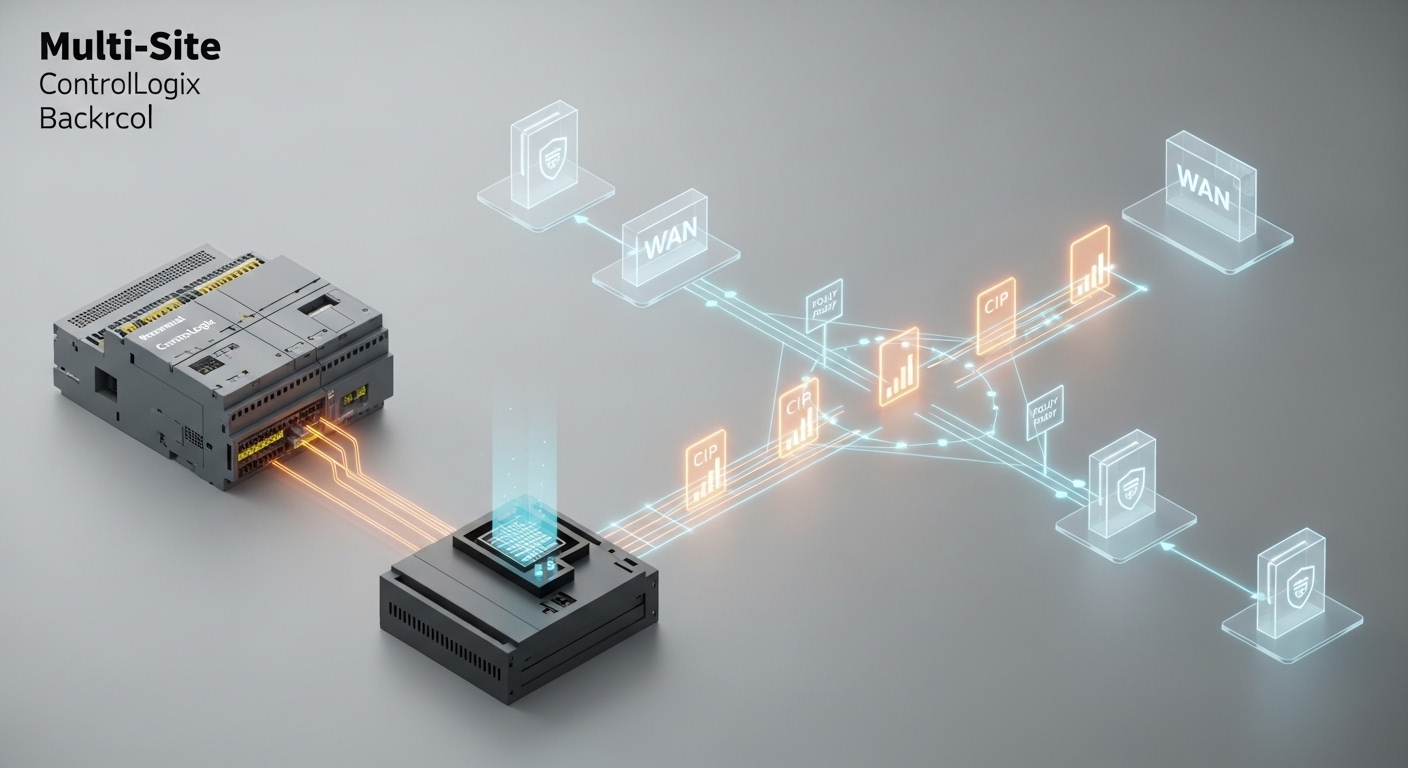
Deploy Transparent Policy Enforcement Points (PEPs): Instead of deploying traditional firewalls, the architecture calls for transparent, bump-in-the-wire PEPs placed at strategic network chokepoints—typically at the ingress/egress of each PLC's network segment or at the aggregation point before the WAN link. These PEPs must be engineered for near-zero latency, often utilizing FPGA-based hardware acceleration or DPDK/kernel-bypass techniques to inspect and pass traffic without impacting control loops.
Implement a Centralized Policy Decision Point (PDP): A logically centralized PDP serves as the brain of the operation. This is where security and operations teams define access policies using a high-level, human-readable format. The PDP translates these policies into precise enforcement rules that are pushed down to the distributed PEPs. This centralization ensures consistency across all sites and allows for dynamic updates in response to operational changes (e.g., a maintenance window) or security alerts.
Define Policies at the CIP Application Layer: This is the core of the solution's intelligence. Policies must transcend simple IP address and port rules. A CIP-aware policy engine enables rules of unprecedented granularity, directly aligning security with operational intent. True granular control at the PLC register level is the goal.
- User/Role Context:
ALLOW [Maintenance_Engineers_Group] to invoke [Firmware_Update_Service] on [PLC_Substation_3] - Tag-Level Specificity:
ALLOW [HMI_Mixer_5] to READ_TAG [Motor_Speed, Tank_Temp] from [PLC_Mixer_5] but DENY_WRITE - Process State Context:
DENY [ALL] to invoke [Program_Mode_Change] on [PLC_Production_Line_1] IF [Process_State_Tag] == RUNNING - Service Restriction:
DENY CIP service code 0x4D (Write Tag Fragmented) from any source not explicitly authorized as a programming terminal.
- User/Role Context:
Integrate with Identity and Access Management (IAM): To achieve true dynamic enforcement, the PDP must integrate with enterprise IAM systems (e.g., Active Directory). When an engineer connects for a remote session, their authenticated IT identity is correlated with their OT role. The PDP then generates and deploys a temporary, just-in-time policy to the relevant PEPs, permitting access only to the specific PLCs and tags required for their task. Once the session ends, the permissive rules are automatically revoked.
Practical Implementation Challenges
Deploying this architecture in a live manufacturing environment presents significant engineering hurdles that require careful consideration.
Latency and Jitter in Deterministic Paths
Even with hardware acceleration, any inline device adds latency. For Class 1 CIP traffic, which may have a Requested Packet Interval (RPI) as low as 2ms, even a few hundred microseconds of added jitter from a PEP can cause a connection timeout, leading to a line stoppage. The PEPs must have deterministic performance characteristics under full load, and the entire communication path must be rigorously tested in a lab environment that mirrors production network conditions before deployment.
Handling Multicast Implicit I/O
ControlLogix PLCs make extensive use of UDP multicast for efficient producer/consumer I/O. Applying a traditional, unicast-focused security policy to multicast traffic is complex. A PEP cannot simply block an unauthorized subscriber without potentially impacting authorized subscribers in the same multicast group. The policy engine must be able to understand the IGMP (Internet Group Management Protocol) state and apply filtering rules that can differentiate between legitimate and illegitimate attempts to join a CIP I/O multicast group, a key tenet of a non-disruptive micro-segmentation blueprint for EtherNet/IP.
CIP Path Parsing Complexity
CIP uses a complex 'path' attribute within its messages to address specific objects inside a device (e.g., through a backplane, across a ControlNet bridge, to a specific tag). A malformed or maliciously crafted path can be used to bypass simplistic security policies. The DPI engine within the PEP must be capable of fully parsing and validating these complex, multi-segment paths to prevent sophisticated evasion techniques.
State Synchronization and Policy Consistency Over WAN
In a multi-site deployment, ensuring that every PEP has the most up-to-date policy without interruption is critical. If a WAN link between a site's PEP and the central PDP is unstable, how does the PEP behave? It must be designed to continue enforcing its last known good policy and have a clear, pre-defined behavior for handling new, unknown flows (typically default-deny). The control channel between the PEP and PDP must be robust, secure, and lightweight.
Conclusion: From Implicit Trust to Explicit Verification
Implementing dynamic Zero-Trust for legacy Rockwell ControlLogix systems across a WAN is a formidable but achievable engineering endeavor. The historical model of perimeter security and implicit internal trust is no longer defensible. By shifting to a network-centric enforcement model that leverages deep, protocol-aware inspection of CIP traffic, organizations can build a security architecture that is both robust and operationally transparent.
The key is to move beyond the limitations of IT-centric security tools and embrace solutions architected for the unique demands of OT. Through a phased approach of baselining, transparent enforcement, and defining policies based on operational intent—at the level of individual tags and services—manufacturers can enforce the principle of least privilege without disrupting the deterministic processes that underpin their operations. This explicit verification is the future of resilient industrial automation.
Sources / References
- ODVA. (2020). Securing EtherNet/IP Networks (Pub 35). Available at: https://www.odva.org/wp-content/uploads/2020/06/PUB00035R2_Securing-EtherNetIP-Networks.pdf
- Rockwell Automation. (2022). EtherNet/IP Modules in ControlLogix User Manual (Publication ENET-UM001). Available at: https://literature.rockwellautomation.com/idc/groups/literature/documents/um/enet-um001_-en-p.pdf
- National Institute of Standards and Technology. (2024). Guide to Operational Technology (OT) Security (NIST Special Publication 800-82, Revision 3 Draft). Available at: https://csrc.nist.gov/pubs/sp/800/82/r3/ipd