The Serial Conundrum: Architecting Zero-Trust Segmentation for Non-IP OT Protocols Without Downtime
Apex Insights Research Desk
The Fundamental Disconnect: IP-Native Security vs. Serial OT Reality
The prevailing discourse on Zero-Trust architecture is overwhelmingly dominated by IP-native constructs. It presupposes a world of routable packets, MAC and IP addresses, and clearly defined network segments that can be programmatically reconfigured. However, this model collapses when confronted with the reality of brownfield manufacturing facilities. These environments are built upon decades of non-IP, serial-based OT protocols—Modbus RTU, PROFIBUS DP, DeviceNet, and countless proprietary point-to-point serial links. These protocols represent the foundational layer of industrial control, yet they are architectural blind spots for modern security frameworks.
Unlike Ethernet, where switches and routers create logical segmentation, serial protocols like RS-485 often operate on a multi-drop bus architecture. Every device on the bus physically sees all traffic, creating an environment of implicit trust. There is no native mechanism for authentication, authorization, or encryption. The core engineering assumption was that physical isolation equated to security—an assumption that has been decisively invalidated by the convergence of IT and OT networks. Standard micro-segmentation, which relies on firewalling IP addresses or VLANs, is simply not applicable. The challenge, therefore, is not to adapt existing tools, but to architect a new enforcement paradigm that respects the physical and logical constraints of these legacy systems while superimposing a dynamic, Zero-Trust policy layer.
Architectural Blueprint: A Phased, Non-Disruptive Enforcement Strategy
Implementing Zero-Trust controls on live, non-IP production networks demands a meticulous, phased approach that prioritizes operational continuity above all else. A "rip and replace" strategy is a non-starter; the solution must be overlaid onto the existing infrastructure with zero operational impact. The following blueprint outlines a field-tested methodology for achieving this.
Phase 1: High-Fidelity Passive Discovery & Communication Baselining The foundational step is to achieve complete visibility without any active intervention. This involves deploying passive network taps on the physical serial links (e.g., splitting RS-485 pairs) connected to specialized protocol analyzers or OT security sensors. The objective is to capture and deconstruct the raw serial traffic, building a granular baseline of all communications. This is not merely an inventory of devices, but a stateful map of transactions: Which master PLC is polling which slave VFD? What Modbus function codes are being used? What specific register addresses are being read from and written to? What are the typical polling intervals and response latencies? This baseline becomes the immutable source of truth for policy creation.
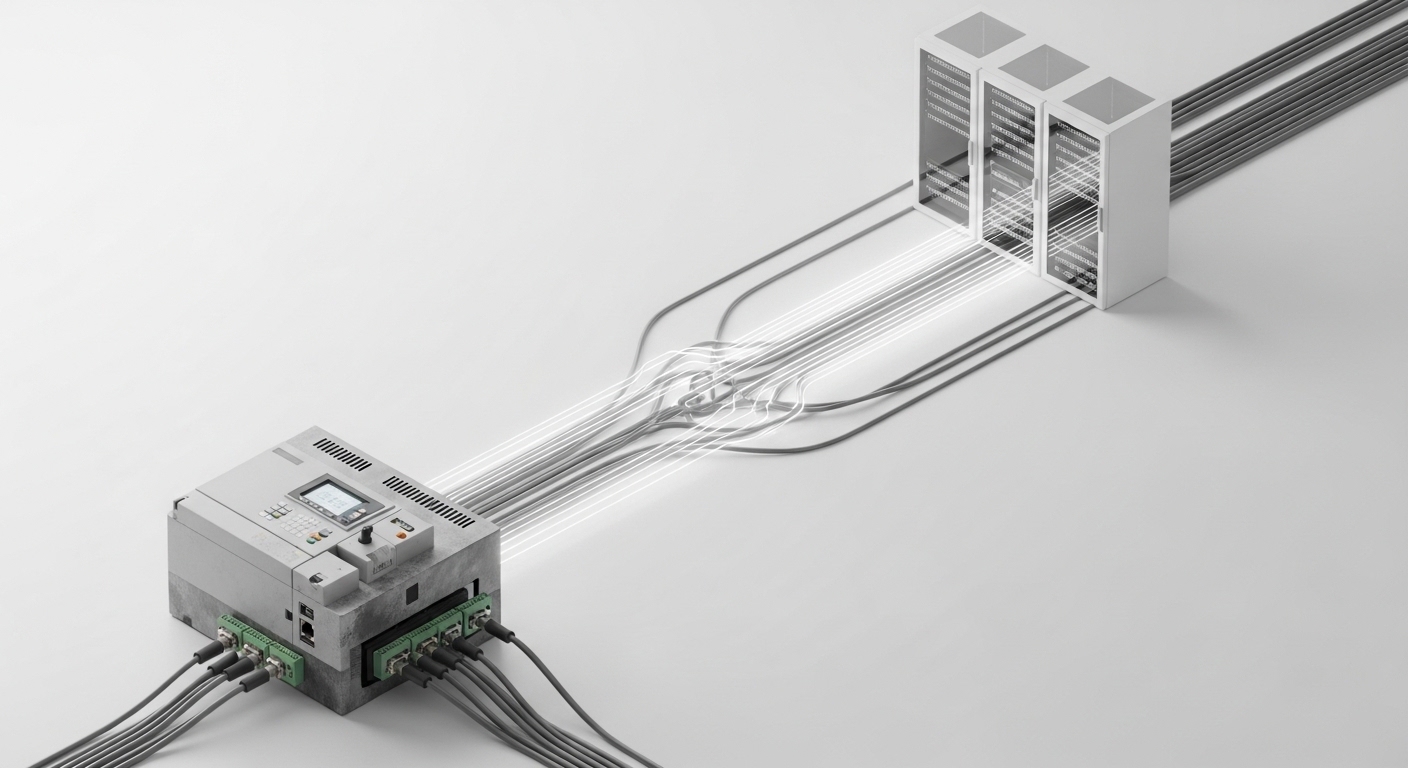
Phase 2: Strategic Insertion of Protocol-Aware Enforcement Points With a validated baseline, the next step is to introduce Policy Enforcement Points (PEPs). For non-IP protocols, these PEPs take the form of intelligent serial-to-ethernet gateways or purpose-built security proxies deployed in-line. The key is their placement: they must be inserted at strategic choke points, typically between a master controller (like a PLC or RTU) and its string of slave devices. These are not simple media converters; they must possess sufficient processing power to perform deep packet inspection (DPI) on the serialized data stream in real-time and enforce policies at the command level.
Phase 3: Decoupling Policy Logic with an Out-of-Band Policy Decision Point (PDP) The intelligence for enforcement should not reside solely within the PEPs. A centralized Policy Decision Point (PDP)—the brain of the Zero-Trust architecture—is implemented out-of-band. The PEPs query the PDP to make allow/deny decisions. This decoupling allows for scalable, consistent policy management across a multi-site facility. The PDP must be architected to understand OT context. Instead of IP-based rules, it ingests the baseline data to formulate rules like: "Allow PLC_Boiler_A (communicating via PEP_1) to execute Modbus Function Code 06 (Write Single Register) to Slave_ID_10 (Pressure_Valve_B) at Register_40001, but only if the value is within the range of 80-120 PSI."
Phase 4: Monitor-First Deployment and Incremental Enforcement Rollout To guarantee zero production impact, the PEPs are initially deployed in a passive, monitor-only mode. In this state, they inspect all traffic, evaluate it against the defined policies, and generate alerts for any violations, but they do not block any communication. This critical step allows engineers to validate and refine policies against live production traffic, ensuring no legitimate process communication is inadvertently flagged. This methodology is central to achieving a zero-downtime microsegmentation in legacy ICS. Once policy confidence is at 100%, enforcement is enabled segment by segment, starting with the least critical systems and progressing methodically across the plant floor.
The Crucial Role of Protocol-Aware Gateways
The technical linchpin of this entire strategy is the intelligent gateway acting as a PEP. Its capabilities extend far beyond simple protocol conversion.
Deep Packet Inspection (DPI) for Serial Streams
These gateways must contain sophisticated DPI engines capable of deconstructing the application layer of protocols like Modbus RTU or PROFIBUS DP. This means parsing the raw binary data to identify the source and destination (e.g., Slave ID), the specific action being requested (e.g., Function Code 03 - Read Holding Registers), the memory addresses being targeted, and the data payloads. This granularity is what enables true least-privilege enforcement at the command level.
Identity Brokering and Trust Anchors
Legacy serial devices have no concept of identity, certificates, or authentication tokens. The gateway must act as an identity broker on their behalf. When the gateway is installed, it is provisioned with a strong identity, which it uses to communicate with the PDP. The trust in the legacy endpoint is transferred to the trust in the gateway protecting it. To prevent the gateway itself from being compromised, it must be a hardened appliance with features like secure boot and, ideally, utilize hardware-rooted attestation to cryptographically prove its integrity to the rest of the security architecture before being allowed to enforce policy.
In legacy OT, the perimeter cannot be the network; it must be the transaction itself. The fundamental unit of trust evaluation shifts from an IP address to a specific register write or function code invocation within a validated process context.
Practical Implementation Challenges
Transitioning this architecture from blueprint to a functioning system in a brownfield environment presents significant engineering hurdles that require specialized expertise.
- Physical Media Interception: Safely tapping into a live RS-485 bus or a point-to-point RS-232 link inside a cramped, energized control panel requires meticulous planning. Improper termination or impedance mismatches introduced by a physical tap can corrupt data and halt production. Specialized non-intrusive probes or carefully planned, minimal-downtime cutovers are necessary.
- Protocol Ambiguity and Proprietary Extensions: While standards like Modbus exist, decades of implementation have led to vendor-specific extensions and subtle deviations. A DPI engine might successfully parse 95% of traffic but fail on a proprietary function code used for device diagnostics, potentially causing a critical alert flood or blocking a necessary maintenance function. The approach must be adaptable, often requiring custom parsers for the unique protocol dialects found in a multi-vendor environment, a key challenge in segmenting proprietary industrial networks.
- Deterministic Latency Constraints: Industrial control loops are often highly sensitive to timing. A PEP that adds even a few milliseconds of processing latency to a serial communication path can destabilize a fast-moving PID loop, leading to process oscillations, quality defects, or emergency shutdowns. Rigorous performance testing of any in-line device under full load is not optional; it is a prerequisite for deployment.
- Environmental Hardening and Reliability: The PEPs are not deployed in a climate-controlled data center. They reside on the factory floor, subject to extreme temperatures, humidity, vibration, and significant electromagnetic interference (EMI). They must be industrially hardened systems with high mean time between failures (MTBF) ratings to match the reliability expectations of the operational technology they protect.
The End State: Context-Aware, Dynamic Micro-Perimeters
By successfully navigating these challenges, the resulting architecture achieves what was previously considered impossible: the creation of dynamic, software-defined micro-perimeters around devices that lack any native networking or security capabilities. The security boundary is no longer the physical wire; it is a logical, context-aware policy enforced on every single transaction. A request from a maintenance laptop to update PLC logic might be permitted during a scheduled maintenance window but is automatically blocked during active production. An anomalous command attempting to overwrite a safety parameter on a variable frequency drive is dropped at the PEP before it ever reaches the device.
This strategy effectively retrofits Zero-Trust principles onto the most vulnerable and critical assets within a manufacturing facility. It moves beyond the static, brittle security of network firewalls and embraces a fluid, resilient model where trust is continuously verified based on the real-time context of the industrial process itself, securing the unsecurable without disrupting the critical operations they support.
Sources / References
- NIST Special Publication 800-207, Zero Trust Architecture: https://csrc.nist.gov/publications/detail/sp/800-207/final
- ISA/IEC 62443 Series of Standards on Industrial Automation and Control Systems Security: https://www.isa.org/standards-and-publications/isa-standards/isa-iec-62443-series-of-standards
- The Modbus Organization, Modbus Protocol Specifications: https://modbus.org/specs.php
- PROFIBUS & PROFINET International (PI), PROFIBUS Technology and Application - System Description: https://www.profibus.com/download/profibus-technology-and-application-system-description