The Digital Airlock: Architecting Zero-Trust Vendor Access to Level 0/1 Industrial Control Systems
Apex Insights Research Desk
The Imperative for a New Access Paradigm in OT
Granting remote access to third-party vendors for maintenance, diagnostics, and system integration is a non-negotiable operational reality in modern manufacturing. The sophisticated machinery populating Level 0 (the physical process) and Level 1 (basic control) of the Purdue Model demands specialized expertise that is often external to the organization. However, the traditional architectural approach to this access—typically a corporate Virtual Private Network (VPN)—presents an existential threat to plant safety and production continuity. A VPN, by its nature, extends a trusted network boundary to an untrusted external endpoint. Once connected, a vendor's machine is effectively 'on the network,' creating a broad attack surface and an ideal pivot point for lateral movement. For Level 0/1 systems, where digital commands translate directly into physical action, this model of implicit trust is indefensible.
The Zero-Trust security model offers a fundamentally different architectural approach. It inverts the traditional security posture, operating on the principle of "never trust, always verify." It assumes that no user or device, whether internal or external, should be trusted by default. Every access request must be rigorously authenticated, authorized, and encrypted before access is granted, and that access must be constrained to the absolute minimum required for the task at hand. This paper details an architectural blueprint for applying Zero-Trust principles to grant ephemeral, least-privilege access for remote vendors to the most critical assets on the plant floor.
Deconstructing the Zero-Trust Architecture for ICS
Transitioning from a perimeter-based security model to a Zero-Trust architecture (ZTA) requires a paradigm shift in how we define trust and enforce access. The network perimeter is no longer the firewall at the edge of the plant; it is the identity of the user, the health of their device, and the context of their access request. The core tenets are not products, but strategic principles:
- Identity as the Perimeter: All access is brokered based on the verified identity of the entity requesting it (user, device, service), not its network location. Strong, multi-factor authentication is the baseline.
- Least-Privilege Access (JEA/JIT): Users are granted Just-Enough-Access (JEA) for the specific task and only for the duration needed, a concept known as Just-in-Time (JIT) access. Default-deny policies are enforced universally.
- Micro-segmentation: The network is logically divided into small, isolated segments—ideally down to the individual asset level. This prevents lateral movement by ensuring that a compromise in one segment cannot spread to others.
- Continuous Verification: Trust is not a one-time event at login. Device posture, user behavior, and session context are continuously monitored. If anomalies are detected, access can be terminated in real-time.
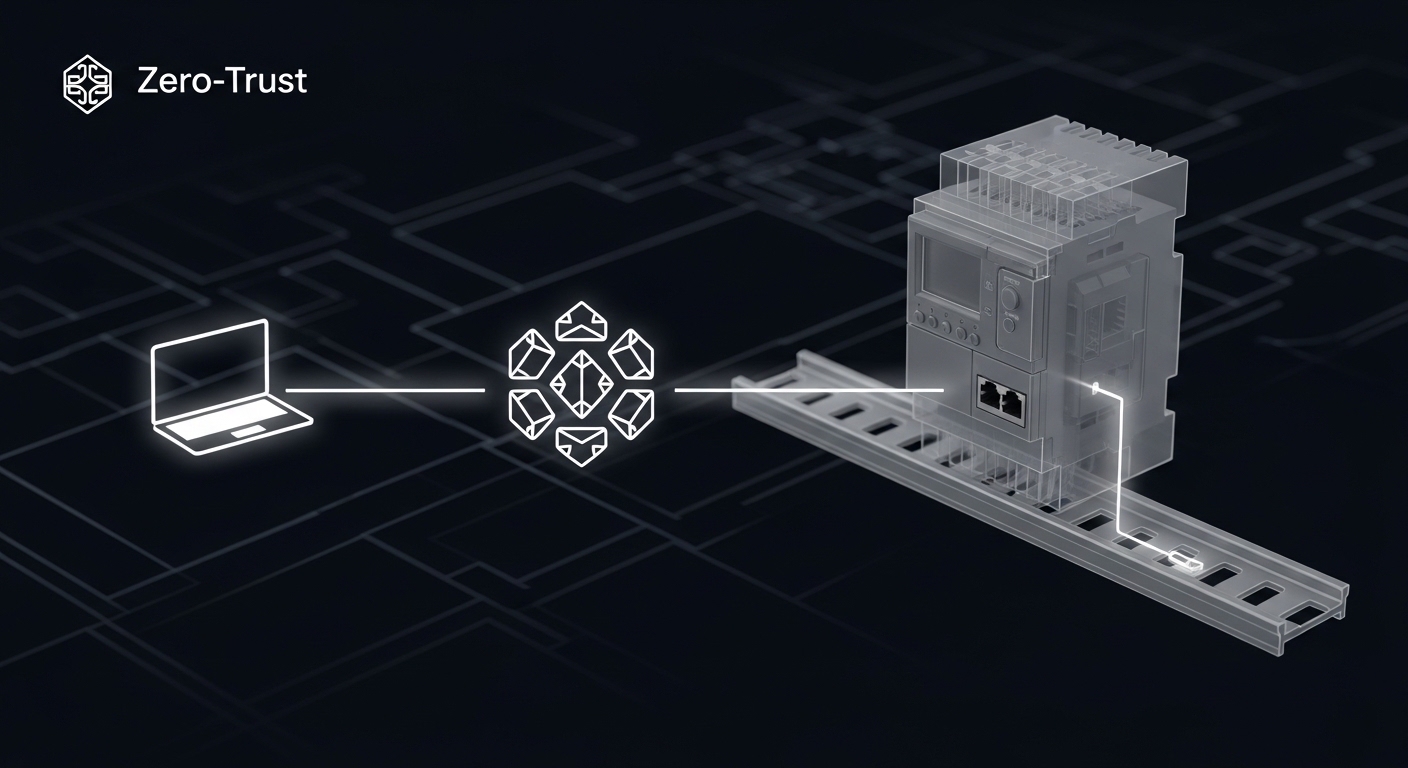
This stands in stark contrast to the VPN's 'connect-first, access-later' model. Under Zero-Trust, a vendor's endpoint is never placed on the OT network. Instead, it is granted a temporary, encrypted, one-to-one connection to a specific asset, for a specific purpose, after passing a stringent policy check.
An Architectural Blueprint for Secure Vendor Access
Implementing a robust Zero-Trust framework for vendor access to Level 0/1 systems is a multi-stage process that integrates identity management, policy enforcement, and secure connectivity. The following blueprint outlines a phased architectural approach.
Establish a Dynamic Identity & Trust Anchor: The process begins with identity. Vendor user accounts must be federated through a modern Identity Provider (IdP) such as Azure Active Directory or Okta. Access policies are not tied to static IP addresses but to dynamic identities. A trust assessment must be performed on the connecting endpoint, verifying its posture (e.g., OS version, patch level, running security agents, disk encryption). This composite identity—user + device health + context—becomes the basis for all access decisions.
Deploy a Policy Enforcement Point (PEP): A Zero-Trust Network Access (ZTNA) controller or Software-Defined Perimeter (SDP) gateway is deployed as the PEP, typically in a secure enclave or DMZ (Level 3.5). This component is the policy decision and enforcement engine. It is 'dark' to the public internet, meaning it has no listening ports and initiates all connections outbound. This completely cloaks the OT infrastructure from external scans and unauthorized discovery attempts.
Implement Just-in-Time (JIT) Access Workflows: Vendor access is requested via a ticketing or approval system (e.g., ServiceNow). The request must specify the user, the target asset (e.g., PLC-101 in Cell 7), the required protocol/port (e.g., S7COMM on TCP/102), and the time window. Upon multi-level approval, the ZTNA controller is dynamically provisioned with a temporary policy allowing this specific connection. Once the window expires, the policy and the associated access are automatically revoked.
Broker Ephemeral Micro-Tunnels: When the approved vendor attempts to connect, their client software establishes an outbound, encrypted tunnel to the ZTNA controller. After re-validating identity and posture, the controller brokers a second outbound, encrypted tunnel to the target asset (or a secure proxy fronting it). The vendor is never directly connected to the OT network; they are only connected to the specific resource through this brokered, ephemeral session. This architecture inherently contains the blast radius of a compromised vendor endpoint, a critical strategy for Halting the Pivot: Real-Time Response Architectures for Lateral Movement in Unpatchable OT Networks.
Enforce Application-Layer Granularity: The connection must be terminated at a point where deep packet inspection (DPI) can be performed. It is not enough to allow TCP port 102; the policy must understand the OT protocol itself. The system should be able to differentiate between a benign 'Read System Status' command and a disruptive 'PLC Program Stop' or firmware download command. This level of granularity can extend down to the function code or even the register, a concept we explore in our research on Architecting Granular Control: A Blueprint for Zero-Trust Policy at the PLC Register Level. Unauthorized commands are dropped at the PEP, never reaching the PLC.
The principle of least functionality is paramount. The system should be configured to provide only the essential capabilities required to perform its specified function. Any functions, ports, protocols, and services not required for the intended mission should be restricted, disabled, or removed.
- Aggregate Immutable Session Logs: Every aspect of the session must be logged and audited: the request, the multi-party approval, the user identity, the source IP, the endpoint posture check results, the session duration, and a full packet capture of the commands executed. For highly critical actions, video session recording can provide an irrefutable audit trail, demonstrating exactly what the vendor saw and did on the target system.
Practical Implementation Challenges
The theoretical elegance of Zero-Trust meets the harsh realities of the plant floor when implementation begins. Asset owners must anticipate and engineer solutions for several significant technical hurdles.
First, the issue of latency and determinism is critical. Level 0/1 control loops often operate on millisecond timescales. The cryptographic overhead of creating and maintaining encrypted tunnels, coupled with policy lookup latencies at the ZTNA controller, can introduce jitter and delay. While diagnostic sessions may be tolerant of this, any solution that intermediates real-time control traffic must be carefully benchmarked to ensure it does not violate process timing constraints. This introduces the engineering challenge of The Determinism Dilemma: Preserving Real-Time Integrity in Micro-Segmented ICS Networks, where security controls must not violate the stringent timing requirements of the physical process.
Second, brownfield protocol incompatibility poses a major barrier. Many critical controllers at Level 1 communicate via serial, non-IP protocols like Modbus RTU or PROFIBUS DP. ZTNA solutions are inherently IP-based. Bridging this gap requires specialized OT-aware secure access gateways that can terminate the IP-based ZTNA tunnel and act as a secure protocol proxy, translating the commands to the native serial interface. This adds complexity and another component to secure and manage.
Third, validating the posture of unmanaged vendor endpoints is a complex problem. Forcing all vendor access through a hardened Virtual Desktop Infrastructure (VDI) or secure jump host provides the highest level of isolation, as the vendor's potentially insecure machine never has any direct network path to the asset. However, this can be cumbersome and may not support all proprietary engineering software. Agentless posture checking offers a compromise, but it provides a less comprehensive snapshot of device health compared to a managed VDI environment.
Finally, designing effective emergency 'break-glass' procedures is essential. In a plant-down emergency, the need for immediate vendor access may override standard approval workflows. A ZTNA architecture must have pre-defined, highly audited emergency access roles that can be activated with executive approval. These roles must still enforce authentication and logging, but may bypass time-window or JIT approval steps. The activation and use of these accounts must trigger high-priority alerts to security operations and be automatically revoked after a short, fixed duration.
Conclusion: From Implicit Trust to Explicit Verification
Securing remote vendor access to Level 0/1 ICS is not a problem that can be solved by deploying a better firewall or a more complex VPN. It requires a fundamental shift away from the legacy model of implicit network trust. A Zero-Trust architecture, built on the foundations of strong identity, least-privilege enforcement, and continuous verification, provides a robust and defensible framework for the digital airlock needed in modern industrial environments. While the implementation challenges related to latency, legacy protocols, and emergency access are significant, they are engineering problems that can be solved. The alternative—continuing to extend a trusted network perimeter to unmanaged third-party endpoints—is an unacceptable risk to operational safety and national critical infrastructure.
Sources / References
- NIST Special Publication 800-207, Zero Trust Architecture:
https://csrc.nist.gov/publications/detail/sp/800-207/final - ISA/IEC 62443 Series of Standards for Industrial Automation and Control Systems Security:
https://www.isa.org/standards-and-publications/isa-standards/isa-iec-62443-series-of-standards - CISA Zero Trust Maturity Model:
https://www.cisa.gov/resources-tools/resources/zero-trust-maturity-model