The Untouchables: Agentless Zero-Trust Micro-segmentation for Legacy PLCs in Brownfield OT
Apex Insights Research Desk
The Brownfield Conundrum: Securing Operationally Critical, Inherently Insecure PLCs
In the realm of brownfield manufacturing, the operational technology (OT) landscape is a living museum of industrial control systems (ICS). Legacy Programmable Logic Controllers (PLCs)—some decades old—form the deterministic bedrock of production, yet they represent a profound security paradox. These devices were engineered for reliability and uptime in physically isolated networks, not for the hyper-connected, threat-laden environment of the modern converged IT/OT ecosystem. They lack the computational resources for agent-based security, their firmware is often unpatchable, and any form of network scan or active interrogation risks catastrophic operational disruption. This leaves a critical vulnerability at the heart of manufacturing: how do you enforce modern security principles, like Zero-Trust, on devices that cannot be touched, modified, or interrupted?
The traditional approach of perimeter firewalls and VLANs offers a brittle, porous defense. Once breached, an attacker has near-unfettered access to move laterally across the flat network architecture of the Purdue Model's Level 1, compromising PLCs, manipulating processes, and causing physical damage. The architectural mandate is clear: we must move from a network-centric trust model to an identity-centric, least-privilege model. This requires micro-segmentation—the creation of granular security perimeters around individual PLCs or small functional groups of assets—enforced by a Zero-Trust policy engine. The challenge, however, remains the implementation method. An agentless, non-disruptive architecture is not a preference; it is a fundamental engineering requirement.
The Architectural Pivot: From Network Segmentation to Identity-Based Micro-Perimeters
Zero-Trust operates on a simple yet powerful principle: never trust, always verify. Every request, regardless of its origin within the network, must be authenticated, authorized, and inspected before being granted access to a resource. Applying this to legacy PLCs requires a fundamental architectural shift away from static network constructs.
"Zero trust is a set of cybersecurity principles used to design and implement an information technology (IT) and operational technology (OT) architecture. Zero trust focuses on protecting resources (assets, services, workflows, network accounts, etc.), not network segments, as the network is no longer assumed to be the implicit trust boundary." - NIST SP 800-207
This principle dictates that we must decouple security policy from network topology. A PLC's security posture should not be defined by its VLAN or IP subnet but by its operational identity: what it is, what it is supposed to communicate with, and the specific protocol commands it is authorized to use. This is the essence of micro-segmentation. In a brownfield context, this cannot be achieved by installing software on the PLC (agent-based) or by re-architecting the entire network. Instead, we must insert policy enforcement externally and transparently.
The Agentless Enforcement Blueprint
An effective agentless micro-segmentation architecture is composed of three core, interoperating components that work in concert to secure legacy assets without direct modification.
Passive Discovery and Deep Packet Inspection (DPI) Engine: The foundation of any Zero-Trust implementation is complete visibility. You cannot protect what you cannot see. In OT, active scanning is untenable. Therefore, the initial phase must involve deploying passive network sensors (via SPAN/TAP ports) to ingest a copy of all network traffic. A sophisticated DPI engine, fluent in OT protocols (e.g., Modbus/TCP, S7COMM, EtherNet/IP, CIP), analyzes these conversations to build a comprehensive asset inventory and a high-fidelity communication baseline. This baseline is not just a map of IP-to-IP connections; it is a granular record of which HMI can send a specific 'Write Coil' command to a particular PLC, or which engineering workstation is permitted to initiate a 'Program Upload' function.
Centralized Policy Decision Point (PDP): This is the strategic brain of the architecture. The PDP ingests the baseline data from the DPI engine and provides a platform for security engineers to define and model least-privilege access policies. For example, a policy might state: "HMI-01 (10.10.1.50) is authorized to send Modbus Function Codes 1 (Read Coils) and 5 (Write Single Coil) to PLC-07 (10.10.1.22) on TCP port 502, and nothing else. All other traffic, including from other trusted subnets, is to be denied." The PDP simulates the impact of these policies against the live baseline to identify potential operational disruptions before enforcement begins.
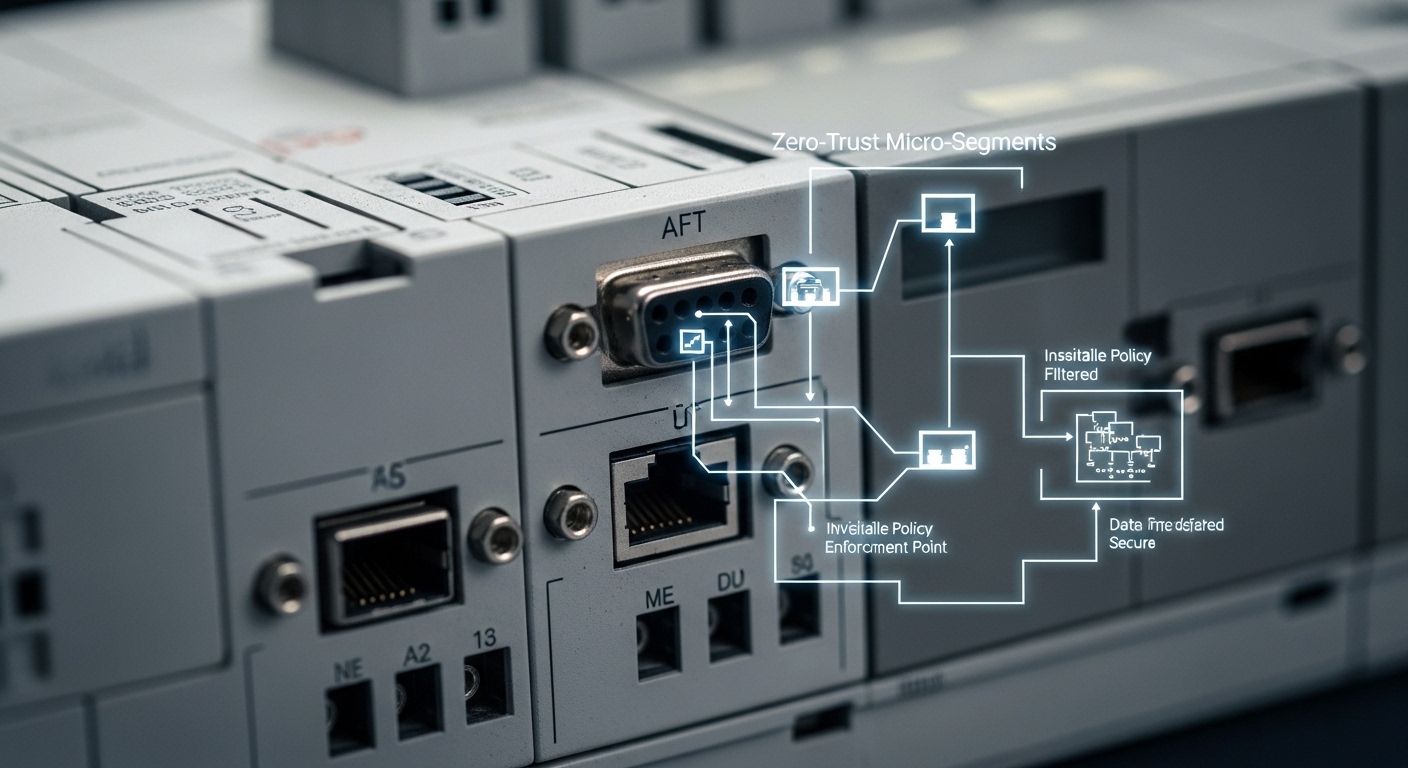
Distributed, Network-Based Policy Enforcement Points (PEPs): Since agents are not an option, enforcement must occur on the network. This is typically achieved using purpose-built industrial gateways or next-generation firewalls configured in a transparent, bump-in-the-wire mode. These PEPs are placed physically or logically in front of the PLCs or groups of PLCs they are protecting. The PDP pushes the granular micro-segmentation policies to these distributed PEPs. The PEPs then perform stateful inspection of all traffic destined for the protected PLC, allowing only the explicitly authorized communication flows defined in the policy and dropping everything else. This creates a secure micro-perimeter around the legacy asset without requiring any changes to the PLC's configuration, IP address, or logic.
This three-tiered architecture allows for a phased, non-disruptive rollout, typically moving from a 'monitor-only' mode to active blocking, ensuring that security implementation does not compromise plant availability.
Practical Implementation Challenges
While architecturally sound, deploying agentless micro-segmentation in a real-world brownfield plant presents significant engineering hurdles that demand careful consideration.
Latency, Jitter, and Determinism
Many industrial processes rely on high-speed, deterministic communication protocols like PROFINET IRT or EtherCAT, where timing is measured in microseconds. Inserting any inline device, such as a PEP, inevitably introduces some degree of latency and packet delay variation (jitter). While negligible for standard TCP traffic, even a few hundred microseconds of added jitter can violate the timing constraints of a deterministic control loop, leading to PLC faults and process shutdowns. The selection of a PEP must therefore be rigorously evaluated for its packet processing latency and its ability to operate transparently without disrupting the real-time nature of these protocols. Addressing this requires a deep understanding of preserving real-time deterministic communication in micro-segmented ICS networks to ensure control integrity is maintained.
Proprietary and Encrypted Protocol Payloads
Standard DPI engines excel at parsing well-documented protocols. However, brownfield environments are rife with vendor-specific protocol extensions, proprietary protocols, and, increasingly, encrypted payloads (e.g., Siemens S7COMM+). A PEP that cannot fully parse the application-layer commands within these protocols is reduced to a simple L3/L4 firewall, unable to enforce granular, command-level policies. Overcoming this challenge requires advanced DPI capabilities, often involving custom parser development, machine learning-based protocol discovery, or strategic decryption. This makes the ability to perform deep packet inspection of proprietary OT protocols at the edge a critical prerequisite for meaningful micro-segmentation.
Physical Topology and Network Redundancy
Plant floor network topologies are often rigid and designed for specific control architectures, such as ring or star configurations with redundancy protocols like MRP or DLR. Finding a physical insertion point for an inline PEP without breaking these redundancy loops or requiring extensive downtime for re-cabling can be a major project in itself. Architectural alternatives may include leveraging policy enforcement capabilities on modern industrial switches (if available) or placing PEPs at network aggregation points rather than directly in front of every PLC. Each approach involves trade-offs between security granularity, cost, and implementation complexity.
The Endgame: Verifiable Containment and Operational Resilience
The ultimate goal of implementing agentless Zero-Trust micro-segmentation is not just threat prevention but verifiable containment. By wrapping each critical legacy PLC in its own software-defined micro-perimeter, the architecture effectively eliminates the attack surface for lateral movement. An adversary who compromises a single HMI or data historian can no longer pivot across the control network to manipulate PLCs because the PEPs will block any unauthorized communication attempts at the protocol level. This approach allows organizations to build a resilient and defensible architecture, effectively halting lateral movement in multi-vendor PLC networks and ensuring that a localized breach does not escalate into a plant-wide shutdown.
By embracing a network-based, agentless enforcement model, brownfield operators can superimpose modern Zero-Trust security controls onto decades-old infrastructure. This is achieved without demanding the impossible: a rip-and-replace of functional-but-insecure PLCs. It is a pragmatic, architecturally sound strategy that addresses the brownfield conundrum head-on, securing the untouchable assets that underpin global manufacturing.
Sources / References
- NIST Special Publication 800-207, Zero Trust Architecture. Available: https://csrc.nist.gov/publications/detail/sp/800-207/final
- ISA/IEC 62443 Series of Standards on Industrial Automation and Control Systems Security. Available: https://www.isa.org/standards-and-publications/isa-standards/isa-iec-62443-series-of-standards
- SANS Institute, Improving Industrial Control System Cybersecurity with Defense-in-Depth Strategies. Available: https://www.sans.org/white-papers/33583/