Halting Lateral Movement: A Zero-Trust Micro-segmentation Blueprint for Multi-Vendor PLC Networks
Apex Insights Research Desk
The Fallacy of the Perimeter in Modern OT
For decades, the prevailing security model for Operational Technology (OT) has been the 'castle-and-moat' architecture. This approach, centered on a hardened perimeter, assumes that any entity inside the network is trusted. In today's interconnected industrial landscape, this assumption is not only outdated but catastrophically dangerous. Once an adversary breaches the perimeter—through a compromised engineering workstation, a malicious USB drive, or a vulnerable IT/OT bridge—a flat, trusting internal network becomes a digital playground for lateral movement. A threat actor can pivot from a non-critical HMI to a safety-instrumented system PLC with devastating ease, simply because the internal network architecture implicitly trusts all east-west traffic. This is particularly acute in environments with a heterogeneous mix of PLC vendors—Siemens, Rockwell Automation, Schneider Electric, etc.—each with unique protocols and vulnerabilities, creating a vast and complex attack surface.
This paper presents an engineering blueprint for implementing a Zero-Trust micro-segmentation policy within existing, multi-vendor OT networks. The objective is singular and critical: to architect an environment where lateral movement is not just difficult, but fundamentally contained by design, assuming breach as a certainty, not a possibility.
Core Tenets: Applying Zero-Trust to the Plant Floor
Zero-Trust is not a product but a security architecture paradigm built on the principle of "never trust, always verify." It requires that no actor, system, network, or service operating inside or outside the security perimeter is trusted. In the context of a PLC network, this translates into a radical shift in perspective.
The foundational assertion of a Zero-Trust architecture is that an asset is guilty until proven innocent. Every connection attempt, every data packet, every command sent from an HMI to a PLC must be explicitly authenticated and authorized against a granular policy, every single time. There is no concept of a trusted internal network segment.
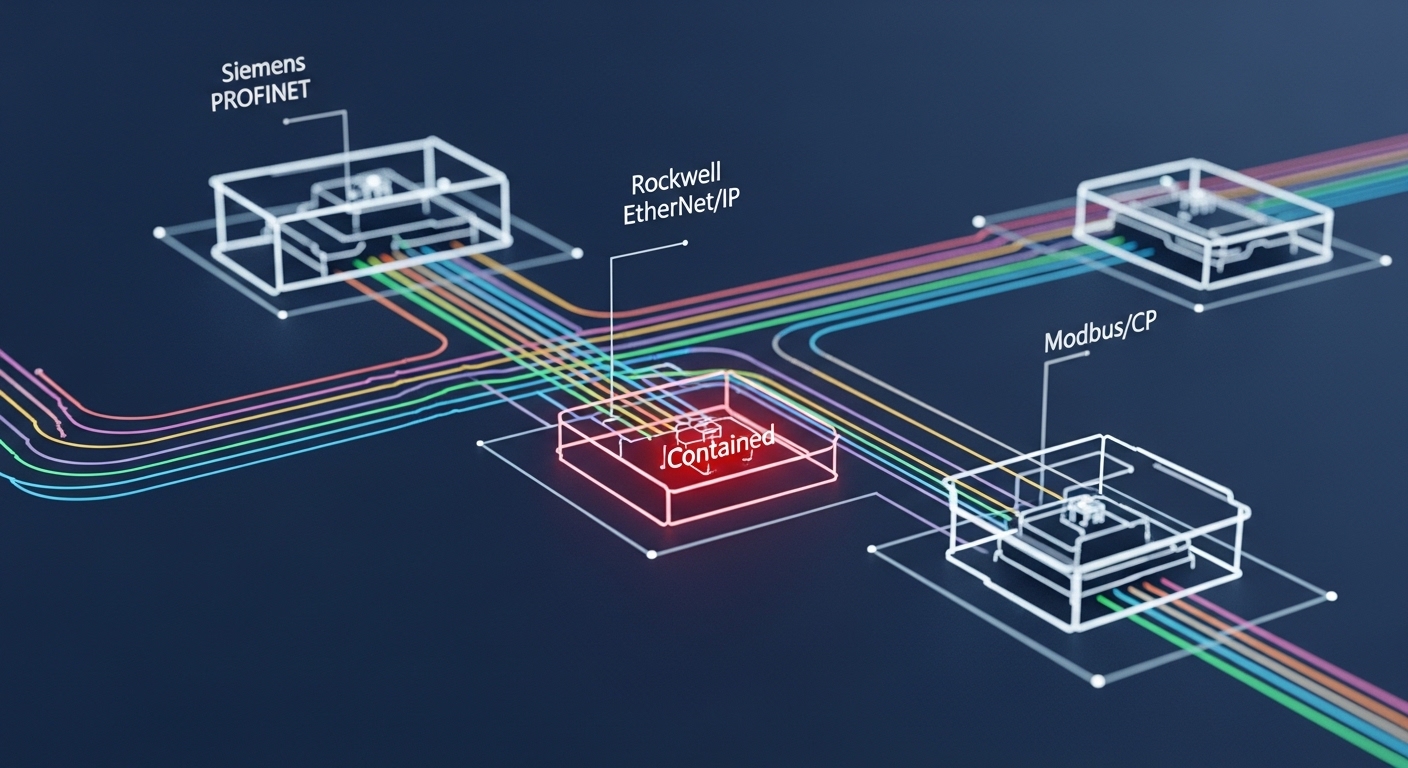
Micro-segmentation is the primary mechanism for enforcing this principle. Instead of creating large, permissive network zones (as prescribed by the Purdue Model's Level 2 or 3), micro-segmentation creates small, isolated security perimeters around individual or small groups of assets. A single Rockwell ControlLogix PLC controlling a critical process might constitute its own micro-segment. Its policy would dictate that it may only communicate with a specific list of HMI IP addresses using EtherNet/IP (CIP) protocol, and only allow read/write access to a predefined list of tags, while denying all other connection attempts, including pings from a neighboring Siemens S7 PLC on the same physical switch.
An Architectural Blueprint for Implementation
Deploying micro-segmentation in a brownfield OT environment requires a methodical, phased approach that prioritizes operational continuity. The following steps outline a robust architectural implementation plan.
Phase 1: Deep Asset Discovery and Communication Baselining The first principle of control is visibility. It is impossible to segment what is not fully understood. This phase involves deploying passive network sensors (utilizing SPAN/TAP ports on switches) to capture all east-west and north-south traffic. The goal is to build a comprehensive asset inventory and a high-fidelity communication map. This process must leverage OT-aware deep packet inspection (DPI) capable of parsing a multitude of protocols: Siemens S7COMM, Rockwell's EtherNet/IP, Schneider's Modbus TCP, PROFINET, and others. The output of this phase is not just a list of IPs and MAC addresses, but a detailed matrix showing which PLC talks to which HMI, which historian pulls data from which devices, and which engineering workstation programs which controllers, down to the specific protocol commands and function codes used.
Phase 2: Defining Micro-Perimeters and Scoping Policies With a complete communication baseline, the next step is to logically define the micro-perimeters. This should be driven by process function, not just network topology. For example, all PLCs, VFDs, and HMIs associated with a single packaging line could form a logical group. Policies are then drafted based on the principle of least privilege. This requires moving beyond simple IP-based rules to a more application-centric model. The objective is to achieve a state of architecting granular least-privilege access on legacy PLC infrastructure, ensuring each device has the bare minimum connectivity required for its function. A policy might state:
Allow HMI-Packaging-01 (10.10.20.5) to communicate with PLC-Packaging-01 (10.10.20.10) on TCP port 44818 (EtherNet/IP) ONLY for reading tags A, B, C and writing to tag D. Deny all other communication.Phase 3: Deployment of Policy Enforcement Points (PEPs) With policies defined, the next stage is enforcement. Unlike IT environments where software agents can be deployed, OT assets like PLCs are closed boxes. Therefore, enforcement must be network-based. Key engineering takeaways for PEP selection include:
- Industrial Firewalls: These are the primary tools, deployed as transparent bridges or routers between physical or logical network segments. They must possess robust DPI engines for the specific OT protocols in use and be 'bump-in-the-wire' capable without introducing significant network disruption.
- Smart/Managed Switches: Modern industrial switches can enforce policies using VLANs and Access Control Lists (ACLs). While less granular than a dedicated firewall, they are effective at creating basic segments, especially at the edge (Level 1).
- Secure Remote Access Solutions: A critical component of Zero-Trust is controlling third-party and remote vendor access. A secure gateway or Zero-Trust Network Access (ZTNA) solution acts as a policy broker, ensuring that a vendor technician can only access the specific PLC they are authorized to service, for a limited time. This approach embodies the principles detailed in The Digital Airlock: Architecting Zero-Trust Vendor Access.
Phase 4: Monitor, Validate, and Iterate Deployment is not the final step. The Zero-Trust environment must be continuously monitored. The PEPs become critical sources of logging data. Any denied connection attempt is a security event that must be investigated. Policies should be reviewed regularly and updated as processes change. It is crucial to have a feedback loop where operational teams can request policy modifications through a formal change control process, ensuring security does not impede production.
Practical Implementation Challenges
Architecting this model in the real world presents significant engineering hurdles that must be addressed upfront.
The Determinism Dilemma
Any inline security device, be it a firewall or a gateway, introduces latency. While a few milliseconds may be irrelevant for IT traffic, it can be catastrophic for a high-speed motion control application with tight, deterministic cycle times. The process of packet inspection, policy lookup, and forwarding can add jitter and delay that violates the operational constraints of the control loop. This requires careful selection of high-performance hardware and rigorous testing in a lab environment that mimics production loads to ensure that preserving real-time deterministic communication is not compromised.
Brownfield Protocol Heterogeneity
Real-world plant floors are museums of industrial protocols. Alongside modern protocols like PROFINET, it's common to find legacy serial protocols (Modbus RTU, DF1) encapsulated in TCP/IP or running on dedicated hardware gateways. A comprehensive micro-segmentation strategy must have a plan for these non-IP and legacy protocols. This often requires specialized industrial gateways that can act as protocol-aware PEPs, terminating the serial connection and applying policy before regenerating the communication on a separate network segment.
Policy Orchestration and Management Overhead
In a large facility with thousands of devices, manually managing firewall rules for each micro-segment is untenable. The risk of human error—a single 'any/any' rule left in place by mistake—is immense. This necessitates a centralized policy management and orchestration platform. Such a platform should ideally ingest the baselined traffic data and suggest initial policies, provide a workflow for approvals, and then automatically push the configuration to the distributed PEPs. Without this automation, the administrative burden can quickly overwhelm the security team.
Emergency Override and Fail-Safe Mechanisms
In an operational emergency, processes must exist to override security policies safely. What happens when a critical PLC fails and a technician needs immediate, unrestricted access to diagnose it? The architecture must include a 'break-glass' procedure. This could be a physically controlled bypass switch or a time-boxed, fully audited administrative override capability within the policy orchestration platform. The mechanism must be designed to fail-safe or fail-secure depending on the specific process risk assessment, ensuring that a failure of the security system does not lead to an unsafe physical state.
Conclusion: Architecting Resilience
The transition from a perimeter-based security model to a Zero-Trust architecture is no longer an academic exercise; it is an operational imperative for any organization running critical infrastructure. Micro-segmentation provides the tactical enforcement mechanism to make Zero-Trust a reality on the plant floor. By meticulously discovering assets, baselining communications, defining granular least-privilege policies, and deploying appropriate network-based enforcement points, organizations can build an intrinsically resilient OT network. This architecture effectively transforms the network from a conduit for threats into an active defense system, where the compromise of a single PLC remains just that—a contained incident, not the prelude to a plant-wide shutdown.
Sources / References
- NIST Special Publication 800-207: Zero Trust Architecture - https://csrc.nist.gov/publications/detail/sp/800-207/final
- ISA/IEC 62443 Series of Standards for Industrial Automation and Control Systems (IACS) Security - https://www.isa.org/standards-and-publications/isa-standards/isa-iec-62443-series-of-standards
- CISA: Layering Network Security Through Segmentation - https://www.cisa.gov/uscert/ncas/tips/ST18-001