The Granularity Mandate: Architecting Least-Privilege Access on Legacy PLC Infrastructure
Apex Insights Research Desk
The Architectural Fallacy of the Trusted Network
For decades, the design philosophy underpinning Industrial Control Systems (ICS) was predicated on a fundamental, now-obsolete assumption: the inherent trustworthiness of the local network. Programmable Logic Controllers (PLCs), the workhorses of industrial automation, were engineered for deterministic performance and operational uptime, not for granular security controls. Their native communication protocols—Modbus, S7, EtherNet/IP, and others—were built for efficiency within an isolated, air-gapped perimeter. Consequently, once an actor gained access to the OT network, they typically possessed unrestricted lateral access to manipulate any connected PLC. This architectural model is no longer tenable.
The convergence of IT and OT, coupled with the rise of sophisticated cyber-physical threats, has rendered the traditional perimeter-based defense model inadequate. A flat network architecture at Level 1 and Level 2 of the Purdue Model is a significant liability. The modern mandate is Zero Trust, which dictates that no user or device is trusted by default, regardless of its network location. Achieving this in a brownfield environment, populated with legacy PLCs that lack native identity and access management (IAM) capabilities, presents a formidable engineering challenge. It requires retrofitting granular, least-privilege access control onto an infrastructure that was never designed to support it, without inducing downtime or compromising real-time operational determinism.
This research brief provides an architectural blueprint for implementing granular access control in existing ICS environments. We will move beyond rudimentary network segmentation to explore network-centric enforcement mechanisms capable of imposing policy at the individual PLC register and function code level.
Deconstructing the Problem: Why PLCs Are Natively Opaque to Access Control
Legacy PLCs operate on a simple, implicit-allow basis. If a device can route a packet to the PLC's industrial protocol port, the PLC will typically process the command. There is no native concept of user roles, session authentication (beyond rudimentary passwords, which are often shared or stored insecurely), or context-based authorization. An HMI, an engineering workstation, or a malicious actor's laptop can all issue the same Write Single Coil or Write Multiple Registers command with equal authority.
This absence of granular control means that traditional security measures, such as placing a firewall at the IT/OT boundary (Level 3.5), are insufficient. While this approach can block unauthorized ingress into the OT zone, it does nothing to prevent lateral movement or privilege escalation once inside. A compromised HMI could be used to send unauthorized commands to a PLC controlling a critical physical process, and a standard firewall would be blind to the malicious nature of the traffic. The solution, therefore, must be positioned closer to the asset, enforcing policy with a deep understanding of the OT protocols themselves.
Architectural Blueprints for Compensating Controls
Since modifying the firmware of legacy PLCs is often impossible or operationally prohibitive due to recertification requirements, the focus must shift to implementing robust compensating controls. These are external security measures that provide the control capabilities missing from the PLCs themselves. The objective is to build an intelligent, policy-driven fabric around the PLCs.
1. Zero-Trust Micro-segmentation with Protocol-Aware DPI
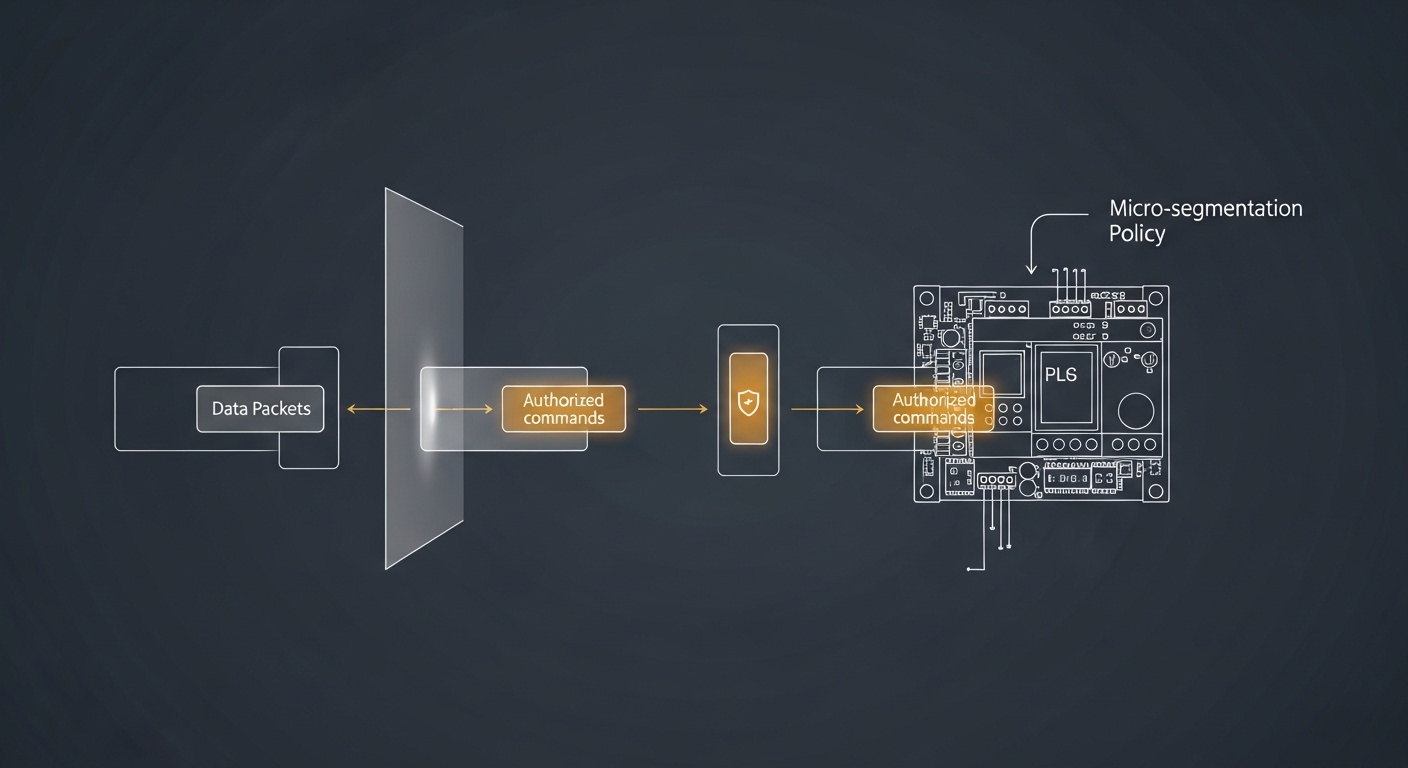
The foundational strategy is to abandon the concept of large, trusted network zones in favor of micro-segmentation. This involves creating micro-perimeters around individual PLCs or small, functionally-related groups of controllers (e.g., a single production line cell). This is not simple VLANing; it requires an enforcement point that can perform deep packet inspection (DPI) on industrial protocols.
A protocol-aware enforcement point—be it an OT-specific firewall, a secure remote access gateway, or a dedicated network security appliance—can parse the payload of Modbus TCP or EtherNet/IP packets. This allows for the creation of highly granular policies that transcend simple IP address and port rules.
Key Engineering Takeaways for Policy Definition:
- Source/Destination Binding: A policy must explicitly define which specific IP addresses (e.g., HMI_A) are permitted to communicate with a specific PLC (e.g., PLC_B). All other traffic is denied by default.
- Function Code Whitelisting: The policy should specify which protocol functions are permissible. For example, an HMI may only need read-only access (
Read Holding Registers), while an engineering workstation may be granted temporary write access (Write Multiple Registers) during a scheduled maintenance window. - Register-Level Scoping: The most granular level of control involves defining policies for specific memory addresses or register blocks. An HMI for monitoring temperature might be restricted to only reading registers
40100-40110, while being blocked from writing to the control logic registers at40500. - Value and Range Checking: Advanced enforcement points can validate the data being written to a register. A command to set a motor speed to 50,000 RPM could be blocked if the policy defines the safe operating range as 0-3,600 RPM. This serves as a critical defense against both accidental misconfiguration and malicious manipulation.
Implementing this requires a deep understanding of the control strategy. It's not just a security exercise; it's a collaborative effort between control engineers and security architects. The initial phase involves deploying monitoring tools to baseline all legitimate communication flows, a critical step before transitioning to an enforcement mode. A detailed analysis on this topic can be found in our brief on deep packet inspection of proprietary OT protocols at the edge.
2. Identity-Aware Proxy Architecture
To bridge the identity gap inherent in legacy PLCs, an identity-aware proxy or gateway can be deployed as an intermediary. In this model, no device communicates directly with the PLC. Instead, all connections are terminated at the proxy.
Here is a step-by-step architectural blueprint:
- Identity Verification: A user or system (e.g., a maintenance engineer on a laptop) initiates a connection request to the proxy, not the PLC. The proxy enforces strong authentication, potentially integrating with a centralized RADIUS or Active Directory server to verify the user's identity and role.
- Policy Evaluation: Upon successful authentication, the proxy evaluates its Attribute-Based Access Control (ABAC) policy engine. It considers multiple attributes: Who is the user? What is their role (operator, engineer, manager)? What is the source asset? What time of day is it? What is the target PLC and requested function?
- Authorized Connection Initiation: If the policy permits the action, the proxy initiates a new, separate connection to the target PLC on behalf of the user. The PLC only ever sees traffic originating from the proxy's trusted IP address.
- Command Tunneling and Auditing: The proxy then tunnels the authorized commands to the PLC and logs every transaction. This creates a detailed, identity-linked audit trail of every change made to the control system—a capability fundamentally absent in direct PLC communications.
This architecture effectively decouples user identity from the control network, allowing modern IAM principles to be applied to legacy infrastructure. The implementation of such a system is the core of achieving a deterministic, secure environment, as discussed in our research on architecting zero-trust for legacy Modbus SCADA.
The Principle of Least Privilege in OT: "Every program and every privileged user of the system should operate using the least amount of privilege necessary to complete the job." - Saltzer and Schroeder, The Protection of Information in Computer Systems. In an ICS context, this means an HMI should not have the privileges to update PLC firmware, and a data historian should not have the ability to write new setpoints. Granular access control is the primary mechanism for enforcing this foundational security principle.
Practical Implementation Challenges
Deploying these advanced controls in a brownfield environment is fraught with technical hurdles that require careful engineering consideration.
Latency and Determinism: Introducing any intermediary device, such as a firewall or proxy, into a control loop adds latency. While negligible in many IT scenarios, even a few milliseconds of added latency or jitter can destabilize a high-speed, deterministic control process (e.g., turbine control, coordinated robotics). The chosen security appliance must be benchmarked under full load to guarantee it can forward traffic at line rate without compromising the real-time requirements of the system.
Protocol Obfuscation and Encryption: While many legacy protocols are cleartext, an increasing number of vendors are implementing proprietary encryption or session-level obfuscation between their controllers and software (e.g., for protecting intellectual property in the ladder logic). This can render DPI ineffective, blinding the enforcement point to the commands within the payload. In such cases, the security model may have to fall back to stricter source/destination controls or rely on terminal server architectures that proxy the entire engineering software session.
Policy Orchestration and Management: In a large facility with thousands of PLCs and hundreds of users, the number of granular access rules can become unmanageable. The chosen solution must have a centralized management platform with robust policy orchestration capabilities, including the ability to define policies based on asset groups, network tags, and user roles, rather than just individual IP addresses.
Fail-Safe Design: What happens if the enforcement point fails? The system must be designed with a clear and tested fail-safe state. A 'fail-closed' approach, where all traffic is blocked, could trigger a costly and potentially unsafe shutdown of the physical process. A 'fail-open' approach, where all traffic is allowed, temporarily negates all security benefits. High-availability pairs of enforcement appliances are often required, adding to the architectural complexity and cost. Effectively managing these systems, especially in environments with unpatchable devices, is a significant challenge, detailed further in our analysis of zero-downtime micro-segmentation in heterogeneous legacy ICS.
Conclusion: From Implicit Trust to Explicit Verification
Achieving granular access control on existing PLC infrastructure is not a matter of replacing hardware but of augmenting the network with intelligence. The architectural shift is from an implicit trust model, where connectivity equals capability, to an explicit verification model, where every action is authenticated, authorized, and audited against a granular policy. By deploying compensating controls like protocol-aware micro-segmentation and identity-aware proxies, organizations can enforce the principle of least privilege deep within the OT environment. This approach allows security architects to build a resilient, defensible ICS architecture without demanding a cost-prohibitive 'rip and replace' of functional, legacy control systems. The journey toward a Zero Trust posture in OT begins with mastering granular control at its most fundamental level: the PLC.
Sources / References
- NIST Special Publication 800-82 Rev. 3 (Draft), Guide to Operational Technology (OT) Security. URL: https://csrc.nist.gov/publications/detail/sp/800-82/rev-3/draft
- ISA/IEC 62443 Series of Standards on Industrial Automation and Control Systems Security. URL: https://www.isa.org/standards-and-publications/isa-standards/isa-iec-62443-series-of-standards
- CISA, Securing Industrial Control Systems: A Recommended Practice. URL: https://www.cisa.gov/sites/default/files/publications/Recommended_Practice_Securing_Industrial_Control_Systems.pdf