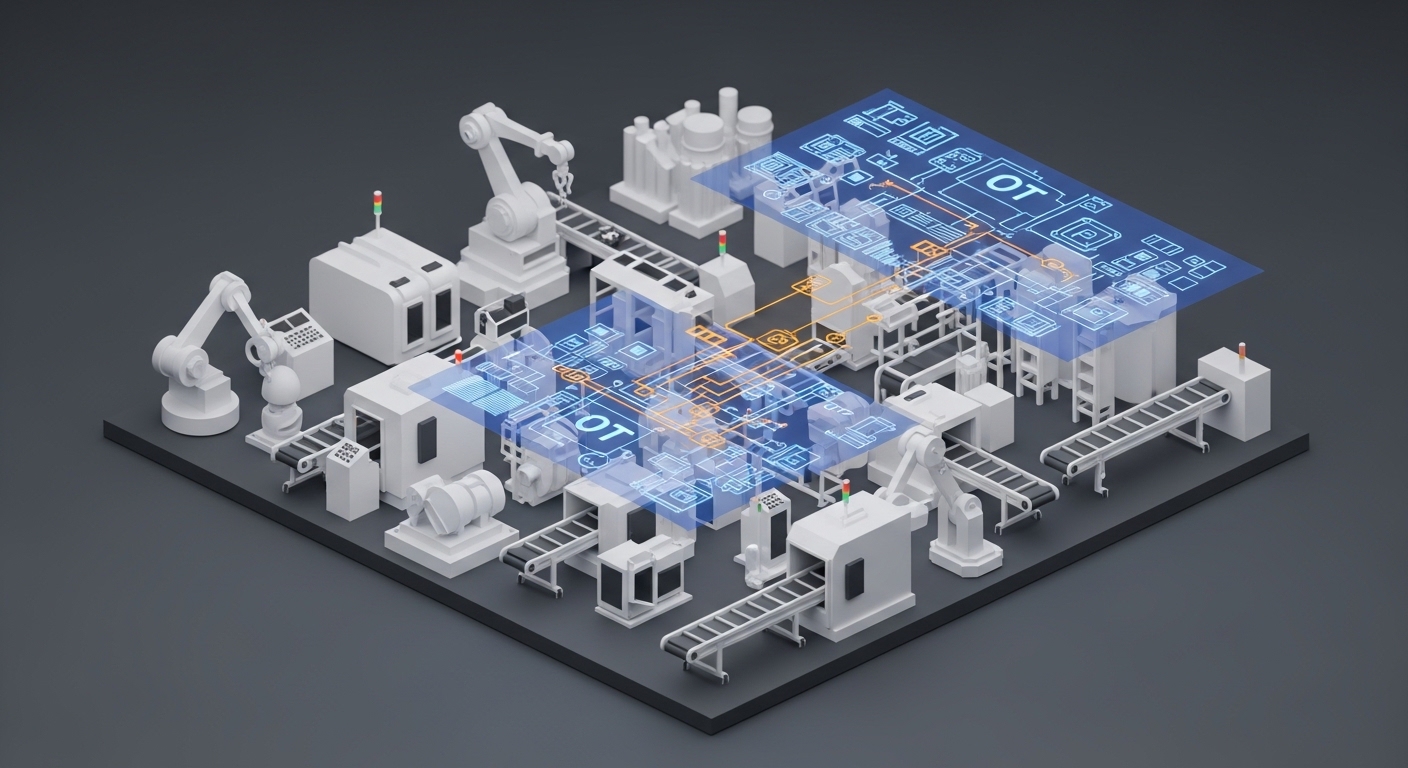
The Brownfield Paradox: Architecting Dynamic Zero-Trust Policy for Heterogeneous Legacy OT
Apex Insights Research Desk
The Core Conundrum: Retrofitting Zero-Trust onto Inherently Trusting OT Architectures
The mandate to secure Operational Technology (OT) environments is no longer a niche concern; it is a board-level imperative. Yet, the dominant security paradigm, Zero-Trust Architecture (ZTA), was conceived in the malleable, API-driven world of IT. Its direct application to the rigid, deterministic, and often fragile world of industrial manufacturing presents a profound engineering paradox. In a typical multi-vendor plant, a heterogeneous collection of legacy Programmable Logic Controllers (PLCs), Remote Terminal Units (RTUs), and Human-Machine Interfaces (HMIs) communicate using a polyglot of protocols—Modbus/TCP, PROFINET, EtherNet/IP, DNP3—many of which predate modern authentication concepts by decades. These devices lack standardized identities, possess constrained computational resources incapable of supporting cryptographic agents, and operate under latency constraints where milliseconds dictate physical outcomes.
Deploying a dynamic Zero-Trust policy enforcement framework in such a brownfield environment is not a matter of installing a new firewall; it is an exercise in architectural synthesis. It requires creating a logical security overlay that can understand the implicit trust relationships of the physical process and enforce explicit, granular policies without disrupting the underlying deterministic control loops. This article from the Apex Insights Research Desk deconstructs the critical architectural considerations for achieving this, moving beyond theoretical principles to outline a pragmatic engineering blueprint.
Deconstructing Zero-Trust for the Realities of the Factory Floor
The foundational tenant of Zero-Trust, as codified in NIST SP 800-207, is to "never trust, always verify." In IT, this translates to strong, cryptographically-verifiable identities for users and services, which are then used to grant ephemeral, least-privilege access to resources. This model fundamentally breaks down in legacy OT.
A PLC does not have an identity in the way a cloud service does. Its 'identity' is a composite of its network location (IP/MAC address), its function in the control process (e.g., 'Pump_Controller_Line_3'), and its expected communication patterns (e.g., 'polls register 40100 on PLC-B every 200ms'). An effective OT Zero-Trust architecture must therefore synthesize identity from observable behavior rather than relying on non-existent intrinsic credentials.
This distinction is paramount. A traditional ZTA Policy Enforcement Point (PEP) might challenge a connecting entity for a certificate or token. An OT-centric PEP must instead validate a connection against a baseline of known-good process behavior. The policy becomes a question not of "who are you?" but "is this communication expected and safe based on the established operational baseline?"
An Architectural Blueprint for OT-Native Zero-Trust Enforcement
Building a viable framework requires a multi-layered, abstracted approach that decouples policy definition from on-the-wire enforcement. This allows for a centralized security strategy to be implemented across a distributed and heterogeneous physical environment.
Layer 1: The Asset Synthesis & Behavioral Baselining Engine
The cornerstone of any OT security architecture is a complete, context-rich asset inventory. Active scanning is often prohibited due to the risk of crashing sensitive devices. Therefore, the first architectural layer must be a passive discovery and synthesis engine.
- Passive Network Tapping: Utilize SPAN/mirror ports on industrial switches to gain non-intrusive visibility into all network traffic. This data feed is the raw material for the entire framework.
- Deep Packet Inspection (DPI) & Protocol Dissection: The engine must possess fluent decoders for a wide array of OT protocols. It should not just identify a packet as Modbus/TCP, but parse its function code (e.g., Read Holding Registers, Write Single Coil), unit ID, and register addresses.
- Identity Synthesis: The engine correlates multiple data points to construct a 'synthetic identity' for each asset. This includes its MAC address, IP address, hostname (if available from protocols like PROFINET), vendor information (from OUI), and—most critically—its role in the process derived from observed communication patterns.
- Behavioral Baselining: Machine learning algorithms analyze the synthesized asset data over time to build a high-fidelity baseline of normal operations. This model captures the deterministic nature of the control process, mapping every valid device-to-device communication, the specific commands used, and their timing and frequency. This baseline becomes the ground truth for policy definition.
Layer 2: The Abstracted Policy Decision Point (PDP)
With a rich behavioral baseline, security policies can be defined in terms of the industrial process, not network constructs. The PDP is the centralized brain of the operation, but it must be architected to speak the language of OT.
- Process-Oriented Policies: Instead of rules like
allow tcp src 192.168.1.10 dst 192.168.1.20 dport 502, policies are written asAllow HMI_Packaging_Line_1 to READ_ONLY registers 40001-40100 from PLC_Packaging_Line_1. This abstraction is crucial for maintainability and clarity. - Policy as Code: Policies should be managed in a version-controlled system, allowing for rigorous testing, auditing, and automated deployment. This brings DevOps principles (SecDevOps) to the OT security domain.
- Dynamic Context Integration: The PDP should be capable of integrating external context. For example, if a work order in the MES indicates maintenance is scheduled for a specific production cell, the PDP could automatically compile and push a temporary policy allowing an engineering workstation authenticated via the IT domain to access the relevant PLCs for the duration of the maintenance window.
Layer 3: The Distributed, Low-Latency Policy Enforcement Fabric
This is where the architecture meets the unforgiving reality of the physical network. The enforcement points (PEPs) must implement the PDP's decisions without introducing latency or jitter that could disrupt real-time control. A single, monolithic firewall at the IT/OT boundary is insufficient. Enforcement must be distributed deep within the OT network, as close to the assets as possible.
This is the domain of micro-segmentation, which effectively creates secure enclaves around individual assets or small functional groups. The goal is to make lateral movement by an attacker prohibitively difficult. Implementing this in a live plant requires advanced techniques, as detailed in our research on Zero-Trust policy enforcement in legacy industrial networks via software-defined micro-segmentation. The primary enforcement mechanisms include:
- Next-Generation Industrial Firewalls (Bump-in-the-wire): Transparent inline devices placed at key network chokepoints (e.g., in front of a production cell). These must be OT-protocol-aware and capable of stateful inspection of industrial commands, all while operating at line-rate with microsecond-level latency.
- Enforcement-Capable Industrial Switches: Modern managed switches can implement access control lists (ACLs) at the port level. While less granular than a dedicated firewall, they can be orchestrated by the PDP to provide basic segmentation, blocking all unauthorized communication at the L2/L3 level.
- Host-Based Enforcement (Where Possible): On the few devices that can support it (e.g., modern Windows-based HMIs or SCADA servers), a host-based agent can provide the most granular enforcement, tying policy directly to processes and services. This is the exception, not the rule, in legacy environments.
Practical Implementation Challenges
Architecting such a framework is fraught with technical hurdles that demand rigorous engineering solutions.
- Deterministic Network Performance: Inserting any inline enforcement device (a PEP) risks introducing latency and jitter. For high-speed protocols like PROFINET IRT or EtherCAT, which rely on sub-millisecond isochronous cycles, even a few microseconds of delay can cause a process fault. PEPs must be specifically engineered and certified for these deterministic networks.
- Proprietary and Encrypted Protocols: Many vendors use proprietary protocols or custom extensions that DPI engines cannot parse. This creates blind spots in the behavioral baseline. The architecture must accommodate these by relying on L3/L4 metadata for segmentation or by using vendor-specific protocol gateways as targeted PEPs.
- Policy Granularity vs. Device Stability: While it is architecturally possible to write a policy that blocks a specific Modbus write command to a single register, the impact of enforcing such a granular rule on a 30-year-old PLC is often unknown. A phased approach, starting with broader network segmentation and gradually increasing policy granularity, is essential to avoid unintended process disruptions.
- Resilience of the Control Plane: If the distributed PEPs cannot reach the central PDP, what is their default behavior? A 'fail-closed' state could halt production, while a 'fail-open' state could leave the network vulnerable. The architecture must include a 'last known good' policy caching mechanism on the PEPs and a clear, pre-defined strategy for PDP connectivity loss.
- Bridging the Identity Gap: The synthesis of OT asset identity is a complex task. A key challenge is mapping the passively observed network behavior to a robust, context-aware identity that can be used for policy decisions. Effectively architecting context-aware identity for Zero-Trust OT/IT security is fundamental to moving beyond simple IP-based rules. Applying this concept requires a deep understanding of each protocol, making an identity-driven micro-segmentation blueprint for Modbus and OPC UA environments a critical prerequisite for success.
Conclusion: From Implicit Trust to Explicit, Verifiable Security
Deploying a dynamic Zero-Trust policy enforcement framework in a multi-vendor legacy OT environment is one of the most complex cybersecurity challenges facing the industrial sector. It cannot be solved by simply porting IT security tools to the factory floor. Success hinges on an architecture built from the ground up to respect the unique constraints of OT: the lack of identity, the intolerance for latency, and the primacy of operational availability.
A successful architecture abstracts security policy away from network infrastructure, synthesizes identity from observable process behavior, and distributes enforcement through a low-latency fabric of OT-native controls. This approach transforms the network from a collection of implicitly trusted, disparate devices into a cohesive system where every communication is explicitly authorized and continuously verified against a model of known-good operational behavior. It is a paradigm shift from perimeter defense to pervasive, process-aware security.
Sources / References
- NIST Special Publication 800-207: Zero Trust Architecture. Available at: https://csrc.nist.gov/publications/detail/sp/800-207/final
- ISA/IEC 62443 Series of Standards on Industrial Automation and Control Systems (IACS) Security. Available at: https://www.isa.org/standards-and-publications/isa-standards/isa-iec-62443-series-of-standards
- CISA, Recommended Practice: Securing Industrial Control Systems. Available at: https://www.cisa.gov/sites/default/files/publications/ics_rp_securing-industrial-control-systems_s508c.pdf