The Perpetual Handshake: Continuous Authentication in Zero-Trust OT Micro-Segmentation
Apex Insights Research Desk
Introduction: Beyond the Initial Gateway
The foundational premise of Zero Trust in Operational Technology (OT) is the dissolution of the traditional perimeter. In its place, we architect granular, policy-defined micro-perimeters around critical assets, a practice known as micro-segmentation. However, initial authentication—the single moment in time when a device is granted access to its designated micro-segment—represents a static security posture in a dynamic, 24/7 operational environment. A device authenticated at the start of a production run could be compromised minutes later, yet its access rights would persist, creating a significant attack vector. This is the critical gap that continuous authentication aims to close.
Continuous authentication is not a singular event but an ongoing, dynamic process of identity and posture verification. For field devices—the PLCs, RTUs, VFDs, and IIoT sensors that form the sensory and control backbone of industrial processes—this concept is paramount. These devices don't have user-driven sessions; they have operational lifecycles that can span decades. Implementing a framework that perpetually validates their integrity without introducing latency, jitter, or operational disruption is one of the most complex challenges in modern OT cybersecurity. This research brief dissects the critical architectural considerations for deploying such a system within a Zero-Trust OT micro-segmentation framework, focusing on the non-negotiable mandate of operational continuity.
Core Architectural Tenets: Identity, Behavior, and Context
Successfully implementing continuous authentication hinges on moving beyond simple network credentials. It requires a multi-faceted approach that fuses device identity, expected behavior, and operational context into a dynamic trust score. The goal is to answer not just "Who are you?" at the beginning of a connection, but "Are you still who you should be, and are you doing what you're supposed to be doing, right now?"
The Immutable Identity Anchor
At the lowest level, every device requires a strong, non-repudiable identity. In brownfield environments saturated with legacy equipment, this is a formidable challenge. The ideal implementation leverages hardware roots of trust.
- Trusted Platform Modules (TPMs) / Hardware Security Modules (HSMs): For modern devices, TPMs provide a secure vault for cryptographic keys and a platform for performing measured boot and remote attestation, cryptographically proving the device's boot-time integrity.
- Physically Unclonable Functions (PUFs): An emerging technology for resource-constrained devices, PUFs leverage minute physical variations from the manufacturing process to create a unique, unclonable device-specific key. This is a powerful tool for retrofitting identity onto devices with no native security capabilities.
Where hardware identity is not feasible, a robust Public Key Infrastructure (PKI) with automated certificate lifecycle management becomes the next best alternative. This software-based identity, however, must be buttressed by other verification methods. Building out a universal identity fabric for M2M communication is a critical precursor to any continuous authentication strategy, ensuring that identity can be managed consistently across a heterogeneous device landscape.
Behavioral Biometrics as a Trust Signal
For most OT devices, behavior is highly deterministic. A PLC controlling a specific process will communicate with the same HMI and engineering workstation, using the same protocol function codes, at predictable intervals. This deterministic pattern is a powerful authentication factor.
The principle of least privilege in OT extends beyond access control lists; it encompasses behavioral expectations. A device should not only be restricted to communicating with authorized endpoints but should also be constrained to using only the specific protocol commands and data registers necessary for its function.
By employing passive, out-of-band network traffic analysis and deep packet inspection (DPI), the system can build a high-fidelity baseline of normal behavior for each device within its micro-segment. Deviations from this baseline—such as an attempt to use a programming command during normal operation, communication with an unauthorized endpoint, or even subtle changes in traffic timing—become a negative trust signal, triggering a re-evaluation of the device's authentication status. This form of agentless behavioral analytics for legacy ICS is essential for monitoring devices that cannot host security agents.
The Non-Disruptive Implementation Mandate
The primary constraint in any OT security architecture is the absolute requirement for operational continuity. Any continuous authentication mechanism that introduces latency or jitter into control loops is not just ineffective; it is dangerous. This mandates an architecture built on passive verification and graceful enforcement.
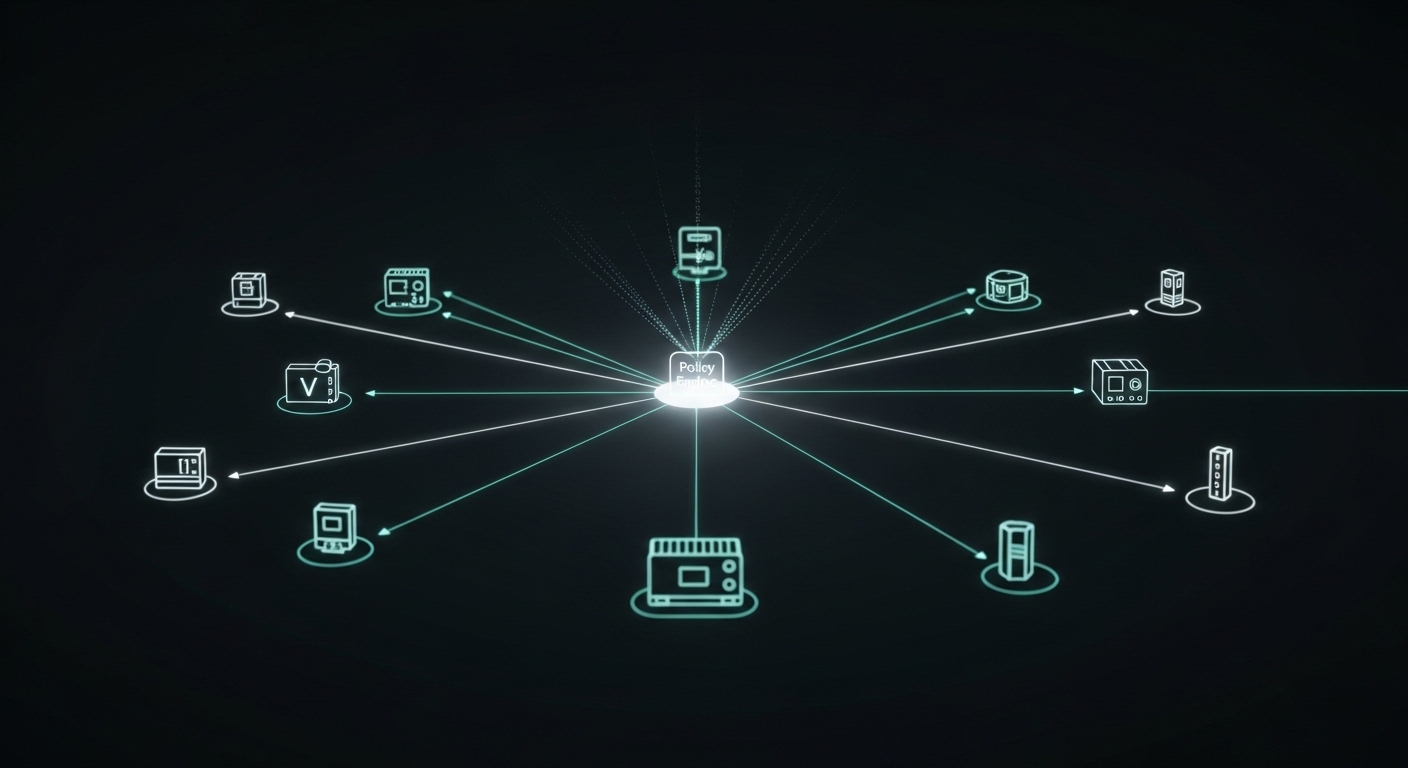
Out-of-Band Verification Plane: The trust evaluation engine should not sit inline with high-priority process control traffic. Instead, it should operate on a mirrored or tapped data stream. This ensures that the analysis process, regardless of its computational intensity, has zero impact on network performance. The Policy Enforcement Point (PEP) may be inline (e.g., a next-gen firewall or secure gateway), but its decisions must be informed by the out-of-band Policy Decision Point (PDP) without adding significant delay.
Dynamic and Adaptive Policy Enforcement: A failed authentication check should not automatically result in a
DROPrule. The enforcement action must be context-aware. For instance, a minor behavioral anomaly might trigger an alert and a reduction in the device's trust score. A more severe anomaly, like a failed cryptographic integrity check, might lead to the device being placed in a quarantined VLAN where it can only communicate with a security forensics platform. A critical alert might block all non-essential traffic (e.g., file transfers, diagnostics) while still permitting essential, life-safety control messages to pass, pending human intervention. This adaptive approach is crucial for maintaining stability.Latency Budgeting and Determinism: The entire system must operate within the strict latency budget of the industrial process. For real-time applications, such as motion control over EtherNet/IP, this budget can be in the low single-digit milliseconds. The authentication framework's total processing time—from data ingestion to policy enforcement—must be rigorously benchmarked and validated to ensure it does not violate these deterministic requirements. This is a core component of architecting a deterministic lockdown for real-time protocols, where security cannot come at the cost of operational precision.
Practical Implementation Challenges
Transitioning from theory to a live production environment unearths significant engineering hurdles that require specialized solutions.
Brownfield Protocol and Hardware Constraints
- Lack of Native Identity: Legacy protocols like Modbus/TCP or DNP3 were not designed with authentication in mind. There is no field for a device certificate or a security token. Identity must be inferred from L2/L3 identifiers (MAC/IP addresses) and then correlated with passively observed behavioral patterns.
- Resource Starvation: A significant portion of deployed PLCs and RTUs have extremely limited CPU and memory. They cannot terminate a TLS session, run a security agent, or perform complex cryptographic calculations without impacting their primary control function. This necessitates agentless, network-based approaches.
- Cryptographic Overhead: Even for capable devices, the processing overhead of asymmetric cryptography can be prohibitive. Symmetric key cryptography and message authentication codes (MACs) are often more suitable, but require a secure and scalable key distribution infrastructure.
Policy Orchestration and State Management
- Scale and Complexity: A large industrial facility can have tens of thousands of field devices. Manually defining and managing authentication policies for each one is untenable. The system requires a centralized policy orchestration engine that can use templates, grouping, and AI/ML-driven recommendations to manage policy at scale.
- Maintaining State: Continuous authentication is a stateful process. The system must maintain a current trust score for every single device on the network. This requires a high-performance, resilient data store capable of handling a massive volume of real-time telemetry and security events.
Operational Integration and Maintenance
- Graceful Enrollment: How is a new or replacement device enrolled into the system without causing a production outage? The process must include a secure, temporary provisioning state where the device's identity can be verified and its initial behavioral baseline can be established in a controlled manner before it is granted full operational access.
- False Positive/Negative Management: Behavioral anomaly detection systems can generate false positives. The framework must include robust tuning and feedback mechanisms, allowing OT engineers to easily validate or correct the system's findings, thereby refining the behavioral models over time without overwhelming the security operations team.
Conclusion: The Path to Dynamic Resilience
Continuous authentication of field devices within a Zero-Trust framework is the evolution of OT security from a static, perimeter-based model to a dynamic, identity-centric one. It transforms security from a brittle wall into an adaptive immune system that constantly verifies the health and integrity of every component in the industrial process. The implementation is not a simple product deployment but a deep architectural commitment. It demands a fusion of hardware-rooted identity, protocol-aware behavioral analysis, and a non-disruptive, out-of-band enforcement fabric. By focusing on these critical considerations, organizations can build a resilient OT environment that is secured by a perpetual handshake of verified trust, ensuring the integrity and availability of 24/7 operations in the face of ever-advancing threats.
Sources / References
- NIST Special Publication 800-207: Zero Trust Architecture. Available at: https://csrc.nist.gov/publications/detail/sp/800-207/final
- ISA/IEC 62443 Series of Standards on Industrial Automation and Control Systems (IACS) Security. Available at: https://www.isa.org/standards-and-publications/isa-standards/isa-iec-62443-series-of-standards
- Trusted Computing Group (TCG): TPM 2.0 Library Specification. Available at: https://trustedcomputinggroup.org/resource/tpm-library-specification/
- IETF RFC 9154: A YANG Data Model for Hardware Management. Available at: https://www.rfc-editor.org/rfc/rfc9154.html