The Deterministic Mandate: Ensuring Control Plane Integrity During Dynamic Policy Updates in Brownfield SCADA Micro-segmentation
Apex Insights Research Desk
The Core Dilemma: Determinism vs. Dynamism in SCADA Security
In the domain of brownfield energy Supervisory Control and Data Acquisition (SCADA) systems, the principles of operational determinism and real-time latency are sacrosanct. These networks, responsible for the command and control of physical processes within critical infrastructure, operate under timing constraints measured in milliseconds. The introduction of any jitter or unpredictable latency can cascade into process instability, equipment damage, or catastrophic failure. Simultaneously, the evolving threat landscape mandates a shift from perimeter-based security to a more granular, adaptive model like zero-trust micro-segmentation. This creates a fundamental architectural conflict: how can a security fabric dynamically update its enforcement policies in real-time without violating the stringent latency requirements of the underlying SCADA control plane?
The challenge is most acute during policy updates. A naive implementation that pushes new rules sequentially can create transient states where network flows are governed by a chaotic mix of old and new policies, leading to dropped packets, connection resets, and unpredictable control loop behavior. This paper from the Apex Insights Research Desk presents an architectural blueprint for ensuring the integrity of latency-sensitive command and control planes during dynamic policy updates within a real-time, zero-trust micro-segmentation framework specifically designed for brownfield energy SCADA environments.
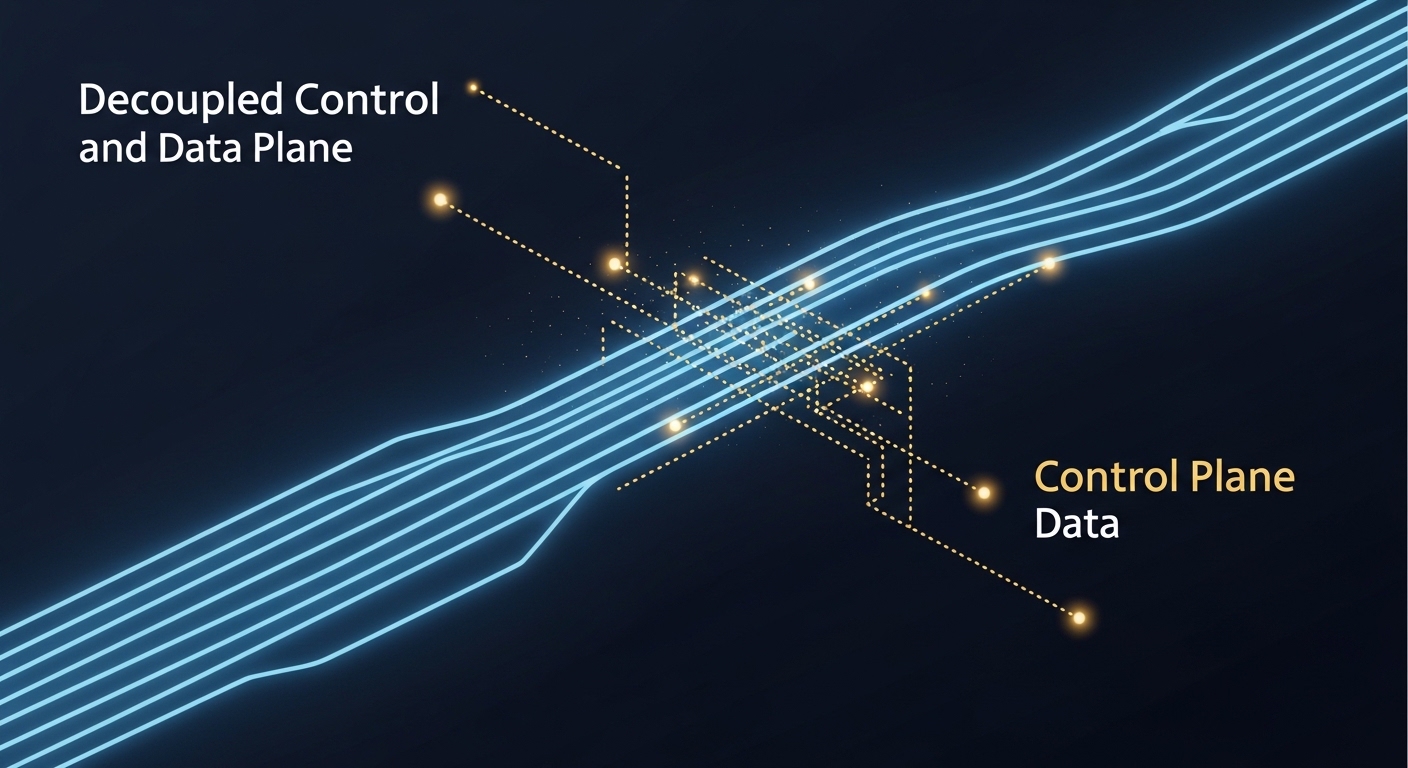
Architectural Prerequisite: Rigorous Decoupling of Control and Data Planes
The foundational strategy for resolving this conflict is a strict, architectural decoupling of the control plane and the data plane, a concept borrowed from Software-Defined Networking (SDN) but adapted for the unique constraints of Operational Technology (OT).
The Data Plane (or Forwarding Plane): This is the path of the actual SCADA protocol traffic (e.g., DNP3, Modbus/TCP, IEC 61850). It consists of the network infrastructure and the Policy Enforcement Points (PEPs) that inspect and forward or block packets based on an active policy. This plane is the domain of hard real-time constraints, where every microsecond of processing latency matters. The primary design goal for the data plane is to achieve line-rate, low-jitter packet processing for all allowed flows.
The Control Plane: This is the distributed intelligence of the security system. It is responsible for calculating, distributing, and activating the security policies that the PEPs in the data plane will enforce. Its primary function is to translate high-level security intent into low-level enforcement rules and ensure these rules are propagated to all relevant PEPs consistently and reliably. While not subject to the same hard real-time constraints as the data plane, its operations must be meticulously orchestrated to be non-disruptive.
The Management Plane: This is the interface through which human operators or automated orchestration systems define security intent. This is where policies are authored, but it has no direct, real-time interaction with the data plane.
By separating these concerns, we can engineer a solution where the complex, potentially time-consuming operations of policy computation and distribution (control plane) are performed out-of-band, without ever interfering with the high-speed, deterministic packet forwarding of the SCADA communications (data plane).
Strategies for Hitless Policy Propagation
Ensuring that a policy update is 'hitless'—meaning it introduces zero packet loss or additional latency to established, legitimate flows—requires specific transactional mechanisms. The goal is to transition the entire distributed system from Policy A to Policy B atomically, as if flipping a single switch across the entire network simultaneously.
Atomic Policy Transactions with Shadow Configurations
The most robust method for achieving a hitless update is to implement a shadow policy mechanism. This approach treats a policy update not as a series of individual rule changes but as a single, atomic transaction.
- Intent and Compilation: An operator defines a new security intent in the management plane (e.g., 'Allow new maintenance access from IP X to RTU Y on port 20000'). The central Policy Decision Point (PDP) compiles this intent, along with the entire existing policy, into a complete, new ruleset version (the 'shadow policy').
- Secure Distribution: The PDP uses a secure and reliable control plane channel (e.g., a gRPC-based service with mutual TLS) to distribute this complete shadow policy to every relevant PEP in the network.
- Pre-loading and Validation: Each PEP receives the shadow policy and loads it into a secondary, inactive memory buffer. Crucially, the PEP performs sanity checks: it validates the policy's syntax, integrity, and potentially runs pre-computation tasks (like calculating flow hashes) to ensure the policy is valid and ready for instant activation.
- Distributed Acknowledgment: Upon successful pre-loading and validation, each PEP sends a 'Ready' acknowledgment back to the PDP. The PEP does not activate the policy yet; it simply signals its preparedness.
- Synchronized Activation Command: Once the PDP has received a 'Ready' signal from all targeted PEPs, it broadcasts a single, low-payload 'Activate' command. This command is timestamped or triggered via a high-precision time protocol signal.
- Atomic Swap: Upon receiving the 'Activate' command, each PEP performs an atomic memory operation—typically, changing a single pointer from the active policy buffer to the shadow policy buffer. This switch is computationally negligible, often taking only a few CPU cycles, thus introducing no measurable jitter on the data plane.
This sequence guarantees that the network never exists in a partially-updated state. The entire fabric transitions from the old policy to the new one within a minuscule, deterministic time window defined by the propagation delay of the final 'Activate' command.
Pre-Computation and Efficient Lookups
To maintain data plane performance, PEPs cannot afford to traverse a complex list of access control rules for every packet. Instead, performance is maintained by pre-computing the results of the policy.
The fundamental principle is to treat policy updates as a transactional, ACID-compliant database operation applied to a distributed system, where the 'database' is the collective state of the network's security policy and 'atomicity' is the guarantor of operational integrity.
When the PEP loads a shadow policy, it can compile the rules down to a highly efficient data structure, such as a hash table. Each allowed communication flow (defined by its 5-tuple and potentially deeper protocol attributes) is represented by an entry in this hash table. Packet processing on the data path is then reduced to a single, constant-time O(1) hash table lookup. The atomic policy swap simply involves pointing to a new, pre-populated hash table. This offloads all complex policy evaluation from the real-time data path to the non-real-time policy pre-loading phase.
Practical Implementation Challenges
Architecting such a system for a brownfield SCADA environment presents significant engineering hurdles that must be addressed.
High-Precision Clock Synchronization: The concept of a simultaneous, atomic swap is predicated on a common understanding of time across all distributed PEPs. Without it, a 'simultaneous' activation becomes a rolling update, reintroducing the very inconsistency we aim to prevent. Deploying the Network Time Protocol (NTP) is a baseline requirement, but for environments with extremely low jitter tolerances, the Precision Time Protocol (PTP) as defined by IEEE 1588 becomes essential to ensure activation commands are executed within a tightly controlled, sub-millisecond window.
Stateful Protocol Awareness: SCADA protocols like DNP3 are often stateful, operating over long-lived TCP sessions. A policy update that removes a previously allowed flow cannot simply start dropping packets mid-session. This can leave endpoints in an unstable state. A sophisticated PEP must be session-aware. When a flow is no longer permitted by a new policy, the PEP should ideally inject a clean TCP FIN/RST sequence to gracefully terminate the connection, allowing the application endpoints to handle the disconnection cleanly rather than experiencing a timeout.
Control Plane Resilience and Policy Verification: A centralized PDP model introduces a potential single point of failure. The PDP must be designed as a high-availability (HA) cluster. Furthermore, if a PEP is offline during a policy push, it must have a robust mechanism to query the PDP for the latest policy version upon reconnection and refuse to forward traffic until it is fully synchronized. This is a core tenet of ensuring that you have a system of verifiable micro-segmentation in legacy OT without operational disruption, where the security posture of every enforcement point can be continuously audited and confirmed.
Resource Constraints on Enforcement Points: Brownfield deployments often involve integrating PEPs in the form of ruggedized network taps or gateways with constrained CPU and memory resources. The policy language, its compiled representation, and the update mechanism must be highly efficient. Complex XML-based policies or full policy pushes of multi-megabyte configurations can overwhelm these devices. This is a key reason why architectures promoting agentless zero-trust micro-segmentation for legacy PLCs are favored, as they centralize the heavy computation and push lightweight, pre-compiled enforcement logic to the edge.
Formal Policy Validation: Before a new policy is pushed, how can an organization be certain it won't inadvertently sever a critical control communication? Pushing a flawed policy atomically simply means you break the system consistently and everywhere. This necessitates a robust pre-deployment validation pipeline, including policy simulation, formal methods to mathematically prove properties (e.g., 'the emergency shutdown path is never blocked'), and testing in a digital twin environment that accurately models the production network's behavior.
Conclusion: Architecting for Deterministic Agility
Ensuring the integrity of latency-sensitive command and control planes during dynamic policy updates is a solvable, albeit complex, engineering challenge. It requires a departure from traditional, monolithic security appliances and an embrace of SDN principles adapted for the stringent realities of OT. By architecting a system with a cleanly decoupled control and data plane, and by implementing transactional, atomic policy update mechanisms like shadow configurations, it is possible to achieve both dynamic, real-time security adaptation and the unwavering deterministic performance that energy SCADA systems demand. The solution lies not in compromising on security or performance, but in building a resilient architecture where policy agility is a native, non-disruptive function. This approach allows operators to implement advanced security models, such as non-intrusive ABAC for brownfield SCADA systems, enabling policies that adapt to changing operational contexts without ever putting the underlying physical process at risk.
Sources / References
- NIST Special Publication 800-207, Zero Trust Architecture. Available at: https://csrc.nist.gov/publications/detail/sp/800-207/final
- IEEE Std 1588-2019, IEEE Standard for a Precision Clock Synchronization Protocol for Networked Measurement and Control Systems. Available at: https://ieeexplore.ieee.org/document/8979479
- IETF RFC 7426, Software-Defined Networking (SDN): Layers and Architecture Terminology. Available at: https://www.rfc-editor.org/info/rfc7426
- DNP3 (Distributed Network Protocol) Technical Resources, DNP Users Group. Available at: https://www.dnp.org/About/Technical-Resources-and-Links