The Serial Enclave: A Blueprint for Dynamic Micro-segmentation of Non-IP OT Protocols
Apex Insights Research Desk
The Architectural Fallacy of IP-Centric Segmentation in OT
For decades, the bedrock of network security has been the IP address. Firewalls, access control lists (ACLs), and virtual LANs (VLANs) are all predicated on the ability to filter, route, and contain traffic based on Layer 3 and Layer 4 headers. This paradigm, while foundational to IT security, collapses when confronted with the reality of Level 0 and Level 1 industrial control environments. These networks, the domain of PLCs, RTUs, and field devices, are frequently dominated by non-IP, serial-based protocols like Modbus RTU, Profibus DP, and DeviceNet. These are not routable, packet-switched networks; they are often electrically-signaled, multi-drop buses where every device hears every transmission.
The concept of applying an IP-based firewall to a Profibus DP segment is an architectural non-sequitur. The threat model is fundamentally different. Lateral movement isn't a sophisticated pivot through network subnets; it's an unauthorized device physically connected to an RS-485 bus issuing a malicious function code that propagates instantly to every listening PLC. Traditional segmentation provides a coarse, brittle perimeter, but within that perimeter lies a flat, unmonitored attack surface. To achieve meaningful risk reduction in these environments, security architecture must pivot from an IP-centric model to a protocol-aware, edge-enforced strategy. This is the domain of dynamic micro-segmentation for non-IP protocols.
Core Principles for Non-IP Micro-Segmentation
Effectively segmenting non-routable industrial networks requires abandoning IT conventions and embracing a new set of engineering principles tailored to the physics and logic of the operational environment. The objective is to create granular, policy-enforced enclaves around individual devices or small functional groups, even when they share the same physical wire.
Principle 1: Policy Enforcement at the Edge
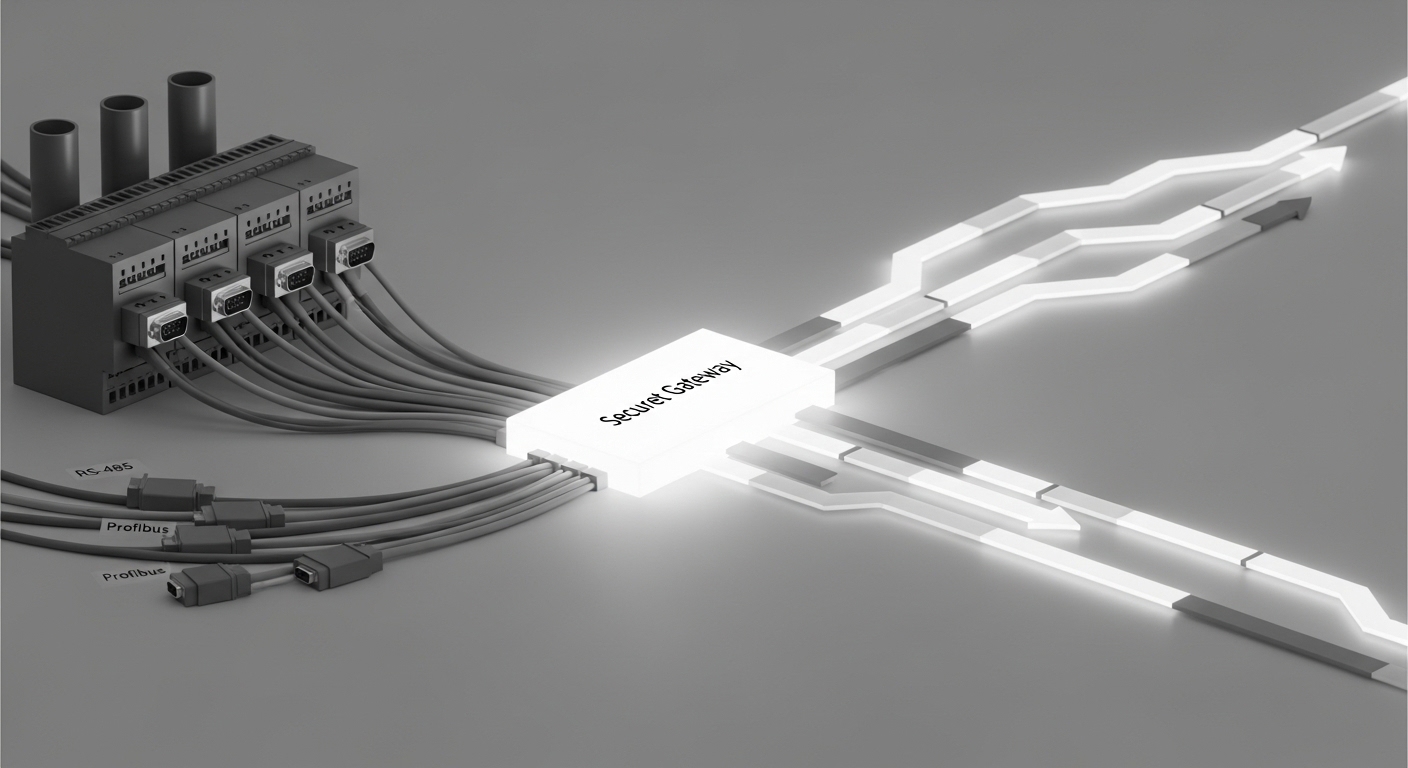
The security perimeter must be radically decentralized. Instead of a monolithic firewall at the IT/OT boundary, policy enforcement must occur at the logical edge of the non-IP segment itself. This enforcement point is typically a secure gateway, a protocol converter, or an intelligent serial device server that serves as the choke point through which all communication must pass. It is at this ingress/egress point that policies can be applied before signals are placed onto the physical bus or translated to another network medium.
Principle 2: Protocol-Aware Introspection
Standard Deep Packet Inspection (DPI), which primarily inspects packet headers and known signatures, is insufficient. True non-IP micro-segmentation demands deep protocol-aware introspection. The enforcement point must parse the entire serial frame and understand the application layer—the industrial protocol's structure and commands. This means distinguishing between a Modbus read request (Function Code 03) and a write request (Function Code 06), identifying the target register addresses, and even validating the data values being written. This level of granularity is essential for creating meaningful policies beyond simple device-to-device communication whitelists. Implementing this correctly involves specialized tools and techniques, as detailed in our guide on the best practices for deep packet inspection of proprietary OT protocols at the edge.
Principle 3: Identity-Agnostic Segmentation
A significant portion of legacy OT assets have no concept of digital identity. There are no usernames, passwords, or certificates at the fieldbus level. Therefore, segmentation policies cannot rely on user or device identity in the traditional sense. Instead, security must be built using a combination of factors that form a composite, inferred identity:
- Physical Port: The specific physical port on the secure gateway to which the device is connected.
- Device Fingerprinting: Analyzing the unique timing, jitter, and electrical characteristics of a device's transmissions to create a high-fidelity signature.
- Communication Baselining: Passively learning the expected communication patterns (e.g., PLC-A only ever polls registers 100-150 from VFD-B) and creating a whitelist policy that allows only that specific behavior.
This approach effectively builds a Zero-Trust framework using compensating controls, a necessity when dealing with devices that cannot participate in modern authentication schemes. For a deeper dive into this specific challenge, we have architected a blueprint for Zero-Trust micro-segmentation in identity-agnostic PLC networks.
Principle 4: Determinism is Non-Negotiable
Industrial control protocols are often deterministic, meaning messages must be delivered within a strict, predictable time window. A delay of even a few milliseconds in a high-speed motion control application can result in physical damage or product defects. Any security solution introduced in-line must have a published, guaranteed latency and jitter profile that is negligible relative to the process control loop's requirements. The security architecture must be subordinate to the laws of physics and the demands of the control process.
Architectural Blueprints for Implementation
Translating these principles into a defensible architecture involves selecting the correct hardware and software components for the specific environment. Two primary models have emerged as best practices.
The Secure Gateway / Protocol Converter Model This is the most common and versatile approach. It involves deploying an industrial-grade secure gateway at the boundary between the non-IP serial network and an IP-based network (typically the control network in Level 2). The gateway acts as both a protocol translator (e.g., Modbus RTU to Modbus TCP) and the Policy Enforcement Point (PEP).
- Architecture: Serial devices (PLCs, VFDs, sensors) connect to the gateway's serial ports (RS-232/485). The gateway connects to the Ethernet network.
- Policy Enforcement: The gateway's internal logic performs deep protocol introspection on all incoming and outgoing messages. A security administrator defines granular rules such as: "Allow HMI at 10.10.20.5 to execute Modbus Function Codes 03 and 04 on registers 40001-40100 for the PLC on serial port 1. Deny all other requests."
- Benefits: Enables centralized management and monitoring of legacy devices from the IP network while creating a robust micro-segment around the serial bus. It effectively 'IP-enables' the legacy assets in a controlled, secure manner.
The Bump-in-the-Wire (BITW) Serial Firewall Model For environments that must remain strictly serial-to-serial, often for legacy compatibility or contractual reasons, a BITW serial firewall is the appropriate solution. This is a dedicated hardware appliance that is physically inserted into the serial communication line.
- Architecture: The device has a serial input and a serial output (e.g., DB9-in, DB9-out). It sits physically between two serial devices or segments of a multi-drop bus.
- Policy Enforcement: The BITW device inspects every frame that passes through it in real-time. It checks the source/destination address (for protocols that support it), the function code, and the data payload against a configured ruleset. Unauthorized frames are dropped before they can propagate down the line. This is a crucial technique when grappling with architecting Zero-Trust segmentation for non-IP OT protocols without downtime.
- Benefits: Provides micro-segmentation without altering the fundamental network architecture or introducing IP protocols. It is ideal for isolating a single critical controller on a larger, shared fieldbus.
Practical Implementation Challenges
Deploying these architectures is not without significant engineering hurdles that require careful planning and specialized expertise.
- Protocol Ambiguity and Proprietary Extensions: The term "Modbus" is not monolithic. Vendors frequently implement proprietary function codes or data structures that can confuse generic protocol parsers. The chosen security solution must either have a comprehensive library of these vendor-specific extensions or provide a mechanism for defining custom parsers.
- The Latency Budget: Every in-line device introduces processing and serialization delay. Before deployment, the end-to-end latency of the security appliance must be rigorously tested under full load and compared against the control process's maximum allowable latency. For a high-speed bottling line or a robotics cell, a 5ms delay could be the difference between normal operation and a catastrophic failure.
- Physical and Electrical Layer Integrity: Serial communication, particularly RS-485, is sensitive to electrical noise, impedance mismatches, and proper termination. A poorly designed BITW device can corrupt the electrical signaling on the bus, leading to intermittent communication failures that are incredibly difficult to diagnose. All hardware must be industrially hardened and electrically compatible with the existing bus infrastructure.
- Policy Creation and Management at Scale: In a large facility, manually defining register-level whitelists for thousands of devices is operationally infeasible. A critical prerequisite is a 'learning' or 'discovery' phase where the security appliance passively monitors traffic to automatically baseline normal communication patterns. This baseline then serves as the foundation for the initial policy, which can be refined by OT engineers.
- The Fail-State Conundrum: The default IT security posture is 'fail-closed'. In OT, this can be catastrophic. If a serial firewall fails, should it block all traffic, potentially tripping a turbine, or should it fail-open, temporarily sacrificing security for operational continuity? Most industrial-grade devices incorporate a configurable fail-state, often using a physical bypass relay that automatically closes if the device loses power or faults, ensuring the primary control communication path is maintained.
Conclusion: From Static Perimeters to Dynamic Enclaves
The security of non-IP industrial protocols cannot be an afterthought addressed with repurposed IT tools. It demands a purpose-built architectural approach centered on protocol-aware introspection and edge-based enforcement. By moving beyond the fallacy of IP-centric security and embracing principles of identity-agnostic segmentation and deterministic performance, organizations can transform their flat, vulnerable fieldbus networks into a series of defensible, dynamically-managed micro-enclaves. This evolution is not merely a best practice; it is a fundamental requirement for building a resilient and secure industrial operation in an era of converging threats.
Sources / References
- NIST Special Publication 800-82 Rev. 3 (Initial Public Draft), Guide to Operational Technology (OT) Security: https://csrc.nist.gov/publications/detail/sp/800-82/rev-3/draft
- ISA/IEC 62443 Series of Standards on Industrial Automation and Control Systems (IACS) Security: https://www.isa.org/standards-and-publications/isa-standards/isa-iec-62443-series-of-standards
- Modbus Application Protocol Specification V1.1b3: https://modbus.org/docs/Modbus_Application_Protocol_V1_1b3.pdf