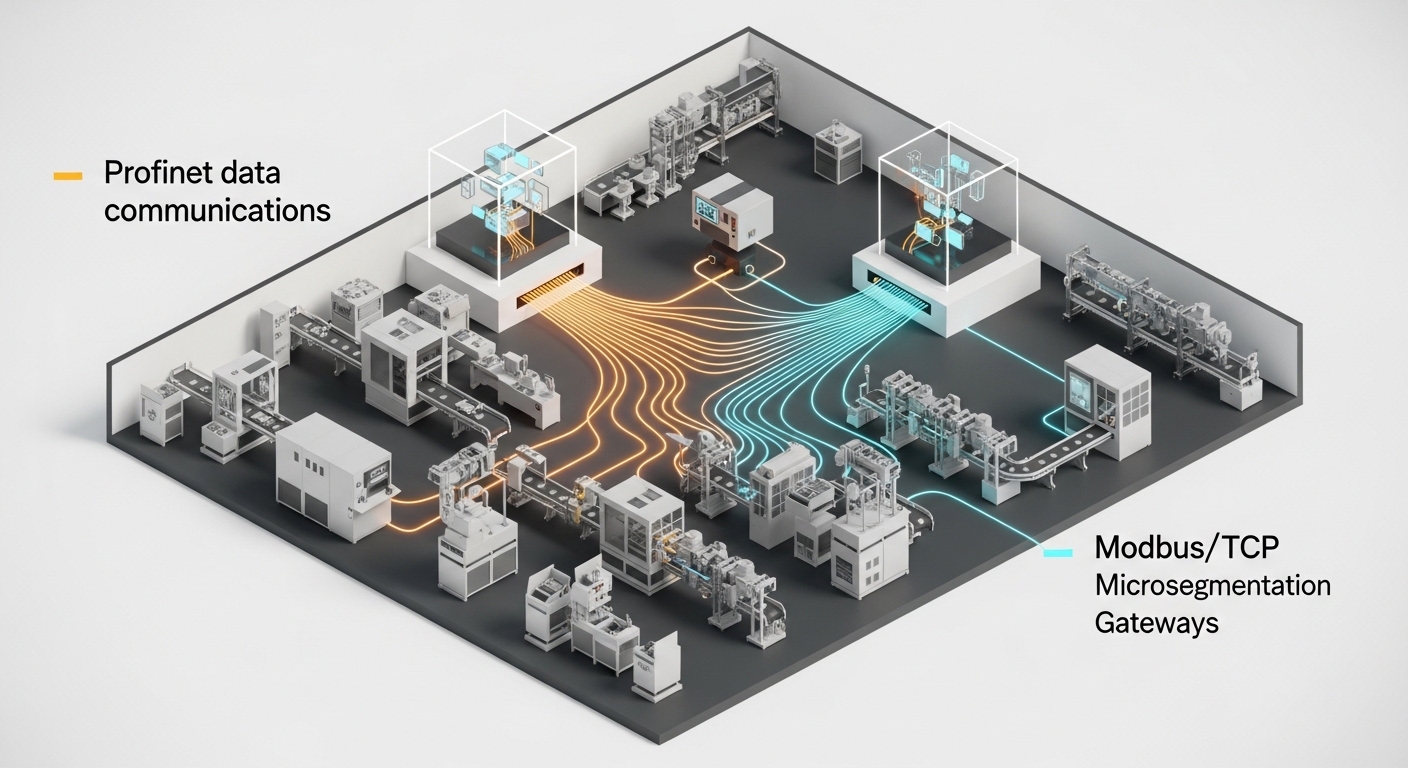
Granular Zero-Trust for OT: Policy Enforcement Strategies for Modbus/TCP and Profinet
Apex Insights Research Desk
The Imperative for Granular Control in OT Zero-Trust
The traditional air-gapped, perimeter-defended operational technology (OT) network, architected around the Purdue Model, is a relic. The convergence of IT and OT, driven by demands for production analytics and remote operations, has rendered the trusted internal network a fundamentally flawed security assumption. Consequently, the Zero-Trust model—never trust, always verify—has emerged as the definitive architectural paradigm for modern industrial control systems (ICS). However, transposing this IT-native concept into the deterministic, protocol-diverse world of OT presents a formidable engineering challenge. The core problem is not merely segmentation but achieving granular policy enforcement for proprietary and legacy fieldbus protocols like Modbus/TCP and Profinet, which were designed for function and reliability, not security.
Granular enforcement transcends the simple allow/deny rules of Layer 3 and 4 firewalls. In an OT context, it signifies the ability to control not just which devices can communicate, but precisely what they can say, to whom, and under what context. This means differentiating between a benign read request and a potentially catastrophic write command to a PLC's logic registers, or permitting real-time I/O data exchange while blocking unauthorized device configuration changes. This level of control is paramount for building a resilient defense-in-depth strategy that can mitigate both external threats and insider risk without compromising the deterministic nature of process control.
The Protocol-Specific Enforcement Conundrum
The primary obstacle to granular policy enforcement lies within the DNA of the protocols themselves. They lack the identity and authentication constructs that underpin modern Zero-Trust frameworks, forcing security architects to impose control externally.
Modbus/TCP
As a master-slave (client-server) protocol, Modbus/TCP is notoriously simple and devoid of security features. It operates on a trust-by-default basis, where any device that can route to a Modbus server can potentially send any valid function code. Granular enforcement must therefore be capable of deconstructing the Modbus Application Protocol (MBAP) header and the Protocol Data Unit (PDU) to enforce policies such as:
- Function Code Whitelisting: Allow only specific function codes (e.g.,
03 Read Holding Registers) from an HMI, while restricting a data historian to04 Read Input Registers. - Register-Level Access Control: Permit a specific engineering workstation to execute a
06 Write Single Registercommand, but only for a predefined range of memory addresses corresponding to non-critical setpoints. - Unit ID Scrutiny: Confine communications to specific slave devices (Unit IDs) on a multi-drop serial line fronted by a Modbus gateway.
Without this level of deep packet inspection, a Zero-Trust implementation for Modbus is functionally equivalent to a standard firewall, leaving critical attack vectors—such as malicious register manipulation or logic modification—wide open.
Profinet
Profinet presents a more complex challenge due to its real-time characteristics and multiple communication channels. It uses standard TCP/IP for non-time-critical tasks like configuration and diagnostics, but relies on Layer 2 mechanisms for real-time (RT) and isochronous real-time (IRT) data exchange to achieve low latency and minimal jitter. A granular policy enforcement strategy for Profinet must accommodate this multi-channel nature.
- Real-Time Frame Prioritization: The Policy Enforcement Point (PEP) must process Profinet RT frames (EtherType 0x8892) with extreme prejudice to avoid introducing latency that could disrupt a machine control cycle. Policy lookups for these frames must be executed in hardware (e.g., FPGAs) to stay within the sub-millisecond cycle times.
- Contextual Channel Control: The policy must differentiate between Profinet I/O (cyclic data), alarms (asynchronous), and engineering access (RPC-based). For instance, a policy might allow I/O data to flow continuously between a PLC and a robot controller but only permit RPC traffic for device parameterization from a specific, authenticated engineering laptop during a designated maintenance window. This approach is central to architecting dynamic Zero-Trust policy for heterogeneous legacy OT, where diverse assets require tailored rule sets.
- DCP Filtering: The Discovery and Configuration Protocol (DCP) allows for device identification and IP address assignment. Malicious use of DCP could disrupt network operations; therefore, policies should restrict DCP commands (e.g., "Set IP Address") to authorized network management tools or engineering stations.
Core Strategies for Granular Enforcement
Achieving this level of protocol-aware control requires a multi-faceted architectural approach that moves beyond traditional network appliances and embraces a software-defined, identity-centric model.
The principle of zones and conduits, as defined by ISA/IEC 62443, provides a foundational architectural blueprint for segmentation. Zero-Trust elevates this by enforcing policy within zones and across every conduit, treating them as untrusted boundaries by default, regardless of their location in the Purdue model. This mandates a shift from broad network segments to discrete, policy-defined micro-perimeters.
1. Stateful, Protocol-Aware Deep Packet Inspection (DPI) The core enabling technology is a DPI engine that can parse, understand, and enforce policy on the application layer content of OT protocols. Unlike stateless firewalls, a stateful PEP tracks the context of a Modbus TCP or Profinet session. It understands the request-response pairing and can identify anomalous sequences, such as a write command issued without a preceding, contextually appropriate read. This engine must be powered by a continuously updated library of protocol parsers and vulnerability signatures.
2. Identity-Driven, Software-Defined Micro-segmentation Micro-segmentation is the tactical implementation of the Zero-Trust philosophy. It involves creating infinitesimally small perimeters, often around a single asset or a small group of functionally related assets (a "cell"). The policies governing these segments are not based on static IP addresses but on a richer concept of identity, which can include:
- Device Properties: MAC address, hardware/firmware version, manufacturer.
- Device Role: What is the device's function in the process? (e.g., HMI, PLC, VFD).
- Application Context: What process is currently running? (e.g., "Production Batch A" vs. "Maintenance Mode").
- Network Location & User Identity: The originating subnet and, for human interaction, the authenticated user identity.
By leveraging this rich context, Zero-Trust policy enforcement in legacy industrial networks via software-defined micro-segmentation can create dynamic policies. For example, a rule can be instantiated to allow a specific technician's laptop to update PLC logic for the duration of a scheduled work order, with those privileges being automatically revoked upon completion.
3. Centralized Policy Orchestration A scalable Zero-Trust architecture requires a centralized Policy Decision Point (PDP) that manages the distributed network of PEPs. This allows engineers to define abstract, intent-based policies (e.g., "Isolate the packaging line from the mixing vats") which the orchestrator translates into concrete, granular rules for each enforcement point. This decouples the security policy from the physical or logical network topology, simplifying management and reducing the potential for human error.
Practical Implementation Challenges
Deploying a granular Zero-Trust architecture in a brownfield OT environment is fraught with technical hurdles that demand careful engineering consideration.
Deterministic Latency and Jitter: The most significant challenge is the performance impact of the PEP. Any inline security appliance that performs DPI introduces latency. For high-speed, deterministic protocols like Profinet IRT or EtherCAT, even a few microseconds of processing jitter can lead to dropped packets and process failures. This necessitates the use of specialized hardware, such as network processing units (NPUs) or FPGAs, within the PEP to perform policy evaluation at line rate.
Policy Discovery and Baselining: In a complex facility with thousands of devices, manually defining every legitimate communication flow is impossible. The initial policy set must be created through a discovery and learning phase. This involves deploying network sensors in a passive, tap-based mode to observe traffic, baseline normal behavior, and automatically generate a draft policy. This process is critical but must be carefully managed to ensure the baseline is captured during normal operating conditions, free from anomalous or malicious traffic.
Handling Proprietary and Encrypted Protocols: While Modbus/TCP and Profinet are open standards, many vendors implement proprietary extensions or encapsulate data in encrypted payloads. These opaque communications blind standard DPI engines, rendering policy enforcement impossible. Overcoming this requires either vendor collaboration to provide protocol parsers or the use of advanced techniques like behavioral analysis and anomaly detection to identify deviations from established communication patterns.
Fail-Safe Operational Posture: IT security systems are designed to "fail-closed," blocking all traffic in the event of a failure. In OT, this can trigger a dangerous and costly shutdown of a physical process. PEPs must be architected with a "fail-open" or, more appropriately, a "fail-to-last-known-good-state" capability, often incorporating redundant bypass switches. This ensures process continuity but requires compensating controls to handle the security gap during a failure event.
Asset Identity and Authentication: The cornerstone of Zero-Trust is strong identity. However, legacy OT devices often lack the capability to participate in modern authentication schemes like 802.1X. Identity must therefore be inferred through passive discovery and bound to network location (switch port) or MAC address, which can be spoofed. This necessitates continuous network monitoring to detect anomalies that might indicate a compromised or impersonated device. Architecting a system that can secure brownfield PLC networks with Zero-Trust without sacrificing real-time latency is a delicate balancing act between security and operational necessity.
Conclusion: From Theory to Tactical Enforcement
Implementing granular policy enforcement for protocols like Modbus/TCP and Profinet is the crucible where Zero-Trust theory meets OT reality. It is a complex, multi-stage process that moves beyond simplistic network segmentation to a dynamic, identity-aware security posture. The strategy is not to replace these essential protocols but to wrap them in a fabric of intelligent enforcement points that can parse their language and apply context-aware rules. By combining stateful DPI, software-defined micro-segmentation, and centralized orchestration, industrial organizations can build a defensible architecture that contains threats, prevents lateral movement, and ensures the integrity and availability of critical control processes in an increasingly connected world.
Sources / References
- NIST Special Publication 800-82 Rev. 3 (Draft): Guide to Operational Technology (OT) Security - https://csrc.nist.gov/publications/detail/sp/800-82/rev-3/draft
- ISA/IEC 62443 Standards for Industrial Automation and Control Systems Security - https://www.isa.org/standards-and-publications/isa-standards/isa-iec-62443-series-of-standards
- Modbus-IDA Protocol Specifications - https://modbus.org/specs.php
- PROFIBUS & PROFINET International (PI) - https://www.profibus.com/technology/profinet