Architecting the Zero-Trust Data Conduit: Securing KUKA Predictive Maintenance with IEC 62443
Apex Insights Research Desk
Introduction: The High-Stakes Data Pipeline of Industry 4.0
The convergence of Operational Technology (OT) and cloud-native AI represents a seismic shift in manufacturing. The potential to stream real-time kinematic, thermal, and torque data from assets like a KUKA KR C4 robotic arm to a cloud-based predictive maintenance (PdM) platform is immense. It promises to preemptively identify component wear, optimize maintenance schedules, and eliminate costly unplanned downtime. However, this direct data conduit from the factory floor (Purdue Model Level 1/2) to the enterprise cloud (Level 5) carves a direct path through historically air-gapped security boundaries, creating an attack surface of unprecedented scale and complexity.
Traditional perimeter-based security models, reliant on a trusted internal network, are fundamentally incompatible with this paradigm. A single compromised asset could provide an adversary with a pivot point to disrupt physical processes. This is where a modern, rigorous security framework becomes not just an IT requirement, but a fundamental enabler of business transformation. This article details an architectural blueprint for designing a secure, auditable communication channel for KUKA KR C4 PdM data, leveraging the IEC 62443 series of standards as the guiding risk framework and a Zero-Trust Architecture (ZTA) as the implementation philosophy.
Deconstructing the Architectural Challenge
To engineer a robust solution, we must first dissect the components and inherent risks. The architecture involves three primary elements: the data source (KUKA controller), the transport mechanism, and the data destination (cloud AI platform).
The OT Asset: KUKA KR C4 Controller
The KUKA Robot Controller (KR C4) is a sophisticated industrial computer, typically running a real-time operating system like VxWorks and KUKA's proprietary KUKA System Software (KSS). It generates a rich stream of telemetry ideal for PdM, including:
- Kinematic Data: Axis positions, velocities, and accelerations.
- Motor Data: Current, torque, and temperature for each motor.
- System State: Program status, cycle times, I/O states, and error codes.
From a security perspective, the KR C4 is a sensitive Level 1 control device. Its native communication protocols might include PROFINET, EtherNet/IP, and, crucially for data exchange, OPC UA. While powerful, exposing these OT-centric protocols directly to an untrusted network is an architectural antipattern that invites significant risk.
The Cloud Destination: The AI/ML Engine
The cloud platform's role is to ingest this high-velocity data stream, store it, and run complex machine learning models to detect anomalies and predict failures. While cloud providers offer robust security controls for their infrastructure, the responsibility for securing the data-in-transit and the application-level access control rests with the asset owner. The ingestion endpoint (e.g., an MQTT broker, an IoT Hub endpoint) is a primary target for attackers seeking to inject malicious data or perform denial-of-service attacks.
Applying the IEC 62443 Framework: From Zones to Secure Conduits
IEC 62443 is not a prescriptive checklist but a comprehensive framework for managing cybersecurity risk in Industrial Automation and Control Systems (IACS). Its core strength lies in its risk-based approach, centered on the concepts of Zones and Conduits.
Core Principle: Defense in Depth through Segmentation The IEC 62443 standard mandates the partitioning of an IACS into logical groupings of assets called Zones, based on common functionality and security requirements. All communication between these Zones must occur through defined pathways called Conduits, where security policies are enforced.
In our use case:
- The Robot Cell Zone: The KUKA KR C4 controller, the robotic arm itself, and any local HMIs or sensors constitute a critical manufacturing zone. This zone would likely be classified at Purdue Model Level 1 or 2. Based on a thorough risk assessment, it is assigned a target Security Level (SL-T).
- The Cloud Platform Zone: The cloud-hosted MQTT broker, data lake, and AI/ML services form an enterprise/cloud zone at Level 5.
- The PdM Data Conduit: The logical path connecting the Robot Cell Zone to the Cloud Platform Zone is the Conduit. The central engineering task is to secure this Conduit to meet the required Security Level (SL), ensuring that it doesn't compromise the integrity or availability of the source zone.
The standard's Foundational Requirements (FRs) provide the specific security capabilities the Conduit must possess. For this data channel, the most critical FRs are Data Confidentiality (DC), System Integrity (SI), and Restricted Data Flow (RDF).
A Blueprint for a Zero-Trust Conduit
A Zero-Trust Architecture, as defined by NIST SP 800-207, operationalizes the principles of IEC 62443. It moves beyond network location-based trust and enforces granular, per-session verification for every access request. The following steps outline a reference architecture for the KUKA-to-cloud data conduit.
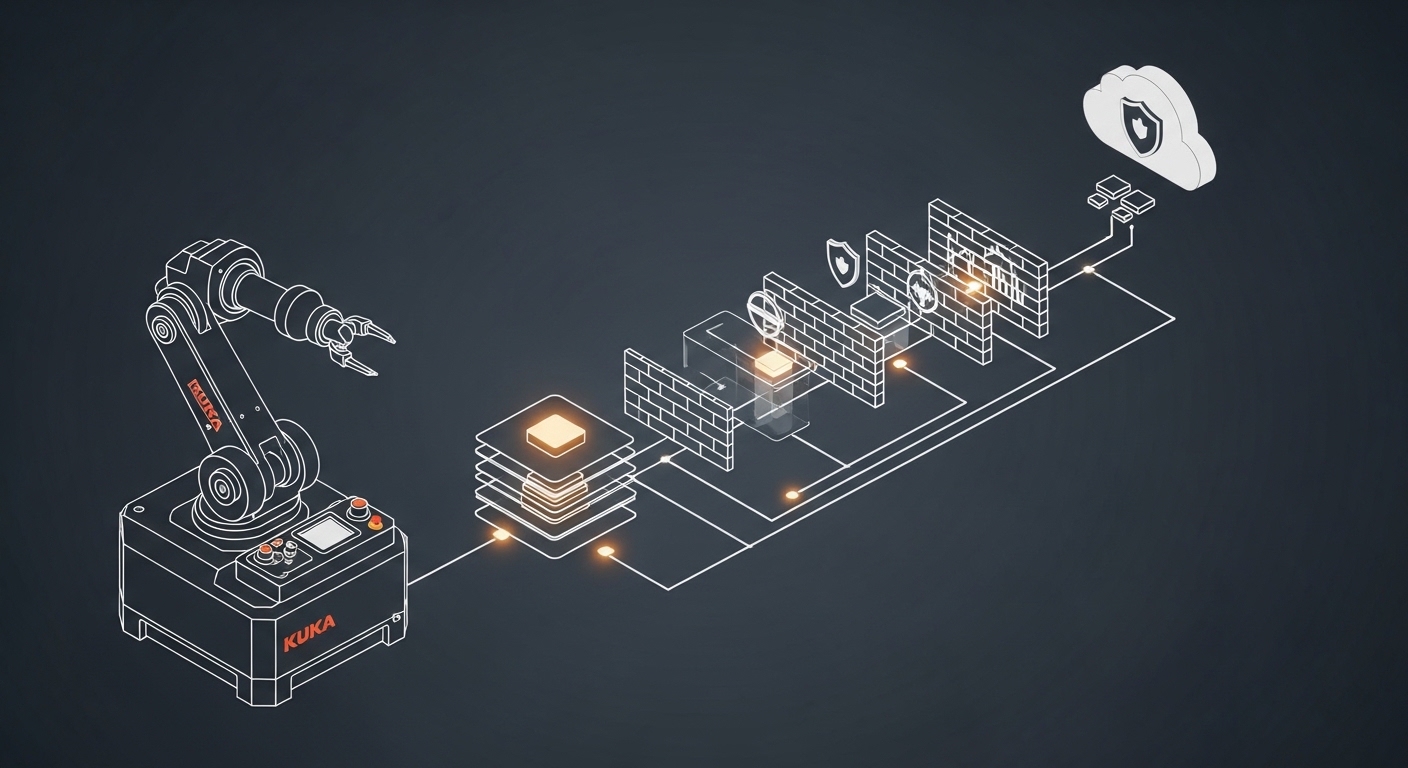
Identity-Based Segmentation at the OT Edge: Directly exposing the KR C4 to the internet or even the corporate IT network is untenable. Instead, deploy a dedicated OT edge gateway or security appliance within the Robot Cell Zone. This device acts as the Zero-Trust Policy Enforcement Point (PEP). Its primary function is to isolate the controller completely. The KUKA KR C4 only ever communicates with this single, trusted gateway over a physically or logically segmented local network link.
Secure Protocol Mediation: The edge gateway connects to the KR C4 using a native OT protocol, such as OPC UA. It authenticates with the controller, subscribes to the required PdM data tags, and then terminates this OT protocol session locally. This step is critical; it prevents any external entity from ever speaking directly to the robot controller's native services. The gateway then repackages the telemetry payload into a lightweight, secure, and cloud-native format like MQTT 5.0.
Authenticated, Encrypted Tunneling (mTLS): The connection from the edge gateway to the cloud MQTT broker must be established over a mutually authenticated Transport Layer Security (mTLS) 1.3 tunnel. This ensures both endpoints cryptographically prove their identity using X.509 certificates before any application data is exchanged. The server verifies the client's (gateway's) identity, and the client verifies the server's identity, preventing man-in-the-middle attacks.
Fine-Grained Policy Enforcement: Authentication is not authorization. Once the mTLS tunnel is established, the cloud broker (acting as another PEP) must enforce granular authorization policies. These policies, managed by a central Policy Decision Point (PDP), should adhere to the principle of least privilege. For instance, a policy might state: "The identity associated with certificate serial number
0x1A2B3C(representing Robot Arm #7) is ONLY authorized to PUBLISH messages to the MQTT topiciot/plant-a/cell-3/robot-7/telemetryand is explicitly DENIED from subscribing to any topic." This strict, identity-based control is the essence of thwarting lateral movement in brownfield SCADA with hardware-enforced zero-trust.Immutable Audit Trail: To satisfy the "auditable" requirement, every action must be logged. This includes every connection attempt (successful or failed), every policy decision from the PDP, every published message, and any administrative changes to the system. These logs should be streamed to a write-once, tamper-evident logging service (e.g., AWS CloudTrail or Azure Monitor) to provide a verifiable record for incident response and compliance reporting, fulfilling IEC 62443's FR6 (Timed Event Recording).
Practical Implementation Challenges
Deploying this architecture in a live production environment presents several formidable engineering hurdles.
Cryptographic Resource Constraints
The KR C4 controller is optimized for real-time motion control, not for intensive cryptographic operations. While it may support some basic security features, offloading the demanding TLS handshake and session management to a dedicated edge gateway is almost always the correct architectural choice to avoid impacting the controller's primary deterministic functions.
Certificate and Key Lifecycle Management at Scale
A factory may contain hundreds or thousands of such robots. Manually managing the X.509 certificates that serve as their machine identities is not scalable. A robust Public Key Infrastructure (PKI) is required, coupled with automated certificate enrollment and rotation protocols like SCEP (Simple Certificate Enrollment Protocol) or EST (Enrollment over Secure Transport) to manage the entire identity lifecycle without manual intervention.
Protocol-Specific Vulnerabilities and Data Access
Accessing the rich telemetry from the KR C4 often requires licensed KUKA software options like KUKA.OPC UA or KUKA.Ethernet KRL. Each of these interfaces has its own configuration surface and potential vulnerabilities. The security architecture must account for securing these specific packages, hardening their configurations, and ensuring that only the minimally required data points are exposed to the edge gateway. This is analogous to the complexities faced when addressing the challenges of zero-trust microsegmentation for proprietary protocols like S7Comm+.
Assuring Operational Continuity
The most significant challenge is deploying these advanced security controls without causing production downtime. The entire architecture must be designed for resilience and fail-safe operation. Implementation should follow a phased approach, beginning with passive monitoring before moving to active blocking and enforcement. Any solution that requires re-architecting the core control network or introduces unacceptable latency will be rejected by operations teams. This imperative underscores the need for a well-defined zero-downtime blueprint for micro-segmentation in live manufacturing OT.
Conclusion: From Risk Framework to Secure Enabler
Connecting high-value OT assets like KUKA robots to cloud platforms is a foundational step toward the smart factory. However, it cannot be done at the expense of security and operational stability. By using the IEC 62443 standard as the strategic risk management framework, organizations can systematically identify requirements and define necessary security levels. A Zero-Trust Architecture then provides the tactical blueprint for implementation, translating those requirements into concrete controls like identity-based segmentation, protocol mediation, and granular, continuously verified authorization.
This fusion of a top-down risk framework with a bottom-up, identity-centric security architecture transforms the KUKA-to-cloud data pipeline from a significant liability into a secure, auditable, and powerful enabler of AI-driven manufacturing excellence.
Sources / References
- IEC 62443 Series of Standards: International Electrotechnical Commission. (URL:
https://www.iec.ch/cyber-security) - NIST Special Publication 800-207: Zero Trust Architecture: National Institute of Standards and Technology. (URL:
https://csrc.nist.gov/publications/detail/sp/800-207/final) - KUKA AG Technical Documentation: (URL:
https://www.kuka.com/en-us/services/downloads) - OPC Foundation - OPC Unified Architecture (UA): (URL:
https://opcfoundation.org/about/opc-technologies/opc-ua/) - OASIS MQTT Standard: (URL:
https://mqtt.org/mqtt-specification/)