The Immutable Grid: A Zero-Trust Blueprint for Micro-segmenting Dispersed Legacy SCADA
Apex Insights Research Desk
The Strategic Imperative: Beyond the Brittle Perimeter
The security architecture of geographically dispersed energy grids represents a paradox of modern critical infrastructure. These Supervisory Control and Data Acquisition (SCADA) systems are responsible for the real-time stability of vast electrical networks, yet they often rely on security paradigms conceived decades ago. The foundational assumptions of perimeter security—a trusted internal network firewalled off from an untrusted external world—have catastrophically failed. The modern threat landscape, characterized by sophisticated state-sponsored actors and insider threats, treats the perimeter as a trivial obstacle, not a definitive barrier.
Once breached, a flat, legacy SCADA network offers an attacker unrestricted lateral movement. A single compromised Human-Machine Interface (HMI) or engineering workstation can become a beachhead to pivot across the entire operational technology (OT) environment, from the central control room to remote terminal units (RTUs) in unmanned substations hundreds of miles apart. The intrinsic vulnerabilities of legacy protocols like DNP3 and Modbus, designed for performance and reliability in isolated networks, are now liabilities in a converged IT/OT world. A new architectural mandate is required—one that assumes breach, enforces granular control, and introduces deterministic predictability into security policy. This is the mandate for an immutable, zero-trust micro-segmentation architecture.
Deconstructing the Architecture: Core Tenets for Resilient SCADA
Transitioning from a perimeter-based model to a zero-trust architecture is not merely an incremental upgrade; it is a fundamental shift in security philosophy and engineering execution. It is built upon three interdependent pillars: the principle of zero trust, the mechanism of micro-segmentation, and the operational model of immutability.
Zero Trust: The Principle of Explicit Permission
At its core, Zero Trust is an assertion that no actor, system, or network flow is trusted by default, regardless of its location within the network. Every access request must be explicitly authenticated and authorized before it is granted. This principle is a direct repudiation of the high-trust model inherent in legacy OT networks.
The National Institute of Standards and Technology (NIST) in its Special Publication 800-207 defines Zero Trust Architecture (ZTA) as an enterprise cybersecurity architecture that is based on zero trust principles and designed to prevent data breaches and limit internal lateral movement. It is a response to a trend in which network perimeters are becoming less distinct and the location of data and workloads is shifting.
In the context of a SCADA grid, this means a command from the master terminal unit (MTU) to an RTU is not permitted simply because it originates from the 'trusted' OT network segment. The request must be cryptographically verified based on the identity of the MTU, the identity of the destination RTU, the specific DNP3 function code being requested, and the operational context at that moment. All other communication attempts are implicitly denied.
Micro-segmentation: The Granular Control Plane
Micro-segmentation is the mechanism by which the zero-trust principle is enforced. Instead of creating large, monolithic network zones (like a 'substation LAN' or 'control center network'), micro-segmentation creates a secure enclave around each individual asset or a very small, logically-grouped set of assets. This is the logical evolution of network segmentation, reducing the attack surface to its absolute minimum—the individual device or workload.
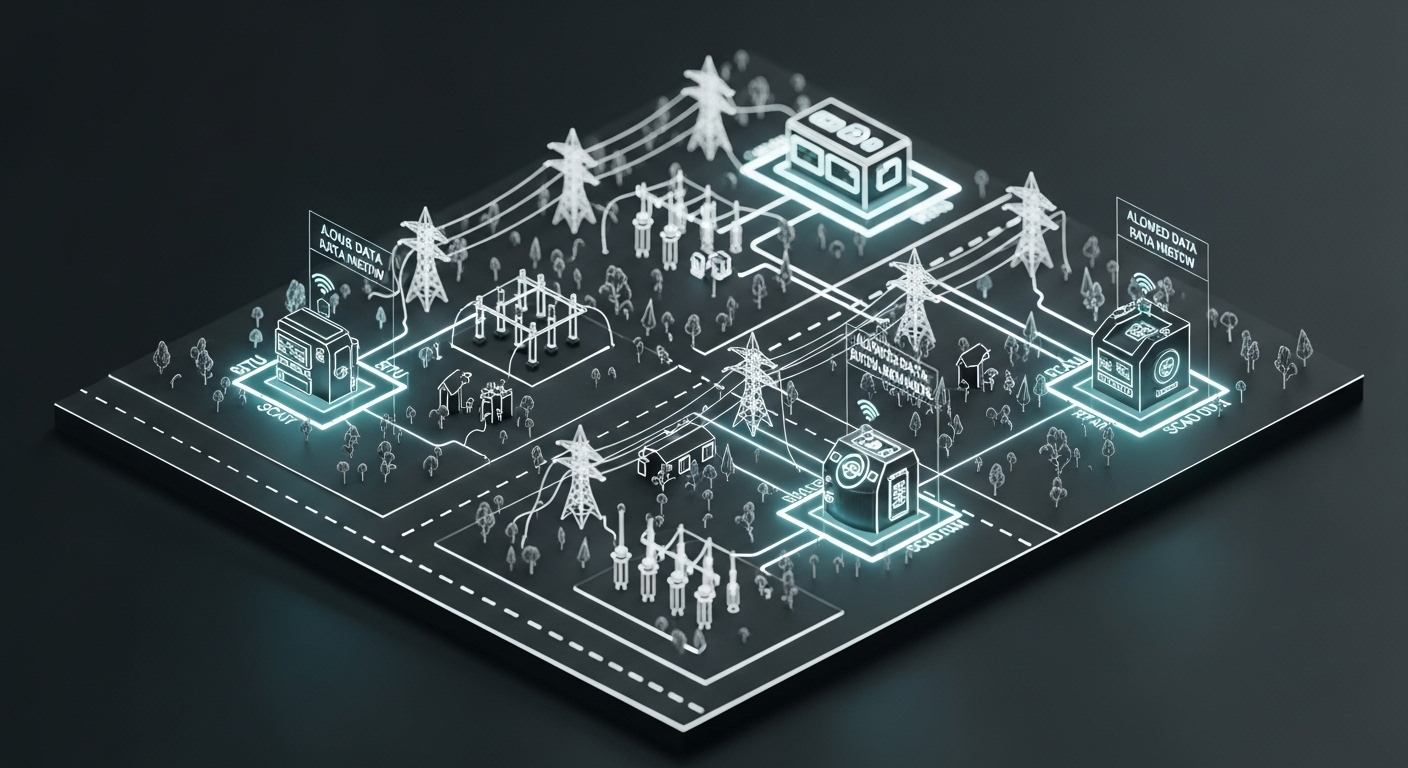
For an energy grid, this means an RTU controlling a circuit breaker is in its own micro-segment. The protective relay adjacent to it is in another. The HMI in the substation is in a third. Policy then dictates that the only permitted traffic is, for example, a specific set of IEC 61850 GOOSE messages between the relay and the RTU, and a specific set of DNP3 commands from the central MTU to that specific RTU. An attempt by a compromised HMI to scan the protective relay would be blocked by policy at the segment boundary, even if they are connected to the same physical network switch. This is the primary engineering method for containing chaos: a zero-trust blueprint for halting lateral movement in multi-vendor ICS environments and preventing a minor incident from cascading into a grid-wide outage.
Immutability: Engineering Predictability into Security Policy
Immutability, a concept borrowed from modern cloud infrastructure-as-code (IaC) practices, is the architectural linchpin. It dictates that security policies and network configurations are not modified in-place on live enforcement points. Instead, the entire policy set is treated as a version-controlled, declarative artifact. To implement a change—such as commissioning a new RTU or authorizing a new maintenance connection—an engineer modifies the policy file in a central repository (e.g., Git), the change is peer-reviewed and automatically tested in a simulation environment, and upon approval, the new, complete policy set is deployed, atomically replacing the old one.
This workflow eradicates configuration drift, unauthorized 'emergency' changes, and the ambiguity of manual firewall rule management. The deployed security posture is always a direct reflection of the last known-good, committed configuration. This provides an unprecedented level of auditability and predictability, which is paramount for NERC CIP compliance and operational resilience.
An Engineering Blueprint for Implementation
Deploying an immutable zero-trust architecture in a brownfield SCADA environment is a multi-phased engineering effort that demands methodical execution.
Phase 1: Deep Asset Discovery and Communication Flow Mapping The foundation of any zero-trust implementation is a complete and accurate understanding of the environment. This phase involves deploying passive network sensors to capture all SCADA traffic. Using deep packet inspection (DPI) capable of parsing protocols like DNP3, Modbus/TCP, and IEC 61850, a baseline of all legitimate communication flows is established. This isn't just about IP addresses and ports; it's about mapping which specific HMI reads which register addresses from which specific PLC, using which function codes, and at what frequency. This creates the 'golden blueprint' of normal operations.
Phase 2: Defining a Centralized Policy Abstraction Layer The mapped flows are translated into a human-readable, abstracted security policy. Instead of writing firewall rules, engineers define intents, such as
allow(source.role='SCADA_MTU', dest.role='Substation_1138_RTU_A', protocol='DNP3', function_codes=['READ', 'WRITE']). A central Policy Decision Point (PDP) or controller translates these high-level intents into the specific, low-level rules required by the distributed enforcement points.Phase 3: Deploying Distributed Policy Enforcement Points (PEPs) PEPs are the distributed agents or gateways that enforce the policy. In a geographically dispersed grid, a hybrid approach is essential. This may include:
- Host-based agents on modern Windows-based HMIs and SCADA servers.
- Next-generation firewalls acting as segmentation gateways at substation ingress/egress points.
- Most critically for legacy devices, transparent inline enforcement gateways placed directly in front of RTUs or PLCs that cannot host an agent. These specialized devices act as cryptographic anchors and policy enforcers for otherwise indefensible endpoints. This strategy is central to creating an agentless zero-trust for SCADA: a network-centric blueprint for securing constrained OT devices and ensuring complete coverage.
Phase 4: Implementing the Immutable CI/CD Workflow The abstracted policies from Phase 2 are stored as code in a version control system. A Continuous Integration/Continuous Deployment (CI/CD) pipeline is established. When a policy change is committed, the pipeline automatically triggers a series of validation checks: syntax validation, simulation against captured traffic to check for unintended blocked flows, and compliance checks. If all tests pass, the pipeline securely pushes the updated configuration to the central PDP, which then disseminates the new rules to all relevant PEPs across the grid.
Phase 5: Continuous Verification and State Attestation The final phase closes the loop. The system must continuously verify that the enforced state at the PEPs matches the intended state defined in the policy repository. This is achieved through automated configuration audits, where the PDP queries the PEPs for their running configuration, and through cryptographic attestation, where devices can prove their identity and integrity to the policy controller.
Practical Implementation Challenges: The Engineering Reality
Architecting such a system is not without significant technical hurdles that must be addressed at the design stage.
Determinism Under Duress: Latency and Jitter in Real-Time Protocols
Introducing any inline device, such as a PEP, risks adding latency and jitter to time-sensitive SCADA communications. A DNP3 poll that times out or a GOOSE message that arrives late can trigger false alarms or even cause a protective relay to trip incorrectly. PEPs must be engineered for deterministic, line-rate performance, often requiring hardware-based fast paths and protocol-specific processing offloads to ensure that security inspection does not compromise operational timing constraints.
The Protocol Authentication Gap: Securing Unauthenticated SCADA Commands
Legacy protocols like Modbus/TCP have no concept of authentication. A valid command is simply one with the correct slave ID and function code. A PEP must therefore go beyond simple IP filtering and perform stateful DPI. It must validate that a WRITE_SINGLE_COIL command is only targeting a legitimate register address on that specific RTU, is coming from an authorized source, and falls within operational parameters. This requires the PEP to have a granular, protocol-aware understanding of the application's baseline behavior.
Bridging the Legacy Divide: Securing Serial Communications
Many of the most critical assets at the grid edge, particularly older RTUs, still communicate via serial protocols like DNP3-Serial or Modbus RTU. These are often connected to the IP network via terminal servers or gateways. These gateways become a critical chokepoint and a massive vulnerability. Securing them requires specialized PEPs that can terminate the serial connection, inspect the raw protocol data, apply zero-trust policy, and then re-encapsulate it over a secure, authenticated IP tunnel. Properly designing the serial enclave: a zero-trust blueprint for micro-segmenting modbus rtu in brownfield ics is a non-trivial task that is essential for comprehensive security.
Conclusion: From Reactive Defense to Engineered Resilience
The adoption of an immutable, zero-trust micro-segmentation architecture is the most significant leap forward in SCADA security since the advent of the firewall. It moves the energy sector away from a reactive, perimeter-focused posture towards a proactive model of engineered resilience. By treating every asset as its own defensible island, enforcing policy based on verified identity, and managing that policy through a rigorous, automated, and auditable workflow, grid operators can build a system that is secure by design. The complexity is significant, but the alternative—continuing to operate critical infrastructure on a foundation of implicit trust—is an untenable risk in the current threat environment.
Sources / References
- NIST Special Publication 800-207: Zero Trust Architecture
https://csrc.nist.gov/publications/detail/sp/800-207/final - ISA/IEC 62443 Series of Standards on Industrial Automation and Control Systems (IACS) Security
https://www.isa.org/standards-and-publications/isa-standards/isa-iec-62443-series-of-standards - NERC Critical Infrastructure Protection (CIP) Standards
https://www.nerc.com/pa/Stand/Pages/CIPStandards.aspx - Securing DNP3 and Modern SCADA Systems (Sandia National Laboratories Report)
https://www.sandia.gov/app/uploads/sites/149/2021/04/SecuringDNP3.pdf