Agentless Zero-Trust for SCADA: A Network-Centric Blueprint for Securing Constrained OT Devices
Apex Insights Research Desk
The Unpatchable Mandate: Securing SCADA Without Endpoint Agents
The core principle of Zero-Trust—never trust, always verify—presents a significant architectural challenge within Supervisory Control and Data Acquisition (SCADA) and Operational Technology (OT) environments. The traditional IT-centric approach to Zero-Trust Network Access (ZTNA) often relies heavily on software agents deployed on endpoints to assert identity, check posture, and enforce policy. This model fails catastrophically when applied to the vast installed base of SCADA devices. Programmable Logic Controllers (PLCs), Remote Terminal Units (RTUs), and various embedded controllers are frequently built on resource-constrained hardware, run real-time operating systems (RTOS), and are subject to stringent vendor warranties and regulatory certifications that prohibit the installation of third-party software. Attempting to deploy an agent on such a device is not merely difficult; it is often impossible and invariably ill-advised.
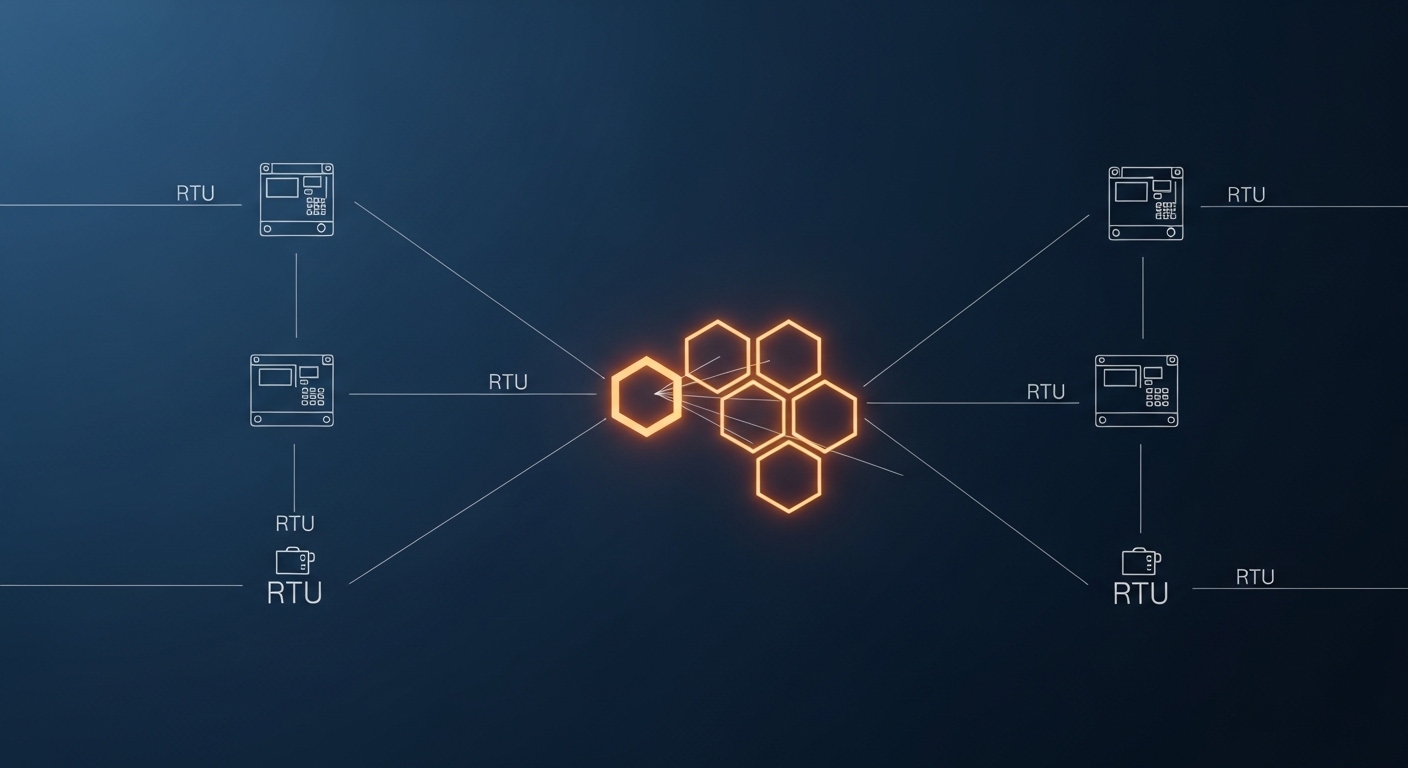
This creates a critical security paradox: the most vital, process-critical assets are often the least capable of hosting modern security controls. The solution lies not in attempting to force IT paradigms onto OT hardware, but in fundamentally rethinking the enforcement topology. An agentless Zero-Trust architecture externalizes the security functions—the Policy Decision Point (PDP) and the Policy Enforcement Point (PEP)—from the endpoint into the network fabric itself. This network-centric model is not a compromise; it is a prerequisite for securing brownfield SCADA systems, transforming the network from a simple transport medium into an active, intelligent enforcement layer.
Architectural Blueprints for Agentless Enforcement
Implementing Zero-Trust without endpoint agents requires placing intelligent enforcement chokepoints within the network architecture. These chokepoints must be capable of authenticating and authorizing every connection request based on granular policy, effectively creating micro-perimeters around individual devices or small groups of assets. The following strategies represent the primary architectural patterns for achieving this objective.
1. Network-Based Micro-segmentation via Protocol-Aware Gateways
This is the most direct and powerful method for agentless enforcement in OT. It involves deploying industrial firewalls or dedicated segmentation gateways inline, directly in the data path to the SCADA assets they are protecting. Unlike traditional IT firewalls that operate primarily at Layer 3/4 (IP address and port), these gateways perform deep packet inspection (DPI) at Layer 7, providing protocol-specific context.
For a connection to be permitted, the gateway validates it against a multi-faceted policy:
- Identity Verification: The source of the request (e.g., an HMI, an engineering workstation, another PLC) is authenticated. This may use MAC addresses, 802.1X, or integration with a central identity provider.
- Protocol-Level Authorization: The gateway parses the specific OT protocol (e.g., Modbus/TCP, DNP3, EtherNet/IP, S7). The policy can then enforce least-privilege at an extremely granular level. For instance, it can permit an HMI to execute a Modbus
Read Coilcommand (Function Code 01) but explicitly deny aWrite Single Coilcommand (Function Code 05) to a specific register range on a specific PLC. This prevents unauthorized or accidental process modifications, even from an otherwise legitimate source. - Stateful Inspection: The gateway maintains connection state, ensuring that only valid, solicited responses are allowed back from the SCADA device, mitigating certain classes of spoofing attacks.
This approach effectively turns a flat, vulnerable network into a series of defensible enclaves. It is a cornerstone of modern OT security and the foundation for building a robust, protocol-aware micro-segmentation blueprint for securing Modbus/TCP and EtherNet/IP. The PEP is the gateway itself, which queries an external PDP (the policy engine) or holds a cached version of the policy for low-latency decision-making.
2. Software-Defined Networking (SDN) for Dynamic Flow Control
In more modern or greenfield OT environments equipped with SDN-capable switches, the network fabric can become a distributed enforcement plane. In this model, an SDN controller acts as the centralized PDP. When a new communication flow is initiated, the first packet is sent to the controller.
- Policy Evaluation: The SDN controller evaluates the request against the Zero-Trust policy, considering the identity of the source, the requested destination SCADA asset, and the required protocol/port.
- Dynamic Rule Provisioning: If the request is authorized, the controller dynamically programs an explicit flow rule into the access lists (ACLs) of the relevant network switches.
- Hardware-Speed Enforcement: Subsequent packets in that authorized flow are processed directly by the switch hardware at line rate, introducing negligible latency.
This architecture provides immense flexibility and centralized control, allowing for rapid, network-wide policy changes in response to emerging threats. However, its adoption is often constrained by the requirement for a significant network infrastructure overhaul, a challenging proposition in many established industrial facilities. It represents a powerful strategy within the broader context of the brownfield imperative for Zero-Trust micro-segmentation, but one that requires careful planning and investment.
3. Identity-Aware Proxies and Access Gateways
For securing remote access, particularly for third-party vendors or remote engineers, an identity-aware proxy or ZTNA gateway is the superior architectural choice. This model externalizes the entire trust evaluation process away from the protected network.
Instead of a traditional VPN that grants broad network-level access, the ZTNA gateway functions as a broker. A user connects to the gateway, not the network. The gateway then performs a rigorous identity and context check—verifying multi-factor authentication (MFA), device posture, time of day, and geographic location—before granting access. Crucially, access is granted only to a specific application or device for a limited time, based on an explicit policy. The proxy then establishes a separate, secure connection to the target SCADA device on behalf of the user. This ensures that the end-user's device never directly connects to the OT network, completely eliminating a significant vector for lateral movement.
The Central Role of an OT-Aware Identity Fabric
Agentless strategies shift enforcement to the network, but the intelligence still resides in the policy. A robust Zero-Trust architecture is entirely dependent on a sophisticated policy engine capable of understanding OT context. This requires integration with an identity provider that manages not just human users, but also machine and service identities.
A key challenge is that legacy SCADA devices lack native identity constructs. Their "identity" must be inferred and asserted by the network based on static attributes like MAC/IP address pairs, physical switch port location, and observed communication patterns. A modern OT security platform must build and manage this inventory, creating a foundational device identity database. Building the universal identity fabric for vendor-agnostic M2M IAM is a critical precursor to implementing any meaningful Zero-Trust policy, as it provides the essential "who" component for every access decision.
Practical Implementation Challenges
Transitioning to an agentless Zero-Trust model in a live SCADA environment is a complex engineering task fraught with unique, high-stakes challenges.
Latency and Real-Time Determinism: The introduction of any inline device, such as a segmentation gateway, adds latency. While typically measured in microseconds, even this can be unacceptable for high-speed, deterministic control loops (e.g., turbine control, coordinated robotics). Architectural designs must carefully place enforcement points to avoid disrupting time-sensitive communications, often segmenting at the cell/zone level rather than around every individual device.
Asset Discovery and Traffic Baselining: A foundational requirement is a complete and accurate inventory of all network assets and a comprehensive map of all legitimate communication flows. In large, mature brownfield sites, this discovery phase can be a monumental undertaking. Passive network monitoring is essential to build this baseline without disrupting operations, but it requires significant time to capture all valid operational states (e.g., startup, shutdown, emergency procedures).
Handling Proprietary and Encrypted Protocols: While DPI works well for common open protocols, many OT environments contain proprietary vendor protocols. If the enforcement gateway cannot parse these protocols, it is forced to fall back to Layer 3/4 enforcement, losing the granular command-level control that is a key benefit of the architecture. Similarly, the increasing use of encryption (e.g., OPC UA with security) can blind network-based PEPs unless they are designed to act as man-in-the-middle proxies, which introduces its own complexity and performance overhead.
Physical and Environmental Constraints: Industrial environments present significant physical hurdles. There may not be physical space in existing control cabinets for new gateway hardware. Equipment may need to meet specific environmental ratings for temperature, humidity, or hazardous locations (e.g., ATEX certification), drastically limiting hardware choices and increasing costs.
The principles of ISA/IEC 62443 provide a structured methodology for this journey. The standard's concept of defining zones (groupings of assets with common security requirements) and conduits (the communication paths between zones) aligns perfectly with the agentless ZTNA model. A network segmentation gateway is the physical manifestation of a secure conduit, enforcing the required security level for all traffic that passes through it.
Conclusion: From Endpoint Defense to Network Resilience
The inability to deploy agents on legacy SCADA devices is not a roadblock to Zero-Trust; it is a design constraint that forces a more resilient and architecturally sound solution. By externalizing policy enforcement into the network fabric, organizations can implement granular, identity-based controls that protect critical infrastructure without modifying or jeopardizing the stability of the underlying control systems.
This network-centric approach transforms security from a fragile, host-based feature into an intrinsic property of the environment. The focus shifts from protecting individual, often indefensible, endpoints to securing the conversations between them. It is a pragmatic, effective, and often the only viable strategy for imposing a Zero-Trust security posture on the foundational systems that underpin modern industry.
Sources / References
- NIST Special Publication 800-207, Zero Trust Architecture: https://csrc.nist.gov/publications/detail/sp/800-207/final
- ISA/IEC 62443 Standards for Industrial Automation and Control Systems Security: https://www.isa.org/standards-and-publications/isa-standards/isa-iec-62443-series-of-standards
- CISA, Recommended Practice: Securing Industrial Control Systems: https://www.cisa.gov/sites/default/files/recommended_practice/RP_Securing-Industrial-Control-Systems_S508C.pdf