The Brownfield Imperative: A Zero-Trust Micro-segmentation Blueprint for Air-Gapped and Proprietary ICS
Apex Insights Research Desk
Introduction: The Paradox of Securing the Unsecurable
Industrial Control Systems (ICS) in brownfield environments represent a formidable cybersecurity challenge. These are not pristine, software-defined networks; they are complex, heterogeneous ecosystems of proprietary hardware, decades-old legacy devices, and protocols that predate the modern internet. The conventional wisdom of perimeter security, often manifested as a hardened shell with a soft, trusted interior—sometimes theoretically protected by an 'air gap'—is a demonstrably failed paradigm. The increasing porosity of these perimeters, driven by IT/OT convergence, remote vendor access, and transient devices, necessitates a fundamental architectural shift.
Enter Zero-Trust. While the term has reached buzzword saturation in the IT domain, its application in Operational Technology (OT) is a far more nuanced and complex engineering problem. A naive lift-and-shift of IT-centric Zero-Trust models, which often rely on software agents and ubiquitous API access, is not only impractical but dangerous in a world governed by deterministic control loops and certified, unmodifiable firmware.
This research brief outlines a pragmatic and defensible architectural blueprint for implementing true Zero-Trust micro-segmentation in brownfield ICS. Our focus is specifically on the most challenging assets: proprietary hardware with opaque protocols and physically or logically air-gapped legacy devices. The approach hinges on an agentless, out-of-band enforcement model that redefines the protect surface from the network level down to individual process control conduits.
Redefining the Protect Surface: From Networks to Deterministic Conduits
The foundational error in applying traditional security models to ICS is the focus on the IP address as the primary unit of identity. In OT, the process is the asset. The identity of an endpoint is defined by its function: Is it a PLC controlling a valve? An HMI visualizing a turbine's speed? A historian collecting temperature data? True security requires protecting the integrity of these functions, not just the network packets they generate.
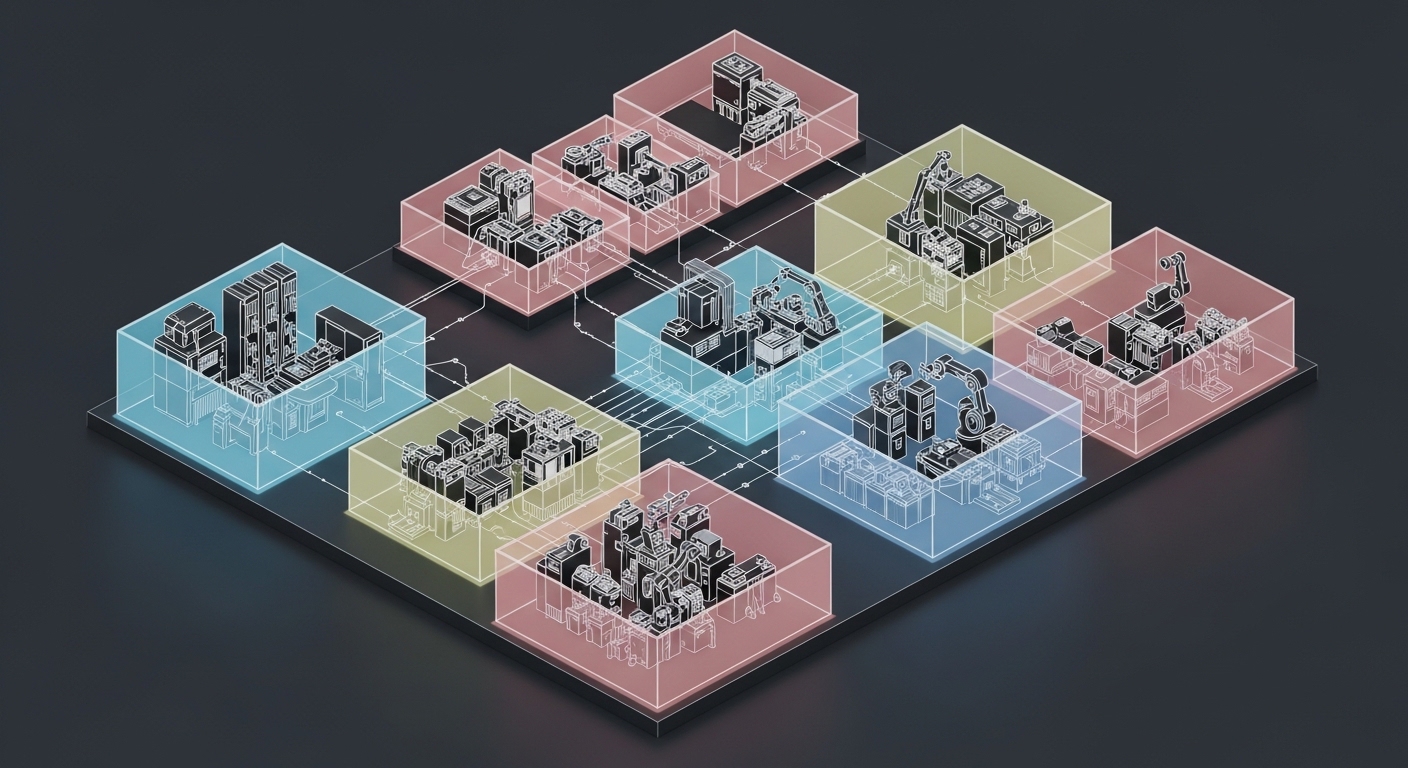
Micro-segmentation in this context is not about creating VLANs. It is about establishing cryptographically-enforced, policy-defined micro-perimeters around individual PLCs, RTUs, I/O racks, and even specific serial connections. The goal is to create what we term "deterministic conduits": explicitly defined, unidirectional or bidirectional communication pathways that are validated based on process necessity. Anything outside of these conduits is implicitly denied. This model inherently assumes breach and ensures that even if one device is compromised, its ability to move laterally or disrupt adjacent processes is nullified. This requires a shift towards solutions that can provide agentless Zero-Trust micro-segmentation for legacy PLCs, as installing software on these devices is an operational non-starter.
An Architectural Blueprint for Agentless, Out-of-Band Enforcement
Given the constraints of brownfield ICS—where modifying endpoints can void warranties, decertify systems, or introduce catastrophic instability—any viable solution must be agentless and non-intrusive. The enforcement mechanism cannot reside on the asset itself but must be placed externally in the communication path. The following step-by-step blueprint details this out-of-band architecture.
Passive Discovery and High-Fidelity Baselining: The first phase is purely observational. By deploying network TAPs or utilizing SPAN ports on managed switches, a comprehensive and passive inventory of all network communications is assembled. This goes beyond simple IP/port mapping. It requires deep packet inspection (DPI) to identify specific OT protocols, device types (vendor and model), asset roles, and communication patterns. The output is a high-fidelity map of the existing process network, establishing an operational baseline of what constitutes "normal" behavior.
Protocol-Aware Policy Abstraction: With a complete baseline, a policy engine can be used to abstract security rules away from network constructs. Instead of writing a firewall rule like
ALLOW TCP 192.168.1.10:502 -> 192.168.1.20:502, a Zero-Trust policy is defined in terms of process logic:ALLOW HMI-01 to READ_HOLDING_REGISTERS from PLC-07 (Boiler Control). This abstraction layer is critical for creating manageable, human-readable policies that align with engineering and operational workflows, not network administrator conventions.Strategic Deployment of Inline Enforcement Points: The policy is enforced by physical, out-of-band segmentation gateways. These are not traditional firewalls. They are purpose-built devices, often FPGA-based for low-latency performance, that sit inline between critical assets or at network aggregation points (e.g., between a Purdue Model Level 1 ring and a Level 2 supervisory network). These gateways fetch their policy from the central engine and perform real-time, protocol-aware validation and enforcement on every packet.
Bridging the Air Gap: Securing Non-IP and Serial Devices: The most significant challenge is extending the Zero-Trust model to devices that don't speak IP. This is where the architecture must innovate:
- Policy-Aware Serial Gateways: For legacy devices using RS-232/485 with protocols like Modbus RTU, specialized gateways are deployed. These gateways act as transparent bridges, converting serial to Ethernet for monitoring, but more importantly, they contain an embedded policy enforcement engine. They can inspect the serial data stream and enforce function-code-level rules (e.g., allow
Readcommands, blockWrite Firmwarecommands) before the data ever reaches the end device. This is the core principle behind architecting a Zero-Trust microsegmentation on non-IP ICS devices. - Physical Digital Airlocks: For truly air-gapped systems requiring manual updates via removable media or direct laptop connection, a physical enforcement point is required. This "digital airlock" kiosk acts as a mandatory intermediary. A technician must connect their laptop or USB drive to the kiosk, which scans for malware, verifies file integrity, and confirms the user's authorization before a sanitized, temporary connection to the target system is permitted.
- Policy-Aware Serial Gateways: For legacy devices using RS-232/485 with protocols like Modbus RTU, specialized gateways are deployed. These gateways act as transparent bridges, converting serial to Ethernet for monitoring, but more importantly, they contain an embedded policy enforcement engine. They can inspect the serial data stream and enforce function-code-level rules (e.g., allow
Practical Implementation Challenges
Deploying this architecture is not without significant engineering hurdles that demand careful consideration.
- Proprietary Protocol Opacity: While standard protocols like Modbus/TCP or DNP3 are well-documented, many large automation vendors utilize proprietary protocols. Effective DPI and policy enforcement require these protocols to be understood. This often involves either direct collaboration with the vendor to obtain specifications or, more commonly, a significant investment in protocol reverse engineering. Without this understanding, the enforcement gateway is reduced to a simple L3/L4 firewall, defeating the purpose of granular, process-aware control. This is the primary hurdle in enabling non-disruptive anomaly detection for proprietary OT protocols.
- Latency and Determinism: Introducing any inline device adds latency and jitter. In high-speed, deterministic control applications (e.g., motion control, turbine synchronization), even a few hundred microseconds of delay can cause process failure. The enforcement hardware must be rigorously benchmarked and selected based on its ability to operate at line-rate without impacting the deterministic nature of the control network. This often points towards FPGA-based solutions over general-purpose CPUs.
- Policy Lifecycle Management: A Zero-Trust policy is not static. When a pump is replaced, a PLC's logic is updated, or a new sensor is added, the security policy must be updated in lockstep. This requires tight integration between the Zero-Trust policy engine and the plant's formal Management of Change (MoC) process. Failure to do so results in "policy drift," where the enforced rules become dangerously misaligned with the physical reality of the plant, leading to either security gaps or false-positive-induced downtime.
- Fail-Safe and Fail-Open Design: What happens if an enforcement gateway fails? The default behavior must be architected based on a risk assessment of the specific process it protects. A safety instrumented system (SIS) might require a "fail-safe" state (blocking traffic and triggering a safe shutdown), whereas a less critical monitoring system might be designed to "fail-open" (allowing traffic to pass uninspected) to prioritize availability. This decision has profound implications for both safety and security.
The Principle of Least Functionality in Practice
The entire architecture is an embodiment of the principle of least privilege, or more accurately for OT, least functionality. It's a direct application of the core tenants of Zero-Trust architecture.
A core tenet of Zero Trust is to prevent unauthorized access to data and services and to make access control enforcement as granular as possible. All resource authentication and authorization are dynamic and strictly enforced before access is allowed. This includes checking the identity, device, and other behavioral and environmental attributes. - NIST SP 800-207, Zero Trust Architecture
In our blueprint, this translates to enforcing rules at the OT application layer. For example, a Rockwell ControlLogix PLC communicating via EtherNet/IP might be segmented such that an HMI is authorized to read and write specific tags related to process values (CIP Read/Write Tag Service). However, that same HMI is explicitly denied the ability to issue a CIP Forward Open request to modify the PLC's configuration or logic. The enforcement gateway intercepts and drops the unauthorized request, logging the attempt, without the target PLC ever needing to process it. This level of granular control is the ultimate objective of micro-segmentation in ICS.
Conclusion
Implementing Zero-Trust micro-segmentation in a brownfield ICS environment is one of the most challenging but necessary evolutions in industrial cybersecurity. It demands a departure from IT-centric thinking and an embrace of architectures that are agentless, out-of-band, and deeply aware of the underlying physical processes they protect. By redefining the protect surface around deterministic conduits and deploying specialized enforcement points capable of securing both IP and non-IP assets, organizations can build a resilient, defensible security posture. This is not a product to be installed but an architectural commitment—a journey that transforms the network from a brittle, trusted plane into a robust, granularly-controlled fabric capable of withstanding the sophisticated threats targeting critical infrastructure today.
Sources / References
- NIST Special Publication 800-207, Zero Trust Architecture. URL: https://csrc.nist.gov/publications/detail/sp/800-207/final
- NIST Special Publication 800-82r3 (Draft), Guide to Operational Technology (OT) Security. URL: https://csrc.nist.gov/publications/detail/sp/800-82/rev-3/draft
- ISA/IEC 62443 Series of Standards on Industrial Automation and Control Systems Security. URL: https://www.isa.org/standards-and-publications/isa-standards/isa-iec-62443-series-of-standards