The Serial Lockdown: A Blueprint for Zero-Trust Micro-segmentation on Non-IP ICS Devices
Apex Insights Research Desk
The Unseen Liability: Securing Non-IP Assets in Brownfield OT
In the discourse of modern Industrial Control System (ICS) cybersecurity, the focus is disproportionately skewed towards IP-enabled devices. We architect complex zero-trust frameworks for EtherNet/IP, Modbus/TCP, and OPC UA, yet a vast and critical substrate of operational technology remains dangerously exposed: the legacy, non-IP devices that form the bedrock of brownfield industrial environments. These are the workhorses of Level 0 and Level 1—the PLCs, RTUs, VFDs, and sensors communicating over serial protocols like Modbus RTU, DF1, and Profibus. They are, by design, devoid of modern security primitives. They lack identity, authentication, and encryption, operating on a paradigm of implicit trust that has become a critical vulnerability.
The core engineering challenge is stark: How do we impose a granular, zero-trust security posture on devices that were never designed for it, within a live production environment, and without the possibility of firmware modification? The answer lies not in altering the endpoints, but in architecting an intelligent, non-intrusive overlay that externalizes security enforcement. This research desk presents an architectural blueprint for achieving firmware-agnostic, zero-trust micro-segmentation for non-IP ICS devices, effectively creating secure enclaves around the most vulnerable assets without disrupting physical processes.
Architectural Imperative: Moving Beyond the IP-Centric Worldview
The fundamental disconnect between IT security models and OT reality is most apparent at the physical and data link layers of serial communication. Protocols operating over RS-232 or multi-drop RS-485 buses are inherently broadcast-based. Any device on the bus can eavesdrop on all communications, and a compromised or malicious device can issue commands with impunity. There is no concept of a session, no source or destination address in the IP sense, merely a slave ID that can be easily spoofed.
Traditional network segmentation using firewalls and VLANs offers zero protection within the serial bus itself. A firewall can create a perimeter around the serial-to-Ethernet gateway, but once a command traverses that gateway, it has free reign over the entire multi-drop serial line. This flat trust model is antithetical to the core tenets of zero trust.
The principle of Zero Trust mandates that no actor, system, network, or service operating from within or without the security perimeter is trusted. Instead, we must verify anything and everything trying to connect to our systems before granting access.
To apply this principle to non-IP devices, we must shift the enforcement point away from the non-existent network identity of the endpoint and onto the communication path itself. We must architect a system capable of intercepting, decoding, authenticating, and authorizing every single serial command based on a centrally managed policy, effectively treating each transaction as a potential breach until proven otherwise. This requires a new class of security instrumentation designed specifically for the deterministic, low-latency world of serial control systems.
The Engineering Blueprint: Proxy-Based Enforcement and Secure Tunneling
Achieving this level of granular control without altering the legacy endpoint necessitates an inline, proxy-based architecture. This model introduces a hardened security appliance—a serial protection proxy or micro-segmentation gateway—into the communication path. This device acts as the Policy Enforcement Point (PEP), becoming the trusted intermediary that adjudicates all traffic. The implementation follows a deterministic, five-stage process:
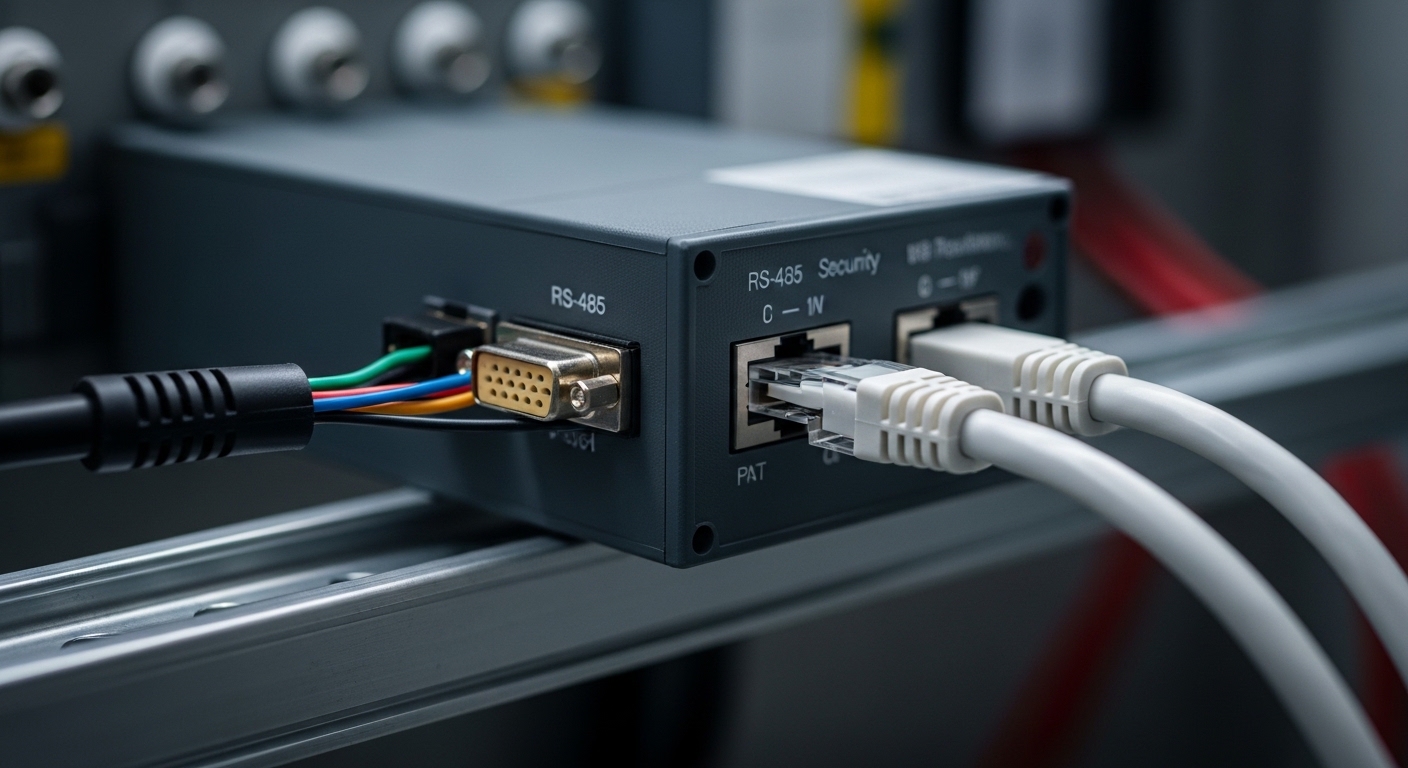
Physical Interposition and Termination: The serial protection proxy is physically deployed inline on the serial cable between a master device (e.g., a SCADA server's serial port or a gateway) and the slave devices (PLCs, RTUs). It physically terminates the connection from both ends, preventing any direct, uninspected electrical path between master and slave. In multi-drop RS-485 scenarios, this may involve a single proxy at the master, or multiple proxies to create micro-segments along the bus.
Stateful Protocol Disassembly and Inspection: Upon receiving a serial frame (e.g., a Modbus RTU request), the proxy's engine performs deep packet inspection (DPI) specific to that protocol. This is not a simple pattern match. A robust engine must understand the protocol's structure, state, and function. For Modbus, this means parsing the Slave ID, function code (e.g.,
0x03Read Holding Registers,0x10Write Multiple Registers), starting register address, and data payload. This disassembly allows the proxy to understand the intent of the command.Contextual Policy Adjudication: The parsed command intent is then checked against a granular, context-aware security policy. This policy, which serves as the Policy Decision Point (PDP), is far more sophisticated than a simple ACL. It defines the explicit, baseline behavior of the process. For example, a policy might state:
ALLOW SCADA_HMI (source) TO READ_REGISTERS(40001-40100) FROM VFD_PUMP_3 (destination). Any attempt by the SCADA HMI to write to those registers, or read from a different address range, would be denied. This is the essence of least-privilege access, enforced on a per-transaction basis. The implementation of such policies is a core component of creating a dynamic micro-segmentation of non-ip ot protocols strategy.Secure Encapsulation and Transport (Optional): If the master and slave are geographically separated and connected via an Ethernet network, the proxy encapsulates the validated serial command within a secure tunnel (e.g., TLS or IPsec). This converts the insecure serial communication into a secure, authenticated, and encrypted IP packet for transit over the untrusted plant network. This step is crucial for protecting data in transit between the enforcement points.
Native Protocol Reconstruction: A second proxy at the destination end receives the encapsulated packet, decrypts it, and reconstructs the original, validated serial command. It then transmits this command to the legacy slave device. To the PLC or RTU, the transaction is indistinguishable from a direct connection to the master. It remains entirely unaware of the comprehensive security inspection that has occurred, ensuring zero impact on its operation.
This architectural pattern effectively creates a secure overlay network that enforces zero-trust principles on top of an insecure, legacy underlay, providing a viable path for the uninterruptible upgrade of live Modbus RTU networks without downtime or firmware risk.
Practical Implementation Challenges
Deploying this architecture in a brownfield environment is not without significant engineering hurdles that require careful planning and execution.
Latency and Determinism: The serial inspection and policy engine within the proxy introduces latency. While often measured in microseconds, this added delay can impact highly time-sensitive control loops. The proxies must be architected with hardware-accelerated processing (FPGAs or specialized ASICs) to ensure that added jitter does not violate the deterministic requirements of the physical process. Thorough testing in a lab environment that mirrors the production load is non-negotiable.
Physical Deployment and Power: Industrial sites are harsh environments. Proxies must be industrially hardened (temperature, vibration, EMI). The physical act of intercepting every required serial line in a dense, aging control cabinet presents a major logistical challenge. Wiring can be brittle, and documentation is often outdated. Furthermore, each proxy requires a reliable power source, which may necessitate additional DIN rail power supplies and wiring within already crowded cabinets.
Protocol Fidelity and Brittleness: The DPI engine's accuracy is paramount. Many OT protocols, while standardized, have vendor-specific variations or are used in non-standard ways. An engine that is too strict may block legitimate traffic, while one that is too permissive negates the security benefit. The system must have a robust learning or discovery mode to accurately baseline legitimate traffic patterns before enforcement is activated. This is a primary challenge addressed by any truly agentless zero-trust micro-segmentation for legacy PLCs.
Policy Orchestration at Scale: Defining and managing least-privilege policies for potentially tens of thousands of serial tags is a monumental task. It requires a centralized management platform that can ingest asset inventory data, assist in policy discovery through passive monitoring, and allow for policy simulation before deployment. The operational workflow for updating policies when a process change occurs must be clearly defined to prevent security from becoming a bottleneck.
High Availability and Fail-Safe Design: The proxy is a new single point of failure. The architecture must include designs for high availability, such as redundant proxy pairs with a heartbeat mechanism. Critically, a fail-state strategy must be defined. A 'fail-closed' approach, where the proxy blocks all traffic upon failure, is the most secure but could trigger a process shutdown. A 'fail-open' (bypass) approach maintains availability but temporarily opens a security hole. This decision must be made on a per-process basis, weighing safety and operational risk.
Aligning with Governance: The ISA/IEC 62443 Framework
This proxy-based micro-segmentation architecture directly supports the implementation of the ISA/IEC 62443 series of standards, particularly concerning the concepts of Zones and Conduits.
Each micro-segment created by a proxy or a pair of proxies can be defined as a security Zone, even if it contains only a single device. The policies enforced by the proxy define the allowable communication paths between these zones, creating secure Conduits. By intercepting and validating every communication flow, this architecture provides the technical controls required to meet the Foundational Requirements (FRs) of the standard, such as:
- FR 1 - Identification and Authentication Control (IAC): By authenticating the validity of the communication based on policy, even when the device itself cannot be authenticated.
- FR 3 - System Integrity (SI): By preventing unauthorized commands that could compromise the integrity of the control process.
- FR 5 - Restricted Data Flow (RDF): By explicitly defining and enforcing all data flows between zones.
This approach transforms the abstract concepts of the standard into a tangible, enforceable, and auditable reality for infrastructure that was previously considered indefensible.
Conclusion: Architecting Resilience for the Untouchables
The challenge of securing non-IP ICS devices in brownfield settings is not a matter of finding a better firewall; it is a matter of fundamentally re-architecting the trust model at the lowest levels of the control system hierarchy. The firmware-agnostic, proxy-based enforcement model provides a pragmatic and powerful solution. It decouples the security posture from the lifecycle of the endpoint, allowing asset owners to impose modern, zero-trust principles on decades-old infrastructure.
By intercepting communications, understanding protocol intent, and enforcing granular policy, this architecture creates micro-enclaves of control around critical assets. It allows operators to halt lateral movement, prevent unauthorized modifications, and build a defensible OT environment without embarking on prohibitively expensive and risky rip-and-replace projects. For the vast portfolio of 'untouchable' legacy devices, this externalized, overlay-based security model represents the most—and perhaps only—viable path toward true cyber-resilience.
Sources / References
- NIST Special Publication 800-82 Rev. 3 (Draft), Guide to Operational Technology (OT) Security. Available: https://csrc.nist.gov/publications/detail/sp/800-82/rev-3/draft
- International Society of Automation (ISA), ISA/IEC 62443 Series of Standards on Industrial Automation and Control Systems (IACS) Security. Available: https://www.isa.org/standards-and-publications/isa-standards/isa-iec-62443-series-of-standards
- CISA, Securing Industrial Control Systems: A Quick Start Guide. Available: https://www.cisa.gov/sites/default/files/publications/Securing-Industrial-Control-Systems_A-Quick-Start-Guide_508.pdf