The Uninterruptible Upgrade: A Zero-Trust Micro-segmentation Blueprint for Live Modbus RTU Networks
Apex Insights Research Desk
Introduction: The Brownfield Imperative
The convergence of Information Technology (IT) and Operational Technology (OT) presents one of the most significant architectural challenges for modern industry. In brownfield manufacturing plants, this challenge is magnified by an entrenched reality: decades-old, business-critical legacy systems running protocols like Modbus RTU over serial links must now coexist with hyper-connected, IP-based IT infrastructure. The core dilemma is not merely one of interoperability, but of security. Modbus RTU, a master-slave protocol designed for trusted, isolated networks, possesses no native authentication, authorization, or encryption mechanisms. It is a relic of a bygone era, yet it remains the lifeblood of countless physical processes.
The C-suite mandate for digital transformation—demanding real-time data analytics, predictive maintenance, and ERP integration—clashes directly with the OT engineer's primary directive: maintaining uptime at all costs. A single, unplanned system restart can result in millions of dollars in lost production. This operational constraint renders traditional IT security paradigms, which often require agent installation and device reboots, completely untenable. The question, therefore, is not if we should secure these hybrid environments, but how to architect a robust, granular security framework without halting production. The solution lies in a federated zero-trust micro-segmentation model, implemented non-disruptively to bridge the chasm between legacy serial devices and modern IT. This approach fundamentally tackles the primary technical barriers of securing non-IP OT networks by abstracting policy from the underlying physical topology.
Foundational Principles: Decoupling Trust from Network Access
Zero Trust is not a product, but a strategic security model that operates on a core tenet: never trust, always verify. It assumes that a breach is inevitable or has likely already occurred, meaning no implicit trust is granted to assets or user accounts based solely on their physical or network location. In the context of a factory floor, this means the HMI in a supposedly secure control room is treated with the same suspicion as a device on the corporate guest Wi-Fi.
The National Institute of Standards and Technology (NIST) Special Publication 800-207, "Zero Trust Architecture," defines the model's essence: "Zero trust architecture is an end-to-end approach to network/data security that encompasses identity, credentials, access management, operations, endpoints, hosting environments, and the interconnecting infrastructure."
Micro-segmentation is the tactical implementation of this strategy. Instead of creating large, trusted network zones (like the traditional Purdue Model's Level 1 or Level 2), micro-segmentation establishes a secure perimeter around each individual PLC, sensor, or application. This "segment of one" approach drastically limits the blast radius of an attack. If one asset is compromised, it cannot laterally move to compromise adjacent systems because no implicit trust exists between them.
Federation extends this principle across disparate domains. A federated framework allows the OT security domain to trust authentication and authorization decisions made by the IT domain's Identity Provider (IdP), and vice-versa, through secure token exchange. This creates a single, cohesive security fabric where a policy can be enforced end-to-end, from an IT-based analytics platform to a specific register on a Modbus RTU-connected PLC, without requiring a single, monolithic control plane.
The Architectural Blueprint: A Zero-Downtime Phased Implementation
Deploying this framework in a live production environment requires a meticulously planned, non-disruptive methodology. The following architectural steps are designed to achieve verifiable security without impacting physical processes.
Phase 1: Agentless Discovery and Baselining The foundational step is to achieve 100% visibility without altering the existing network. By deploying passive network TAPs or utilizing SPAN ports on managed switches, all east-west OT traffic and north-south IT/OT traffic can be mirrored to a monitoring platform. This platform must incorporate deep packet inspection (DPI) engines capable of dissecting not just IP-based protocols but also encapsulated industrial protocols. The objective is to build a definitive asset inventory, map all communication pathways, and establish a behavioral baseline of normal operations. This process of agentless behavioral analytics in legacy ICS is non-negotiable; you cannot protect what you cannot see. This phase identifies every Modbus master polling cycle, every slave response, and every function code being used, forming the empirical basis for future policy creation.
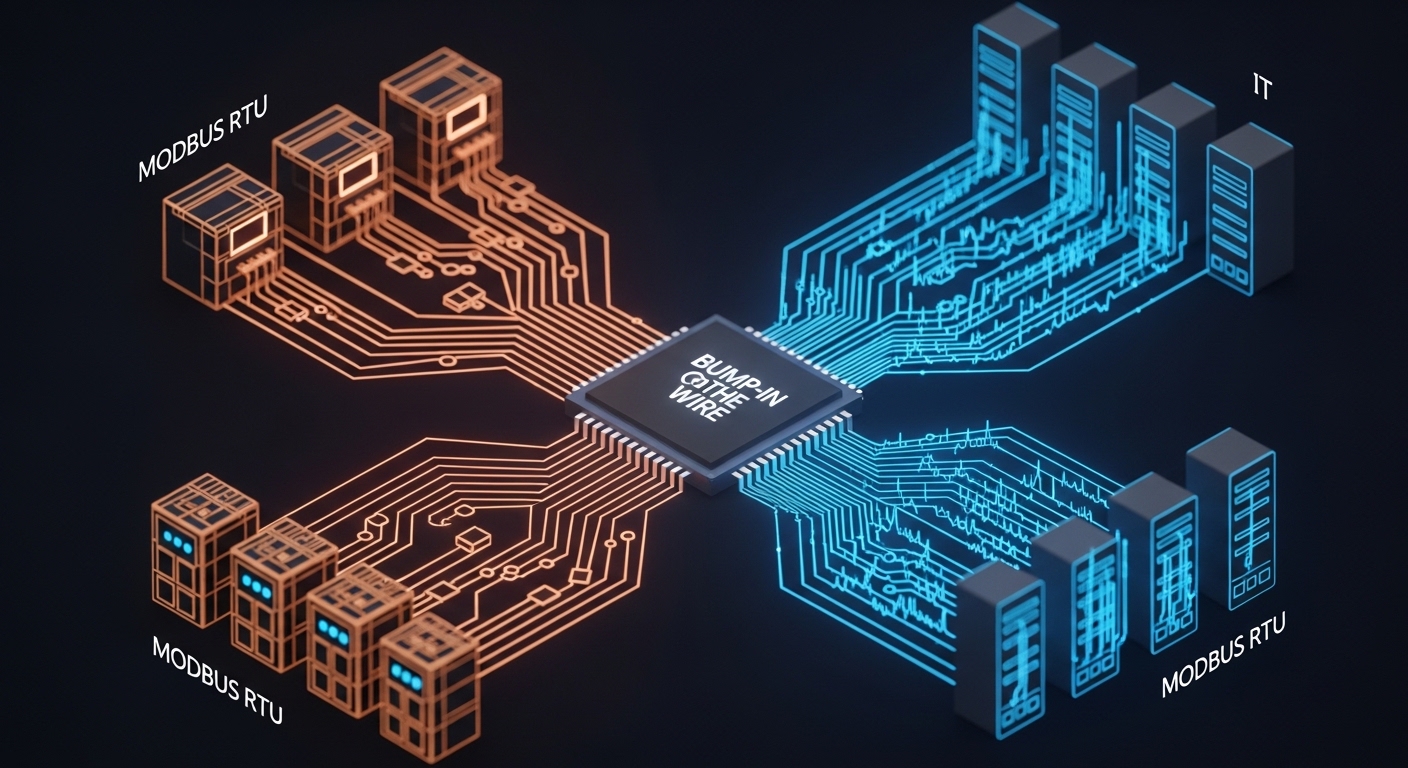
Phase 2: Insertion of a Transparent Abstraction Layer To enforce policy on non-IP Modbus RTU devices, a proxy is required. This takes the form of a specialized industrial security gateway—a "bump-in-the-wire" device physically inserted into the serial link (e.g., RS-485) between the master (HMI/SCADA server) and the first slave device on a daisy chain. Critically, these devices must be deployed in a transparent pass-through mode initially, simply forwarding all electrical signals without modification. This allows for physical installation, power-up, and basic health checks during a planned maintenance window (if available) or even during live operation, with zero logical impact on the control system.
Phase 3: Protocol Normalization and Identity Injection Once the gateway is in place, it can be configured to act as a Policy Enforcement Point (PEP). Its primary function is to terminate the physical Modbus RTU connection and logically represent the downstream slave devices to the IP network. It normalizes the serial traffic, often by encapsulating it into Modbus/TCP. More importantly, it injects a cryptographic workload identity (leveraging frameworks like SPIFFE/SPIRE) for each unique slave ID on the serial bus. This is the pivotal step: an un-authentical legacy PLC is instantly transformed into a cryptographically identifiable entity within the zero-trust fabric. All subsequent policy decisions will be based on this verifiable identity, not a fragile IP address.
Phase 4: Centralized Policy Definition in Monitor-Only Mode With visibility established and enforcement points in place, security policies can be authored in a centralized Policy Decision Point (PDP). These policies are highly granular, whitelisting specific communication flows based on the baseline data from Phase 1. For example:
Source Identity: 'HMI-Mixer-1'Destination Identity: 'PLC-Vat-5'Protocol: 'Modbus'Action: Allow 'Read Holding Registers (FC03)' for registers 40100-40150Action: Deny All OthersInitially, every policy is deployed in a "log and allow" or "monitor" mode. The PEPs analyze traffic against these policies and generate alerts for any violations, but do not block the traffic. This allows network and control engineers to validate that the policies accurately reflect legitimate operational needs and refine them iteratively without risking production downtime.
Phase 5: Incremental Policy Enforcement After a period of monitoring and policy refinement (typically lasting several weeks), confidence in the policy set will be high. At this stage, policies can be transitioned from "monitor" to "block" mode. This should not be a network-wide flag day. Instead, enforcement can be enabled on a per-segment or even per-asset basis, starting with the least critical systems. This gradual, deliberate rollout minimizes risk and allows for immediate rollback of any policy that inadvertently impacts a sensitive process.
Practical Implementation Challenges
Architecting such a system is not without significant engineering hurdles that require careful consideration.
Deterministic Latency and Jitter: Any active device inserted into a control loop introduces latency. For high-speed, deterministic applications, even a few milliseconds of delay or unpredictable jitter can destabilize a physical process. The choice of serial gateway is critical. Devices leveraging FPGA-based hardware offloading for protocol translation and policy enforcement will consistently outperform software-based appliances running on general-purpose CPUs. Rigorous pre-deployment testing with a mirrored or simulated process is essential to certify that the introduced latency and jitter remain within the operational tolerance of the control system. This is a core aspect of preserving real-time integrity in micro-segmented ICS networks.
Resolving Daisy-Chain Ambiguity: On an RS-485 multi-drop bus, a master's request is broadcast to all slave devices, but only the device whose address is specified in the message payload should respond. A naive PEP at the head of the chain sees all this traffic. To apply a policy to a specific PLC (e.g., Slave ID 5), the PEP must perform stateful DPI. It must parse the Modbus Application Data Unit (ADU) to identify the target slave ID in the master's request and then maintain a state table to correlate the subsequent response from that specific slave, enforcing the policy accordingly.
Achieving Sufficient Policy Granularity: Blocking or allowing an entire Modbus function code is often too coarse. A common requirement is to allow a business system to read production counts (e.g., register 40010) while explicitly blocking any attempt to write to a setpoint register (e.g., register 40011) that controls motor speed. This demands that the PEP's policy engine can parse and apply rules based on the register map addresses and even data value ranges within the Modbus payload itself, not just the L2/L3 headers or the function code.
Federated Identity Brokering: The seamless integration between IT and OT domains hinges on the federation model. When a user on the IT network launches a maintenance application that needs data from a PLC, a complex authentication and authorization chain is triggered. The IT application must first authenticate the user against an enterprise IdP (like Azure AD or Okta). The application, now holding a security token (e.g., a JWT), makes a request to an API gateway. This gateway, acting as an identity broker, must validate the IT token and then request a new, short-lived, and narrowly scoped OT-specific token from the OT security management platform. Only this OT token is presented to the PEPs to authorize the specific, least-privilege data flow.
Conclusion: Architecting Resilience Without Disruption
Implementing a federated zero-trust micro-segmentation framework in a brownfield environment with live Modbus RTU devices is a complex but achievable endeavor. It represents a paradigm shift away from brittle, perimeter-based security toward a dynamic, identity-centric model that is resilient by design. By adhering to a phased, non-disruptive methodology centered on passive discovery, transparent abstraction layers, identity injection, and monitor-then-enforce policies, organizations can fundamentally elevate their security posture. This approach effectively neutralizes the threat of lateral movement and contains breaches to a minimal blast radius, all while honoring the non-negotiable operational mandate of 100% uptime. The result is a converged IT/OT ecosystem that is not only connected and efficient but also verifiably secure.
Sources / References
- NIST Special Publication 800-207, Zero Trust Architecture: https://csrc.nist.gov/publications/detail/sp/800-207/final
- Modbus Application Protocol Specification V1.1b3: https://modbus.org/docs/Modbus_Application_Protocol_V1_1b3.pdf
- ISA/IEC 62443 Standards for Industrial Automation and Control Systems (IACS) Security: https://www.isa.org/standards-and-publications/isa-standards/isa-iec-62443-series-of-standards
- SPIFFE (Secure Production Identity Framework for Everyone): https://spiffe.io/