The Unbreachable Conduit: Integrating Threat Intelligence into Air-Gapped ICS with Zero-Trust Architecture
Apex Insights Research Desk
The Air-Gap Paradox: A Legacy Defense Confronting Dynamic Threats
For decades, the physical air gap has been the bedrock of Operational Technology (OT) security. The principle is axiomatically simple: by creating complete network isolation between industrial control systems (ICS) and external, untrusted networks (like corporate IT or the internet), process integrity is preserved. However, the modern industrial enterprise has rendered the absolute air gap a theoretical construct. The demands for predictive maintenance, supply chain integration, and remote operational visibility necessitate data exchange. This reality, coupled with transient vectors like maintenance laptops, removable media, and misconfigured dual-homed devices, has created a porous perimeter that legacy security models are ill-equipped to defend.
Simultaneously, the threat landscape has evolved from generic malware to highly sophisticated, OT-aware adversaries. Static, signature-based defenses within the OT environment are insufficient against zero-day exploits and polymorphic attacks. The critical question facing industrial asset owners is no longer if they should bridge this gap, but how to architect a secure, controlled, and unidirectional conduit for ingesting vital, real-time threat intelligence without dismantling the foundational security principles of the air gap. The answer lies in a paradigm shift: abandoning the broken trust model of the network perimeter and embracing a rigorous Zero-Trust architecture, specifically engineered for the deterministic, high-availability demands of industrial control systems.
Architecting the Unidirectional Intelligence Ingress
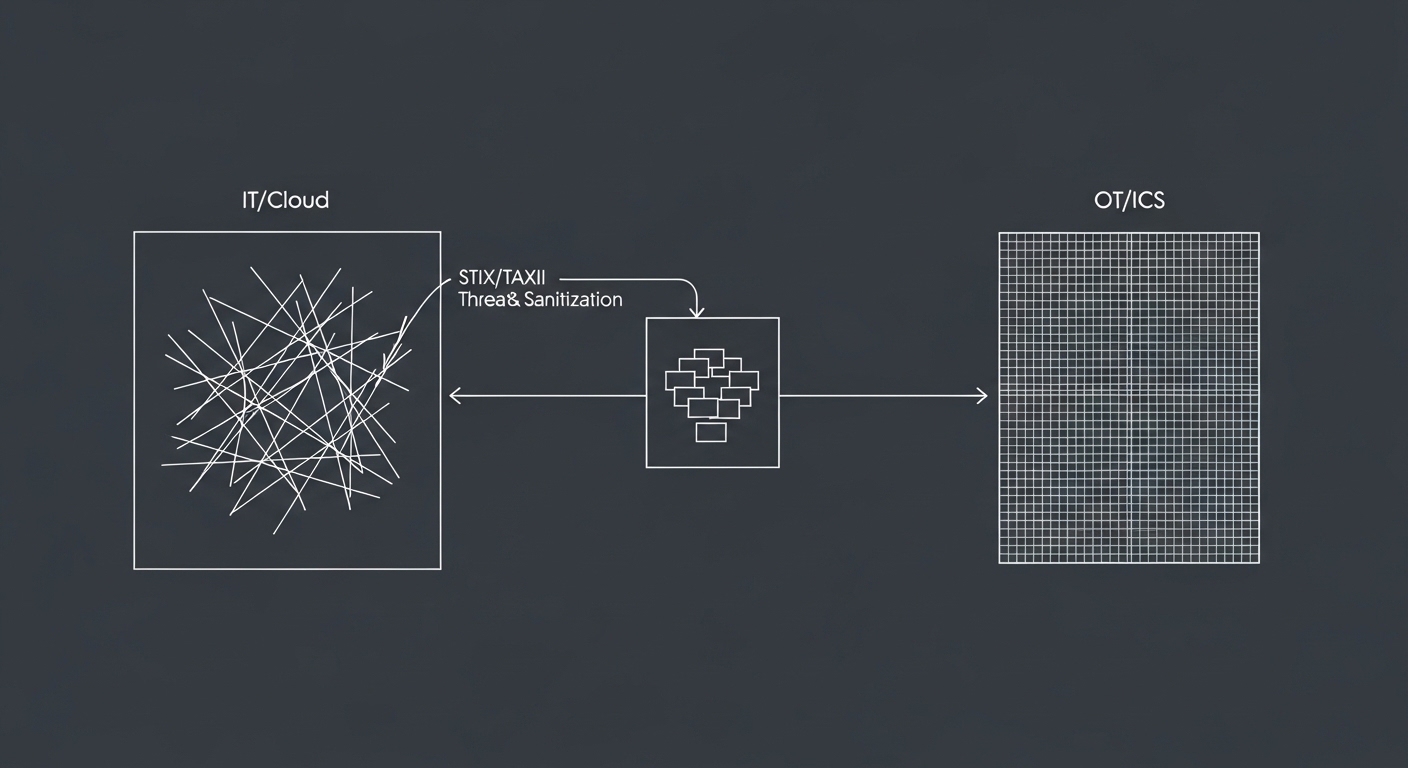
Integrating external threat data into a logically or physically isolated OT network is a high-stakes architectural challenge. It requires a meticulously designed system that ensures data flows in one direction only—from the untrusted external source to the trusted internal environment—while being thoroughly sanitized and contextualized. This is not a simple firewall rule; it is a multi-stage data processing pipeline built on the principle of least functionality.
An effective architecture can be broken down into a logical sequence of enforcement and processing layers:
The Unidirectional Gateway (Data Diode): This is the physical and logical cornerstone of the architecture. A true data diode is a hardware-based security device that, through its physical construction (using a fiber optic transmitter on one side and a receiver on the other, with no corresponding return path), enforces a one-way data flow. This physically prohibits any data exfiltration or command-and-control signals from traversing back out of the OT network through this channel. It is the ultimate enforcement of the 'ingress-only' rule.
The Intelligence Aggregation & Sanitization Platform (IASP): Situated in a dedicated OT DMZ, the IASP acts as the external-facing broker. Its sole function is to subscribe to multiple threat intelligence feeds—such as STIX/TAXII feeds from ISACs, vendor-specific vulnerability alerts, and commercial threat intelligence platforms. Here, the raw data undergoes a rigorous cleansing process. This includes protocol validation, stripping of all executable code, removal of unnecessary metadata, and structural normalization. The goal is to distill complex threat data into a simple, OT-consumable format, such as a curated list of malicious IP addresses, vulnerable software versions relevant to the facility's asset inventory, or specific indicators of compromise (IOCs).
The OT Policy Decision Point (PDP): Once the sanitized intelligence traverses the data diode, it is received by the PDP, the 'brain' of the Zero-Trust fabric within the OT network. The PDP correlates the incoming threat data with a comprehensive, real-time asset inventory of the OT environment. For example, upon receiving an alert for a vulnerability in a specific PLC firmware version, the PDP immediately identifies all assets running that firmware. It then translates this contextualized threat into a set of precise, actionable security policies.
Distributed Policy Enforcement Points (PEPs): The PDP does not execute policy itself; it orchestrates a network of PEPs. These are the 'hands' of the system, enforcing the security decisions. PEPs can be a variety of technologies: next-generation firewalls at network boundaries, dedicated ICS security appliances capable of deep packet inspection on industrial protocols, or, increasingly, software-defined micro-segmentation gateways. This is where the architecture provides the agility to apply real-time Zero-Trust policy enforcement in proprietary ICS, dynamically updating rulesets without manual intervention. The intelligence might trigger a new rule at a PEP to block a newly identified malicious IP, or more granularly, to restrict a vulnerable HMI's communication to only its designated PLC, effectively quarantining it without halting the process.
The foundational principle of Zero-Trust, as outlined by NIST SP 800-207, states: "Never trust, always verify. Treat every user, device, application, and data flow as untrusted. Access should be granted on a per-session basis and based on the principle of least privilege." In this architecture, threat intelligence becomes a dynamic input into the continuous verification process.
Micro-segmentation and Identity: The Core of Zero-Trust Enforcement
The real power of this architecture is realized when the ingested threat intelligence informs a dynamic micro-segmentation strategy. Instead of a single, monolithic OT network, Zero-Trust decomposes the environment into small, isolated zones—sometimes down to the individual device level. This model severely limits an attacker's ability to move laterally.
When new threat intelligence is processed, it doesn't just result in a simple blocklist. It can trigger profound changes to the micro-segmentation policy fabric. For example, an alert about a new worm exploiting the S7comm protocol might cause the PDP to instantly enforce a stricter policy that only allows a specific engineering workstation to communicate with a group of Siemens PLCs for a limited maintenance window, while blocking all other east-west S7 traffic. This proactive containment is key to halting lateral movement in multi-vendor ICS environments before a minor breach becomes a catastrophic failure.
This entire process hinges on a strong notion of identity. Every device, application, and user must be authenticated and authorized before any communication is permitted. The PDP's policies are not based on brittle IP addresses, but on cryptographic identities. This ensures that even if an attacker spoofs an IP address, they cannot communicate without the correct credentials, rendering many common attack vectors inert.
Practical Implementation Challenges
Deploying such an architecture in a brownfield industrial environment presents a unique set of engineering hurdles that demand careful consideration.
Deterministic Network Constraints
OT networks, particularly at the control and field levels (Purdue Levels 1 and 2), operate on deterministic protocols where latency and jitter are measured in microseconds. The introduction of any PEP, such as an inline firewall or segmentation gateway, must be proven to not interfere with real-time process control communications. This requires solutions specifically designed for OT, capable of deep packet inspection and policy enforcement at line-rate without introducing unacceptable delays.
Brownfield Protocol and Asset Heterogeneity
Industrial environments are a heterogeneous mix of modern and legacy systems, often from multiple vendors using proprietary protocols. The IASP and the PEPs must possess deep protocol-aware intelligence to parse and enforce policies on traffic like Modbus/TCP, DNP3, PROFINET, and EtherNet/IP. Furthermore, legacy devices often lack the computational resources for modern authentication mechanisms, requiring network-based identity and access control solutions that can vouch for them without needing an agent.
Policy Orchestration at Scale
A large industrial facility can have thousands of assets, resulting in tens of thousands of potential communication paths. Manually managing micro-segmentation rules derived from a constant flow of threat intelligence is unfeasible and error-prone. A sophisticated policy orchestration engine is required to automate the translation of high-level security intent (e.g., "Isolate all vulnerable PLCs") into granular enforcement rules and distribute them correctly across all PEPs. This is a significant challenge when addressing Zero-Trust micro-segmentation in live OT without disrupting process control, as a single misconfiguration could lead to costly downtime.
Threat Intelligence Contextualization
Raw threat intelligence is often useless in an OT context. An IOC indicating a compromised Windows server is critical for IT, but an alert about a vulnerability in a firmware version not present in the facility is just noise. The PDP must have a highly accurate, continuously updated asset inventory to filter and prioritize threats that are actually relevant to the specific industrial environment, preventing 'alert fatigue' and ensuring that automated responses are based on genuine risk.
Conclusion: Evolving from Static Isolation to Dynamic, Intelligence-Driven Defense
The concept of a pristine, inviolable air gap is no longer a tenable primary defense for critical infrastructure. By integrating a unidirectional flow of sanitized threat intelligence into a Zero-Trust architecture, organizations can transform their OT security posture from static and reactive to dynamic and proactive. This model respects the foundational requirement for network isolation by employing data diodes while enabling the OT environment to adapt its defenses in real time to an evolving external threat landscape. It is not about simply punching a hole in the air gap; it is about building a secure, intelligent, and highly controlled conduit that enhances visibility and resilience without compromising the safety and availability of the industrial process.
Sources / References
- NIST Special Publication 800-82 Rev. 2, "Guide to Industrial Control Systems (ICS) Security": https://csrc.nist.gov/publications/detail/sp/800-82/rev-2/final
- ISA/IEC 62443 Series of Standards on Industrial Automation and Control Systems Security: https://www.isa.org/standards-and-publications/isa-standards/isa-iec-62443-series-of-standards
- CISA Industrial Control Systems Advisories: https://www.cisa.gov/uscert/ics/advisories