The Deterministic Mandate: A Blueprint for Real-Time Zero-Trust Policy Enforcement in Proprietary ICS
Apex Insights Research Desk
The Unseen Risk: Beyond the Air Gap Illusion
For decades, the security of proprietary Industrial Control Systems (ICS) was predicated on a now-obsolete paradigm: physical isolation. The 'air gap' was the ultimate perimeter, a moat separating deterministic operational technology (OT) from the chaotic world of information technology (IT). This model is no longer tenable. The convergence of IT and OT, driven by demands for remote access, predictive maintenance, and process optimization, has dissolved this perimeter, exposing fragile, legacy protocols and unpatched endpoints to a threat landscape they were never designed to withstand.
Traditional security controls, like perimeter firewalls and intrusion detection systems (IDS), are fundamentally inadequate for this new reality. They operate on a 'trust but verify' model, assuming that any actor or device already inside the network perimeter is legitimate. This implicit trust is the vector through which attackers pivot, escalate privileges, and traverse the network laterally. In an environment where a single malicious command can have catastrophic physical consequences, this model represents an unacceptable risk.
This article from the Apex Insights Research Desk presents an architectural blueprint for implementing the only viable alternative: a Zero Trust Architecture (ZTA) with a core focus on real-time policy enforcement. We will dissect the engineering principles required to apply this modern security philosophy to the unique, high-consequence environment of proprietary ICS, where determinism, low latency, and operational continuity are non-negotiable mandates.
Translating Zero Trust to the Plant Floor
Zero Trust is not a product but a security architecture and philosophy centered on the principle of "never trust, always verify." It mandates that no actor, system, network, or service operating inside or outside the security perimeter is trusted. Instead, we must verify every request as though it originates from an untrusted network. In an ICS context, this translates to a granular, identity-centric, and policy-driven approach to every single machine-to-machine (M2M) communication.
The core tenets, as outlined by NIST SP 800-207, must be re-interpreted for the OT environment:
- Identity: In ICS, 'identity' is not limited to human users. It is the PLC on Line 3, the HMI in the control room, the specific process running on an engineering workstation, or a sensor array. Architecting a robust security posture requires an approach that establishes and validates these non-person entities, as detailed in our research on architecting context-aware identity for Zero-Trust OT/IT security.
- Explicit Verification: Every attempt to access a resource must be authenticated and authorized. This means validating the identity of the source (e.g., Engineering Workstation A), the destination (e.g., PLC B), the requested action (e.g., Modbus function code 16 - Write Multiple Registers), and the context (e.g., during a scheduled maintenance window).
- Least Privilege Access: Entities are granted the absolute minimum permissions required to perform their function. An HMI should only be able to read specific registers from its associated PLC; it should be explicitly denied the ability to write to firmware or modify control logic unless specifically authorized for a maintenance task.
- Micro-segmentation: The network is carved into small, isolated zones, or micro-segments, often down to the level of a single device or a small functional group (a 'cell'). This drastically limits an attacker's ability to move laterally across the network. A compromise of a historian server must not grant access to a safety-instrumented system (SIS).
The International Society of Automation (ISA) and the International Electrotechnical Commission (IEC) standard 62443 provides a foundational framework for this approach through its concept of zones and conduits. It mandates the grouping of assets with common security requirements into zones and controlling all communications that cross zone boundaries through defined conduits. Zero Trust provides the dynamic enforcement mechanism to make this static model a real-time, resilient reality.
Architectural Blueprints for Real-Time Enforcement
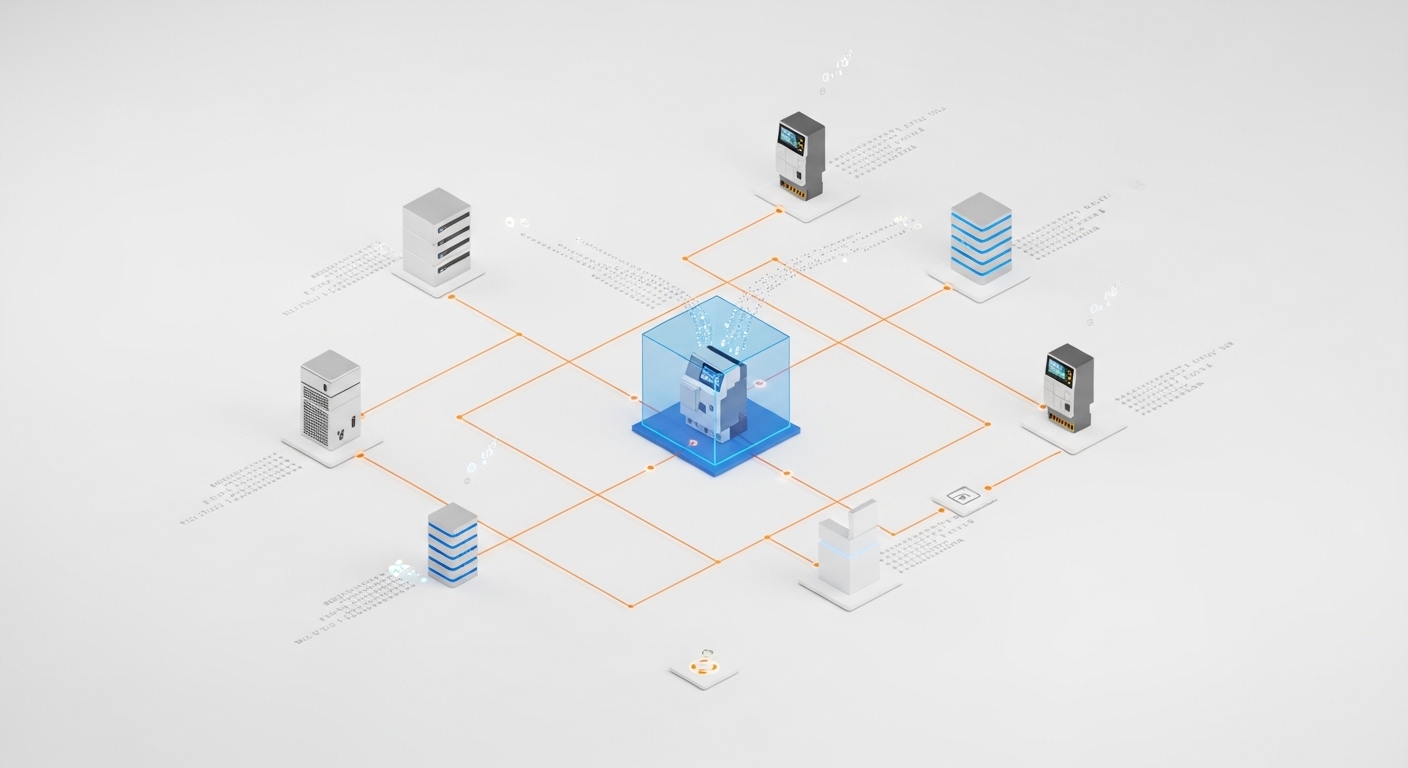
Theoretical principles must be translated into a viable engineering architecture. In proprietary ICS, where protocols are often opaque and devices are resource-constrained, the enforcement mechanism is paramount. The primary architectural pattern is network-centric, leveraging a centralized Policy Decision Point (PDP) and distributed, low-latency Policy Enforcement Points (PEPs).
The Software-Defined Micro-segmentation Fabric
The most effective method for implementing Zero Trust in brownfield ICS environments is through a network overlay or fabric that enables dynamic micro-segmentation. This approach externalizes the security controls from the endpoints themselves, which often cannot host security agents. The PEPs, typically implemented in intelligent network switches or dedicated security appliances, are placed inline between ICS assets.
These PEPs intercept every packet and query the PDP in real-time to make an allow/deny decision. This decision is based on a rich policy that considers the source/destination identity, the protocol, the specific function code or command, and contextual data. This is the essence of Zero-Trust policy enforcement in legacy industrial networks via software-defined micro-segmentation, which allows for the creation of secure enclaves around critical assets without requiring any modification to the endpoints themselves.
For this model to function without disrupting operations, the PEP must possess several key characteristics:
- Protocol-Aware Deep Packet Inspection (DPI): The PEP cannot operate at Layer 3/4 alone. It must have parsers capable of understanding proprietary ICS protocols (e.g., Siemens S7, Rockwell CIP, GE SRTP). This allows it to enforce policies like, "Allow HMI-1 to read holding registers from PLC-A, but block any attempt to write to coils or stop the CPU."
- Ultra-Low Latency: The decision and enforcement process must occur within the deterministic time constraints of the control process. Any introduced jitter or latency can cause PLC cycle overruns, leading to process faults. Enforcement must be a wire-speed, bump-in-the-wire function, often requiring hardware acceleration.
- High Availability and Failsafe Modes: The PEP is a critical inline component. It must support high-availability pairings (e.g., active-passive failover) and have a configurable failsafe state (fail-open or fail-closed) that aligns with the process safety requirements.
Practical Implementation Challenges
Deploying real-time Zero Trust policy enforcement in a live industrial environment is a formidable engineering task fraught with unique challenges that have no direct parallel in the IT world.
The Determinism vs. Security Trade-off
Latency is not just a performance metric in OT; it is a core operational and safety requirement. A security appliance that adds even a few milliseconds of jitter to the communication between a PLC and a variable frequency drive (VFD) can disrupt the delicate timing of a manufacturing process. The entire security architecture, from the PEP's packet processing pipeline to the PDP's query response time, must be engineered and validated to operate well within the sub-10ms latency budgets common in discrete manufacturing and other high-speed applications.
Proprietary Protocol Obfuscation
Many legacy ICS protocols are not publicly documented. Enforcing granular, command-aware policies requires the ability to parse these protocols. This presents a significant hurdle. Solutions typically involve a combination of vendor-provided protocol definitions, laborious reverse-engineering efforts, and advanced behavioral analysis that baselines normal traffic patterns to detect and block anomalous communications, even if the specific protocol syntax isn't fully understood.
The Brownfield Reality
Industrial assets have lifecycles measured in decades, not years. The plant floor is dominated by legacy equipment with no built-in security features, minimal processing power, and operating systems that are decades out of date. These devices cannot be patched, updated, or host security agents. This reality makes a network-centric approach non-negotiable and underscores the importance of solutions like agentless Zero-Trust for SCADA, which secure these constrained devices without requiring any software installation on the asset itself.
The Fail-Open vs. Fail-Closed Conundrum
In IT, the default security posture is often "fail-closed"—if a security control fails, it blocks access to preserve confidentiality and integrity. In OT, this can be catastrophic. A fail-closed event could shut down a critical process, potentially causing a safety incident or significant financial loss. The decision to configure a PEP to fail-open (allow traffic to pass without inspection) or fail-closed requires a detailed risk assessment conducted by both cybersecurity and process control engineering teams. Often, a hybrid approach is used, where critical safety-related communications are allowed to fail-open, while less critical traffic fails-closed.
A Phased Blueprint for Policy Deployment
Implementing a Zero Trust model cannot be a 'big bang' event. It requires a methodical, phased approach that prioritizes visibility and minimizes operational risk.
- Discovery and Baselining: The initial phase is entirely passive. Deploy network sensors to tap into industrial network traffic. The goal is to build a comprehensive asset inventory and a detailed communication map. This map must identify every endpoint, the protocols they use, and the specific communication patterns between them. This is the foundational truth upon which all policies will be built.
- Policy Modeling and Simulation: Using the baseline data, security and operations teams collaboratively define the 'golden configuration'—the whitelist of all known-good communications required for normal operations. A core principle is implicit deny; any communication not explicitly defined in the policy is forbidden. These draft policies should then be run in a simulation mode against live or recorded traffic to identify legitimate communications that were missed and to quantify potential operational impacts.
- Monitor-Only Enforcement: In this phase, PEPs are deployed inline, but in a non-blocking mode. They analyze traffic against the defined policy and generate alerts for any violations. This allows the team to refine the policies based on real-world traffic without any risk of process disruption. This phase can last for weeks or months until the rate of false-positive alerts approaches zero.
- Phased Active Enforcement: Begin active blocking of policy violations, starting with the least critical segments of the network. A common starting point is the IT/OT boundary or segments containing non-production assets like development PLCs. Monitor process KPIs closely at each stage.
- Continuous Optimization: A Zero Trust architecture is not a static state. As processes change, new equipment is added, or maintenance is performed, policies must be updated. The system must provide a robust policy lifecycle management workflow and continuous monitoring to adapt to the evolving operational environment.
Conclusion: The Resilient Mandate
Real-time policy enforcement for Zero Trust in proprietary ICS is no longer a theoretical exercise; it is an operational imperative for any organization seeking to build resilient, secure, and competitive industrial operations. Moving beyond the failed model of perimeter security requires a fundamental shift in mindset and architecture. By adopting a network-centric enforcement model built on the principles of granular identity, deep protocol inspection, and software-defined micro-segmentation, organizations can impose a state of verifiable security on networks that were never designed for it. The challenges are significant, but the alternative—leaving critical infrastructure vulnerable to modern threats—is untenable.
Sources / References
- NIST Special Publication 800-207: Zero Trust Architecture. URL: https://csrc.nist.gov/publications/detail/sp/800-207/final
- NIST Special Publication 800-82 Rev. 3 (Draft): Guide to Operational Technology (OT) Security. URL: https://csrc.nist.gov/publications/detail/sp/800-82/rev-3/draft
- CISA: Securing Industrial Control Systems. URL: https://www.cisa.gov/topics/industrial-control-systems
- IEC 62443 Series of Standards. URL: https://www.isa.org/standards-and-publications/isa-standards/isa-iec-62443-series-of-standards