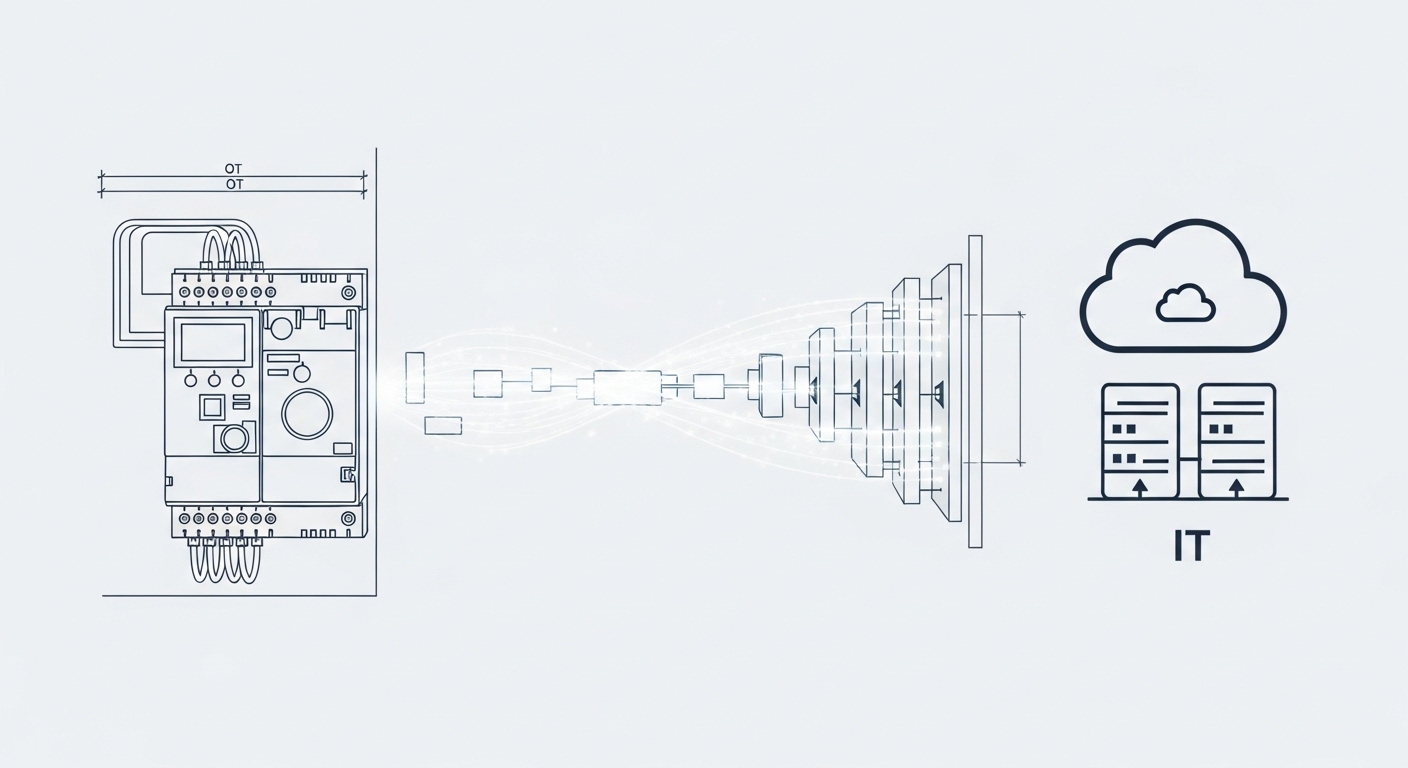
Bypassing Re-certification: A Network-Centric Blueprint for Least-Privilege Access on Legacy PLCs
Apex Insights Research Desk
The Certification Paradox in Converged IT/OT Environments
The strategic imperative to converge Information Technology (IT) and Operational Technology (OT) networks is undeniable. It unlocks unprecedented efficiencies through real-time data analytics, predictive maintenance, and streamlined production control. However, this convergence exposes mission-critical, legacy Programmable Logic Controllers (PLCs) to a threat landscape they were never engineered to withstand. These devices, often the bedrock of industrial processes, typically lack modern authentication, encryption, and authorization mechanisms, rendering them dangerously vulnerable in a connected architecture.
The immediate engineering response—to update, patch, or reconfigure these PLCs—collides with a formidable obstacle: the re-certification paradox. In regulated industries such as pharmaceuticals, energy, and critical manufacturing, any modification to a validated system, including its firmware, software, or even direct network configuration, can invalidate its certification. This triggers a prohibitively expensive and time-consuming re-certification and re-validation process, creating a powerful incentive to maintain the status quo, leaving critical vulnerabilities unaddressed.
This paper from the Apex Insights Research Desk presents a network-centric architectural blueprint for enforcing the principle of least-privilege (PoLP) on legacy PLCs without modifying the endpoint devices themselves, thereby decoupling security enforcement from the system's validated state and circumventing the need for re-certification.
Redefining Least Privilege for Industrial Control Systems
In traditional IT, least privilege is primarily a user-centric concept. In OT, its application must be far more granular and machine-centric. It is not sufficient to simply ask, "Does this user have access to this PLC?" We must enforce policies based on the fundamental physics of the industrial process itself. The correct questions are:
- Who/What? (Identity): Which engineering workstation (EWS), HMI, or historian is initiating the communication?
- To Where? (Resource): Which specific PLC, and which memory register or function block within that PLC, is being targeted?
- To Do What? (Action): Is the operation a benign read of a temperature value (e.g., Modbus Function Code 04, Read Input Registers) or a potentially disruptive write to a control relay (e.g., Modbus Function Code 05, Write Single Coil)?
- When and How? (Context): Is this communication happening during a scheduled maintenance window? Is it originating from the correct network segment? Does its data payload conform to the expected parameters?
A true least-privilege model for OT must be capable of understanding and enforcing these granular, context-aware rules. The challenge is that the legacy PLC itself has no native capability to enforce such policies.
The Architectural Blueprint: Externalized Policy Enforcement
Since the control endpoint cannot be altered, the policy enforcement function must be externalized into the network fabric. This is achieved by deploying a transparent security overlay that intercepts and inspects traffic before it reaches the PLC. This model is predicated on the deployment of compensating controls that create a robust security posture without modifying the underlying validated system.
Phase 1: High-Fidelity Asset Discovery and Communication Baselining The foundational step is to achieve complete visibility. By using a network TAP or a SPAN port on a managed switch, traffic is passively mirrored to a discovery engine. This process is non-intrusive and has zero impact on network performance. The objective is to automatically:
- Identify every asset on the OT network (PLCs, HMIs, EWS, RTUs).
- Fingerprint device types, vendors, firmware versions, and running protocols (e.g., S7, EtherNet/IP, Modbus TCP, DNP3).
- Map the entire communication matrix, establishing a deterministic baseline of all legitimate conversations. This baseline captures the "who, what, where, and how" of normal operations, effectively creating a ground truth for the industrial process.
Phase 2: Deploying Protocol-Aware Micro-segmentation With a validated communication baseline, the next step is to enforce it. This is where traditional IT network segmentation tools like VLANs and firewalls fall short. They lack the protocol-level granularity required for OT. Instead, a Zero-Trust in Brownfield OT: A Non-Disruptive Blueprint for Segmenting Proprietary Industrial Networks approach using network-based micro-segmentation is required. A Policy Enforcement Point (PEP), often a transparent L2 bridge or gateway, is placed in-line between network segments or directly in front of critical PLC assets.
The Core Engineering Principle: The Policy Enforcement Point must function as a transparent bridge, invisible to the legacy endpoints. The PLC and its connected devices should not require any IP address, subnet, or configuration changes. This is the lynchpin for avoiding re-certification, as the validated state of the endpoint remains untouched.
- Phase 3: Deep Packet Inspection (DPI) and Granular Policy Application
The PEP is not a standard firewall; it is a protocol-aware security engine. It performs deep packet inspection on the industrial traffic, dissecting the application layer (L7) of the packets to understand the specific commands being issued. This enables the creation and enforcement of highly specific least-privilege policies:
ALLOW HMI_Panel_01 to execute Modbus Function Codes 03 (Read Holding Registers) and 04 (Read Input Registers) to PLC_Mixer_A on registers 40001-40050.ALLOW EWS_Station_03 to execute Siemens S7 'Program Block' commands to PLC_Conveyor_B only during the sanctioned maintenance window (Saturday 02:00-04:00).DENY all 'Write' commands to any PLC originating from the IT network segment, except for the authorized Historian server.
This level of granular control ensures that even if an attacker compromises a legitimate HMI, they cannot use it to issue unauthorized or destructive commands to the PLC. The attack surface is dramatically reduced from the entire device to only the explicitly permitted operations required for the process. Implementing such controls requires a deep understanding of Low-Latency ABAC: Architecting Zero-Trust for Modbus & EtherNet/IP in Converged OT/IT Networks to ensure policies are both effective and performant.
Practical Implementation Challenges
Deploying this architecture in a live production environment requires navigating several complex engineering hurdles:
Deterministic Latency and Jitter: Industrial control networks are often real-time systems where deterministic communication is paramount. Any in-line security solution must not introduce latency or jitter that could disrupt sensitive control loops. PEPs deployed in these environments must be architected for line-rate processing, often leveraging hardware offloading (FPGA/ASIC) for DPI and policy evaluation to guarantee sub-millisecond latency.
Proprietary and Encrypted Protocols: While open protocols like Modbus are well-understood, many OT environments rely on proprietary vendor-specific protocols. A capable DPI engine must be equipped with regularly updated protocol dissectors and threat intelligence to correctly interpret these traffic flows. For encrypted traffic, solutions may require a brokered or proxy-based approach, which presents its own architectural complexities.
Policy Orchestration at Scale: Manually defining granular policies for thousands of individual PLC-to-HMI communication flows is untenable. A scalable implementation requires a centralized management platform that can ingest the discovered baseline and assist operators in defining intent-based policies (e.g., "HMIs can only read data"). This platform must then compile these high-level intents into the granular rules enforced by the distributed PEPs.
Ensuring High Availability and Fail-Safe Operation: Introducing a new in-line component creates a potential point of failure. PEPs must be deployed in high-availability (HA) pairs with sub-second failover. Furthermore, the operational philosophy must be considered. While IT systems typically
fail-closed, blocking traffic to prevent a breach, shutting down a power plant or manufacturing line is often a more catastrophic event than the potential threat. Therefore, PEPs must support a configurablefail-openorfail-safemode that maintains process availability while aggressively alerting security and operations personnel of a device failure.
Demonstrating Non-Interference to Avoid Re-certification
The ultimate goal is to prove to auditors and regulatory bodies that this security overlay is a non-intrusive, compensating control. The argument rests on demonstrating zero impact on the validated system. This requires a meticulous, evidence-based approach.
Initial Passive Deployment: Deploy the PEPs in a passive, tap-only mode. For weeks or months, the system only monitors and logs, building a rich dataset of network performance metrics (latency, jitter, packet loss) and validating proposed policies against live traffic without enforcement. This proves the system's analytical capabilities without touching a single production packet.
Staging and Digital Twin Validation: Replicate a portion of the production environment in a lab or staging area. Deploy the PEPs in active enforcement mode here and run rigorous performance and integration tests. This is a critical step for Zero Downtime Validation: A Framework for Deploying Micro-Segmentation in Brownfield OT Environments with OPC-DA before moving to the live network.
Phased Enforcement and Continuous Monitoring: Once validated, move the PEPs into active enforcement on the production network, often starting with less critical segments first. Continuously monitor network performance metrics to provide documented evidence that the security overlay is operating within the deterministic tolerances of the industrial process.
By following this methodology, the organization can present a compelling case that the security architecture enhances safety and security without altering the PLC's certified operational logic or configuration, thus obviating the need for a full re-certification cycle.
Conclusion
Enforcing least-privilege access on legacy PLCs in converged networks does not require a risky and expensive rip-and-replace strategy. The re-certification paradox can be solved by adopting a network-centric security model that externalizes policy enforcement. By deploying non-intrusive, protocol-aware micro-segmentation, organizations can superimpose a sophisticated, granular security framework onto their existing infrastructure. This approach allows them to protect their most critical assets from modern threats while preserving the validated, certified state of their industrial control systems, achieving robust security without disrupting operations or incurring prohibitive regulatory costs.
Sources / References
- NIST Special Publication 800-82 Rev. 2, "Guide to Industrial Control Systems (ICS) Security": https://csrc.nist.gov/publications/detail/sp/800-82/rev-2/final
- ISA/IEC 62443 Series of Standards on Industrial Automation and Control Systems Security: https://www.isa.org/standards-and-publications/isa-standards/isa-iec-62443-series-of-standards
- SANS Institute Whitepaper, "Securing Industrial Control Systems": https://www.sans.org/white-papers/33568/