The Integrity Mandate: Architecting Bidirectional PROFINET-Oracle ERP Data Flows Under Zero-Trust
Apex Insights Research Desk
The Convergence Imperative: Bridging Deterministic OT with Enterprise IT
The strategic fusion of Operational Technology (OT) and Information Technology (IT) is no longer a forward-looking concept; it is the bedrock of modern industrial competitiveness. The flow of data between the factory floor—orchestrated by real-time protocols like PROFINET—and enterprise planning systems, such as Oracle ERP, unlocks unprecedented efficiencies in supply chain management, predictive maintenance, and quality control. However, this convergence creates a high-stakes, bidirectional data conduit that, if architected improperly, becomes a critical vulnerability. Threat actors can exploit this bridge to pivot from compromised IT networks into deterministic OT environments, or manipulate data in transit to disrupt physical processes or corrupt enterprise-level reporting.
Traditional perimeter-based security models, reliant on firewalls segmenting the Purdue Model's layers, are fundamentally inadequate for this new paradigm. They operate on an implicit-trust model within a network zone, a concept directly at odds with the realities of modern cyber threats. The solution lies in a paradigm shift towards a fundamentally different security philosophy: Zero-Trust. This article presents an architectural blueprint for establishing and maintaining bidirectional data integrity between PROFINET OT systems and Oracle ERP, anchored in the granular, explicit-trust principles of a Zero-Trust architecture.
Core Architectural Tenets: Moving Beyond the Brittle Perimeter
At its core, a Zero-Trust model discards the notion of a trusted internal network and an untrusted external network. Every access request, regardless of its origin, must be treated as a potential threat. This requires a robust and dynamic security posture built on several key principles when applied to the OT/IT integration challenge.
The foundational tenet of Zero Trust is to never trust, always verify. This means that no entity (user, device, or application) is trusted by default. Every access request must be explicitly verified, authenticated, and authorized before being granted, based on the least-privilege principle.
Translating this into an architectural strategy for PROFINET-to-Oracle data exchange involves three primary considerations:
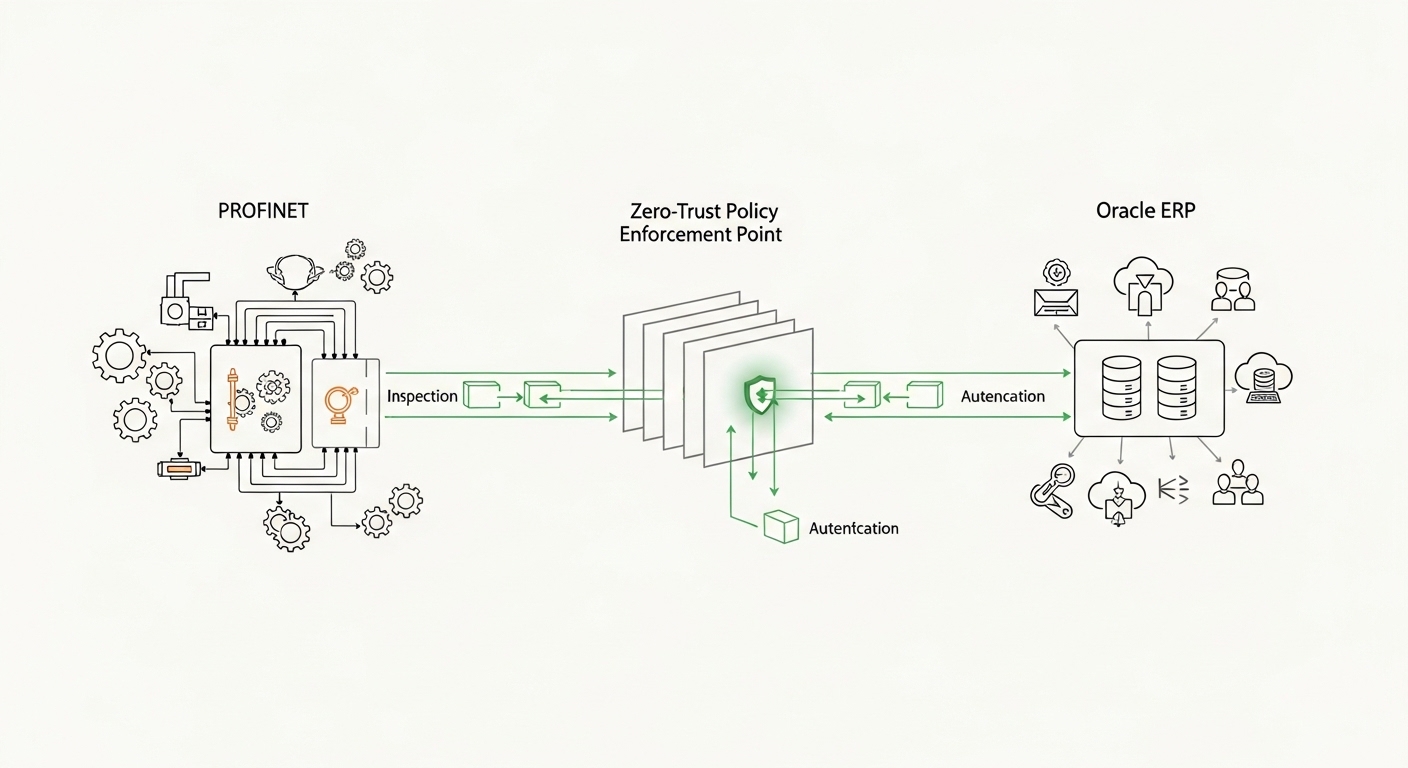
Micro-segmentation and Policy Enforcement: The integration architecture cannot be a monolithic data pipe. It must be a series of micro-segments with a dedicated Policy Enforcement Point (PEP) that adjudicates every transaction. This PEP is not a simple stateful firewall; it is an application-aware gateway that understands the protocols in use (e.g., OPC UA, MQTT, HTTPS) and the context of the data being exchanged. It moves the security perimeter from a network location to the data transaction itself.
Explicit Identity and Authentication: Every entity in the transaction—the source PLC on the PROFINET network, the middleware gateway, the Oracle ERP module—must have a verifiable, cryptographically-provable identity. Access is not granted based on IP addresses, which are easily spoofed, but on strong identities (e.g., X.509 certificates, OAuth tokens) that are authenticated for every session.
Least-Privilege Access Control: The principle of least privilege must be enforced with extreme granularity. An Oracle MES module requesting production counts should only be granted read-only access to specific OPC UA tags corresponding to those counters. It should be explicitly denied access to control logic parameters or other unrelated data points. This access should be further constrained by context, such as time of day or current production batch ID.
An Architectural Blueprint for Zero-Trust Integration
A robust and secure integration architecture requires a multi-layered, defense-in-depth approach that isolates the real-time OT network from the enterprise IT network, with all traffic arbitrated by a central Zero-Trust policy engine. The following numbered blueprint outlines the critical stages of this architecture.
The OT Aggregation & Contextualization Hub Directly exposing individual PROFINET devices (PLCs, VFDs, I/O modules) to the IT network is architecturally indefensible. Instead, an OT-side aggregation layer must be established. An industrial edge device running an OPC UA server is the ideal candidate for this role. This server connects to the PROFINET devices, polls the required data points, and exposes them through the secure, structured, and metadata-rich OPC UA information model. This achieves two critical goals: it abstracts the underlying proprietary complexities of the PROFINET network, and it provides a single, secure endpoint for data exchange. All communications from this point onward leverage the OPC UA security model, including client/server authentication via X.509 certificates and encryption of data in transit.
The Industrial DMZ as a Policy Enforcement Zone The Industrial Demilitarized Zone (IDMZ) remains a critical architectural component, but its function evolves from a simple buffer zone to an active Policy Enforcement Zone. Within the IDMZ sits the core of the Zero-Trust architecture: the Policy Enforcement Point (PEP). This is typically a next-generation industrial gateway or a purpose-built software-defined perimeter (SDP) controller. No traffic flows directly between the OT and IT networks. Instead, all connections terminate at the PEP. For data flowing from OT to ERP (e.g., production telemetry), the OT-side OPC UA server initiates an outbound connection to a message broker (like MQTT) or a historian located in the IDMZ. This connection is authenticated and authorized by the PEP. The Oracle ERP system then subscribes to the broker from the IT side, with its connection also being terminated and adjudicated by the PEP. This ensures no inbound connections are ever initiated into the OT network. For data flowing from ERP to OT (e.g., production recipes), the Oracle system publishes the data to the IDMZ broker. The OT aggregation hub polls the broker for new messages, again via a connection arbitrated by the PEP. This brokered, polling mechanism is crucial for preventing the IT environment from having direct, push-based command-and-control capabilities into the OT zone.
Attribute-Based Access Control (ABAC) as the Core Logic The PEP's decision-making process must be governed by a rich, context-aware ABAC policy engine. This moves beyond simple IP/port-based rules to evaluate multiple attributes for every request. A policy might look like this: ALLOW
oracle-mes-server(identity) to perform awriteoperation (action) onLine_4_Recipe_Parameters(resource) IF thesource_ipis within the corporate subnet AND thetime_of_dayis between 8am-5pm AND theproduction_batch_idmatches the active schedule. This level of granularity ensures that even if an IT-side system is compromised, the attacker's ability to impact the OT environment is severely constrained by pre-defined, context-aware policies.
Maintaining End-to-End Data Integrity
Ensuring that data is not only securely transmitted but also remains correct and consistent is paramount. This requires several integrity-focused mechanisms layered on top of the access control architecture.
Transactional Guarantees: For critical operations like recipe downloads, a simple 'fire-and-forget' message is insufficient. The architecture must implement a transactional handshake. This can be achieved using MQTT Quality of Service (QoS) levels 1 (at least once) or 2 (exactly once) delivery, combined with an application-layer acknowledgment. The ERP sends the recipe, the PEP authorizes it, the OT hub receives it, applies it to the PLC, reads back the values to confirm, and only then sends a success acknowledgment back through the chain.
Payload Hashing: To protect against in-transit data manipulation (e.g., a man-in-the-middle attack within the IDMZ), data payloads should be cryptographically hashed at the source and the hash verified at the destination. The OT aggregation hub can hash the production data before publishing, and the ERP application can verify this hash upon receipt, ensuring the data has not been altered.
State Reconciliation Engine: A periodic reconciliation process is vital. An independent process should periodically query key state variables from both the Oracle ERP database and the OT historian/OPC UA server and compare them. Any discrepancies trigger an alert for investigation. This acts as a failsafe to detect silent data corruption or missed updates that may not have violated access policies but resulted in an inconsistent state.
Practical Implementation Challenges
Deploying such an architecture in a brownfield industrial environment presents significant engineering hurdles that require careful planning.
Latency and Determinism: The introduction of brokers, PEPs, and cryptographic operations inevitably adds latency. While this is acceptable for supervisory-level data exchange, it is critical that these security layers do not interfere with the PROFINET network's core real-time control loops, especially those using Isochronous Real-Time (IRT). The integration point must be architected to tap into data without disrupting the deterministic communication path between PLCs and their I/O. The complexities involved in this are immense, as preserving real-time integrity in micro-segmented ICS networks is a non-trivial challenge that requires deep protocol understanding.
Protocol and Semantic Mediation: The PEP and middleware are responsible for more than just security; they must act as a protocol and data model translator. Oracle ERP operates on a relational database model with well-defined schemas, while PROFINET data is often a stream of raw register values and I/O states. The mediation layer must correctly map, scale, and contextualize this data, a process that is often complex and error-prone if not meticulously engineered.
Identity Provisioning for OT Endpoints: A core tenet of Zero-Trust is strong identity, yet most PLCs and I/O devices lack the capability to manage cryptographic identities like X.509 certificates. This necessitates the use of a proxy or gateway architecture where the aggregation hub acts as a trusted entity on behalf of the devices. The security of this proxy then becomes paramount. Effective policy enforcement relies on correctly identifying the source device, which requires a level of granular introspection into PROFINET communications at the network edge to uniquely fingerprint devices and bind them to logical identities.
Policy Management Overhead: Defining and maintaining thousands of granular ABAC rules is a significant operational burden. The process requires a 'policy-as-code' approach, where policies are version-controlled and deployed through automated CI/CD pipelines. It also necessitates unprecedented collaboration between OT engineers, who understand the physical process and data context, and IT security teams, who understand identity management and policy enforcement frameworks.
Conclusion: A Strategic Imperative for Industrial Security
Integrating PROFINET OT systems with Oracle ERP is a powerful enabler of Industry 4.0, but it fundamentally redefines the industrial attack surface. Relying on outdated perimeter security models is an invitation for catastrophic failure. A Zero-Trust architecture, while challenging to implement, provides the only viable path forward. By treating every data transaction with suspicion, enforcing access through strong, verifiable identities, and applying granular, context-aware policies, organizations can build a resilient and secure bridge between the plant floor and the enterprise. This is not merely a security upgrade; it is a foundational architectural strategy required to operate safely and competitively in the age of converged industrial systems.
Sources / References
- NIST Special Publication 800-207: Zero Trust Architecture - https://csrc.nist.gov/publications/detail/sp/800-207/final
- OPC Foundation: OPC Unified Architecture Specification - https://opcfoundation.org/developer-tools/specifications-unified-architecture/
- PROFIBUS & PROFINET International (PI): PROFINET Security Guideline - https://www.profibus.com/download/profinet-security-guideline
- Oracle Corporation: Oracle Fusion Cloud Manufacturing Documentation - https://docs.oracle.com/en/cloud/saas/manufacturing/23d/index.html