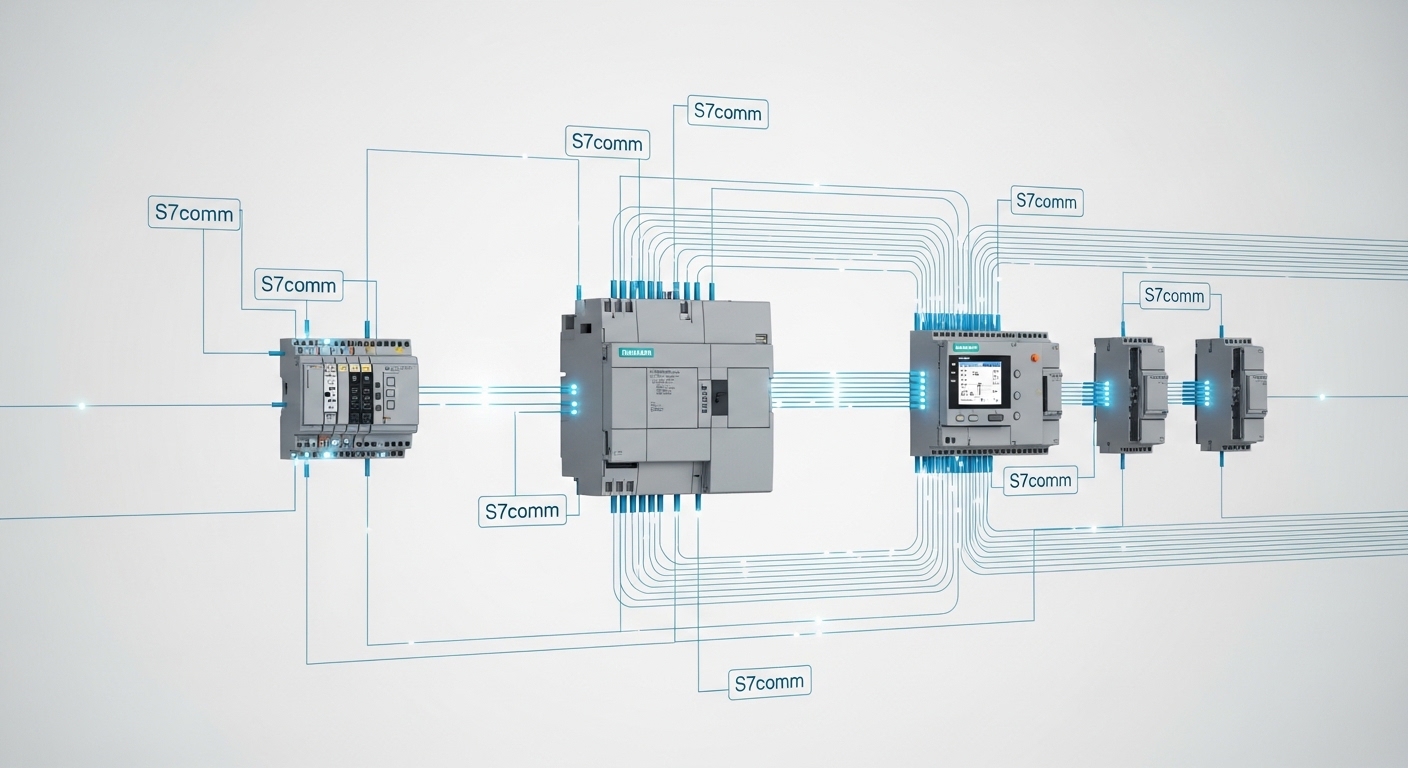
Architecting Granular Introspection: A Zero-Trust Blueprint for PROFINET & Siemens S7 at the Industrial Edge
Apex Insights Research Desk
The Imperative for Protocol-Level Visibility in Converged OT
The convergence of Information Technology (IT) and Operational Technology (OT) is no longer a theoretical concept but a tactical reality on the modern factory floor. While this integration unlocks unprecedented efficiency and data-driven insights, it simultaneously dissolves the air-gapped security model that once protected industrial control systems (ICS). In this new paradigm, the adoption of a Zero-Trust architecture is not a luxury but a foundational necessity for resilient manufacturing. However, applying Zero-Trust principles to the deterministic, high-speed world of OT, particularly to Siemens S7 controllers communicating via PROFINET, presents a unique and formidable engineering challenge.
Standard IT-centric security tools, which rely on inspecting IP headers and TCP/UDP ports, are fundamentally blind to the critical operations occurring within the Layer 2 and Layer 7 payloads of industrial protocols. For Siemens S7 ecosystems, this means the core commands that dictate physical processes—such as modifying controller logic, starting or stopping a motor, or updating a setpoint—are invisible. Achieving granular, protocol-level introspection is the bedrock upon which any credible OT Zero-Trust strategy must be built. This analysis from the Apex Insights Research Desk provides an architectural blueprint for achieving this level of deep visibility for PROFINET traffic at the industrial edge.
The PROFINET Introspection Challenge in a Zero-Trust Paradigm
PROFINET is not a single, monolithic protocol. It is a multi-faceted standard designed to meet varying performance requirements, which complicates security monitoring. Understanding its components is critical:
- PROFINET RT (Real-Time): This is the most common class, operating at Layer 2 and bypassing the standard TCP/IP stack for cyclic I/O data exchange to achieve deterministic communication. Standard firewalls do not process these EtherType 0x8892 frames, rendering them ineffective.
- PROFINET IRT (Isochronous Real-Time): Used for high-precision applications like motion control, IRT employs a hardware-based, time-scheduled approach to deliver messages with sub-millisecond jitter. Any inline security inspection device that introduces even microseconds of latency can disrupt the physical process, leading to equipment damage or production halts.
- PROFINET TCP/IP: Used for non-time-critical tasks such as initial device configuration, diagnostics, and engineering. This channel is where protocols like S7 Communication (S7comm and S7comm-plus) operate.
The S7comm protocol, which is used by Siemens TIA Portal and HMIs to program and control PLCs, is the primary vector for logical attacks. An adversary who can manipulate S7comm traffic can maliciously alter ladder logic, download rogue configurations, or issue commands that cause physical disruption. A Zero-Trust model mandates that no communication is trusted by default, meaning every S7comm function code from every source must be authenticated, authorized, and inspected. This presents The Determinism Dilemma: Preserving Real-Time Integrity in Micro-Segmented ICS Networks, as any enforcement action must not compromise the real-time nature of the underlying PROFINET network.
The fundamental principle of Zero-Trust in an ICS context is continuous verification of not just the who (identity) and the what (asset), but the why (the specific industrial command or process value). This requires moving beyond network-level segmentation to application-level, protocol-aware micro-segmentation.
Architectural Blueprint for Granular Introspection at the Edge
Achieving deep visibility without disrupting operations requires a purpose-built architecture deployed at the industrial edge, typically at the Cell/Area Zone boundary as defined by the Purdue Model. A centralized, cloud-based inspection model is unfeasible due to the latency and data volume constraints of OT.
Here is a step-by-step blueprint for this edge architecture:
Strategic Deployment of Passive Network TAPs: The foundational layer of data acquisition must be non-intrusive. Industrial network TAPs are fail-open hardware devices that create an exact copy of all network traffic, including Layer 2 frames, without introducing any latency or becoming a point of failure. They are vastly superior to using Switch Port Analyzer (SPAN) ports on industrial switches, which can drop packets under high load and alter frame timing.
Establishment of an Edge Compute and Analysis Node: The mirrored traffic from the TAP is fed into a dedicated industrial PC or edge server. This node serves as the local brain, running the deep packet inspection (DPI) engine. Processing traffic at the edge prevents the need to backhaul terabytes of raw, high-frequency PROFINET data across the IT network, preserving bandwidth and enabling real-time response.
Implementation of a Protocol-Aware DPI Engine: This is the core software component. The DPI engine must possess highly optimized, native dissectors for the entire PROFINET suite (RT, IRT, DCP, etc.) and, most critically, for S7comm and S7comm-plus. The engine must be capable of parsing S7comm payloads to identify specific function codes (e.g., 'Read/Write Variable', 'Start/Stop PLC', 'Download Block'), memory areas being accessed (I/O, Data Blocks), and the associated parameters.
Integration with a Contextual Policy Enforcement Point (PEP): The parsed protocol data is fed into a Zero-Trust Policy Enforcement Point. In a brownfield environment, this PEP may not be an inline firewall. Instead, it can execute compensating controls. For example, if the DPI engine detects an unauthorized 'Stop PLC' command from an HMI that should only have read access, the PEP can be configured to send a TCP RST packet to terminate the session or use switch API integrations to quarantine the offending device's port, thereby blocking the malicious command without being physically inline with the critical PROFINET RT traffic.
Synchronization with a Centralized Policy Decision Point (PDP): While enforcement is distributed at the edge, policy management should be centralized. The edge PEPs should synchronize with a central PDP, which could be a component of a larger security management platform. This allows security administrators to define and distribute granular policies—such as 'Allow HMI-01 to read DB10.DBD4 from PLC-05, but deny all write attempts'—from a single interface.
Best Practices for Protocol-Level Policy Definition
Once the architecture is in place, the effectiveness of the system hinges on the granularity of the security policies. Effective policies are not generic; they are a direct reflection of the intended physical process.
- Stateful S7comm Inspection: Policies should be stateful, understanding the legitimate sequence of operations. For example, a block download command should only be permissible after a successful authentication sequence from a specific, authorized engineering workstation during a predefined maintenance window.
- Least-Privilege Function Code Whitelisting: The cornerstone of this approach is to deny all S7comm commands by default and explicitly whitelist only the required functions on a per-asset, per-user basis. An operator's HMI may only need the 'Read Variable' function, while a historian needs 'Read Multiple Variables'. This is a core tenet of how to architect least-privilege access on legacy PLC infrastructure.
- PLC Configuration Monitoring: The DPI engine should create a hash or checksum of the PLC's running configuration. Policies should alert or block any S7comm command that attempts to modify this configuration (e.g., 'Download Block', 'Modify Protection Level') unless it originates from an authorized source as part of a formal change control process.
- PROFINET Device Role Enforcement: Utilize the data within PROFINET DCP (Discovery and Configuration Protocol) frames. A policy can enforce that a device identified as a 'Compact I/O Module' should never attempt to initiate S7comm programming traffic. This prevents a compromised I/O device from being used as a pivot point.
Practical Implementation Challenges
Deploying this architecture in a live production environment is not without significant technical hurdles that require specialized expertise.
PROFINET IRT and Timing Constraints: This is the most critical challenge. Any security solution that requires being inline with IRT traffic is typically a non-starter. Even with passive TAPs, the time from detection to response (e.g., sending a quarantine command to a switch) must be carefully measured to ensure that a malicious command isn't executed before the response takes effect. For processes with cycle times in the low milliseconds, this becomes a significant race condition.
S7comm-plus Encryption: Modern Siemens S7-1200/1500 controllers and the TIA Portal can enable TLS encryption for S7comm-plus communications. This encrypts the very payloads the DPI engine needs to inspect. Overcoming this requires a controlled TLS decryption/re-encryption architecture (a form of 'break and inspect' or 'TLS interception') at the edge. This solution is complex, requires robust certificate management infrastructure, and must be implemented with extreme care to avoid breaking the trust chain or introducing unacceptable latency.
Application-Layer Context Acquisition: Simply knowing that a 'Write Variable' command was sent to Data Block 20 is insufficient. True security requires knowing that DB20 contains the pressure setpoint for a critical vessel and that the new value of '5000 PSI' is dangerously outside the safe operating parameters. Achieving this level of context requires integrating the security platform with the PLC project files from the TIA Portal to resolve tag names and, in advanced cases, integrating with process historians or physics-based models to validate data values.
Performance at Scale: A single PROFINET network segment can generate hundreds of thousands of frames per second, especially in motion-control applications. The edge DPI engine must be highly performant, often leveraging hardware offloading via FPGAs or specialized network interface cards (NICs), to process this firehose of data without dropping critical frames and losing visibility.
Integration with a Converged IT/OT Security Operations Center (SOC)
The goal of granular introspection is not just local enforcement but enterprise-wide visibility. The rich, contextualized telemetry generated at the edge—'Unauthorized PLC Stop command from HMI-03 to PLC-Main_Press'—is infinitely more valuable to a security analyst than a generic firewall log. This data must be forwarded in a structured format (like STIX/TAXII or CEF) to a central SIEM. This enables the SOC to correlate OT events with IT-side indicators of compromise. Furthermore, this deep protocol visibility is the essential data source required to architect AI-powered anomaly detection for Modbus & S7COMM in Zero-Trust OT, allowing machine learning models to identify subtle deviations from a learned operational baseline that may signify a novel attack.
In conclusion, securing Siemens S7 systems within a converged Zero-Trust architecture demands a fundamental shift away from perimeter-based, protocol-agnostic tools. The solution lies in an edge-centric architecture founded on passive data acquisition and powered by a deep, protocol-aware inspection engine. By creating and enforcing policies based on the specific industrial functions being executed, organizations can build a security posture that is not only robust but also intimately aware of the physical process it is designed to protect. This is the future of resilient industrial operations.
Sources / References
- PROFIBUS & PROFINET International (PI). (2019). Security Guideline for PROFINET. Version 1.1. Available at: https://www.profibus.com/download/security-guideline-for-profinet
- Siemens AG. (2022). SIMATIC S7-1500, S7-1500R/H, ET 200SP, ET 200pro S7 Communication Function Manual. Available at: https://support.industry.siemens.com/cs/document/59192925/
- National Institute of Standards and Technology (NIST). (2020). Special Publication 800-207: Zero Trust Architecture. Available at: https://csrc.nist.gov/publications/detail/sp/800-207/final
- ISA/IEC 62443 Series of Standards on Industrial Automation and Control Systems Security.