Architecting AI-Powered Anomaly Detection for Modbus & S7COMM in Zero-Trust OT
Apex Insights Research Desk
The Convergence of AI and Zero-Trust in Modern Manufacturing
The operational technology (OT) landscape of modern manufacturing is at a critical inflection point. The drive for hyper-efficiency, predictive maintenance, and integrated supply chains—hallmarks of Industry 4.0—has accelerated the convergence of IT and OT networks. While this fusion unlocks unprecedented productivity, it also exposes legacy industrial control systems (ICS) to a threat landscape they were never designed to face. Protocols like Modbus and S7COMM, the workhorses of industrial automation, were engineered for performance and reliability in isolated, physically secure environments, not for the interconnected, perimeter-less reality of today.
In this new paradigm, traditional security models based on a hardened perimeter are obsolete. The adoption of a Zero-Trust architecture is no longer a strategic option but an operational imperative. However, implementing Zero-Trust in a brownfield OT environment, dominated by legacy protocols and deterministic, low-latency requirements, presents a unique set of architectural hurdles. The central challenge becomes: how can we continuously verify every transaction and detect malicious or anomalous activity in real-time without disrupting sensitive production processes? This is where AI-powered anomaly detection emerges as a critical enabling technology, providing the intelligence layer necessary to enforce dynamic, context-aware security policies.
This article from the Apex Insights Research Desk provides an in-depth analysis of the key challenges in developing and deploying an AI-powered, real-time anomaly detection system for Modbus and S7COMM protocols within a Zero-Trust manufacturing environment. We will dissect the architectural complexities, from data acquisition at the packet level to the practical engineering hurdles of deploying machine learning models at the industrial edge.
Deconstructing the Core Challenge: Unsecured Protocols in a High-Stakes Environment
Modbus and S7COMM are fundamentally insecure by design. They lack authentication, authorization, and encryption, making them susceptible to a wide range of attacks, including man-in-the-middle, replay attacks, and unauthorized command injection. An attacker with network access can read sensitive process values, modify controller logic, or halt production with relative ease.
- Modbus: A master-slave protocol that operates on a request-reply model. Its simplicity is its greatest strength and its most profound weakness. Commands to read or write coils and registers are sent in cleartext, providing no mechanism to verify the identity of the master device.
- S7COMM/S7+: The proprietary Siemens protocol used for communication between SIMATIC S7 PLCs, engineering stations, and HMIs. While more complex than Modbus, legacy versions share similar vulnerabilities, lacking robust cryptographic protections for data integrity and authenticity.
The goal of an AI-powered anomaly detection system is to overcome these protocol-level deficiencies by building a dynamic, behavioral baseline of legitimate communication patterns. By continuously monitoring every packet and transaction, the system can identify deviations that signal a potential compromise or operational malfunction, long before a catastrophic failure occurs.
The Zero-Trust Mandate: From IT Theory to OT Reality
The core tenet of Zero-Trust is simple but profound: never trust, always verify. In an OT context, this translates to a model where no device, user, or data flow is trusted by default, regardless of its location on the network. Every request to read a register, write a coil, or update PLC logic must be authenticated and authorized against a granular policy.
A Zero-Trust Architecture (ZTA) is an enterprise cybersecurity architecture that is based on Zero-Trust principles and designed to prevent data breaches and limit internal lateral movement. The core principle is maintaining strict access control. Access to services and resources is granted on a per-session basis, predicated on the confidence in the device, the user, and other contextual attributes.
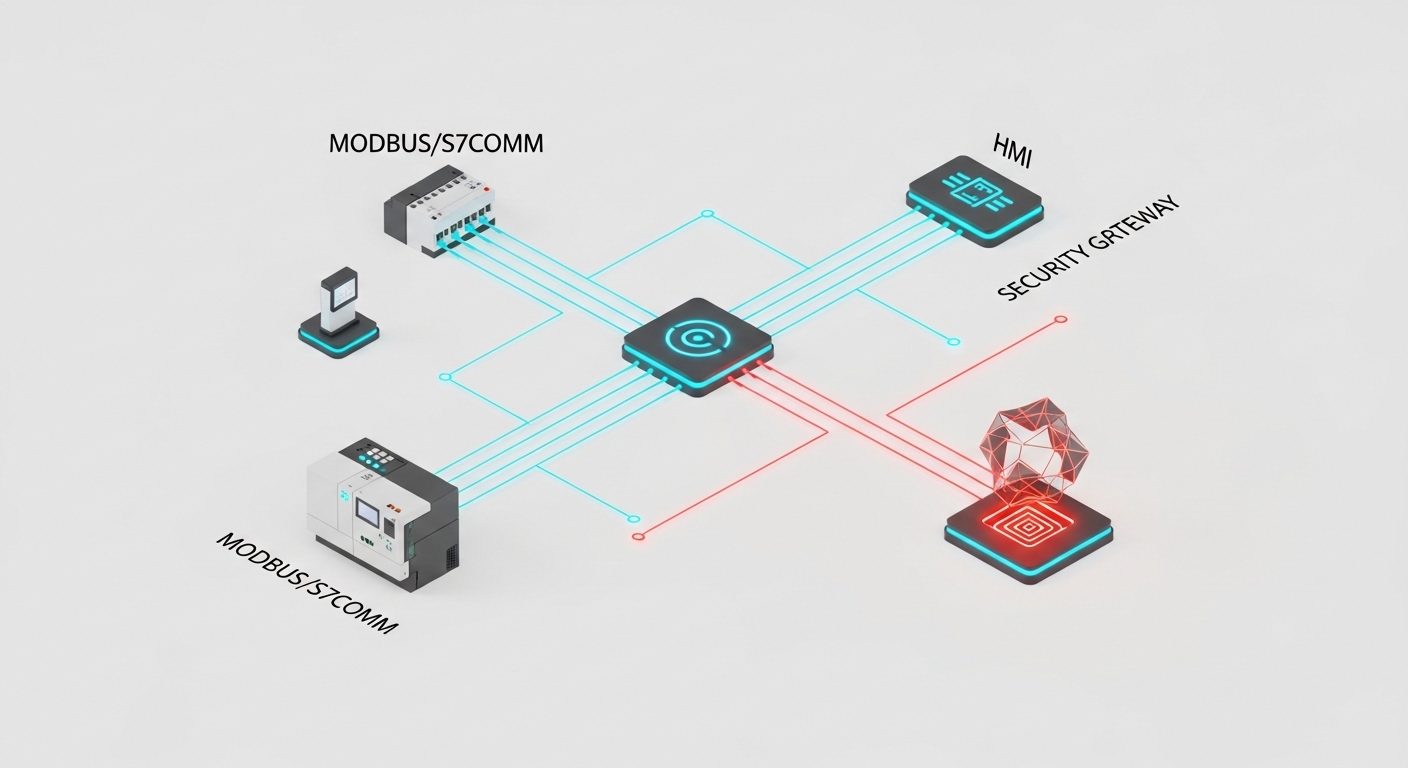
Applying this principle to Modbus and S7COMM is exceptionally difficult. How do you verify a protocol that has no concept of identity? This is where the synthesis of AI and Zero-Trust becomes crucial. The AI system provides the "confidence score" for each transaction based on behavioral analysis. This intelligence feeds the Policy Enforcement Point (PEP)—such as a micro-segmentation gateway or a secure proxy—which then makes the real-time decision to allow or block the communication. Achieving this requires a deep understanding of architecting least-privilege access on legacy PLC infrastructure, moving beyond simple IP-based rules to control actions at the protocol function code and register level.
Core Architectural Challenges
Developing an effective AI anomaly detection system for this environment is not simply a matter of applying a standard machine learning algorithm. It involves solving complex, interconnected challenges across the data pipeline, model deployment, and policy integration layers.
Challenge 1: High-Fidelity Data Acquisition Without Introducing Latency
The first hurdle is acquiring the raw network data without impacting the deterministic nature of the control network. Industrial processes often rely on communication cycles measured in milliseconds. Introducing even minor latency with a traditional inline security appliance can disrupt operations, leading to product defects or safety incidents.
This necessitates the use of passive monitoring via network TAPs (Test Access Points) or the SPAN/mirror port on industrial switches. The captured data stream must then be processed by a robust Deep Packet Inspection (DPI) engine capable of parsing the full Modbus TCP and S7COMM protocol stacks, not just the headers. The engine must reconstruct sessions, understand the context of request-reply pairings, and extract meaningful features for the AI model—all in real-time.
Challenge 2: The Real-Time Inference Constraint
Once the data is acquired and parsed, the AI model must perform inference (i.e., classify the transaction as normal or anomalous) within the same tight time budget. Many sophisticated ML models, particularly deep neural networks, can be computationally intensive. Deploying these models on resource-constrained industrial hardware at the edge is a significant engineering feat. This is where the concept of The 50ms Mandate: Architecting Deterministic Zero-Trust for Legacy Modbus SCADA becomes a hard architectural requirement. The entire detect-to-respond cycle, from packet capture to policy enforcement, must fit within the operational latency tolerance of the physical process being controlled.
This often leads to trade-offs between model complexity and inference speed. Techniques like model quantization, pruning, and the use of specialized hardware accelerators (e.g., TPUs or FPGAs) may be required to meet these stringent performance targets.
Challenge 3: Establishing and Maintaining the Behavioral Baseline
Perhaps the most significant challenge is training the AI to understand what constitutes "normal" behavior. In a manufacturing environment, "normal" is a moving target. Production lines are re-tooled, recipes are changed, and equipment is calibrated. This leads to a phenomenon known as "baseline drift," where the established model of normal behavior becomes outdated, resulting in a flood of false positive alerts.
A robust system must incorporate mechanisms for continuous learning and automated model retraining. However, this process must be carefully managed. Unsupervised retraining on a network that has already been compromised could lead the model to learn malicious activity as part of the new baseline. This requires a human-in-the-loop workflow, where OT engineers can review and validate proposed baseline changes before they are deployed, ensuring the model's integrity over time.
Challenge 4: Integrating Detection with Automated Enforcement
An anomaly alert without a corresponding enforcement action is merely an observation. The true value of the system lies in its ability to translate detection into prevention. The AI detection engine must be tightly integrated with the Zero-Trust policy enforcement points.
When a high-confidence anomaly is detected—for instance, an engineering workstation attempting to write to a PLC's logic registers from an unusual IP address outside of a scheduled maintenance window—the AI system should be able to trigger an automated response via an API call. This response could involve instructing a gateway to block that specific S7COMM Write PDU command while still allowing legitimate HMI monitoring traffic to pass. This form of dynamic, policy-driven response is the cornerstone of adaptive micro-segmentation for Legacy Modbus OT: a brownfield implementation blueprint, which allows for surgical quarantine of threats without causing widespread operational disruption.
Practical Implementation Challenges
Beyond the high-level architectural hurdles, engineering teams face a number of granular, highly technical challenges during implementation.
Granular Feature Engineering: The performance of any AI model is heavily dependent on the quality of its input features. For Modbus and S7COMM, this requires going beyond simple metadata. Key features to engineer include:
- Function Code/Job Type Analysis: Frequency and sequence of specific function codes (e.g., Read Coils, Write Single Register).
- Register/Data Block Address Mapping: Tracking which devices are permitted to access specific memory areas within a PLC.
- Payload Value Analysis: Statistical analysis of the data being written to registers to detect out-of-bounds or physically implausible values.
- Timing and Periodicity: Modeling the precise timing and cyclical nature of legitimate master-slave polling.
- Transaction Chaining: Analyzing the sequence of multiple related requests as a single behavioral fingerprint.
Managing the False Positive/False Negative Equilibrium: In OT, the cost of error is immense. A false positive (flagging a legitimate operation as malicious) could trigger an unnecessary shutdown, leading to significant financial losses. A false negative (missing a real attack) could lead to equipment damage or a safety incident. Tuning the model's detection threshold is a critical, ongoing process that requires deep collaboration between data scientists and OT engineers with domain expertise of the physical process.
Model Explainability (XAI): When an anomaly is flagged, operators and security analysts need to understand why. A black-box model that simply outputs "anomaly detected" is insufficient. The system must provide a clear, human-readable explanation, such as "Anomaly: Unexpected S7
Stop CPUcommand from HMI-3, which has never issued this command before." This is crucial for rapid, accurate incident response.
Conclusion: The Path to a Resilient, AI-Defended OT Environment
Developing an AI-powered, real-time anomaly detection system for legacy protocols within a Zero-Trust framework is one of the most complex but necessary undertakings in modern industrial cybersecurity. It demands a multi-disciplinary approach, blending deep expertise in OT networking, data science, and distributed systems engineering.
The challenges—from latency-free data acquisition and real-time inference to managing baseline drift and integrating with enforcement points—are substantial. However, they are not insurmountable. By architecting systems with these challenges in mind, organizations can move beyond the fragile security of the traditional perimeter and build a truly resilient, self-defending manufacturing environment. This proactive, intelligence-driven approach is the foundation upon which the security and operational integrity of Industry 4.0 will be built.
Sources / References
- NIST Special Publication 800-207, Zero Trust Architecture. https://csrc.nist.gov/publications/detail/sp/800-207/final
- Modbus Application Protocol Specification V1.1b3. https://modbus.org/docs/Modbus_Application_Protocol_V1_1b3.pdf
- Siemens, SIMATIC S7 S7-300/S7-400 System and Standard Functions Reference Manual. https://support.industry.siemens.com/cs/document/44240604/simatic-s7-s7-300-s7-400-system-and-standard-functions?dti=0&lc=en-WW
- IEC 62443 Series of Standards for Industrial Automation and Control Systems (IACS) Security. https://www.isa.org/standards-and-publications/isa-standards/isa-iec-62443-series-of-standards