Architecting the Unbreachable Conduit: A Zero-Trust Blueprint for Bridging Air-Gapped Serial OT with Cloud Analytics
Apex Insights Research Desk
Introduction: The Paradox of the Modern Air Gap
In the domain of high-consequence Operational Technology (OT), the air gap has long been the gold standard for security. This physical isolation of control networks from enterprise IT and external connections served as a definitive, albeit blunt, security control. However, in an era dominated by data-driven decision-making, predictive maintenance, and enterprise-wide operational intelligence, the air gap has transformed from a simple security feature into a significant business impediment. The critical data residing within these isolated legacy systems—often communicated via proprietary, non-IP serial protocols—is a goldmine for analytics platforms. The core engineering challenge is therefore not if we should bridge this gap, but how to architect a data conduit that extracts this value without nullifying the foundational security principles that mandated the air gap in the first place.
This analysis from the Apex Insights Research Desk presents an architectural blueprint for securely bridging air-gapped legacy OT networks with cloud-based IT analytics platforms. The solution hinges on a rigorous application of a Zero-Trust security model, extending its principles down to the physical and data-link layers of proprietary serial communications.
The Foundational Challenge: Proprietary Serial Protocols and the Air-Gap Dogma
The persistence of serial protocols like RS-232, RS-485, and RS-422 in brownfield OT environments is a testament to their reliability and simplicity in point-to-point or multi-drop configurations. However, these protocols were designed in an era when cybersecurity was not a consideration. They possess no native encryption, authentication, or authorization mechanisms. An attacker with physical or proximal access can trivially eavesdrop, inject commands, or execute replay attacks.
The challenge is compounded by the prevalence of proprietary application layers running on top of these serial standards. Each vendor (e.g., Siemens, Rockwell, Schneider Electric) developed unique command sets, register maps, and data structures for their PLCs, RTUs, and VFDs. A generic serial-to-Ethernet converter is blind to this application-layer context, acting as a dumb pipe that happily forwards malicious payloads. It cannot differentiate a legitimate READ_COIL_STATUS request from a malicious FORCE_SINGLE_COIL command that could trigger a catastrophic physical event.
This inherent insecurity is precisely why these networks were air-gapped. To bridge them, we cannot simply translate the protocol; we must deconstruct, inspect, and reconstruct the communication flow within a strictly controlled, policy-driven architecture.
Architectural Blueprint: The Zero-Trust Data Bridge
A successful bridge must adhere to the core tenet of Zero-Trust: never trust, always verify. This means every device, user, and data flow is treated as potentially hostile until its identity, context, and permissions are explicitly verified. This principle must be applied at every stage of the data's journey from the serial cable to the cloud database.
Here is a step-by-step architectural breakdown:
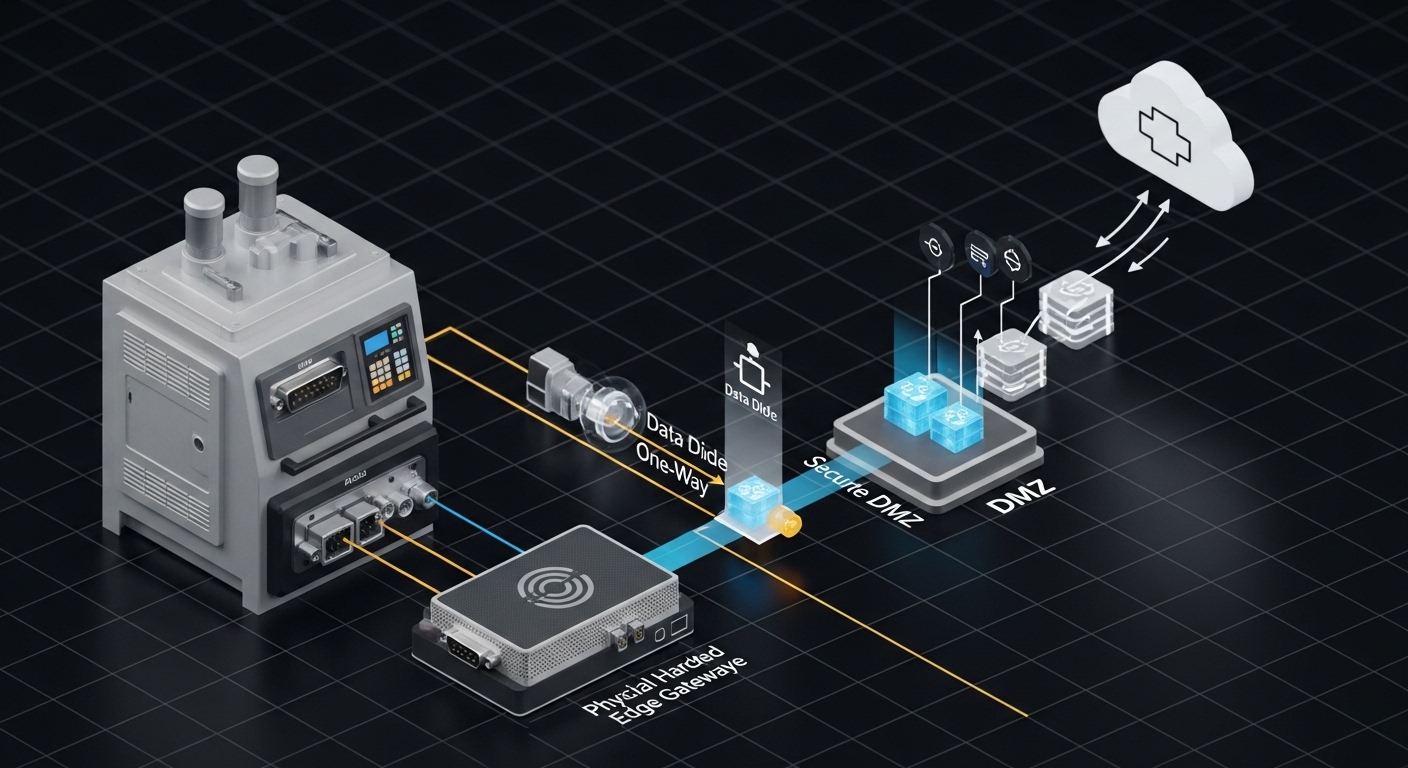
The Edge Demarcation Point: The Hardened Protocol Gateway The architecture begins at the absolute edge, with a physically hardened gateway device connected directly to the serial OT network. This is not a standard IT router. It must be an industrial-grade compute node rated for the target environment (e.g., ATEX, IEC 61850-3). Its primary function is to terminate the physical serial connection and act as the first Policy Enforcement Point (PEP). All subsequent communication is IP-based and subject to Zero-Trust policies.
Protocol Disaggregation and Policy Enforcement This is the most critical function. The gateway must possess deep packet inspection (DPI) capabilities for the specific proprietary serial protocol in use. It parses the raw serial stream, identifying the source device (if possible), the command being executed, the target registers or coils, and the data values. This granular visibility allows for the enforcement of micro-segmentation policies at the command level. For example, a policy can explicitly allow a specific data historian (identified by its cryptographic identity) to issue read-only commands to temperature sensor registers (e.g., addresses 40001-40010) but deny any write commands or requests to other address spaces. This granular approach is the only way to manage the risks inherent in architecting Zero-Trust segmentation for non-IP OT protocols without incurring downtime.
Data Normalization and Secure Encapsulation Once a transaction is validated against policy, the gateway extracts only the permissible data points. This raw OT data is then normalized into a standardized, structured format like JSON or Avro. It is then encapsulated within a secure, modern protocol like MQTT over TLS 1.3 or OPC UA. This step strips away the insecure proprietary protocol, effectively creating a clean, authenticated, and encrypted data stream for transit.
Hardware-Enforced Unidirectional Flow (The Data Diode) For systems where the risk of any data flowing from IT back to OT is unacceptable (e.g., nuclear, power grid), a unidirectional gateway, or data diode, should be placed after the protocol gateway. A data diode uses hardware (typically fiber optic transceivers with one side's transmitter physically removed) to ensure that data can only flow in one direction—from the OT segment to an IT-side DMZ. This provides a physically-unbreakable guarantee against remote command injection into the OT network from the enterprise side.
The OT DMZ: Aggregation and Identity Brokering Data exiting the OT segment (either via the protocol gateway or a data diode) enters a tightly controlled Demilitarized Zone. This network segment houses aggregation servers and, crucially, an identity broker. Since legacy serial devices lack modern identities, the protocol gateway must act as a proxy. Upon seeing traffic from a known PLC serial port, it can request an identity token (e.g., a short-lived x.509 certificate or JWT) from the broker on behalf of the device. This is a central challenge, and a robust approach to Zero-Trust identity and access for legacy serial devices is a prerequisite for any further secure communication. Every subsequent data packet sent from the DMZ is tagged with this verifiable identity.
Secure Cloud Ingress and Policy Re-evaluation The final leg of the journey involves egress from the OT DMZ to the cloud-based analytics platform (e.g., Azure IoT Hub, AWS IoT Core, GCP IoT Core). This connection must be secured using mutual TLS (mTLS), where both the client (the egress point in the DMZ) and the cloud service present valid certificates to authenticate each other. Cloud IAM policies provide the final PEP, ensuring that the authenticated device identity from the OT network is only authorized to publish data to a specific topic or endpoint. The entire system is built on the principle of continuous verification Zero-Trust for hybrid ICS environments, ensuring that trust is never assumed at any point in the chain.
Governing Principle: Least Privilege in Action The entire architecture is an embodiment of the principle of least privilege. The serial device is granted no trust. The protocol gateway is only allowed to parse specific, whitelisted commands. The data diode ensures one-way flow. The identity broker issues narrowly-scoped, short-lived credentials. The cloud ingress point only accepts data from authenticated and authorized sources for specific destinations. Each component operates with the minimum possible set of permissions required to function.
Practical Implementation Challenges
Architecting such a system is not without significant engineering hurdles that move beyond theoretical blueprints. Our research indicates teams must prepare for the following:
- Proprietary Protocol Reverse Engineering: The single greatest technical obstacle is often the lack of documentation for legacy protocols. This necessitates a painstaking process of reverse engineering using logic analyzers to capture serial traffic, followed by pattern analysis to decode command structures, function codes, checksum algorithms, and data encoding. This process can consume hundreds of engineering hours per protocol.
- Maintaining Determinism and Low Latency: OT networks are often real-time systems. Introducing a gateway that performs DPI and cryptographic operations can add unacceptable latency, potentially violating control loop timing. The solution requires gateways built on high-performance hardware, often utilizing FPGAs for line-rate protocol processing to ensure that security inspection occurs with deterministic, sub-millisecond latency.
- Physical and Environmental Hardening: The edge gateway is not deployed in a climate-controlled data center. It must be a ruggedized, fanless device capable of withstanding extreme temperatures, vibration, humidity, and electromagnetic interference (EMI). Certifications like IEC 60068-2 are non-negotiable.
- Stateful Protocol Analysis: Many industrial protocols are stateful, requiring a series of commands to be executed in a specific sequence. A stateless packet filter is useless here. The gateway's DPI engine must be stateful, tracking the entire session to validate that the communication conforms to the expected operational sequence and flagging any deviations as potential attacks.
- Scalable Cryptographic Key Management: Provisioning, rotating, and revoking cryptographic identities for potentially thousands of distributed edge gateways is a massive operational challenge. The architecture must include a robust Public Key Infrastructure (PKI) and leverage automated protocols like SCEP (Simple Certificate Enrollment Protocol) or EST (Enrollment over Secure Transport) to manage the lifecycle of device certificates without manual intervention.
Conclusion: From Data Isolation to Secure Insight
Successfully bridging an air-gapped OT network is not a matter of punching a hole; it is a matter of constructing a secure, multi-layered, and deeply inspected data channel. By rejecting the notion of a trusted internal network and applying Zero-Trust principles at every step—from the physical serial layer to the cloud application layer—organizations can finally resolve the paradox of the air gap. This architectural approach enables the extraction of high-value operational data for advanced analytics, machine learning, and enterprise visibility, all while strengthening, not weakening, the security posture of the nation's most critical infrastructure.
Sources / References
- NIST Special Publication 800-207, Zero Trust Architecture. Available at: https://csrc.nist.gov/publications/detail/sp/800-207/final
- ISA/IEC 62443 Series of Standards on Industrial Automation and Control Systems (IACS) Security. Available at: https://www.isa.org/standards-and-publications/isa-standards/isa-iec-62443-series-of-standards
- Owl Cyber Defense, Data Diode Technology. Available at: https://owlcyberdefense.com/technology/data-diode-technology/
- MQTT Version 5.0 OASIS Standard. Available at: https://docs.oasis-open.org/mqtt/mqtt/v5.0/os/mqtt-v5.0-os.html