The Ghost in the Machine: Forging Identity for Zero-Trust in Brownfield OT with Legacy Modbus/TCP
Apex Insights Research Desk
The Core Conundrum: Securing the Inherently Insecure
Operational Technology (OT) environments, particularly brownfield sites, present a formidable cybersecurity challenge that lies in stark contrast to their IT counterparts. These networks are the nerve centers of critical infrastructure, valued for their deterministic performance and decades-long operational lifecycles. At the heart of many of these legacy systems lies a workhorse protocol: Modbus/TCP. Designed in an era when network security was an afterthought and physical isolation was the primary defense, Modbus/TCP is a model of simplicity and efficiency. It is also completely devoid of modern security primitives. It lacks authentication, authorization, and encryption, effectively operating on an implicit-trust model within the network segment.
This presents a direct conflict with the foundational principles of a Zero-Trust Architecture (ZTA), which dictates that trust is never implicit and must be continuously evaluated. The core tenet, "never trust, always verify," fundamentally requires a robust identity and access management (IAM) system. How, then, can a security architect possibly implement a truly adaptive, micro-segmented Zero-Trust model on a network populated by devices that possess no native concept of identity? This is the central engineering problem: overlaying a 21st-century security paradigm onto 20th-century industrial control systems without disrupting the sensitive, real-time processes they govern.
Deconstructing the Modbus/TCP Trust Model
Before architecting a solution, it is critical to understand the protocol's inherent vulnerabilities. Modbus/TCP operates on a simple client-server (historically master-slave) model. Any client on the network can send a request to any server, and if the request is formatted correctly (e.g., a valid function code and register address), the server will comply. There is no mechanism within the protocol itself to verify who is making the request or if they are authorized to perform that action.
This design flaw means that once an adversary gains a foothold on the OT network, lateral movement is trivial. A compromised HMI or engineering workstation can be used to send malicious commands to PLCs, RTUs, and other controllers, with the target devices having no way to distinguish a legitimate command from a malicious one. Traditional network segmentation using VLANs and firewalls provides a coarse, brittle layer of defense, but it is insufficient for enforcing the granular, least-privilege access required by a Zero-Trust model.
An Architectural Blueprint: Forging Synthetic Identity
Since Modbus/TCP devices cannot present their own identity credentials, the Zero-Trust architecture must forge one for them. This synthetic identity is not derived from the device itself but is attributed to it based on a collection of immutable and behavioral network characteristics. The implementation of this model is a multi-stage process that shifts the Policy Enforcement Point (PEP) from the endpoint to the network fabric itself.
Stage 1: High-Fidelity Passive Discovery and Baselining The foundational step is achieving complete, unambiguous visibility. You cannot protect what you cannot see. This requires deploying network sensors capable of deep packet inspection (DPI) for OT protocols. The goal is to build a comprehensive asset inventory and a communication map that details every flow. This isn't just about identifying IP and MAC addresses; it's about understanding the language of the process: which HMI reads from specific register blocks on which PLC, what function codes are used, and with what frequency and timing. This baseline of normal behavior becomes the bedrock of the entire security architecture.
Stage 2: The Identity Proxy as a Policy Enforcement Point The core of the solution is the deployment of identity proxies or transparent segmentation gateways that sit in-line, logically positioned in front of the legacy assets or small groups of assets. These gateways act as the Zero-Trust PEP. They intercept traffic destined for the Modbus/TCP device and make a real-time policy decision. Instead of a non-existent device identity, the policy decision is based on a composite, context-aware synthetic identity. This identity is a tuple of attributes, such as:
- Source IP Address
- Source MAC Address
- Ingress Physical Switch Port
- VLAN Tag
- Source Application Profile (e.g., known HMI software)
Stage 3: Granular, Application-Layer Policy Enforcement With the PEP in place, policy enforcement can move beyond simple L3/L4 rules (allow IP A to talk to IP B on port 502). The DPI engine within the PEP allows for stateful, L7 policy enforcement specific to the Modbus protocol. A Zero-Trust policy in this context becomes exceptionally granular:
*"Permit the entity identified by {MAC_HMI_1, IP_HMI_1, SwitchPort_G1/0/5} to execute Modbus Function Code 03 (Read Holding Registers) on registers 40001-40010 of the asset identified by {IP_PLC_5}. Deny all other function codes from this source to this destination."
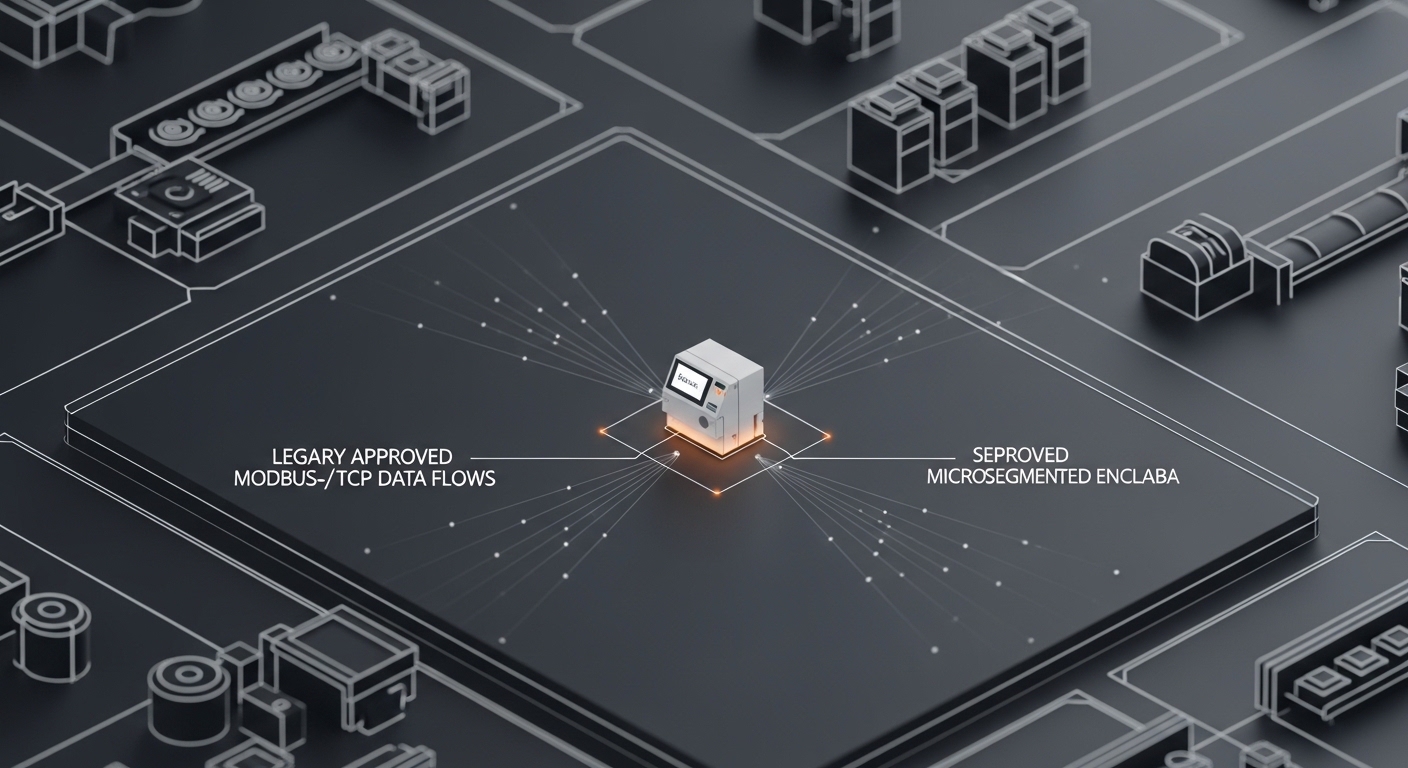
This approach effectively creates micro-perimeters, or enclaves, around each legacy device or functional unit. It enforces least privilege at the application command level, drastically reducing the attack surface. An attacker who compromises the HMI can no longer send a Function Code 16 (Write Multiple Registers) to stop the PLC, as the PEP will drop the packet.
Stage 4: The Centralized Policy Decision Point (PDP) and Adaptation These granular policies are not configured manually on each PEP. They are managed and orchestrated by a centralized Policy Decision Point (PDP), or ZTA controller. This PDP holds the master policy configuration and distributes it to the PEPs across the environment. This is where the "adaptive" nature of the architecture comes into play. The PDP can integrate with other systems—such as asset management databases, vulnerability scanners, and even physical access control systems—to modify policies in real-time. For instance, during a scheduled maintenance window where firmware updates are permitted, the PDP can push a temporary policy to the relevant PEPs allowing write commands from a specific engineering workstation.
Practical Implementation Challenges
The theoretical elegance of this architecture belies significant real-world engineering hurdles. Deploying this model in a live, brownfield environment requires meticulous planning and a deep understanding of control systems engineering.
- Deterministic Performance and Latency: The single greatest concern in any OT network is the potential for increased latency or jitter. Introducing an in-line PEP means every packet must be inspected and adjudicated. This process must be completed within microseconds to avoid disrupting time-sensitive control loops. A deep dive into real-time policy enforcement in deterministic ICS Zero-Trust architectures is essential before any hardware selection.
- Resilience and Fail-Safe Design: The PEP itself becomes a critical point of failure. The device must support high-availability configurations (e.g., active/active or active/passive pairs) and, crucially, a configurable fail-safe state. Should the PEP fail, will it fail-open (allowing all traffic) or fail-closed (blocking all traffic)? The answer depends on the specific industrial process and a thorough risk assessment (process safety vs. security).
- The Burden of Policy Management: While granular control is powerful, managing millions of micro-rules for a large plant can become an operational nightmare. A successful implementation relies on policy-as-code principles, automation, and a robust grouping and templating mechanism within the PDP to make management feasible.
- Discovery and Baselining Accuracy: The entire model's security rests on the accuracy of the initial discovery and behavioral baseline. An incomplete baseline may lead to policies that block legitimate process communication, causing an outage. The baselining period must be sufficiently long to capture all normal operational states, including infrequent but critical operations like emergency shutdowns or batch startups.
The Amplifying Role of Behavioral Analytics
Once a stable baseline of authorized communication patterns is established and enforced, the next layer of maturity involves real-time behavioral analytics. By monitoring the sequence, timing, and payload of permitted flows, the system can detect sophisticated attacks that operate within the confines of an "allowed" policy. For example, a policy might allow an HMI to read a setpoint register. But if that read operation suddenly starts occurring 100 times per second instead of once per second, it could be an indicator of an attempt to exfiltrate process data or a reconnaissance phase of an attack. Integrating such insights from real-time behavioral analytics into a Zero-Trust ICS framework transforms the static defense into a dynamic and responsive system.
Conclusion: Building a Deterministic Security Fabric
Implementing a Zero-Trust architecture in a brownfield environment saturated with legacy protocols like Modbus/TCP is not a matter of replacing hardware or protocols. It is an exercise in architectural ingenuity. The solution lies in building an intelligent and deterministic security fabric that overlays the existing infrastructure without disrupting it. By forging a synthetic, context-aware identity for each legacy device and enforcing granular, application-aware policies at the network level, organizations can achieve the principles of Zero-Trust. The challenges are significant, particularly concerning latency and operational resilience. However, the escalating threat landscape makes inaction an untenable risk. Successfully executing this strategy, a task that absolutely mandates a zero-downtime blueprint for legacy Modbus/TCP networks, is the critical path forward for securing the industrial processes that underpin modern civilization.
Sources / References
- NIST Special Publication 800-207: Zero Trust Architecture. Available at: https://csrc.nist.gov/publications/detail/sp/800-207/final
- ISA/IEC 62443 Series of Standards on Industrial Automation and Control Systems (IACS) Security. Information available at: https://www.isa.org/standards-and-publications/isa-standards/isa-iec-62443-series-of-standards
- Modbus Application Protocol Specification V1.1b3. Available at: http://www.modbus.org/docs/Modbus_Application_Protocol_V1_1b3.pdf