The Deterministic Sentinel: Enforcing Zero-Trust in ICS with Real-Time Behavioral Analytics
Apex Insights Research Desk
The Core Dilemma: Determinism vs. Dynamic Security in Industrial Control Systems
The fundamental mandate of any Industrial Control System (ICS) or Operational Technology (OT) environment is unwavering operational integrity. Process control loops, safety instrumented systems (SIS), and real-time automation depend on deterministic, ultra-low-latency communication. A deviation of even a few milliseconds can lead to unacceptable product quality variations, costly downtime, or catastrophic safety failures. This stringent requirement for determinism has historically created a significant impedance mismatch with traditional IT security paradigms, which often prioritize confidentiality and threat neutralization, sometimes at the expense of performance.
However, the escalating threat landscape, driven by IT/OT convergence and targeted state-sponsored attacks, necessitates a more robust security posture than the legacy perimeter-based defense model can provide. The Zero-Trust model, with its core tenet of "never trust, always verify," offers a compelling framework. Yet, a direct transposition of IT-centric Zero-Trust solutions into an OT environment is a non-starter. The critical question for asset owners and system architects is therefore not if Zero Trust should be applied, but how it can be enforced on proprietary industrial protocols without violating the sanctity of the process control loop. The answer lies in the synthesis of real-time network traffic analysis and advanced behavioral analytics, creating a deterministic sentinel capable of discerning malicious intent from legitimate process communication at line-rate speeds.
Shifting the Paradigm: From Static Perimeters to Dynamic, Process-Aware Policies
For decades, the Purdue Model and the concept of an "air gap" formed the bedrock of ICS security. While conceptually sound, the modern industrial enterprise is far from isolated. Data flows for predictive maintenance, supply chain integration, and enterprise resource planning have rendered the traditional air gap porous. This reality necessitates a security architecture that assumes threats can and will exist within the network perimeter. In this context, legacy defenses become brittle. A firewall rule blocking a port is a blunt instrument; it lacks the context to understand if a specific Modbus function code sent over an allowed port is legitimate or part of an attack sequence.
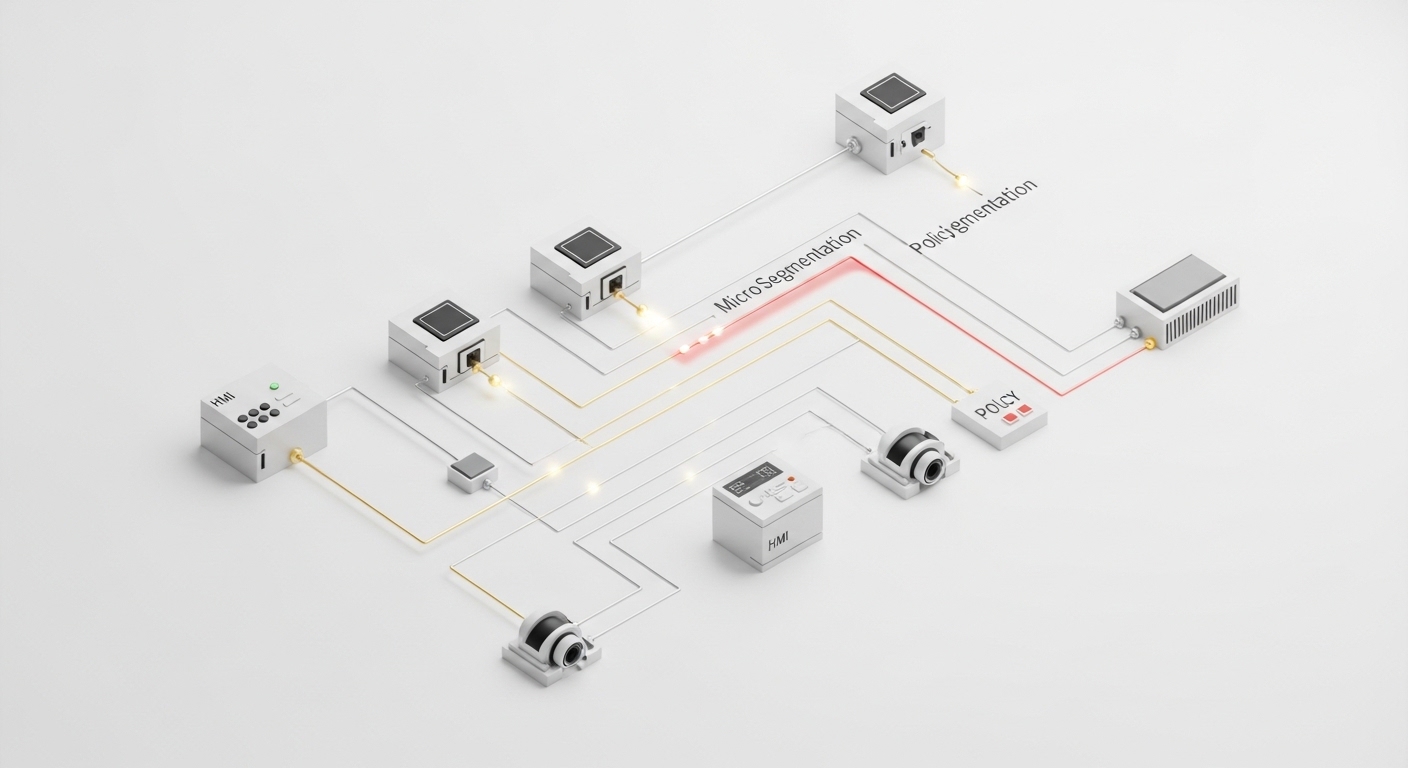
This is where a profound architectural pivot is required. Instead of relying solely on static access control lists, a Zero-Trust approach for ICS must be built upon deep, continuous visibility into the traffic flowing between controllers (PLCs/RTUs), operator workstations (HMIs), and engineering servers. Achieving this level of visibility in a brownfield environment, often filled with decades-old equipment, presents its own challenges. However, the insights gained are transformative. The goal is to move beyond simple network segmentation and towards true, policy-enforced micro-segmentation, where trust is not granted based on network location but on a continuously verified, context-aware identity. Even in environments with physical separation, it is crucial to consider how to securely integrate external data, a concept thoroughly explored in our research on integrating threat intelligence into air-gapped ICS with Zero-Trust architecture.
Building a High-Fidelity Behavioral Baseline
The foundation of this approach is the creation of a high-fidelity behavioral baseline—a multi-dimensional model of what constitutes normal, sanctioned operation for the industrial process. This is far more granular than a simple inventory of assets and open ports. It requires a sophisticated analysis engine, often leveraging machine learning, to profile the network traffic over a sufficient period and extract key features. The quality of this baseline directly dictates the efficacy of the entire security model.
An effective architectural blueprint for establishing this baseline involves several distinct phases:
- Passive Data Acquisition: Using non-invasive network TAPs or switch SPAN/mirror ports, a full, byte-for-byte copy of the network traffic is captured. This is critical to ensure the monitoring process itself introduces zero latency or jitter into the live control network.
- Deep Packet Inspection (DPI) and Protocol Dissection: The captured traffic is parsed by a DPI engine capable of dissecting not just standard TCP/IP or UDP headers, but the application-layer payloads of proprietary and standard industrial protocols (e.g., Siemens S7, Modbus/TCP, DNP3, EtherNet/IP). This decodes the specific commands, function codes, memory registers being written to, and process values being transmitted.
- Multi-Dimensional Feature Extraction: The system moves beyond simple source/destination IP analysis to model the nuanced behavior of the industrial process. Key features to model include:
- Stateful Communication Maps: Which specific devices are authorized to communicate? What protocol and function codes are they allowed to use with each other?
- Command Sequence and Syntax: What is the valid order of operations? For example, a
WRITEcommand to a PLC register controlling a valve should only be preceded by a specific sequence ofREADcommands that verify system state. - Cyclic Timing and Jitter Analysis: Industrial communication is often highly periodic. The model must learn the precise cycle time of messages between a PLC and its I/O, flagging any deviation in timing or jitter as a potential anomaly indicative of device compromise or network manipulation.
- Process Value Semantics: The model establishes sane ranges for process variables. A temperature sensor that normally reports between 80-90°C suddenly reporting 500°C is a clear security and safety event, even if the packet structure itself is syntactically valid.
- Model Training and Validation: This curated data is used to train machine learning models (such as autoencoders or recurrent neural networks) to create a compact representation of "normal." This baseline becomes the dynamic ground truth for the industrial process.
From Anomaly Detection to Real-Time Policy Enforcement
With a validated baseline, the system shifts from learning to enforcement mode. Every new packet is analyzed in real-time against the established model. When a deviation—an anomaly—is detected, a policy engine must decide on a response. This is the most delicate phase of the architecture, where the risk of disrupting operations is highest.
The primary objective of an OT security response is not just to neutralize the threat, but to preserve the integrity and availability of the industrial process. Enforcement actions must be architected to be proportional, deterministic, and fail-safe.
Crude enforcement actions like TCP resets or black-holing an IP address are generally unacceptable in OT. A more sophisticated, policy-driven approach is required. For instance, upon detecting an anomalous command from an HMI to a PLC, the system should not simply block the HMI. Instead, a more granular policy can be enforced dynamically. This might involve alerting operators, quarantining the HMI into a read-only VLAN, and automatically updating firewall or switch ACLs to prevent any further write commands from that source. This method of Zero-Trust policy enforcement in legacy industrial networks via software-defined micro-segmentation allows for a targeted response that contains the threat without triggering a complete process shutdown.
Practical Implementation Challenges
The architectural theory is sound, but its implementation in a real-world industrial environment is fraught with engineering hurdles that demand careful consideration.
The Latency Injection Problem
Any inline device, whether for analysis or enforcement, adds latency. While out-of-band analysis via a network TAP is non-invasive, it limits enforcement to reactive measures (e.g., sending commands to a firewall). For true real-time blocking or modification, an inline solution is needed. The latency budget here is measured in microseconds, not milliseconds. This often necessitates the use of specialized hardware, such as FPGAs (Field-Programmable Gate Arrays) or network processing units (NPUs), to perform DPI and baseline comparison at line rate without queuing packets and introducing jitter.
Baseline Poisoning and Concept Drift
Establishing a baseline on a live network carries the inherent risk that an adversary may already be present. If malicious traffic is included in the training data, it becomes part of the "normal" baseline—a phenomenon known as baseline poisoning. Furthermore, industrial processes are not static. A change in a manufacturing recipe, a sensor recalibration, or a firmware update will legitimately alter network traffic patterns. This "concept drift" can cause a flood of false positives if the behavioral model is not designed to adapt. Advanced solutions must incorporate continuous learning or periodic, carefully supervised retraining cycles to remain accurate.
The Opaque Nature of Proprietary Protocols
While standards like Modbus/TCP are well-documented, many large automation vendors utilize proprietary protocols that are intentionally obfuscated. Dissecting these protocols requires extensive reverse engineering or a close partnership with the vendor. Without this deep protocol awareness, any behavioral analysis is superficial at best, limited to observing header data without understanding the intent of the underlying commands.
Edge Deployment and Environmental Constraints
For the lowest possible latency, analysis and enforcement engines should be deployed as close to the Level 1 (Basic Control) devices as possible. This means placing security appliances on the factory floor, in substations, or in other harsh environments. These devices must be ruggedized to withstand extreme temperatures, vibration, and electromagnetic interference. Furthermore, the computational resources available in such edge deployments are often limited, creating a challenge for running the complex machine learning models required for robust behavioral analytics. This often involves a hybrid architecture where lightweight models run at the edge for real-time detection, while more intensive model training and analysis occur in a more powerful, centralized OT security platform. As these systems become more intelligent, they contribute to the vision of a sentient factory floor with context-aware identity driving security decisions.
Conclusion: Architecting the Deterministic, Self-Defending ICS Network
Leveraging real-time network traffic analysis and behavioral analytics is not merely an enhancement to ICS security; it is a fundamental enabler for applying a true Zero-Trust philosophy in environments where determinism is non-negotiable. By moving beyond static rules and building a deep, contextual understanding of the industrial process itself, this approach allows for the enforcement of granular security policies that can surgically neutralize threats without disrupting critical operations. The path is complex and requires specialized expertise in both control engineering and network security, but it is the necessary evolution to build the next generation of resilient, secure, and self-defending industrial infrastructure.
Sources / References
- NIST Special Publication 800-82 Revision 2, "Guide to Industrial Control Systems (ICS) Security": https://csrc.nist.gov/publications/detail/sp/800-82/rev-2/final
- ISA/IEC 62443 Series of Standards, "Security for industrial automation and control systems": https://www.isa.org/standards-and-publications/isa-standards/isa-iec-62443-series-of-standards
- SANS Institute, "ICS/SCADA Security Resources": https://www.sans.org/ics-security/